
 2,
2,- 1Kyoto Sangyo University, Koyama Space Science Institute, Japan (kawakthd@cc.kyoto-su.ac.jp)
- 2Photocross Co., Ltd., Japan
- 3NASA Goddard Space Flight Center, USA
- 4Applied Physics Laboratory, Johns Hopkins University, USA
- 5American University, USA
Comets are remnants of small, icy bodies that formed in the early solar system 4.6 billion years ago. After their formation, these small icy bodies were scattered into distant, cold reservoirs where they have spent most of their lifetimes under cold conditions. Because cometary ices were not significantly heated by the Sun during their time in these reservoirs, they have retained information about the formation of the solar system. The chemistry of cometary ices is usually investigated by observing gas species in the coma through remote observations. However, chemical reactions occurring in the dense inner coma region may alter the gas composition. Therefore, understanding the physico-chemical evolution of the gas in the inner coma region is essential to determining the chemical composition of cometary ices.
The gaseous coma of a comet is weakly ionized, and the dominant ionic species is H3O+ in the innermost coma of a comet at ~1 au from the Sun. The H3O+ is produced through the ion-molecule chemical reaction; H2O+ + H2O → H3O+ + OH, whereas H2O+ is primarily produced by the photoionization of H2O in the coma by the solar EUV radiation field. The H2O+ ion is the starting point of cometary gas ionization. In situ measurements by spacecraft, such as Giotto for 1P/Halley and Rosetta for 67P/Churyumov-Gerasimenko, have usually been used to investigate cometary H2O+ ions in the inner coma. In contrast, ground-based observations of cometary H2O+ ions were conducted to investigate plasma tails. Because H2O+ exhibits many rovibronic transitions in the optical wavelength region, a combination of a large-aperture telescope and a high-resolution optical spectrograph enables us to reveal the distribution of H2O+ in the inner coma, especially when the comet is close to the Earth.
We present the spatial brightness profile of H2O+ emission in the inner coma of comet C/2023 A3 (Tsuchinshan-ATLAS), where the projected distance is less than ~2,000 km from the nucleus. This profile was extracted from the two-dimensional spectra of the comet observed on UT2024 Oct 31, using the High Dispersion Spectrograph (HDS) mounted on the Subaru telescope. On the same night, we also observed the comet using NIRSPEC on the Keck II telescope and obtained the spatial brightness profile of H2O emission in the inner coma. A direct comparison between the spatial profiles of H2O+ and H2O in the inner coma provides insight into the physico-chemical conditions in this region. In particular, a shallow slope for the distribution of H2O+in the logarithmic plot (see figure below) may reflect the ionization condition of unmagnetized plasma within the diamagnetic cavity of the comet. Ground-based observations of cometary H2O+ and H2O are expected to support a future comet mission, such as Comet Interceptor. In this mission, the main spacecraft and probes will fly by a cometary nucleus at a distance of approximately 1,000 km from the nucleus. Both the ground-based observations and the in situ measurements by the spacecraft can cover similar distances from the nucleus.
This study is financially supported by NASA SSO grants 80NSSC22K1401 (RJV, NDR, BPB) and 22-SSO22_0013 (MD), and NSF AST-AST-2009398 (NDR, BPB).
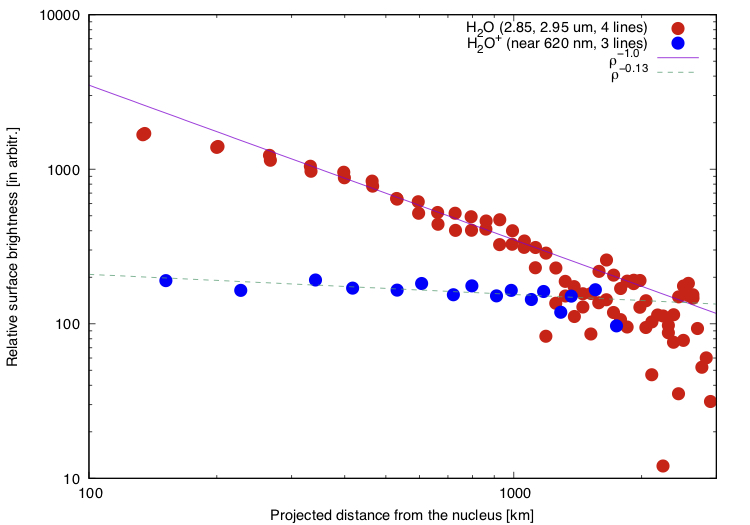
Figure 1: Spatial brightness profiles of H2O+ and H2O in the inner coma of comet C/2023 A3 (Tsuchinshan-ATLAS) on UT2024 Oct 31.
How to cite: Kawakita, H., Kobayashi, H., Shinnaka, Y., Tsujimoto, K., DiSanti, M. A., Vervack, Jr., R. J., Bonev, B., and Dello Russo, N.: Simultaneous spectroscopic observations of comet C/2023 A3 (Tsuchinshan-ATLAS) in the optical and near-infrared wavelength regions: Spatial brightness profiles of H2O+ and H2O, EPSC-DPS Joint Meeting 2025, Helsinki, Finland, 7–12 Sep 2025, EPSC-DPS2025-1122, https://doi.org/10.5194/epsc-dps2025-1122, 2025.


