
 1,2,
1,2,- 1Space Research Center PAS, Warsaw, Poland (natalia@cbk.waw.pl)
- 2Institute of Geological Sciences, PAS, Warsaw, Poland
- 3Faculty of Geology, University of Warsaw, Warsaw, Poland
- 4Extremo Technologies Faculty of Environmental Engineering Wroclaw University of Science and Technology, Wrocław, Poland
Introduction
Studies of terrestrial concretions and their mineralization serve as an important reference point for interpreting geological processes on Mars. In particular, the iron- and silica-rich concretions found in the Dakota and Navajo Formations US, which exhibit signs of ore-related mineralization, may serve as analogs for the structures observed by the Opportunity rover in Meridiani Planum. Analysis of these terrestrial formations enables a better understanding of the genesis of Martian concretions and the potential hydrothermal or diagenetic processes responsible for their formation. Comparing both types of terrestrial concretions and Martian concretions can provide valuable insights into past water activity [1], environmental conditions, and the potential for ore mineralization on Mars.
Research undertaken
For our research, as an analogs of Martian concretions we chose: 1.Utah Dakota Formation concretions 2.Utah Navajo Formation concretions, 3.Romanian „Trovants”-gigantic concretions up to 4.5 meters in diameter Fig.1.
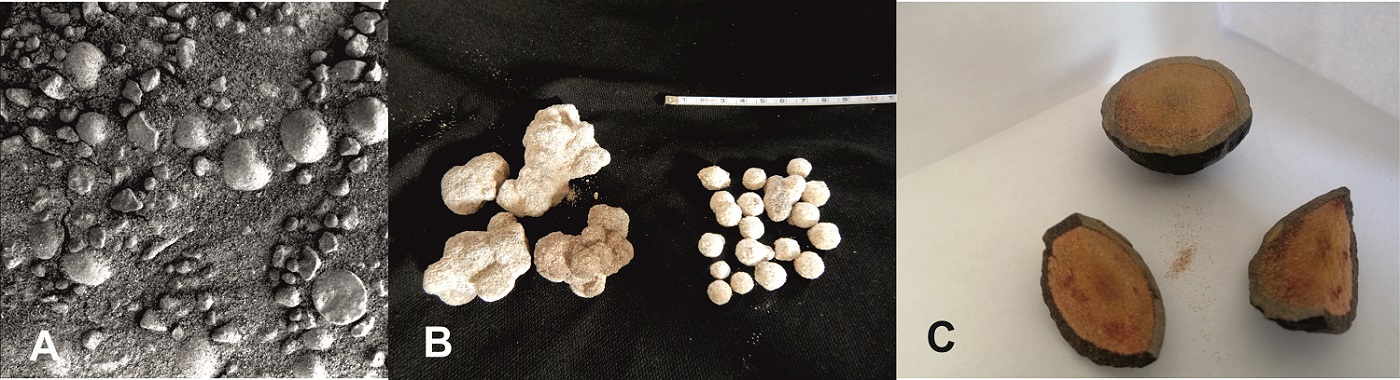
Fig.1. A. Martian spherules. Microscopic camera. Visible spherules on the surface sol 319 (Opportunity rover). Image size 3x3 cm. B. Utah spherules from the Dakota Formation, with leached iron oxides. Some spherules are fused due to mineralization and some are single. Spherule diameter about 1 cm. C. Moqui marbles spherules from the Navajo covered with iron oxides. Spherule diameter about 4-5 cm.
Measurements were made using energy-dispersive X-ray spectroscopy - EDS. The concretions were also examined using a microprobe. Moreover, we used an optical microscope and in most cases have analyzed the content of the main elements.
We also used some of our results based on the Mini-TES infrared spectrometer data from the Opportunity rover [2]. Some of these data was not fully interpreted so far in some aspects. We focused on sols 313 to 325, 329-331 and 382-395 due to the small number of studies of these sectors in. We determined the mineralogical composition using the least-squares method, using the spectra of minerals from the ASU library. The pyrite spectrum was measured in DLR. We used our own software developed by one of the authors (L. Czechowski) to fit the spectra. The results indicate that the Martian concretions (blueberries) may be analogues of terrestrial concretions Fig1.A, [3].
Formation of sandstone concretions
The method of formation of concretions is still a mystery, but many scientists admit that they crystallize in an aqueous environment [1]. There are two types of crystallization of spherules: from the inside to the outside and from the outside to the inside.
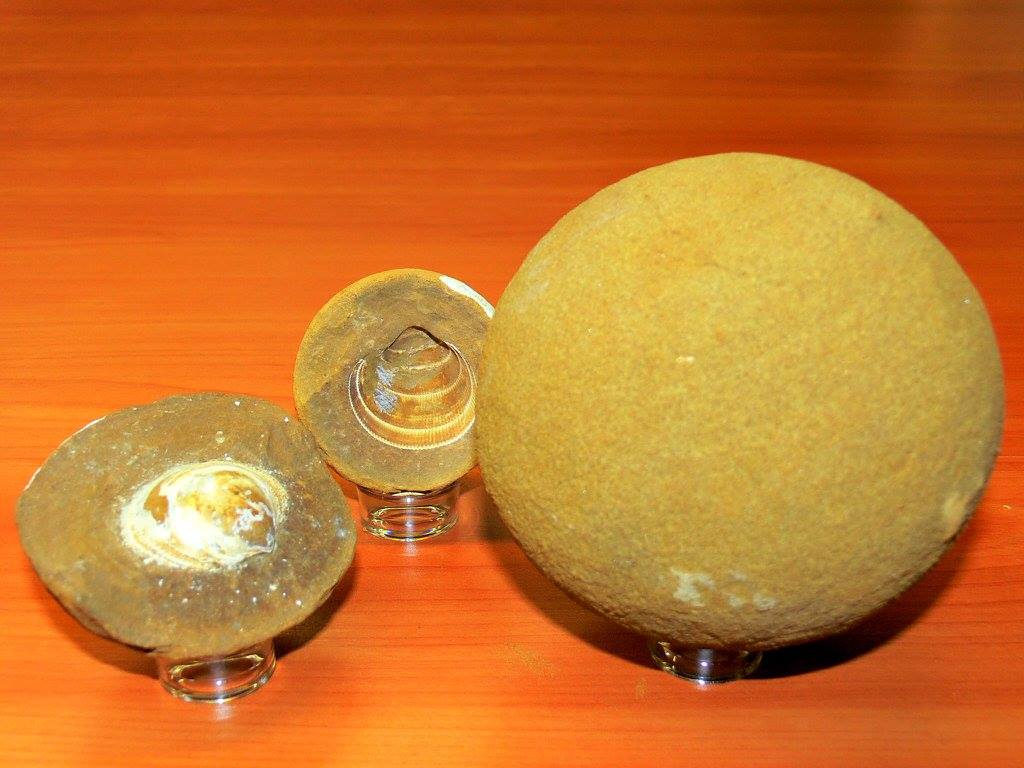
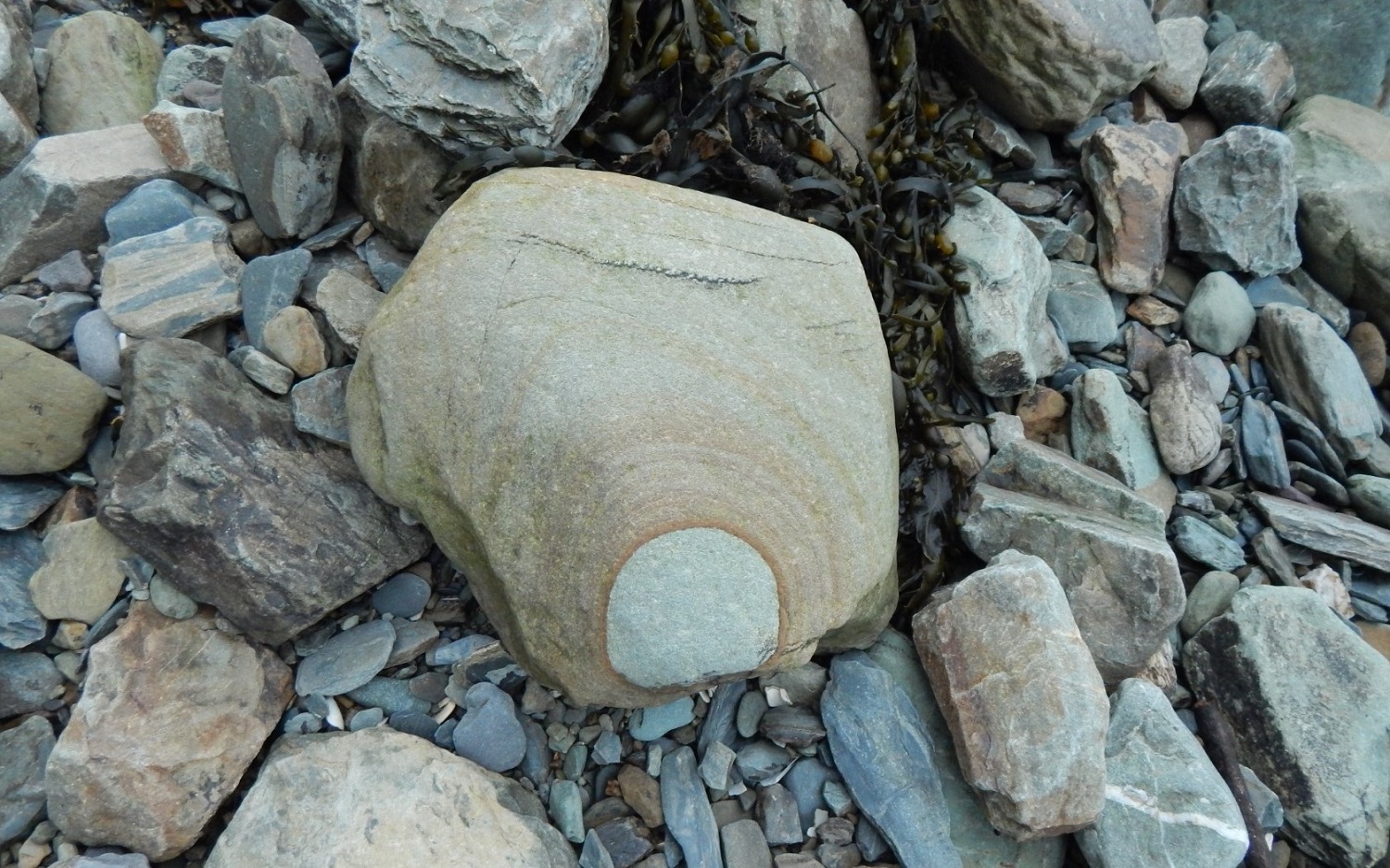
The first ones need a core for crystallization, which can be an organic particle (bone, coral shell) or an inorganic one - a grain of sand. See the example of Szczecin concretions on Fig.2. Crystallization can also take place by means of the so-called self-organization of solutions, then the second type of crystallization occurs, a significant example of which can be the Lieseganga rings Fig.3. This second process fits better the formation of hematite spherules from Mars, because they can be compared to sandstone concretions from Utah, in Dakota and Navajo Formation. Hematite migrated there in aqueous solutions and crystallized together with other minerals in the form of concretions [4]. That is why we started researching the above-mentioned concretions.
|
|
|
|
Fig.2. The Szczecin concretions occur in the Oligocene sands of the Szczecin Landscape Park. Geological Museum of the University of Szczecin. |
Fig.3. Liesegang rings on a sandstone boulder. South-East coast of Ireland on the Celtic Sea. |
Results
Copper was found in the Navajo concretions using the EDS method [5]. In the Romanian Trovants, we can see that the cement between the quartz grains is mainly calcium minerals. All the concretions in question were also examined using an electron microprobe. These results confirmed the results from EDS, where in addition to the basic minerals such as potassium feldspars and quartz, sulfates celestine and barite were also identified. In the Romanian concretions, the presence of ilmenite and rutile (possible sources of titanium) was also found, as well as apatite and analcime.
We investigated under an optical microscope Fig.4 and analyzed the major contain of element in feldspars, analcimes, phyllosilicates, epidotes, apatites and phosphates, sulfates, carbonates, iron-titanium oxides, ilmenite, rutile, sulfides, and Fe-rich cement in the six samples concretions from Earth.
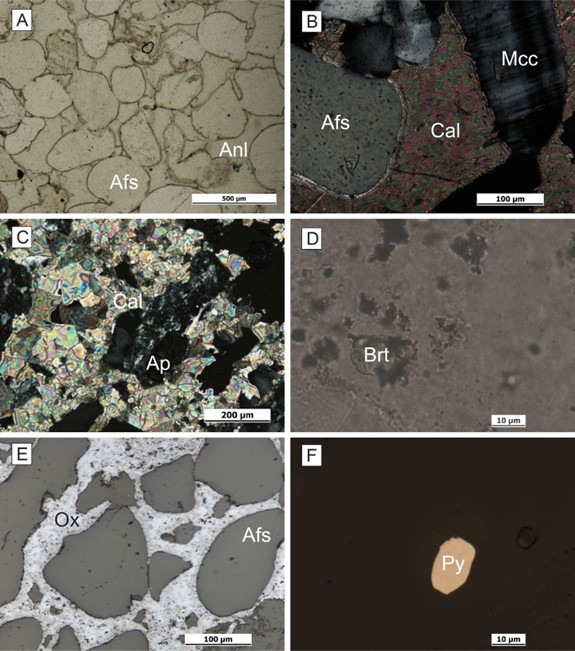
Fig.4. A) Plane polarized light optical microscope image of alkali feldspar (Afs) grains cemented by analcime (Anl) in Dakota concretion. B) Cross-polarized light optical microscope image of alkali feldspar (Afs) and microcline (Mcc) cemented by calcite (Anl) in Dakota concretion. C) Cross-polarized light optical microscope image of a silicate grain containing apatite (Ap) surrounded by calcite (Cal) cement in Trovants concretion. D) Plane polarized light optical microscope image of baryte (Brt) in Navajo concretion. E) Reflected light optical microscope image of alkali feldspar (Afs) grains cemented by oxides (Ox) in Navajo concretion. F) Reflected light optical microscope image of pyrite (Py) in Navajo concretion.
Note that our results from Mini-TES indicate the presence of pyrite at some sites. These results will be discussed in [2]. The pyrite may be an indicator of the presence of gold, silver and platinum group metals [6].
Conclusions
The results suggest that at least some of the concretions in Meridiani Planum may have formed through low-temperature ore-related processes, analogous to those observed in the Earth. This supports the hypothesis that ancient Martian environments may have hosted localized hydrothermal systems favorable to metal concentration. As such, these findings strengthen the case that the Martian subsurface could have supported not only the formation of complex mineral structures but also geochemical processes conducive to the accumulation of potentially economically valuable resources.
References
[1] Christensen P. R. et al. (2004) Science, 306. [2] Zalewska N. Czechowski L. Remote Sens., submitted (2025). [3] Chan, M., et al., (2005) GSA Today, 15. [4] Busigny, V., and Dauphas, N., (2007) Earth and Planet. Sci. Let., 254. [5] Zalewska N. et al (2023) LPSC 54th, Abstract # 2932. [6] Ciążela J. et al., (2022) Remote Sens., 14.
How to cite: Zalewska, N., Czechowski, L., Ciążela, J., Marciniak -Maliszewska, B., and Borowska, E.: Identification of ore minerals on Mars based on data from Opportunity rover and researches on terrestrial analogues, EPSC-DPS Joint Meeting 2025, Helsinki, Finland, 7–12 Sep 2025, EPSC-DPS2025-1125, https://doi.org/10.5194/epsc-dps2025-1125, 2025.


