
 1,2
1,2- 1Kyung Hee University, Korea, Republic of (kilho.baek@gmail.com)
- 2Korea Astronomy and Space Science Institute, Korea, Republic of
The wide-angle polarimetric camera (PolCam) aboard Danuri, South Korea’s first lunar orbiter, represents the first instrument to perform global polarimetric observations of the lunar surface. Since April 2023, PolCam has been conducting polarimetric observations at visible wavelengths of 430 and 750 nm for nearly two years. The mission aims to acquire at least three observation sets across a range of phase angles for latitudes between –70° and +70°. Polarimetric measurements provide critical insight into regolith grain size, a fundamental physical property of the lunar surface, thus PolCam dataset will play a crucial role in advancing our understanding of lunar surface characteristics. Because the degree of polarization on the Moon reaches its maximum near a 100° phase angle, acquiring data at high phase angles is essential; accordingly, PolCam was designed with a 45° off‑nadir tilt, facilitating observations at phase angles up to 135°. Off-nadir observations experience substantially greater geometric distortion compared to nadir measurements, rendering precise geometric calibration and inter-channel alignment imperative for accurate polarization degree estimations. Furthermore, unexpected smear artifacts were identified in all PolCam images, and addressing these effects was both essential and technically challenging to ensure reliable polarization data. In this presentation, we describe the geometric and radiometric calibration procedures necessary to derive polarimetric data and present the first-ever polarimetric measurements in lunar orbit.
For geometric calibration, we employed feature detection and matching techniques to obtain matched point pairs between PolCam and Kaguya MI images and built control networks of over 30,000 matched point pairs. Through bundle adjustment, we derived the extrinsic parameters (mounting angles on the spacecraft body) and the intrinsic parameters of each channel (focal length, principal point, and optical distortion coefficients). Incorporating these parameters into the geometric correction pipeline effectively mitigates distortions induced by complex lunar topography. Figure 1 compares the Copernicus crater before and after geometric correction: Panel (a) displays raw data from five orbital tracks, whereas Panel (b) depicts the mosaic after correction and simple cylindrical projection. The boundaries between orbital tracks are seamlessly aligned, even in highly curved regions near the crater rim, with an alignment accuracy of about 2–3 pixels.
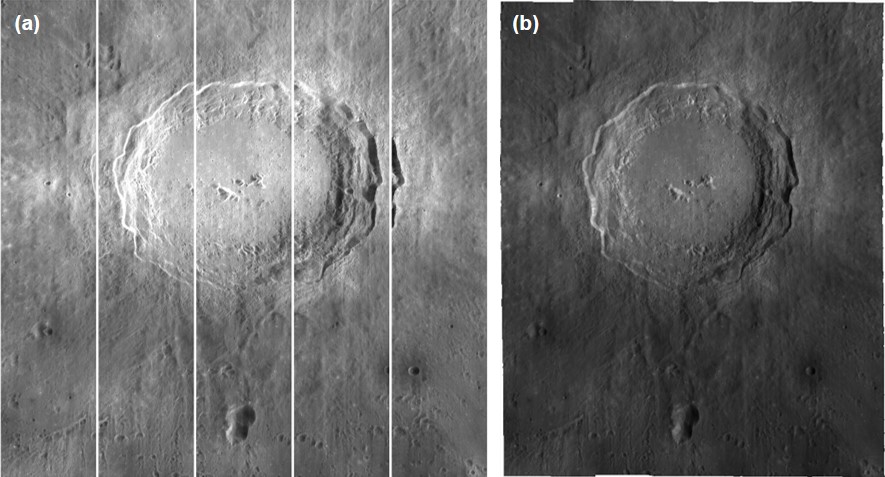
Figure 1. Geometric correction of Copernicus crater. (a) Raw PolCam data from five contiguous orbital tracks. (b) Mosaic after geometric correction and simple cylindrical projection, showing seamless registration across track boundaries.
Radiometric calibration of PolCam includes dark current removal, flat-fielding, and smear correction. In particular, smear artifacts induced by the characteristics of the frame-transfer CCD critically impacts the accuracy of polarization measurements. Figure 2 compares a heavily smeared crater before and after smear correction: Panel (a) applies dark removal and flat-fielding only, whereas Panel (b) incorporates smear correction. Residual artifacts that caused vertical elongation of the crater have been effectively removed. Figure 3 illustrates the 430 nm intensity and degree of polarization of the Reiner Gamma swirl to demonstrate the impact of smear on polarization measurements. Panel (a) presents the results without smear correction, where the “eye-shape” structure of the swirl is not clearly resolved in the polarization image. In contrast, Panel (b) displays the results after smear correction, with enhanced contrast between bright and dark regions in the intensity image, and a pronounced depiction of the swirl’s eye-shape in the polarization image.
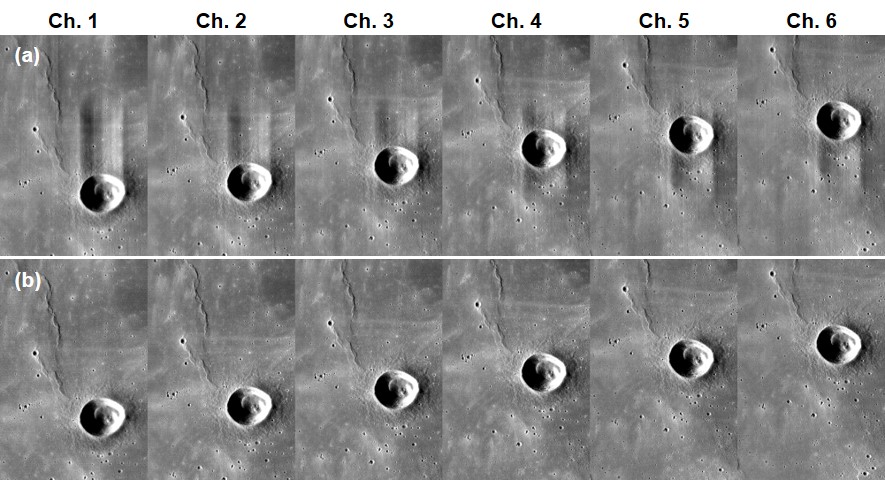
Figure 2. Smear correction in a heavily smeared lunar crater. (a) Images following dark-current removal and flat-fielding only, in which vertical streak artifacts produce a stretched appearance. (b) Images after additional frame-transfer smear correction, with streak artifacts effectively removed and true crater morphology restored.
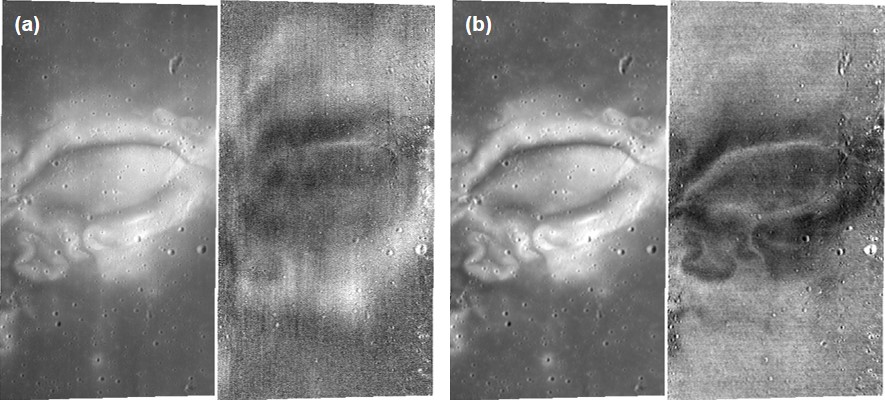
Figure 3. Impact of smear on 430 nm intensity and degree of polarization of the Reiner Gamma swirl. (a) Without smear correction: intensity (left) and polarization (right) images, in which the characteristic “eye‑shape” of the swirl is obscured. (b) With smear correction: intensity (left) exhibits enhanced contrast between bright and dark regions, and the “eye‑shape” structure appears clearly in the polarization (right) image.
Over the past two years, we have operated PolCam in lunar orbit, successfully covering most lunar regions across a broad range of phase angles. Throughout this period, we continuously solved unexpected problems and encountered various trial-and-error in the calibration processes to produce reliable polarization data. In particular, substantial effort was devoted to accurately estimating the intrinsic parameters of the optical system from the observational data and to recovering polarization signals obscured by smear artifacts. Following extensive testing and refinement, we successfully generated the high-resolution polarization datasets. These data are expected to provide new insights for a wide range of studies aimed at understanding the evolution of the lunar surface.
How to cite: Baek, K., Kim, S. S., and Jeong, M.: Calibration of Danuri/Wide-Angle Polarimetric Camera (PolCam): Preliminary Results, EPSC-DPS Joint Meeting 2025, Helsinki, Finland, 7–12 Sep 2025, EPSC-DPS2025-1126, https://doi.org/10.5194/epsc-dps2025-1126, 2025.


