EPSC Abstracts
Vol. 18, EPSC-DPS2025-1131, 2025, updated on 09 Jul 2025
https://doi.org/10.5194/epsc-dps2025-1131
EPSC-DPS Joint Meeting 2025
© Author(s) 2025. This work is distributed under the Creative Commons Attribution 4.0 License.

Theia can arrive late and be oxidized, but not if it is large compared to proto-Earth
 ,
,- Michigan State University, East Lansing, Michigan, United States of America (seth@msu.edu)
The Moon-forming impact was the most significant event during the accretion of Earth substantially establishing the physical and chemical states of the Earth-Moon system. In the canonical giant impact lunar formation hypothesis, a Mars-sized body (Theia) collides with the proto-Earth, and the Moon forms out of the resulting circumplanetary disk. However, in this scenario, the primary contribution to the composition of the Moon is from Theia, which is problematic given the close isotopic similarity between Earth and Moon across a range of isotopic systems (e.g. W, O, Si, Ti). Multiple alternative hypotheses have since been proposed including a smaller but faster moving Theia and a nearly equal size Theia and proto-Earth. We consider these different lunar formation hypotheses in the context of a complete model of terrestrial planet formation. Here, we show that the oxidation state of the proto-Earth and Theia have specific relationships to each other (Figure 1) and the mass ratio between them (Figure 2) in order to reproduces the mantle chemistry of the bulk silicate Earth. On the other hand, different proposed terrestrial planet formation scenarios have different relationships between the composition of the proto-Earth prior to the Moon-forming impact, the amount of mass accreted after the Moon-forming impact (i.e., late accretion; Figure 3), and the timing of the Moon-forming impact (Figure 4).
For this work, we selected 164 N-body simulations of solar system formation from a range of terrestrial planet formation scenarios including the Circular and Eccentric Jupiter-Saturn (Raymond et al., 2009), Truncated Disk (Hansen et al., 2009), Grand Tack (Walsh et al., 2011; Jacobson & Morbidelli, 2014), Early Instability (Clement et al., 2019), and Ring scenarios (Nesvorny et al., 2021). These astrophysical N-body simulations produce solar systems containing Earth analogs with a final mass between 0.9 and 1.1 Earth masses and semi-major axis exterior to the next-largest body. Theia is identified as the final embryo impactor to accrete to the proto-Earth. The composition of every object in each simulation was tracked using a planetary accretion and differentiation model (Rubie et al., 2015). This model processes the accretion histories from the N-body solar system formation scenarios and determines core and mantle chemical evolution due to metal-silicate equilibration following melt-generating planetary impacts during accretion. After each impact, metal-silicate equilibration occurs between the mantles and cores of the target and impacting planetary bodies in a plume of entrained material surrounding the descending impactor core, as determined by analog experiments (Deguen et al., 2011). Elements partition between the equilibrating mantle- and core-forming fluids from the impactor and target bodies governed by mass-balanced equilibration and laboratory-measured metal-silicate partition coefficients. Free parameters in the model control the oxidation state of initial solids in the protoplanetary disk (set by fractions of iron and silicon in metal versus silicate) as well as the pressures at which metal-silicate equilibration occurs. We found the best fit initial conditions for each simulation that result in a simulated Earth analog most closely matching the composition of the bulk silicate Earth. Then we found the characteristics of proto-Earth and Theia that resulted in the successful reproduction of Earth.
We find that the proto-Earth and Theia may possess a range of mantle compositions and mass ratios and still reproduce Earth’s mantle composition. However, Theia and proto-Earth cannot both possess oxidized mantles, since late accretion is oxidizing across all proposed scenarios (Figure 1). Relatedly, Theia may be significantly more oxidized than Earth, but only if it is relatively small compared to the proto-Earth (Figure 2). Whereas, the proto-Earth is almost always more reduced than Earth regardless of the amount of late accretion (Figure 3). Given the relationship between late accreted mass and the timing of the Moon-forming impact (Figure 4), these results are generally agnostic to when the impact occurred.
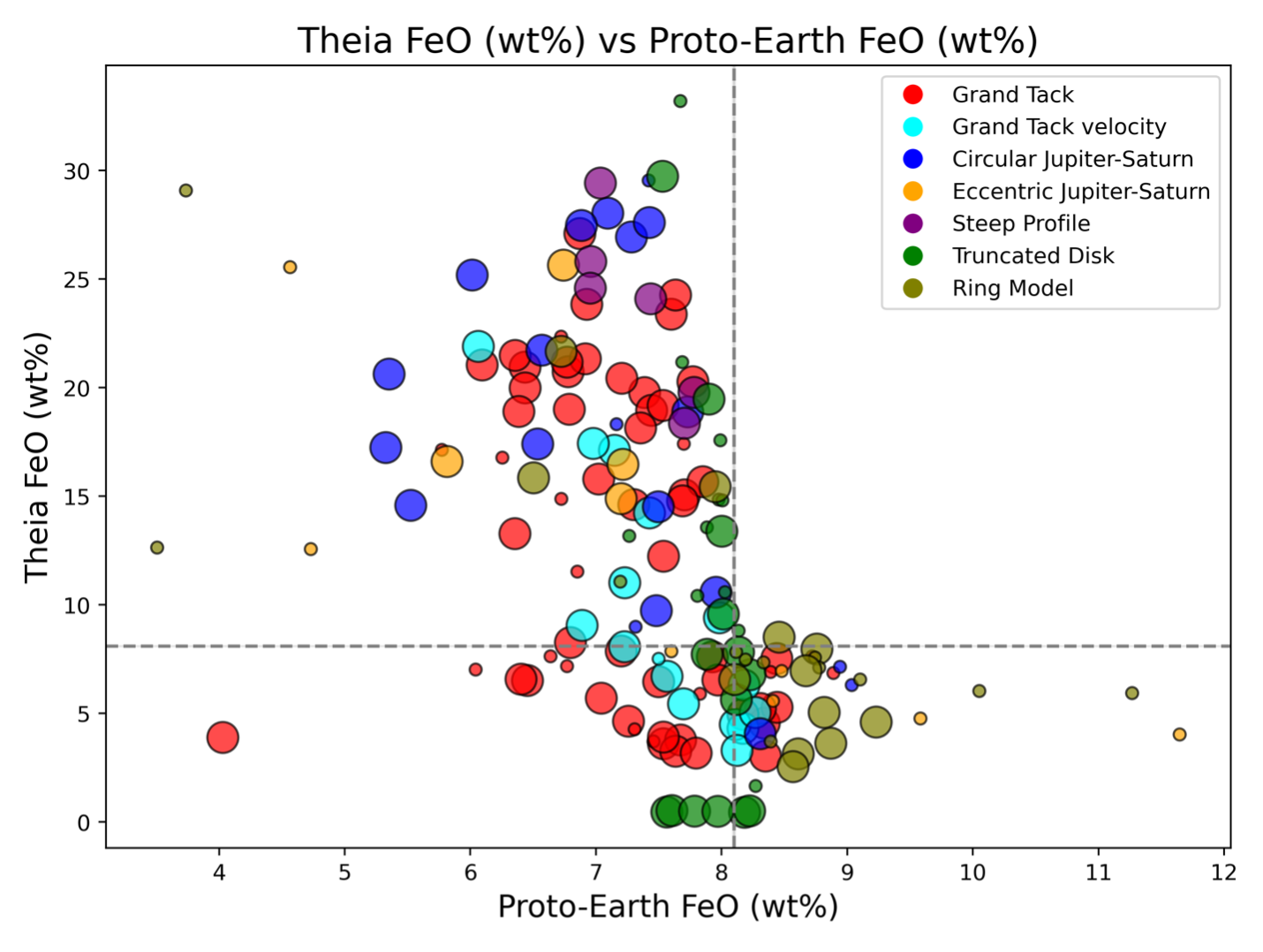
Figure 1: Either Theia or proto-Earth can have a FeO wt.% greater than that of the current Earth mantle but not both. Theia and proto-Earth mantle FeO wt.% are shown for each simulated Earth analog (colors indicate the Earth analog’s formation scenario). The size of the marker represents the goodness-of-fit metric of the final Earth analog in the simulation; a large marker indicates a better fit and a small marker indicates a worse fit. The dashed lines show the final Earth FeO 8.1wt.%, forming four quadrants for combinations of Theia and proto-Earth FeO compositions.
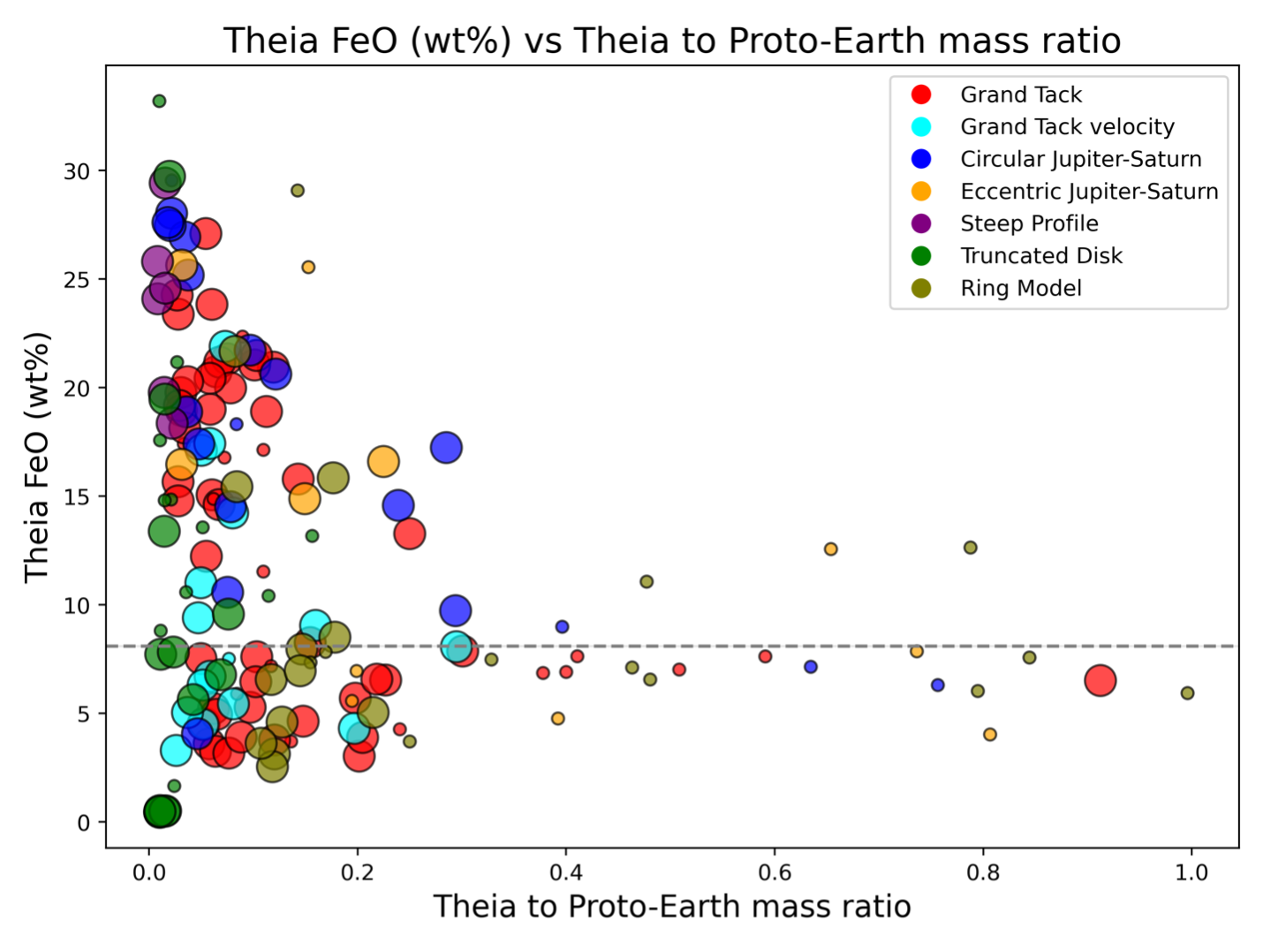
Figure 2: Theia can have a wide range of mantle FeO compositions so long as Theia is small relative to the proto-Earth; if it is larger than a third the mass of the proto-Earth, then the final Earth analog is not a good match to Earth. Theia mantle FeO wt.% and Theia to Proto-Earth mass ratio shown for each simulated Earth analog (colors indicate the Earth analog’s formation scenario). The size of the marker represents the goodness-of-fit metric of the final Earth analog in the simulation; a large marker indicates a better fit and a small marker indicates a worse fit. The dashed line shows the final Earth FeO 8.1wt.%.
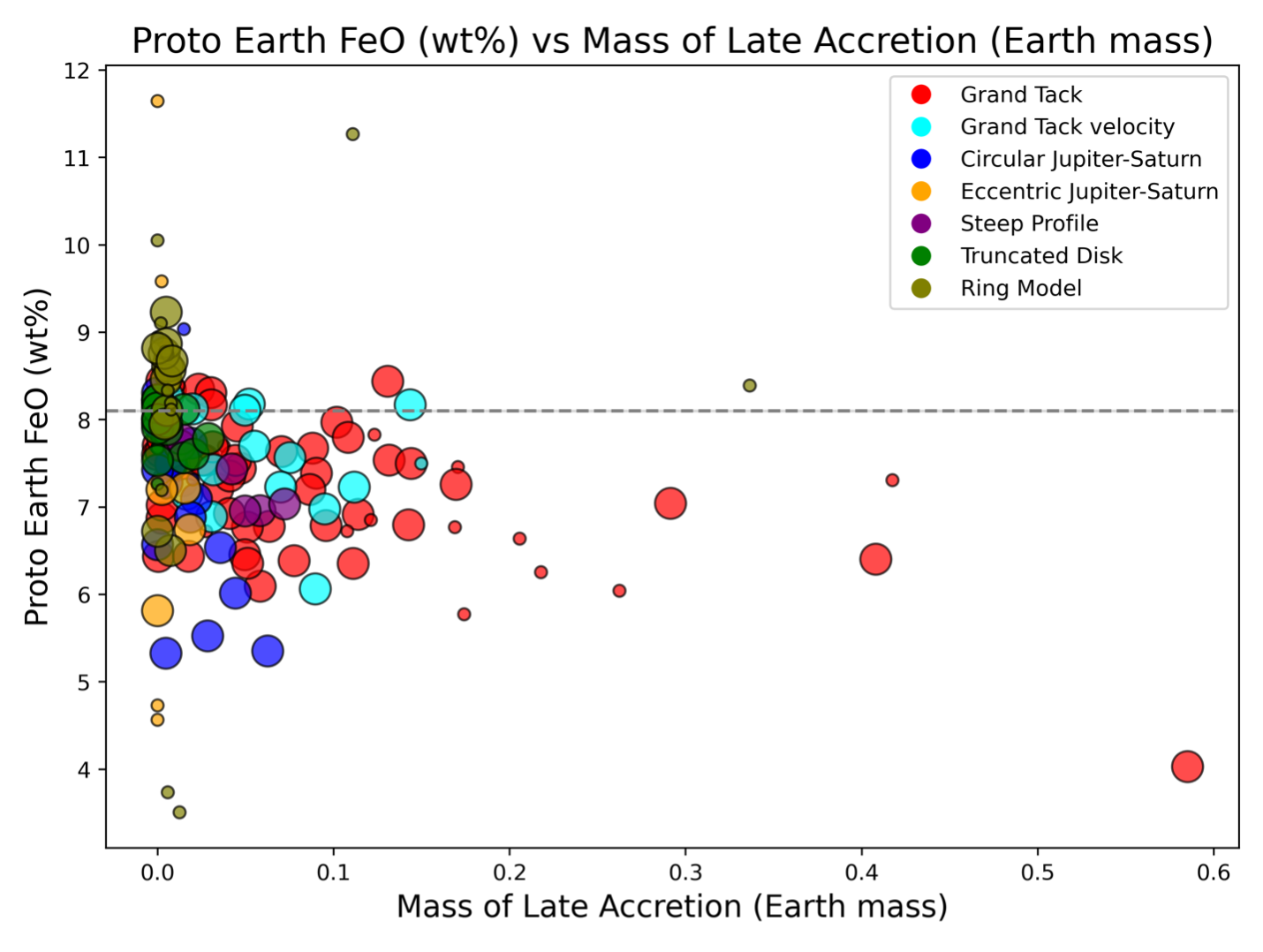
Figure 3: The proto-Earth’s mantle FeO wt.% is typically near or below the current bulk silicate Earth’s FeO wt.%, even when there is a significant mass of late accretion. The proto-Earth mantle FeO wt.% and mass of late accretion are shown for each simulated Earth analog (colors indicate the Earth analog’s formation scenario). The size of the marker represents the goodness-of-fit metric of the final Earth analog in the simulation; a large marker indicates a better fit and a small marker indicates a worse fit. The dashed line shows the final Earth FeO 8.1wt.%.
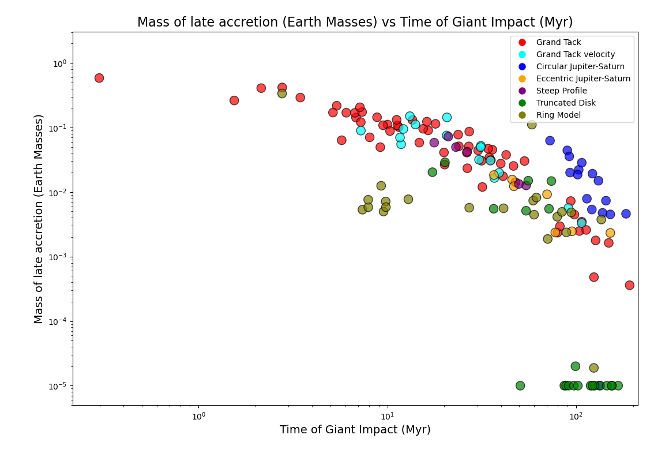
Figure 4: The amount of material accreted by each Earth analog after the Moon-forming impact is related to when the Moon-forming impact occurs. The mass of late accretion and the time of the last (Moon-forming) giant impact are shown for each simulated Earth analog (colors indicate the Earth analog’s formation scenario).
How to cite: Jacobson, S. A., Nathan, G., and Nguyen, H. D.: Theia can arrive late and be oxidized, but not if it is large compared to proto-Earth, EPSC-DPS Joint Meeting 2025, Helsinki, Finland, 7–12 Sep 2025, EPSC-DPS2025-1131, https://doi.org/10.5194/epsc-dps2025-1131, 2025.


