
 1,
1,- 1Department of Astronomy, University of Maryland, College Park, MD, USA (feaga@astro.umd.edu)
- 2Johns Hopkins Applied Physics Laboratory, Laurel, MD, USA
- 3Southwest Research Institute, Boulder, CO, USA
The Rosetta mission to comet 67P/Churyumov-Gerasimenko (67P) was a truly remarkable achievement in cometary science and has facilitated a tremendous advance in our understanding of both comets and cometary processes (see various chapters in Comets III). During its 2014–2016 escort phase as 67P traveled inbound from ~4 au to 1.24 au and back out again, Rosetta observed the comet’s coma and nucleus throughout its perihelion passage in unprecedented detail with a variety of remote sensing and in situ measurements. Ultraviolet (UV) observations acquired by the Alice UV spectrograph (Stern et al. 2007) are particularly valuable as UV measurements of comets are uncommon since they can only be achieved from space. Therefore, the Alice data arguably represent the best, most complete set of UV comet observations we have today.
Rosetta/Alice revealed that 67P exhibited a wide variety of coma activity as it responded to both large-scale seasonal changes such as heterogeneous outgassing from the nucleus (as the subsolar latitude moved from one hemisphere to the other) and more localized, short-term events such as outbursts or the passage of coronal mass ejections (CMEs) from the Sun. These long- and short-term variations in activity are evident in atomic emission from H, O, C, and S, molecular emission from CO in the Fourth Positive and Cameron bands, and absorption by H2O, all of which were regularly observed by Alice (e.g., Noonan et al. 2018, 2020; Feldman et al. 2016; Keeney et al. 2017, 2019). At the same time, the nucleus of 67P was also observed to evolve, as the overall slope of the nucleus bi-directional reflectance (BDRF) spectra obtained by Alice changed during the Rosetta escort phase (e.g., Feaga et al. 2015). Analyses of Alice data to date, however, have focused only on subsets of the data, providing just hints of what Alice can tell us about 67P. No systematic investigation of the complete set of Alice data has been carried out, owing to both the size and complexity of the dataset.
While the nearly 71,000 Alice spectral-spatial raw and calibrated science images are archived in the Planetary Data System Small Bodies Node (PDS-SBN), no advanced data products were generated prior to the end of mission funding. The goal of this archival project is to prepare a comprehensive, user-accessible database of the most important scientific quantities that can be derived from the Alice observations. We have optimized an existing and highly capable spectral fitting code to be applied consistently across the full Alice dataset from 1000 Å to 1950 Å. The code implements an approach that physically and meaningfully constrains a fit to each spectrum as the sum of known components to remove instrumental effects and background levels and ultimately extract atomic and molecular emission and nucleus reflectance (Fig. 1). The retrieved values (e.g., atomic line intensities, molecular column densities, bi-directional reflectance of the nucleus) will be included in the database. The database will be supplemented with documentation and graphics to aid in access, visualization, and interpretation of the derived results (Fig. 2). The final database and document collection will be submitted as PDS4 compliant files to the PDS-SBN in late 2025 and should be available to the community in 2026.
Upon completion, this archival project will enable more in-depth analyses of the Alice data and facilitate multi-instrument comparisons to place the Alice data into the broader mission context. By aiding in our understanding of the full scope of 67P’s properties, behavior, and environment, this database will add to the legacy of the Rosetta mission.
This work is supported by the NASA ROSES-2020 NNH20ZDA001N-PDART program grant 80NSSC21K0884.
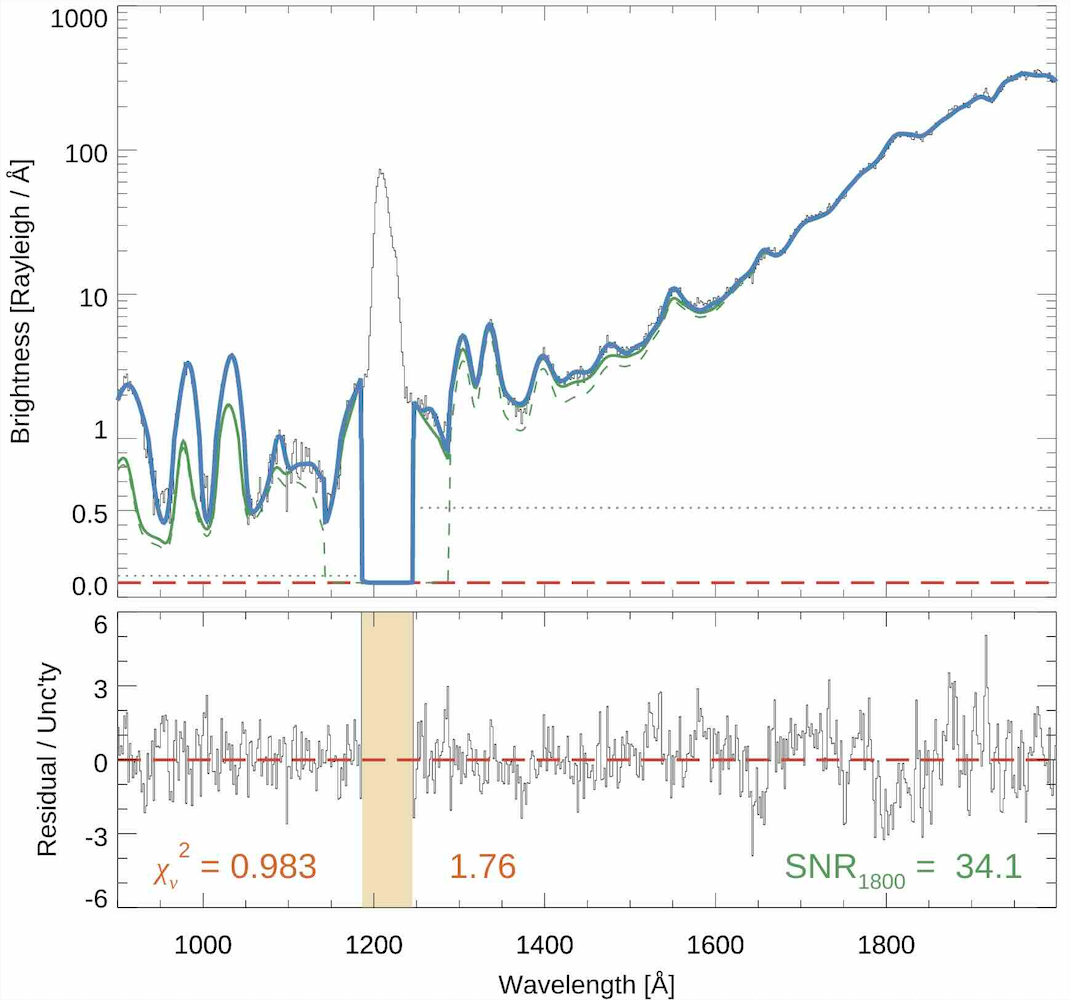
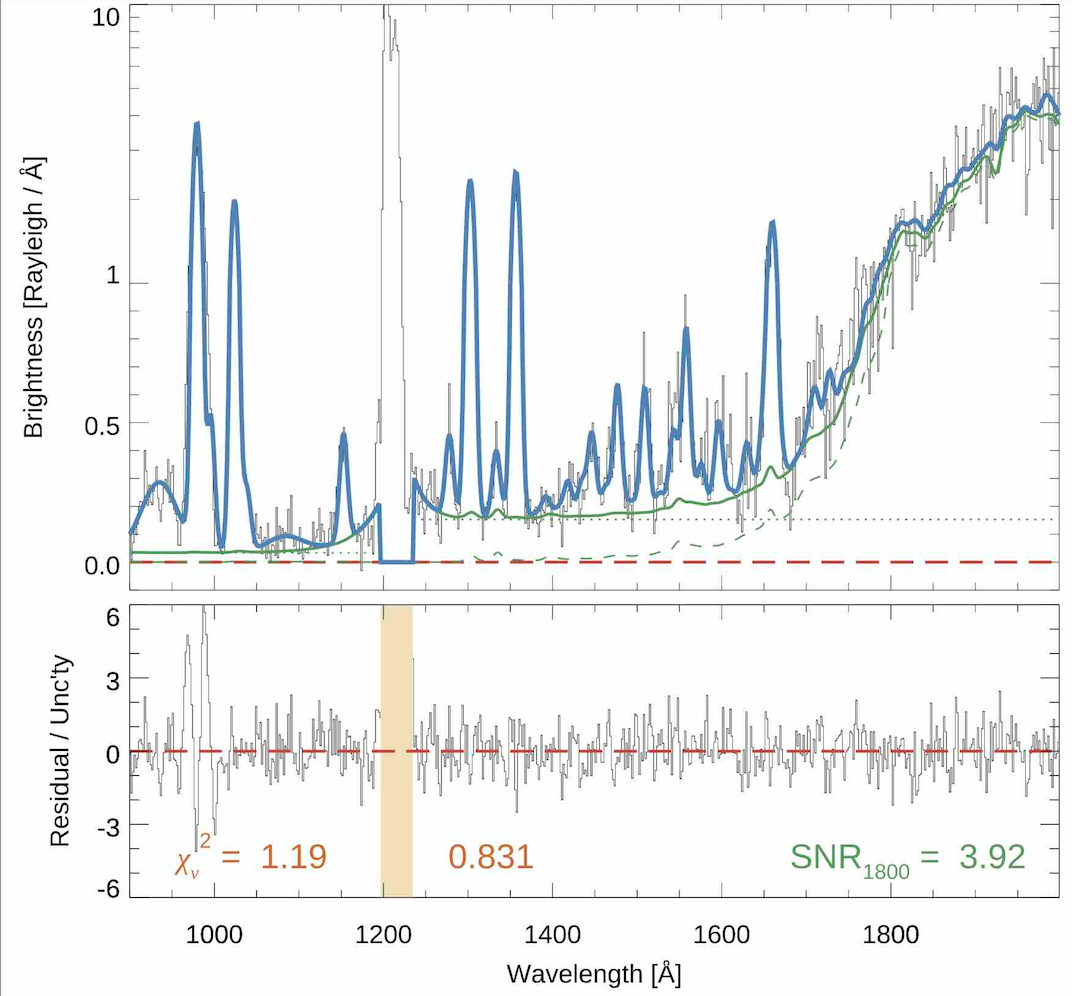
Figure 1. Representative plots of Rosetta/Alice data showing features of the data and various elements of the spectral fit with residuals (background components are in green, final fits with background plus emissions are in blue). The example pre-perihelion spectrum on the left is dominated by the nucleus reflecting solar light while the example post-perihelion spectrum on the right is dominated by coma gas and dust emissions.
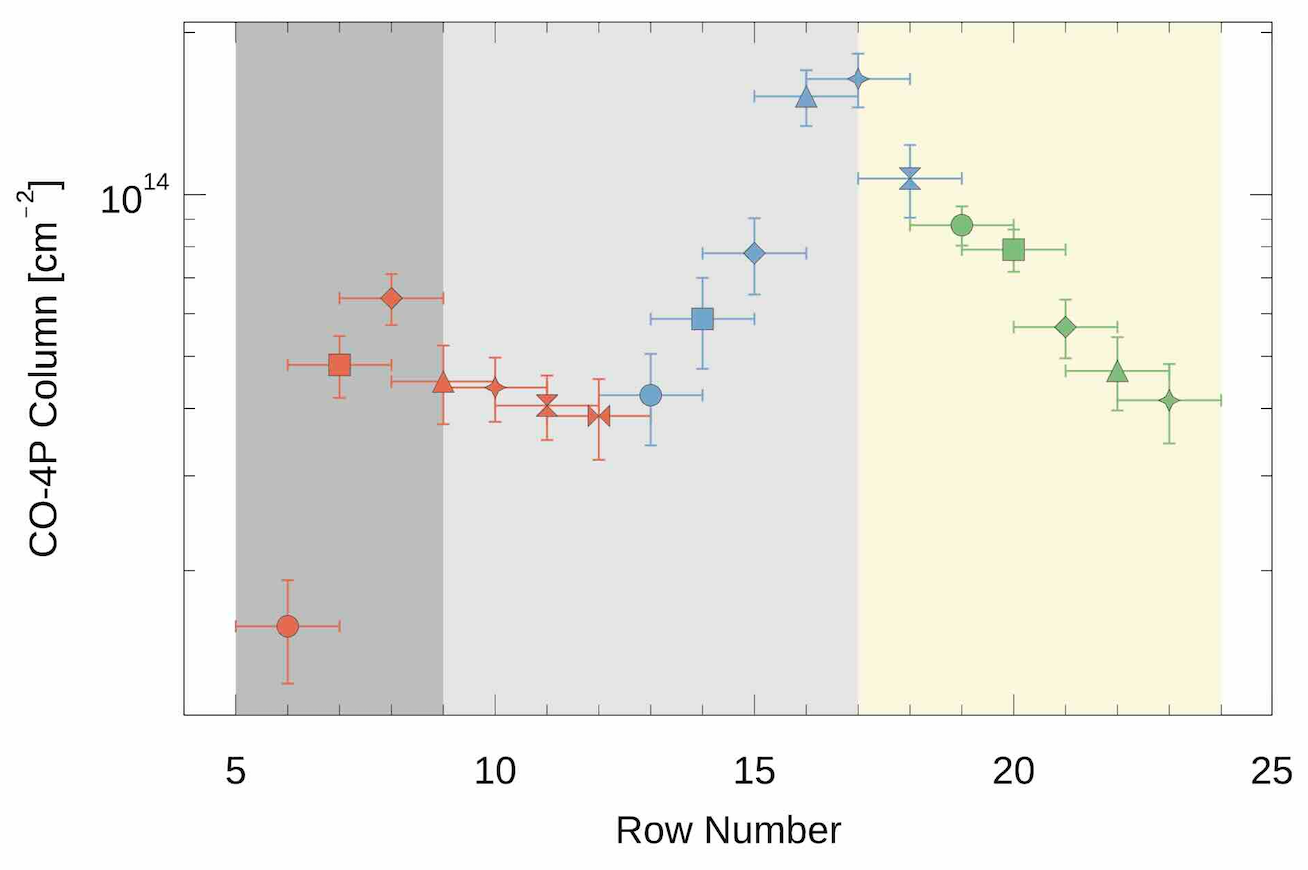
Figure 2. Example visualization to be included with the archive showing the extracted CO Fourth Positive column densities for a single Alice exposure. Lines-of-sight (LOS) intersecting the anti-sunward side of the coma are shaded in dark gray, LOS intersecting the nucleus are shaded in light gray, and LOS intersecting the sunward coma are shaded in yellow. A smooth, radially dependent fall-off of the CO can be seen in the sunward coma.
References
Feaga, L. M., S. Protopapa, E. Schindhelm, et al., Far-UV phase dependence and surface characteristics of comet 67P/Churyumov-Gerasimenko as observed with Rosetta Alice, Astron & Astrophys 583, A27, doi:10.1051/0004-6361/201526671, 2015.
Feldman, P. D., M. F. A’Hearn, L. M. Feaga, et al., The nature and frequency of the gas outbursts in comet 67P/Churyumov-Gerasimenko observed by the Alice far-ultraviolet spectrograph on Rosetta, Astrophys J Lett 825, L8, doi:10.3847/2041-8205/825/1/L8, 2016.
Keeney, B. A., S. A. Stern, M. F. A’Hearn, et al., H2O and O2 Absorption in the Coma of Comet 67P/Churyumov-Gerasimenko Measured by the Alice Far-Ultraviolet Spectrograph on Rosetta, MNRAS 469, S158, doi:10.1093/mnras/stx1426, 2017.
Keeney, B. A., S. A. Stern, R. J. Vervack, Jr., et al., Upper limits for emissions in the coma of comet 67P/Churyumov-Gerasimenko near perihelion as measured by Rosetta’s Alice far-UV spectrograph, Astron J 158, 252, doi:10.3847/1538-3881/ab552e, 2019.
Meech, K. J., M. R. Combi, D. Bockelee-Morvan, S. N. Raymond, and M. E. Zolensky (Eds.), Comets III, Space Science Series, University of Arizona Press, 2024.
Noonan, J. W., S. A. Stern, P. D. Feldman, et al., Ultraviolet observations of coronal mass ejection impact on comet 67P/Churyumov-Gerasimenko by Rosetta Alice, Astron J 156, 16, doi:10.3847/1538-3881/aac432, 2018.
Noonan, J. W., G. Rinaldi, P. D. Feldman, et al., Analysis of hybrid gas-dust outbursts observed at 67P/Churyumov-Gerasimenko, Astron J 162, 4, doi:10.3847/1538-3881/abf8b4, 2021.
Stern, S. A., D. C. Slater, J. Scherrer, et al., Alice: The Rosetta ultraviolet imaging spectrograph, Space Sci Rev 128, 507, doi:10.1007/s11214-006-9035-8, 2007.
How to cite: Feaga, L. M., Vervack, R. J., and Keeney, B. A.: Database of extracted coma and nucleus properties of 67P/Churyumov-Gerasimenko from Rosetta/Alice UV observations, EPSC-DPS Joint Meeting 2025, Helsinki, Finland, 7–12 Sep 2025, EPSC-DPS2025-1142, https://doi.org/10.5194/epsc-dps2025-1142, 2025.


