
 1,
1,- 1Lunar and Planetary Laboratory, University of Arizona, Tucson, United States of America
- 2Department of Geosciences, University of Arizona, Tucson, United States of America
- 3Haystack Observatory, Massachusetts Institute of Technology, Westford, United States of America
- 4Lincol Laboratory, Massachusetts Institute of Technology, Lexington, United States of America
Introduction: Orbital radar sounding and imaging are unique tools in planetary studies, with an extensive array of possible targets. Flight-proven instruments are currently limited to a few examples based on conventional technologies with inherent limitations in terms of mass/power/volume and performance. For example, current and planned spaceborne radar sounders use single dipole antennas for both transmit and receive, which are physically large and linearly polarized in just one direction, precluding studies based on polarization, such as ice detection [1]. They also have broad radiation patterns and are susceptible to off-nadir reflections from the surface (clutter) that can be confused with a nadir subsurface echo since there is no ability to determine the source direction of the echo [2, 3].
Given the wide range of scientific objectives across our solar system that can addressed with radar sounding, plus the increased emphasis on low-cost, small, low mass, and low power consumption missions with flexible launch options, there is a need for radar sounder technology that can deployed in a CubeSat/SmallSat platform, or as part of an instrument suite onboard a larger spacecraft but without dominating the payload. Such a radar must provide fully polarimetric information for the characterization of materials including their scattering properties and have directivity to determine the source of echoes.
Vector Sensor Antenna: The Vector Sensor Antenna (VSA, Fig. 1) is a transformative solution for radar sounding with the potential to address nearly all limitations of current technology. The VSA measures both the electric and magnetic field vectors of an electromagnetic wave at a common phase center [4], enabling the determination of polarization and angle-of-arrival for multiple discrete sources in a small payload of 2U while stowed.
Leveraging heritage from NASA’s AERO-VISTA mission to develop and launch a CubeSat VSA for passive (receive-only) study of the aurora and other galactic radio sources [5], this technology is now sufficiently mature to develop an active VSA-based radar capable of addressing a wide range of planetary science objectives.
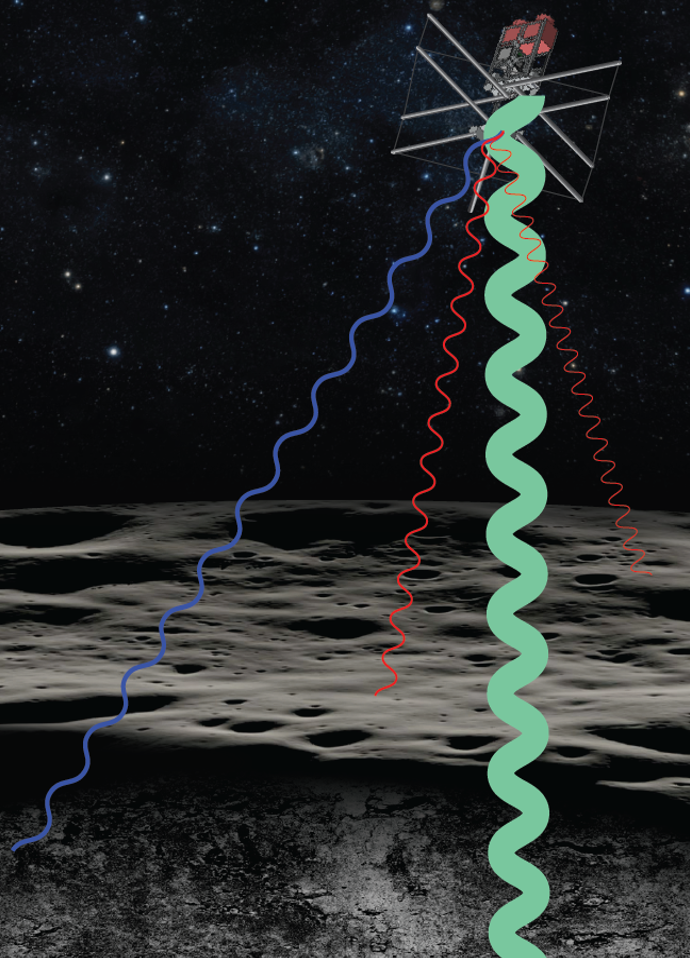
Figure 1: VSA-based sounding radars have full polarization for ice detection and can determine echo direction of arrival for clutter discrimination, in a compact 6-8U, ~6 kg package. The crossed dipoles serve to transmit either linear or circular polarization while all elements operate in receive mode.
ACORN: The Advanced Compact Orbiting Radar for luNar sounding (ACORN) will be based on a 2x2x1 m deployable VSA (Fig. 1) and will operate at 40-70 MHz in low lunar orbit. The ACORN VSA and all radar subsystems are compact and deployable from a 6U volume, enabling the possibility of a complete radar in a very small package. It is a novel approach to providing spatial resolution and penetration (Fig. 2) that provides a new alternative to distributed arrays of elements or large directive apertures.
It has applications to addressing science and exploration priorities that have been set forth by the Planetary Science Decadal Survey, the Lunar Exploration Analysis Group, and the Artemis Science Definition Team. These objectives include (1) the distribution of ice to several meters depth, (2) the depth and structure of regolith, (3) the detection and characterization of lava tubes and stratigraphy of volcanic deposits, and (4) three-dimensional geophysical context for landed and human missions with in-situ instrumentation.
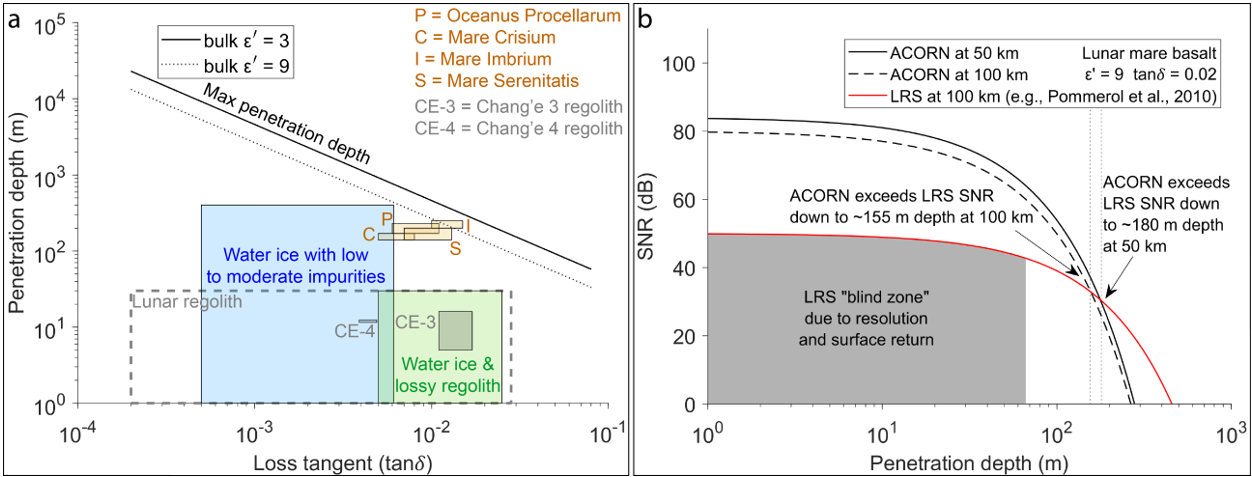
Figure 2: (a) On the Moon, ACORN can penetrate through all regolith types and ice up to several km in thickness [e.g., 6, 7], and tens to hundreds of meters of high loss maria basalts [e.g., 8]. The penetration depth was estimated as a function of loss tangent and real dielectric permittivity based on the methods of [9, 10] and VSA radar performance at 100 km altitude (panel b).
WHISPR: The Wideband Hf Ice and Subsurface Penetrating Radar (WHISPR) builds on the 4x4x2 m deployable VSA of AERO-VISTA to perform radar sounding at a 10-15 MHz frequency range from a compact 8U volume compatible with SmallSat platforms. This very small form factor, mass (6 kg), and power requirements (<36 W in active mode, <25 W in passive mode) enable radar sounding of the surface and exospheres of virtually any solar system target, including gas giants and their moons, asteroids, and comets. The wide bandwidth allows high SNR measurements at 2-5x higher vertical resolution compared to existing sounding radars at similar frequencies, reaching up to ~20 km penetration in ice or other materials at a resolution better than 20 m.
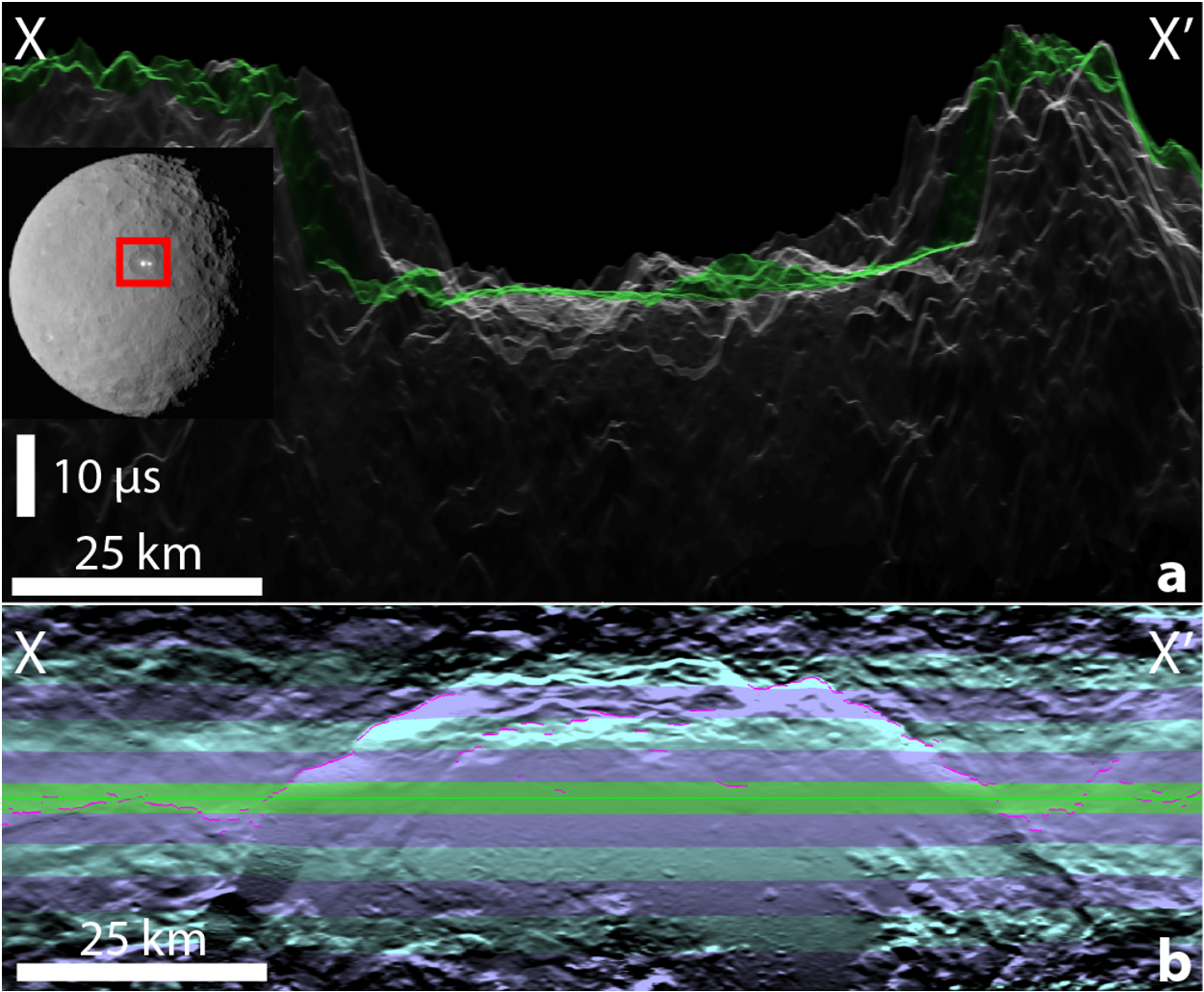
Figure 3: Example of angle of clutter discrimination capability for a radar track crossing Vinalia Faculae in Occator crater on Ceres at 50 km altitude. (a) Clutter simulation in radargram form and (b) surface echo power simulation map. Only clutter within 2.5° off-nadir (green) remains after processing, resulting in the avoidance of clutter sources that would otherwise appear as subsurface signals (gray).
Ongoing prototype testing: All components and subsystems, including hardware and software, have been tested to TRL 4+ for both radars. We demonstrated the full chain of radar operations for both ACORN and WHISPR, exceeding predicted antenna performance. The success of these tests highlights the flexibility of WHISPR to operate in active ionospheric sounding mode at low frequencies, thus enabling further investigations in addition to the existing passive measurement capabilities demonstrated by AERO-VISTA [5, 11-13].
Acknowledgments: The University of Arizona Space Institute and Massachusetts Institute of Technology have both provided funding to develop the ACORN and WHISPR concepts.
References: [1] Slade et al. (1992) Science. [2] Holt et al. (2006) JGR: Planets. [3] Choudhary et al. (2016) IEEE Geoscience and Remote Sensing Letters. [4] Wong and Zoltowski (1997) IEEE Trans. Antennas Propag. [5] Lind at al. (2019) Small Satellite Conference. [6] Zhang (2020) GRL. [7] Abu Hashmeh (2022), JGR: Planets. [8] Hongo et al. (2020) EPS. [9] Seu et al. (2007) JGR Planets. [10] Chyba et al. (1998) Icarus. [11] Silver et al. (2024) IEEE Aerospace Conf. Proc. [12] Morris et al. (2022) IEEE Intern. Symp. on Phased Array Systems and Technology. [13] Kononov et al. (2024) IEEE Aerospace Conf. Proc.
How to cite: Holt, J., Nerozzi, S., Knapp, M., Paritsky, L., Fenn, A., Thompson, E., and Aguilar, R.: Advanced Radar Sounding and Imaging on SmallSat and CubeSat Missions Across the Solar System with Vector Sensor Antennas, EPSC-DPS Joint Meeting 2025, Helsinki, Finland, 7–12 Sep 2025, EPSC-DPS2025-1151, https://doi.org/10.5194/epsc-dps2025-1151, 2025.


