
 6,2,8
6,2,8- 1Lunar and Planetary Institute, Universities Space Research Association, Houston, United States of America (ammcgraw@arizona.edu)
- 2Florida Space Institute, University of Central Florida, Orlando, United States of America
- 3University of Puerto Rico at Humacao, Puerto Rico
- 4Mysterious Meteorites, LLC, Houston, United States of America
- 5European Space Agency, Paris, France
- 6National Radio Astronomy Observatory, United States of America
- 7Jet Propulsion Laboratory, Pasadena, United States of America
- 8University of Liège, Wallonia, Belgium
Asteroids preserve critical evidence about early solar system processes, including accretion, thermal metamorphism, and impact history. This project focuses on asteroid (1036) Ganymed, a large S-type near-Earth asteroid (NEA), with the goal of generating a 3D shape model using radar observations and optical lightcurves, analyzed via the SHAPE software (Magri et al., 2007). As part of the 2025 Asteroid Radar Modeling Workshop, this work will serve as a year-long scientific and technical study of asteroid surface evolution. The specific science goal is to search for large-scale remnant impact structures preserved on Ganymed’s surface, which may record ancient collisional events and offer insight into the fragmentation history of S-type asteroid parent bodies.
Asteroid (1036) Ganymed is one of the largest known NEAs, with an effective diameter of ~35 kilometers and a rotation period of 10.31 hours. It follows an Amor-type orbit with perihelion near 1.24 au. Despite its current NEA classification, its size and dynamical history suggest that it likely spent most of its lifetime in the main asteroid belt, only more recently transitioning into a near-Earth orbit. Its spectral classification as an S-type (Bus-DeMeo taxonomy) indicates a silicate-rich composition dominated by olivine and pyroxene. S-types are widely believed to be the parent bodies of ordinary chondrite meteorites—the most common meteorites found on Earth (Dunn et al., 2010; McGraw et al., 2025). Studying surface morphology on such bodies helps constrain the geological context for meteorite samples and their shock histories.
This project uses radar data collected from Arecibo Observatory and the Goldstone Deep Space Communications Complex during Ganymed's 1998 and 2011 apparitions, as well as optical lightcurves from eight apparitions between 1985 and 2024. These data provide strong constraints on the asteroid’s shape, spin state, and surface roughness. Using the SHAPE software (Magri et al., 2007), we will iteratively refine the model through inversion of radar echoes and photometric data.
While radar imaging has revealed concavities on Ganymed’s surface at scales of ~10 km (Figure 1), it is difficult to resolve smaller features with confidence. One specific goal of this project is to test the resolution limits of our shape models by quantifying the smallest concavity sizes that appear uniquely and robustly across modeling iterations. By exploring how model features vary with input assumptions and data subsets, we aim to establish a practical threshold for interpreting large-scale impact structures.
Large impact structures can persist for billions of years on low-gravity bodies, although modified over time by regolith movement and secondary cratering (Bierhaus et al., 2005; Marchi et al., 2012). If Ganymed preserves such ancient features, it could provide a unique record of early main-belt collisional history. In this context, Ganymed complements broader research efforts aimed at linking asteroid surfaces to meteoritic samples and understanding the evolution of ordinary chondrite source bodies (Vernazza et al., 2014).
The modeling workflow includes processing radar data; investigating shape, spin, and scattering properties; and iteratively adjusting the model to minimize residuals. Surface concavities and basin-like structures will be examined both visually and via automated shape analysis tools, as used in prior studies (Benner et al., 2015). While we will assess candidate features, we emphasize that this model’s resolution limits what can be robustly interpreted as impact structures.
The result will be the best shape model of Ganymed produced to date, incorporating more radar and lightcurve data than any prior study. This project builds on previous shape modeling by Medina et al. (2023) and includes new observations and refinements. The resulting model will be used to examine large-scale surface morphology and investigate whether preserved craters can be linked to specific collisional epochs.
This abstract reflects ongoing collaborative work supported by the Asteroid Radar Modeling Workshop. The final model and crater analysis will inform future studies of asteroid surface evolution and meteorite analogs, while contributing to the broader planetary defense community’s understanding of large NEA structure.
References
Benner, L. A. M., et al. (2015). Radar observations and physical modeling of near-Earth asteroid (162421) 2000 ET70. Icarus, 245, 362–378.
Bierhaus, E. B., et al. (2005). Cratering on asteroids: Reconciling regolith processes and crater populations. Icarus, 175(2), 486–500.
Dunn, T. L., McCoy, T. J., Sunshine, J. M., & McSween, H. Y. (2010). A coordinated spectral, mineralogical, and compositional study of ordinary chondrites. Icarus, 208(2), 789–797.
Magri, C., et al. (2007). Radar observations and a physical model of asteroid 1580 Betulia. Icarus, 186(1), 152–177.
Marchi, S., et al. (2012). The violent collisional history of asteroid 4 Vesta. Science, 336(6082), 690–694.
McGraw, A. C., Reddy, V., & Sanchez, J. A. (2025). The Gefion Asteroid Family: Parent body puzzles and ordinary chondrite pieces. Monthly Notices of the Royal Astronomical Society, 537(4), 3145–3159.
Medina, V. A., Marshall, S. E., Devogèle, M., Taylor, P. A., Brozović, M., Ferrais, M., & Jehin, E. (2023). Shape modeling of 1036 Ganymed from radar and lightcurve data. EPSC-DPS Joint Meeting 2023.
Vernazza, P., et al. (2014). Multiple and fast: The accretion of ordinary chondrite parent bodies. The Astrophysical Journal, 791(2), 120.
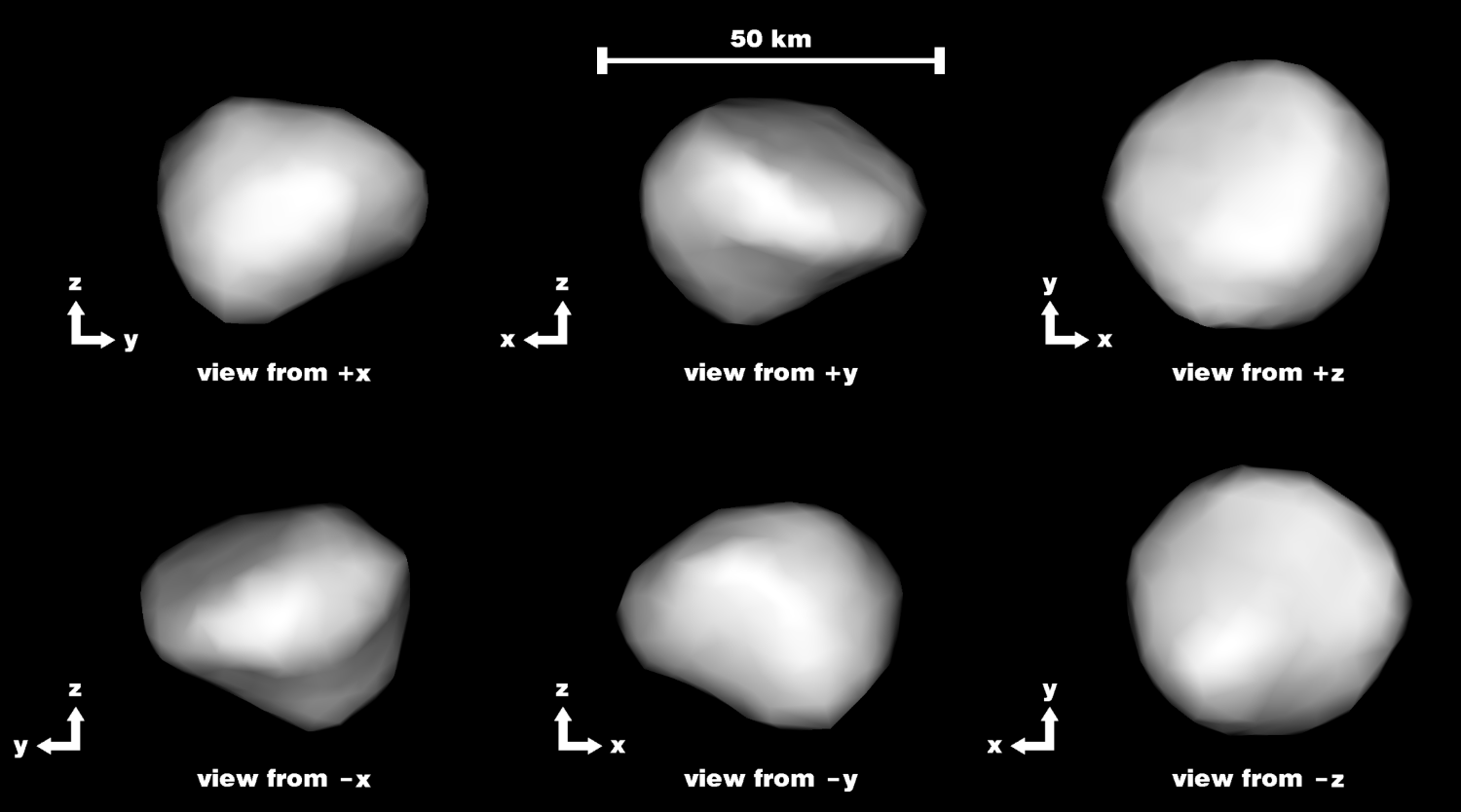
Figure 1: Views of the current best-fit shape model of asteroid (1036) Ganymed along each principal axis, based on radar and lightcurve data. The model reveals large-scale surface concavities and asymmetries that may be remnant impact features. Scale bar = 50 km.
How to cite: McGraw, A., Marshall, S., Medina, V., Lipitz, M., Devogèle, M., Taylor, P., Brozović, M., Ferrais, M., and Jehin, E.: Shape Modeling of Asteroid (1036) Ganymed: Searching for Large-Scale Remnant Impact Structures on a Large S-Type NEA, EPSC-DPS Joint Meeting 2025, Helsinki, Finland, 7–12 Sep 2025, EPSC-DPS2025-1154, https://doi.org/10.5194/epsc-dps2025-1154, 2025.


