
 2,4,6,
- 1Caltech, Pasadena, CA, USA
- 2Space Telescope Science Institute, Baltimore, MD, USA
- 3Isotoparium, Caltech, Pasadena, CA, USA
- 4University of Central Florida, Orlando, FL, USA
- 5Fibernetics LLC, Lititz, PA, USA
- 6Michigan State University, East Lansing, MI, USA
- 7University of Leicester, Leicester, UK
The population of main belt asteroids includes both primitive Solar System bodies as well as the products of early planetesimal melting and differentiation. The surface compositions of these objects shed light on their origins and evolutionary histories. The mid-infrared (mid-IR; ~5-30 microns) spectral range covers emissivity features diagnostic of silicate composition, including the olivine/pyroxene ratio and the Mg/Fe content of the minerals. In addition, mid-IR spectroscopy enables constraints on regolith properties such as particle size and regolith porosity.
We present James Webb Space Telescope (JWST) spectra of 14 main belt asteroids observed over 5-25 microns with the MIRI/MRS instrument, complementing existing visible and near-infrared (near-IR; ~0.7-5 microns) spectra. Our targets include five members of the spinel-rich “Barbarian” L-type class (Figure 1) and nine members of the nominally metal-rich M-type asteroids. All objects show distinctive emissivity features in their spectra; these include the commonly studied ~8-12 micron emissivity “plateau”, but also include features across the 12-24 micron region that can be key to compositional determination, as well as features at 5-8 microns.
We investigate the composition of these objects using laboratory databases of minerals and meteorites across a range of particle sizes and regolith porosities. Mid-IR spectra reveal the presence of silicate minerals that are sometimes undetectable from near-IR spectra alone. For our targets, each wavelength regime is most sensitive to specific surface constituents, and combined data across the visible through thermal wavelengths is needed to provide a more comprehensive picture of the full surface composition. We will present the surface compositions and closest meteorite analogs to the objects that were observed with JWST, and discuss what our findings reveal about the asteroid origins.
Only laboratory spectra of very small particles (<30 microns) with high regolith porosities (>80%, and sometimes even >95%), as simulated with mixtures of IR-transparent potassium bromide (KBr), are able to match the general shape of the asteroid spectra. The spectral comparison therefore indicates that the surfaces of the asteroids in our study, which are tens of kilometers in size, are overlain with a very fine, porous regolith layer. This characteristic emphasizes the need for laboratory spectral databases of meteorites and minerals that include KBr to simulate regolith porosity, and/or the development of modeling approaches that can simulate these very high regolith porosities, which standard Mie theory + Hapke modeling approaches do not reproduce well.
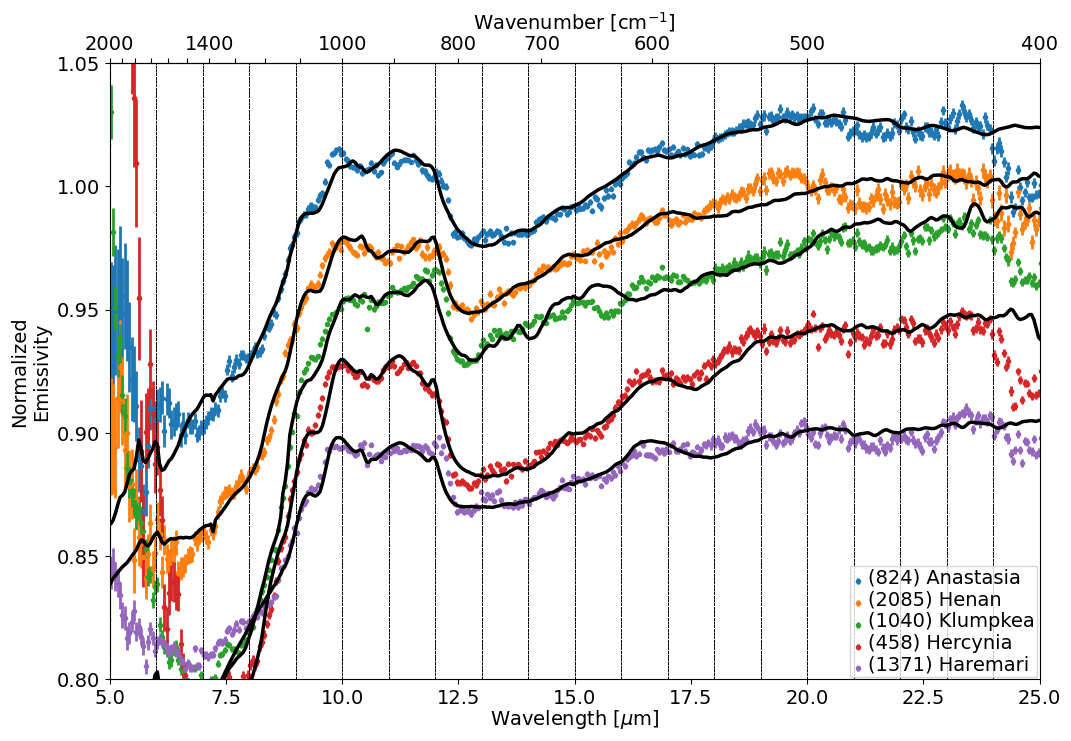
Figure 1: JWST emissivity spectra of five L-type asteroids (colored points), with best-fit laboratory mixtures overlain (black curves). In all cases, the best-fit lab mixtures indicate surfaces composed predominantly of small-particle (<30 micron), porous (~85-97% porosity), crystalline Mg-rich (Fo80-100) olivine. In four out of five cases, the laboratory mixtures shown here are dominated by CV3 chondrite material, as measured in the lab by Izawa et al. (2021) and Dausend et al. (2025).
References
Dausend, M.D., Martin, A.C., Emery, J.P. 2025. PSJ, 6, 54.
Izawa, M.R.M., King, P.L. Vernazza, P., Berger, J.A., McCutcheon, W.A. 2021. Icarus 359, 114328.
How to cite: de Kleer, K., Ehlmann, B. L., Wong, I., Tissot, F. L. H., Martin, A., Lane, M. D., Jacobson, S. A., and King, O.: Surface texture and mineralogy of main belt asteroids from JWST mid-infrared spectroscopy, EPSC-DPS Joint Meeting 2025, Helsinki, Finland, 7–12 Sep 2025, EPSC-DPS2025-1159, https://doi.org/10.5194/epsc-dps2025-1159, 2025.


