
 1,1,1,2,2,3
- 1U. Colorado, LASP, Boulder, CO, USA (nick.schneider@lasp.colorado.edu)
- 2Space Sciences Laboratory, University of California Berkeley, Berkeley, CA, USA,
- 3Laboratoire de Physique Atmosphérique et Planétaire, STAR Institute, Université de Liège, Liège, Belgium
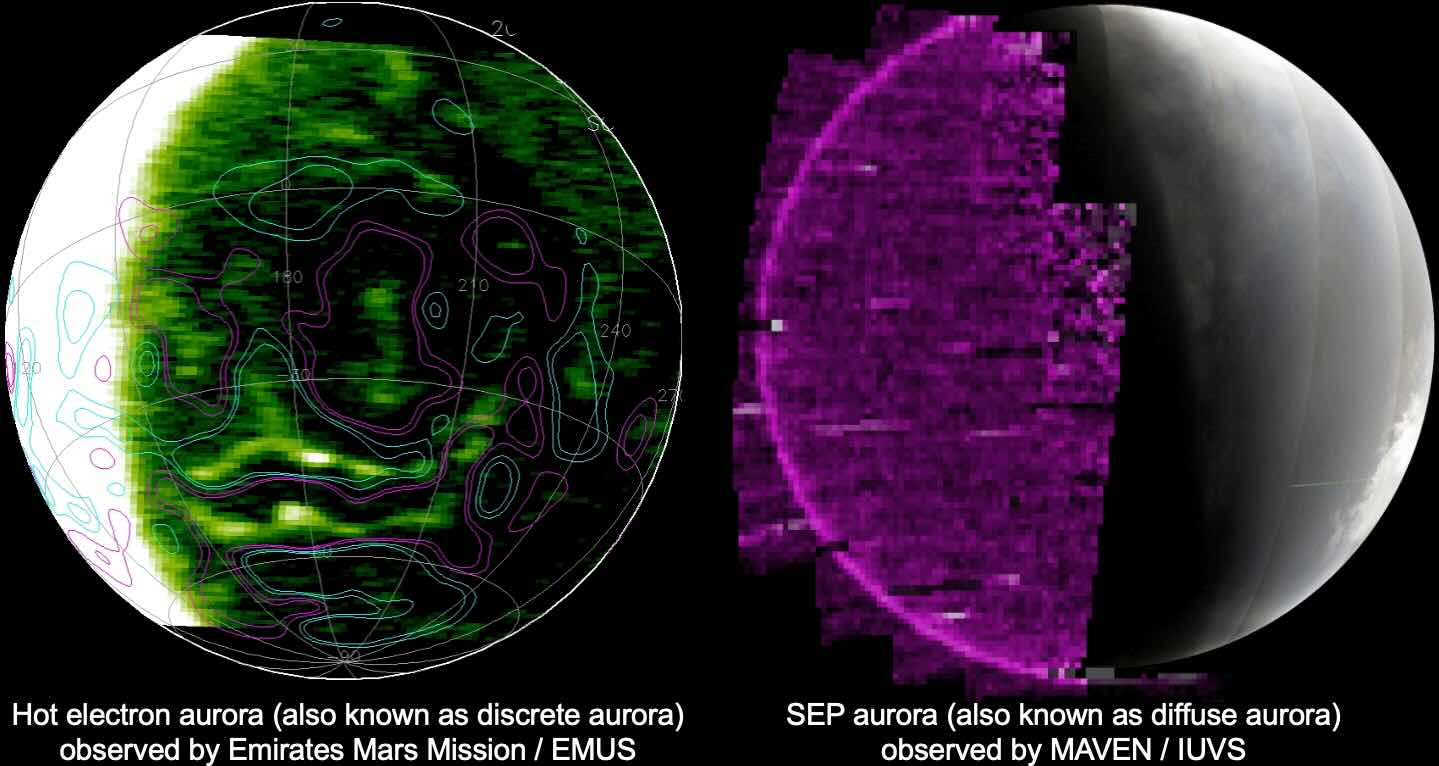
Time domain studies of Mars aurora have enabled new insights into the conditions and mechanisms that give rise to auroral emissions. For example, MAVEN/IUVS observations of global aurora emissions were traced to SEP’s by their coincident timelines. The preferential local time behavior of aurora in the strong crustal field region led to the identification of reconnection as the trigger for emission. We present the decade-long timeline of MAVEN's detections of SEP aurora by the IUVS instrument shown with contemporaneous measurement of the solar energetic electrons and protons. Comparisons of the timelines for emission brightness and the particles fluxes and energies will allow a clearer identification of the precipitating particles and their energies. This in turn allows a deeper understanding of the influence of particle precipitation on heating and chemistry at the ~60 km altitude of particle penetration.
In the same vein, the EMM/EMUS instrument has identified a plethora of new temporal behaviors. We use the unique dataset of EMUS movies obtained through "objective spectroscopy" of the roughly monochromatic image of O 130nm emission. The movies span 20 minutes with 10s integrating time staring at a fixed location on the disk. Among hundreds of such images, some cases stand out for their remarkable temporal behavior. Some auroral features vary by factors of 5 or more over timescales of several tens of seconds, some quasiperiodically. Other features show slow variations over the full 20 minute timespan, or no discernable variation at all. We will present several case studies and offer speculations on possible causes for the different types of variation.
How to cite: Schneider, N., Jain, S., Cessna, J., Gandhi, A., Deighan, J., Lillis, R., Jolitz, R., Chirakkil, K., Gérard, J.-C., and Soret, L.: Time Variability of Mars Aurora: Lessons from MAVEN/IUVS and EMM/EMUS, EPSC-DPS Joint Meeting 2025, Helsinki, Finland, 7–12 Sep 2025, EPSC-DPS2025-1163, https://doi.org/10.5194/epsc-dps2025-1163, 2025.


