TP7 | Ionospheres of unmagnetized or weakly magnetized bodies

TP7

Ionospheres of unmagnetized or weakly magnetized bodies
Convener: Beatriz Sanchez-Cano | Co-conveners: Christopher Fowler, Valeria Mangano, Lina Hadid, Niklas Edberg, Francisco González-Galindo, Candace Gray
Orals TUE-OB5
| Tue, 09 Sep, 15:00–16:00 (EEST)
 
Room Saturn (Hall B)
Orals TUE-OB6
| Tue, 09 Sep, 16:30–17:54 (EEST)
 
Room Saturn (Hall B)
Orals THU-OB3
| Thu, 11 Sep, 11:00–12:24 (EEST)
 
Room Saturn (Hall B)
Posters MON-POS
| Attendance Mon, 08 Sep, 18:00–19:30 (EEST) | Display Mon, 08 Sep, 08:30–19:30
 
Finlandia Hall foyer, F53–70
Tue, 15:00
Tue, 16:30
Thu, 11:00
Mon, 18:00
Ionospheres are a fundamental part of planetary and cometary atmospheres that are formed by solar radiation and are affected by a myriad of different processes, such as space weather activity or neutral atmosphere variations. Moreover, ionospheres play an important role in controlling the dynamics of the system, as they are the link between the neutral atmosphere, exosphere and surrounding plasma environments (e.g. the solar wind for Mars, Venus, Pluto and comets, and the Kronian magnetosphere for Titan). Understanding how each unmagnetized body reacts to all these factors is a key in comparative aeronomy because although a priori all of them have a general similar behaviour, they also have scientifically important differences caused by their different natures.

This session focuses on the ionospheres of Mars, Venus, Pluto, Titan, Jovian moons, comets and any related planetology comparative between them and ionospheres of magnetised bodies. We solicit abstracts concerning remote and in situ data analysis, modelling studies, instrumentation and mission concepts. Abstracts on planetary flybys, such as the BepiColombo, Solar Orbiter and Parker Solar Probe flybys to Venus, are also welcome. Topics may include, but are not limited to, day and night side ionospheric variability, sources and influences of ionization, ion-neutral coupling, current systems, comparative ionospheric studies, and solar wind-ionosphere interactions and responses of the ionized and neutral regimes to transient space weather events. Abstracts on general plasma and escape processes are also welcome.

Session assets

Orals TUE-OB5: Tue, 9 Sep, 15:00–16:00 | Room Saturn (Hall B)

15:00–15:12
|
EPSC-DPS2025-1371
|
ECP
|
On-site presentation
Shubhonkar Paramanick, Eric G. Blackman, and John A. Tarduno
The occurrence of H, N, and light noble gases like He, Ne, and Ar in the lunar regolith—but not in lunar rocks—indicates that these volatiles likely have an extra-lunar origin. While the solar wind (SW) is known to implant ions on the lunar surface and contribute some volatiles, it does not fully explain the abundance of N or the variations in its isotopic composition (15N/14N). To account for this, Ozima et al. [1] proposed that Earth's atmosphere may have served as a source during a time when it lacked a geomagnetic field, allowing atmospheric particles to escape freely. Li et al. [2] connected lunar surface water to interactions with the SW when the Moon passed through this magnetotail, whereas Wang et al. [3] suggested the magnetospheric Earth wind (EW) as a potential exogenous source of lunar surface hydration. Similarly, Poppe et al. [4] observed terrestrial ions in Earth's magnetotail. However, these studies did not model how Earth's escaping atmosphere and the SW might have interacted or mixed with the planetary outflow.
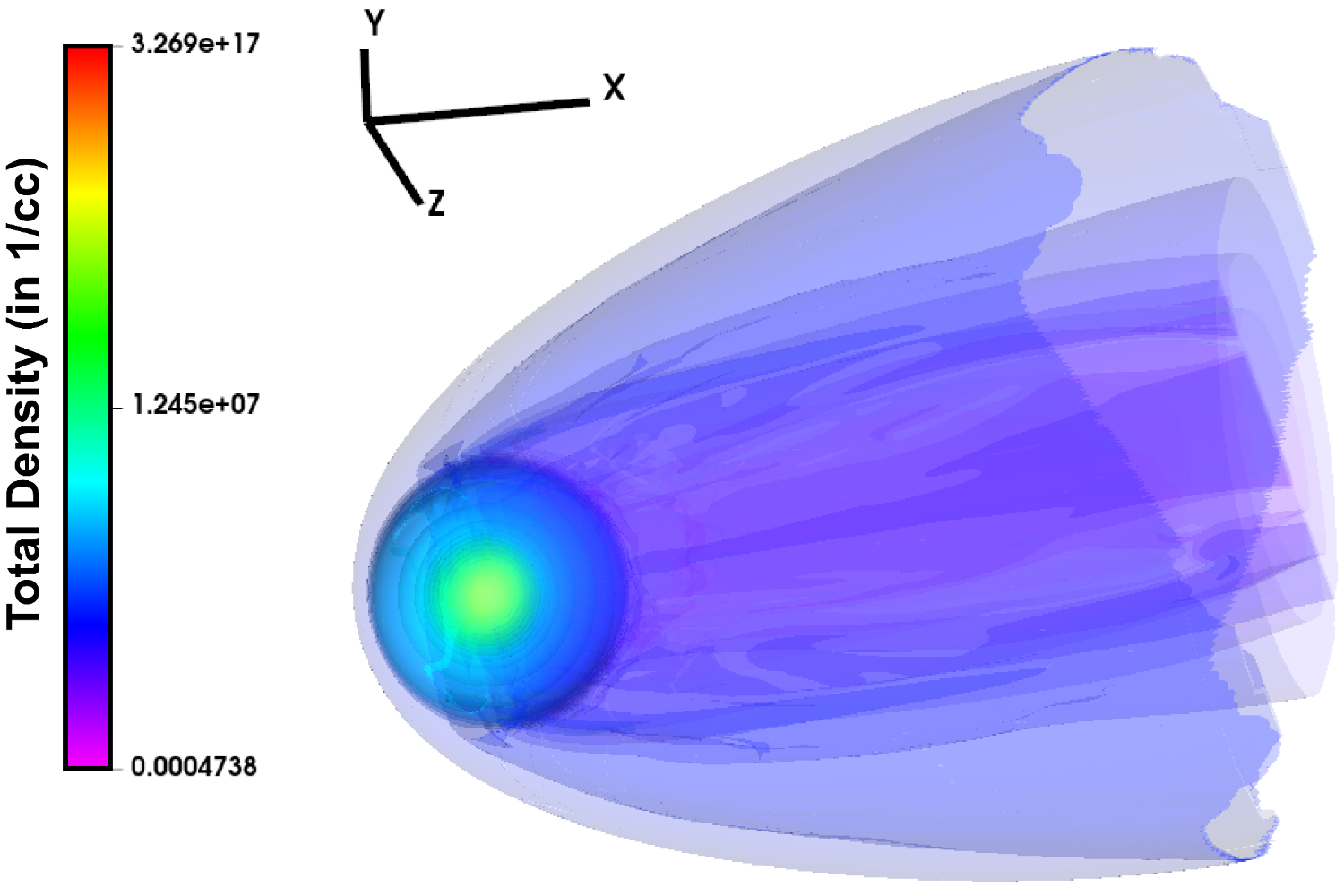
To explore this, our research [5] combines 3D magnetohydrodynamic (MHD) models developed using the AstroBEAR code with a terrestrial ionosphere model. This model simulates how particles from Earth's atmosphere might have reached the lunar surface during both magnetized and unmagnetized phases of Earth's history (Figure 1). Specifically, we assess the contribution of atmospheric and SW fluxes to the Moon by comparing scenarios where Earth either had or lacked a magnetic field. We incorporate solar XUV-driven atmospheric photoionization in our ionosphere models to represent both early (Eoarchean) and late Earth (contemporary) atmospheres to estimate the transport and deposition of volatile species on the lunar nearside. The simulations assume the Moon had no global magnetic field during the relevant period, consistent with paleomagnetic measurements [6].
By analyzing the observed non-solar flux in the Apollo lunar samples and comparing these observations to our simulated EW flux data, we infer when Earth's geodynamo might have begun. We apply the Markov Chain Monte Carlo (MCMC) technique to constrain the pairwise hydrodynamic exobase (PHE) during the period of volatile implantation for various combinations of isotope ratios in mixing diagrams.
Figure 1: 3D rendering of the MHD simulation of the outflows for the present-day Earth case.
 
Method: Our model treats Earth's magnetic field as a dipole and simulates the SW using a Parker wind model at 1 AU. For the Archean Earth, we calculate the surface density of Earth's atmosphere while keeping total atmospheric mass constant. We determine species-specific escape rates using the combined MHD-EUVAC atmospheric models, modified to reflect the higher solar XUV radiation during early Earth. Atmospheric ions picked up by the SW can escape Earth. We therefore estimate the escape flux for different hydrodynamic exobase altitudes by calculating ion production rates above the homopause, then integrating over the dayside. Relative species fluxes from photoionization are then scaled to match orbit-averaged escape rates from 3D-MHD simulations.
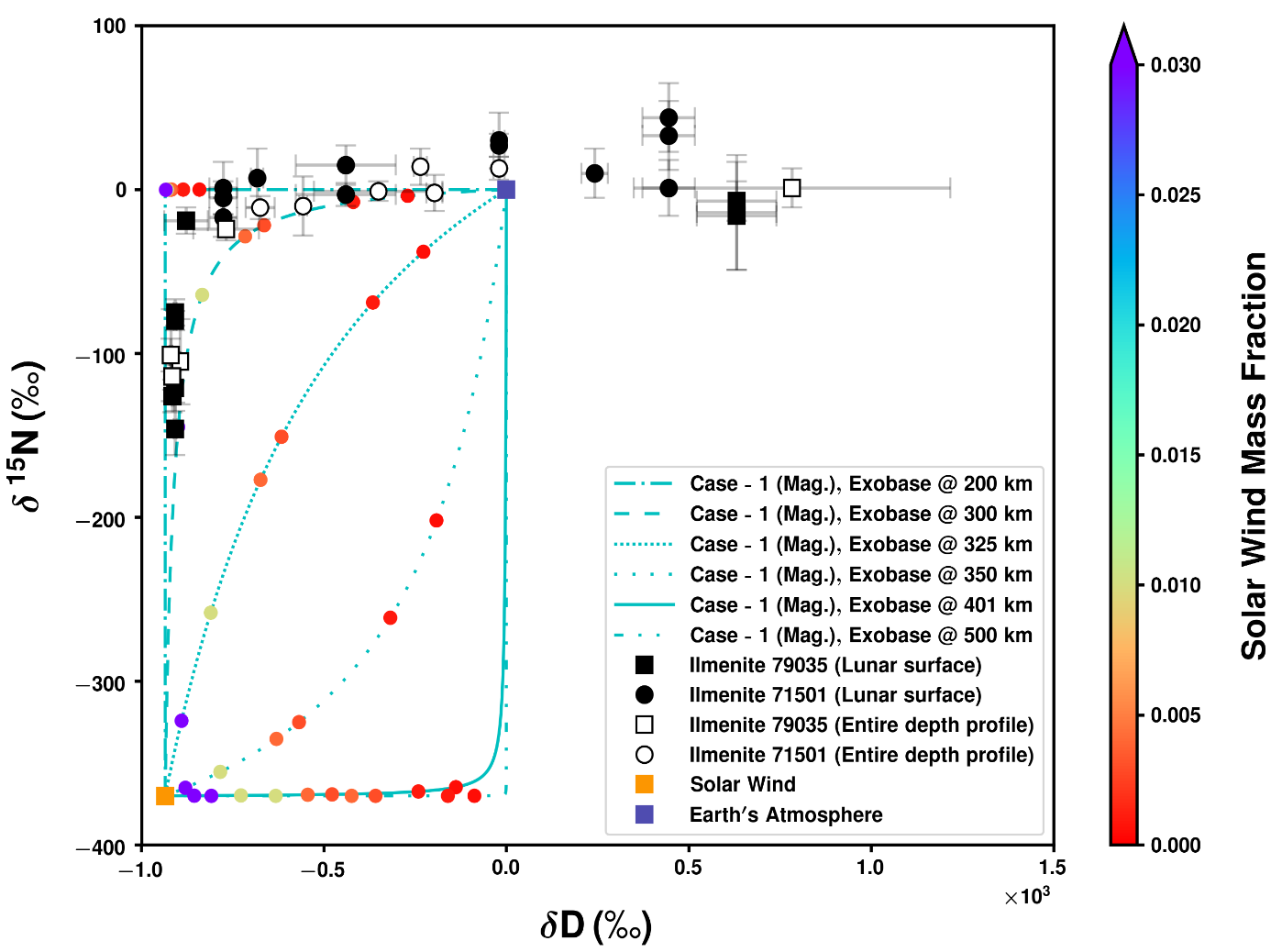
We employ a binary mixing model that leverages distinct isotope ratios and elemental abundances to estimate the relative contributions of solar and non-solar components (NSC). When data align along a single curve, it indicates compatibility with that particular PHE altitude, regardless of the proportion of NSC (Figure 2). Our model explains the data when the EW flux exceeds the measured non-solar flux. For each species considered, we incorporate an early epoch without a geodynamo and strong SW, followed by a period where Earth possessed a dipolar field with a relatively weak SW.
Figure 2: δ15N-δD binary mixing diagram.
 
Key Results: We find that the average atmospheric flux from Earth to lunar soil remains comparable under both early unmagnetized and contemporary magnetized conditions. This is primarily due to the magnetic field modifying atmospheric density gradients, causing them to fall off as a power law with radial distance rather than exponentially. As a result, significant atmospheric mass persists at higher altitudes and can be transported by the SW. Nonetheless, during the early SW phase, characterized by elevated ram pressure and the absence of a geomagnetic field, the SW-to-EW flux ratio becomes large, rendering it insufficient to explain the volatile inventories observed in lunar soils. Instead, the dominant non-solar component in lunar samples is best attributed to long-term implantation facilitated by a sustained geodynamo, thus highlighting the competing effects of SW conditions and dynamo strengths.
To constrain the onset of Earth's magnetic field, we interpret the isotopic composition of lunar volatiles as a linear combination of contributions from both the unmagnetized early Earth and the later magnetized Earth, regardless of how minimal the early atmospheric contribution might have been for each element. This implies that only a brief period of geomagnetic inactivity can be accommodated.
We also conducted analyses with the Chamberlain atmosphere model. When the SW interacts with the exosphere, it sweeps all three populations, picking up from the upper atmosphere. We note that the dominant contribution to the Chamberlain profiles closely resembles the barometric profile we use for the Archean case; therefore, the atmospheric surface density and the plasmapause boundary do not alter substantively.
 
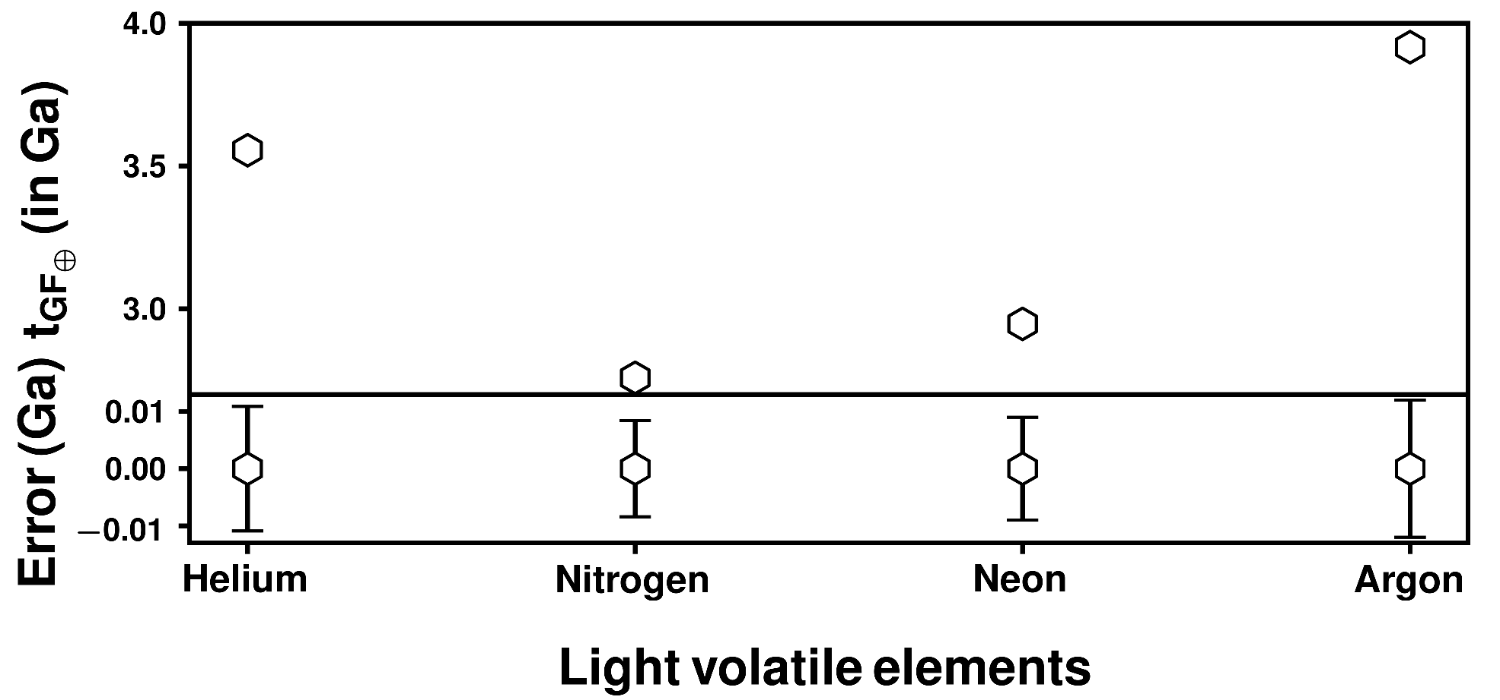
Conclusions: Our findings suggest that, except for hydrogen, the volatiles in lunar soil can be explained by EW from a magnetized Earth under current SW conditions. Among them, Ar imposes the most stringent constraint on how long Earth could have been unmagnetized, such that its presence in lunar soil is still explainable by an atmospheric source from Earth. We also decouple the strong-to-weak transition of the SW from the onset of the geodynamo by conducting simulation runs for a hypothetical early magnetized case. Based on our model, if these volatiles have a terrestrial origin, this points to Earth's geomagnetic field existing as early as 3.9 billion years ago (Figure 3).
Figure 3: Minimum geodynamo ages estimated from the terrestrial flux of different species.
 
References:
[1] Ozima et al., Nature, 2005;
[2] Li et al., Nat. Astron., 2023;
[3] Wang et al., APJ, 2024;
[4] Poppe et al., Planet. Sci., 2021;
[5] Paramanick et al., arXiv, 2024;
[6] Tarduno et al., Sci. Adv., 2021.

How to cite: Paramanick, S., Blackman, E. G., and Tarduno, J. A.: Evolutionary constraints on the solar wind transition epoch and the duration of the terrestrial unmagnetized phase using lunar volatiles deposited from Earth's exosphere, EPSC-DPS Joint Meeting 2025, Helsinki, Finland, 7–13 Sep 2025, EPSC-DPS2025-1371, https://doi.org/10.5194/epsc-dps2025-1371, 2025.

15:12–15:24
|
EPSC-DPS2025-141
|
On-site presentation
Shaosui Xu, Rudy Frahm, Yingjuan Ma, David Mitchell, Janet Luhmann, Jean-Claude Gérard, Lauriane Soret, and Robert Lillis

Auroral emissions have been observed (partially) on magnetized planets, such as Earth, Jupiter, and Mars, illuminating the plasma processes mostly related to planetary intrinsic fields. Aurorae have also been reported to occur at Venus, an unmagnetized planet, by the Pioneer Venus Orbiter (PVO). Previous modeling efforts suggest that the observed CO Cameron-band auroral emissions are mainly produced by electrons at 10s-100s of electron volts (eV) impacting the Venus nightside upper atmosphere. Yet, little was discussed in previous studies regarding how these source electrons access the atmosphere. By applying a linear relation, this study predicts the possible CO Cameron-band emission brightness at Venus using electron observations from Venus Express (VEx). Our results suggest that to produce the PVO observations, electron acceleration is not required as in the case of discrete aurorae at magnetized planets; rather, the magnetic access of precipitating electrons to the lower atmosphere is the more limiting factor for auroral occurrence. This study helps better understand how aurorae can occur at an unmagnetized planet, in contrast to magnetized planets. It also has implications for future Venus mission design: auroral imaging can serve as a remote sensing tool to characterize the magnetization state of the Venus nightside atmosphere.

How to cite: Xu, S., Frahm, R., Ma, Y., Mitchell, D., Luhmann, J., Gérard, J.-C., Soret, L., and Lillis, R.: Predicting CO Cameron-band auroral emission at Venus using VEx Observations, EPSC-DPS Joint Meeting 2025, Helsinki, Finland, 7–13 Sep 2025, EPSC-DPS2025-141, https://doi.org/10.5194/epsc-dps2025-141, 2025.

15:24–15:36
|
EPSC-DPS2025-499
|
On-site presentation
Jean-Claude Gérard, Lauriane Soret, Benoît hubert, Robert Lillis, Justin Deighan, and Sonal Jain

The EMUS far ultraviolet spectrometer on board the Emirates Mars Mission orbiter provides unique observations about the morphology and local time dependence of the atomic oxygen emission at 130.4 nm. However, this triplet transition is optically thick, so that its brightness does not directly depend on its production rate. Consequently, radiative transfer analysis is required to link its production rate to the observed nadir or limb observations.

In contrast, the intensity of the 156.1 and 165.7 nm carbon lines directly reflects the production of the corresponding excited states. We show that their dominant sources are collisions with CO2 and CO. Based on Monte Carlo simulations, we investigate the dependence of the observed brightness with the energy of the auroral electrons. We show how the ratio of the carbon line intensity to that of the OI optically thick 130.4 nm and optically thin 135.6 nm emissions may be combined as a remote sensing diagnostic of the characteristics of the auroral electron precipitation. The sensitivity of this method to the seasonal variations of the composition is also analyzed.

How to cite: Gérard, J.-C., Soret, L., hubert, B., Lillis, R., Deighan, J., and Jain, S.: Far ultraviolet carbon and oxygen emissions in the Martian aurora as a diagnostic of electron precipitation , EPSC-DPS Joint Meeting 2025, Helsinki, Finland, 7–13 Sep 2025, EPSC-DPS2025-499, https://doi.org/10.5194/epsc-dps2025-499, 2025.

15:36–15:48
|
EPSC-DPS2025-1163
|
On-site presentation
Nicholas Schneider, Sonal Jain, Jay Cessna, Amelia Gandhi, Justin Deighan, Robert Lillis, Rebecca Jolitz, Krishnaprasad Chirakkil, Jean-Claude Gérard, and Lauriane Soret

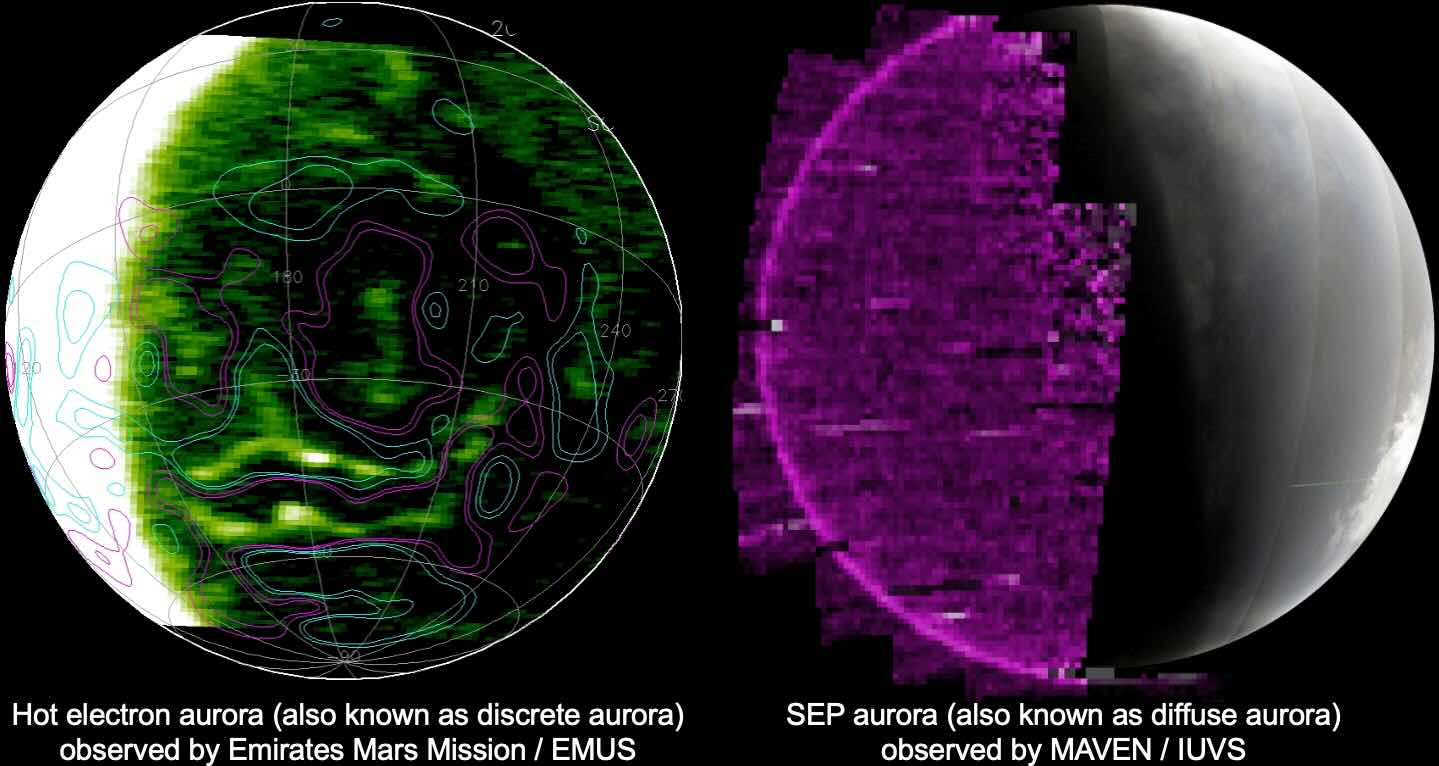
Time domain studies of Mars aurora have enabled new insights into the conditions and mechanisms that give rise to auroral emissions. For example, MAVEN/IUVS observations of global aurora emissions were traced to SEP’s by their coincident timelines. The preferential local time behavior of aurora in the strong crustal field region led to the identification of reconnection as the trigger for emission. We present the decade-long timeline of MAVEN's detections of SEP aurora by the IUVS instrument shown with contemporaneous measurement of the solar energetic electrons and protons. Comparisons of the timelines for emission brightness and the particles fluxes and energies will allow a clearer identification of the precipitating particles and their energies. This in turn allows a deeper understanding of the influence of particle precipitation on heating and chemistry at the ~60 km altitude of particle penetration.

In the same vein, the EMM/EMUS instrument has identified a plethora of new temporal behaviors. We use the unique dataset of EMUS movies obtained through "objective spectroscopy" of the roughly monochromatic image of O 130nm emission. The movies span 20 minutes with 10s integrating time staring at a fixed location on the disk. Among hundreds of such images, some cases stand out for their remarkable temporal behavior. Some auroral features vary by factors of 5 or more over timescales of several tens of seconds, some quasiperiodically. Other features show slow variations over the full 20 minute timespan, or no discernable variation at all. We will present several case studies and offer speculations on possible causes for the different types of variation.

How to cite: Schneider, N., Jain, S., Cessna, J., Gandhi, A., Deighan, J., Lillis, R., Jolitz, R., Chirakkil, K., Gérard, J.-C., and Soret, L.: Time Variability of Mars Aurora:  Lessons from MAVEN/IUVS and EMM/EMUS, EPSC-DPS Joint Meeting 2025, Helsinki, Finland, 7–13 Sep 2025, EPSC-DPS2025-1163, https://doi.org/10.5194/epsc-dps2025-1163, 2025.

15:48–16:00
|
EPSC-DPS2025-1135
|
ECP
|
On-site presentation
Andrea Hughes, Gina DiBraccio, Norberto Romanelli, Michael Chaffin, Edwin Mierkiewicz, Charles F. Bowers, Jasper Halekas, Nicholas Schneider, Justin Deighan, Sonal Jain, Jared Espley, Majd Mayyasi, and Shannon Curry
We evaluate for the first time the large-scale influence of the upstream interplanetary magnetic field (IMF) magnitude and orientation on Martian proton aurora. We specifically look at IMF magnitude and orientations to consider how these factors influence the brightness and likelihood of occurrence for proton aurora activity. Ten years of proton auroral observations from the Mars Atmosphere and Volatile EvolutioN (MAVEN) spacecraft (Jakosky et al., 2015) are utilized in this study. We identify a moderate correlation between proton aurora activity and IMF magnitude that varies seasonally, with highest correlations around Mars southern summer solstice when proton aurora activity reaches an annual high. We also identify preferentially increased proton aurora emission enhancements at IMF cone and clock angles consistent with the shape of the Parker spiral at Mars’s heliocentric distance. An increased proton aurora occurrence rate is observed for near- and quasi-radial IMF orientations, however, this correlation is only observed during seasons other than around southern summer solstice, when the hydrogen corona and bow shock are annually decreased. Lastly, proton aurora are observed to exhibit preferentially higher occurrence rates under strong ±Bz orientations, consistent with the findings of recent studies (e.g., Bowers et al., 2023) which identified conditions of increased likelihood for dayside magnetic reconnection at Mars (i.e., between the IMF and Martian crustal fields) for similar altitudes and geographic locations. Thus, our results suggest that dayside magnetic reconnection may influence Martian proton aurora occurrence. These findings enhance our understanding of the interconnected relationship between proton aurora and the Mars magnetic field environment, as well as the upstream IMF’s role as an important driver of Martian proton aurora activity.

How to cite: Hughes, A., DiBraccio, G., Romanelli, N., Chaffin, M., Mierkiewicz, E., Bowers, C. F., Halekas, J., Schneider, N., Deighan, J., Jain, S., Espley, J., Mayyasi, M., and Curry, S.: Title: The Unique Seasonal Influence of the Interplanetary Magnetic Field on Martian Proton Aurora, EPSC-DPS Joint Meeting 2025, Helsinki, Finland, 7–13 Sep 2025, EPSC-DPS2025-1135, https://doi.org/10.5194/epsc-dps2025-1135, 2025.

Orals TUE-OB6: Tue, 9 Sep, 16:30–18:00 | Room Saturn (Hall B)

16:30–16:42
|
EPSC-DPS2025-1911
|
On-site presentation
Hengle Du, Xiao-Dong Wang, Xing Cao, and Binbin Ni

The small Martian induced magnetosphere sometimes fails to completely screen the solar wind from precipitating on the exobase. The precipitating protons may serve as an additional mass, momentum and energy coupling channel between the Martian upper atmosphere and the plasma environment. Moreover, the plasma flow pattern in the interaction region is governed by the orientation of the interplanetary magnetic field (IMF) and the associated convective electric field (E = −V × B). Therefore, the IMF orientation would influence the proton precipitation situation, modulating the coupling channel. Using a hybrid plasma model (electrons as a massless fluid and ions as kinetic particles), we investigate how the proton and associated energy precipitation rates vary with upstream IMF cone angle, which is the angle between the solar wind velocity direction and the IMF direction. We quantify the precipitation rates by analyzing global maps of downward proton and energy fluxes under different IMF cone angles. Our key findings are: (1) While the total proton precipitation rate increases with altitude, the net precipitation rate remains constant. (2) Proton precipitation exhibits strong sensitivity to IMF orientation. Precipitation fluxes and rates increase progressively from perpendicular IMF through Parker spiral and cone angle 30° configurations, peaking under radial IMF conditions. (3) Under perpendicular and Parker spiral IMF orientations, the net precipitation rates stabilize at ~10²² s⁻¹ in our simulation. In contrast, the radial IMF condition drives a dramatic enhancement, with rates reaching ~10²⁴ s⁻¹—a two-order-of-magnitude increase compared to the other orientations. (4) Precipitation fluxes show distinct +E/-E hemispheric asymmetry for cone angle 30°, Parker spiral, and perpendicular IMF conditions. 

How to cite: Du, H., Wang, X.-D., Cao, X., and Ni, B.: Dependence of Martian Proton Precipitation On IMF Orientation: Hybrid Simulations , EPSC-DPS Joint Meeting 2025, Helsinki, Finland, 7–13 Sep 2025, EPSC-DPS2025-1911, https://doi.org/10.5194/epsc-dps2025-1911, 2025.

16:42–16:54
|
EPSC-DPS2025-188
|
ECP
|
On-site presentation
Umberto Rollero, Yoshifumi Futaana, and Xiao-Dong Wang

Venus lacks an intrinsic magnetic field, and its interaction with the solar wind and interplanetary magnetic field (IMF) creates an induced magnetosphere [1]. The IMF drapes around the planet, forming the magnetotail on Venus’ nightside. The magnetotail is the main channel through which planetary ions escape [2]. However, ion escape in the magnetotail is significantly reduced by unexpected return flows (i.e., planetary ions flowing back towards Venus instead of downtail) [3]. The process responsible for reversing the velocity of magnetotail ions remains unexplained.

A possible mechanism causing the return flows is magnetic reconnection, a plasma process where oppositely directed magnetic field lines break apart and cross connect, releasing magnetic tension to the surrounding plasma, which is heated and accelerated. Magnetic reconnection could occur in Venus’ magnetotail at the current sheet, which separates magnetic field lines with opposite polarities. The process can potentially generate a plasmoid flowing toward Venus. Such magnetic reconnection events have been identified by magnetic and plasma data collected by the Venus Express (VEX) spacecraft [4], but have not been systematically correlated with return flows.

Here, we reassessed the VEX’s magnetometer (MAG) [5] data throughout the mission to identify typical Hall magnetic field signatures when the spacecraft crosses the plasma sheet, as evidence of the magnetic reconnection events [6]. We also used simultaneously measured ASPERA-4/IMA and ASPERA-4/ELS data [7] to detect ions and electrons heating as additional signatures of reconnection. We also systematically reassessed ion data (ASPERA-4/IMA) to identify return flow events when the ions are travelling in the Venusward direction.

In this presentation, we show case studies with simultaneous detections of the Hall magnetic field signature and ion return flows, with consistent velocities and directions of plasmoid ions. Additionally, we present a statistical analysis comparing the occurrence of return flows under quiet current sheet crossings and crossings exhibiting a Hall magnetic field structure. We will discuss the results of the statistical analysis and their implications regarding the correlation between magnetic reconnection and return flows in Venus’ magnetotail.

[1] Futaana, Y., Stenberg Wieser, G., Barabash, S., & Luhmann, G. J. 2017, SSR, 212, 1453, doi: 10.1007/s11214-017-0362-8

[2] Dubinin, E., Fränz, M., Zhang, T. L., et al. 2013, JGR, 118, 7624, doi: 10.1002/2013JA019164

[3] Persson, M., Futaana, Y., Fedorov, A., et al. 2018, GRL, 45, 10805, doi: 10.1029/2018GL079454

[4] Zhang, T.-L., Baumjohann, W., Lu, Q. M., et al. 2012, Science, 336, 567, doi: 10.1126/science.1217013

[5] Zhang, T.-L., Berghofer, G., Magnes, W., et al. 2007, ESA Special Publication SP 1295 (Paris: ESA)

[6] Yamada, M., Kulsrud, R., & Ji, H. 2010, RvMP, 82, 603, doi: 10.1103/RevModPhys.82.603

[7] Barabash, S., Sauvaud, J., Gunell, H., et al. 2007, PSS, 55, 1772, doi: 10.1016/j.pss.2007.01.014

How to cite: Rollero, U., Futaana, Y., and Wang, X.-D.: Return flows in Venus’ magnetotail and potential association with magnetic reconnection, EPSC-DPS Joint Meeting 2025, Helsinki, Finland, 7–13 Sep 2025, EPSC-DPS2025-188, https://doi.org/10.5194/epsc-dps2025-188, 2025.

16:54–17:06
|
EPSC-DPS2025-234
|
On-site presentation
Robert Lillis, Melissa Marquette, Majd Mayassi, Yingjuan Ma, David Mitchell, Shaosui Xu, Laila Andersson, Shane Stone, Mehdi Benna, Jasper Halekas, Robin Ramstad, Jared Espley, and Jacob Gruesbeck

Mars’ nightside ionosphere is highly variable and poorly understood, with several internal, external, and local factors affecting multiple sources of ionospheric plasma, all combining to drive highly complex behavior.  The three primary plasma sources are a) planetary rotation and cross-terminator ion winds transporting dayside plasma to the nightside, particularly at dusk, and impact ionization when magnetic topology connects nightside upper atmosphere to b) dayside suprathermal photoelectrons c) solar wind electrons (accelerated or not) precipitating from the magnetotail.  These sources are impacted by different subsets of: season, local time, subsolar longitude, IMF direction (which determines tail draping configuration), solar wind pressure, solar EUV flux, and the local strength and geometry of crustal magnetic fields that combine with global draping patterns to guide electrons toward or away from certain areas. 

We utilize 130.4 nm auroral observations from the Emirates Mars Ultraviolet Spectrograph, simulations of terminator ion winds, and in situ measurements from MAVEN of ion and electron density and temperature and suprathermal electron precipitation, as well as upstream measurements and proxies of IMF clock angle and solar wind pressure.  Analysis reveals some interesting features.  First, in regions of weak or no crustal magnetic fields, surprisingly, pre-dawn (~4 am) plasma densities vary by up to a factor of 30 in response to solar EUV varying by only a factor of ~3.  Second, 5R aurora occurrence rate in a given region can vary by up to a factor of 7 with IMF orientation, generally highest for southward IMF and lowest for westward IMF, with higher auroral occurrence post-dusk, decreasing toward and past midnight before increasing again towards dawn.  A broad diversity of IMF and local time dependence of plasma density and aurora occurrence is observed across Mars’ crustal magnetic fields.  The polarity of a given crustal field determines whether its field lines preferentially magnetically connect to dayside ionospheric or nightside magnetotail electron sources in the post-dusk or pre-dawn sectors.  These results highlight the complex and dynamic nature of Mars’ magnetic topology in controlling auroral electron access. Future studies integrating two-dimensional ionospheric models with in situ electron measurements with synoptic and limb auroral imaging will further constrain the relative contributions of the many factors controlling Mars’ enigmatic nightside ionosphere.

How to cite: Lillis, R., Marquette, M., Mayassi, M., Ma, Y., Mitchell, D., Xu, S., Andersson, L., Stone, S., Benna, M., Halekas, J., Ramstad, R., Espley, J., and Gruesbeck, J.: What drives Mars’ nightside Ionosphere?  Insights from in situ and remote sensing, EPSC-DPS Joint Meeting 2025, Helsinki, Finland, 7–13 Sep 2025, EPSC-DPS2025-234, https://doi.org/10.5194/epsc-dps2025-234, 2025.

17:06–17:18
|
EPSC-DPS2025-864
|
ECP
|
On-site presentation
Magnetic Topology Dependence of Ionizing Electrons on the Martian Nightside Ionosphere
(withdrawn)
Arnob Sarkar, Narukull Venkateswara Rao, Pavan D. Gramapurohit, and Umesh R. Kadhane
17:18–17:30
|
EPSC-DPS2025-842
|
On-site presentation
Parker Hinton, William Peterson, Yaxue Dong, Yingjuan Ma, Robin Ramstad, Riku Jarvinen, and David Brain

We construct an analytical paradigm called ‘Particles in a Box’ to study the interaction between the solar wind and terrestrial ionospheres. Using energy flux conservation, we derive how wind deceleration drives magnetic pile-up and quantify the critical transition between kinetic-energy-dominated (super-Alfvénic) and magnetic-energy-dominated (sub-Alfvénic) regimes. This framework shows that pick-up ion escape rates in super-Alfvénic stellar winds, such as those experienced by the terrestrial planets in the solar system, can be computed solely from upstream parameters: stellar wind velocity, magnetic field strength, and the cross-sectional area of the interaction region. Hybrid modeling-informed cross-sectional areas are combined with the analytical equations to estimate heavy ion escape rates at Mercury, Venus, Earth, Mars, Titan, and Pluto. Comparisons with spacecraft observations show order-of-magnitude agreement, validating the paradigm’s utility for unmagnetized or weakly magnetized bodies. These results indicate that Particles in a Box is a promising approach for understanding ionospheric escape from weakly magnetized planets. While only solar system objects are directly considered in this study, the paradigm may be able to be extended to non-terrestrial exoplanets.

How to cite: Hinton, P., Peterson, W., Dong, Y., Ma, Y., Ramstad, R., Jarvinen, R., and Brain, D.: Energy Conservation for Stellar Wind Mass-Loading: Atmospheric Ion Escape, EPSC-DPS Joint Meeting 2025, Helsinki, Finland, 7–13 Sep 2025, EPSC-DPS2025-842, https://doi.org/10.5194/epsc-dps2025-842, 2025.

17:30–17:42
|
EPSC-DPS2025-265
|
On-site presentation
David Andrews and Apostolis Kolokotronis

The solar wind interaction with Mars, lacking a global magnetic field, directly impacts its ionosphere, inducing currents to deflect the interplanetary magnetic field (IMF). These currents ultimately drive part of the atmospheric ion loss to space. This study estimates and characterizes these currents using MAVEN data over a long period, examining the influence of crustal magnetism and solar wind activity. Spherical polar magnetic field maps and Ampère's law are used to calculate current densities. Our analysis also considers both the absence of the south pole's crustal fields in order to obtain the “pure” ionospheric current system.  Separately, we also study the effects of varying solar wind dynamic pressure. Results show current structures at the induced magnetosphere boundaries, closing in the ionosphere with hemispheric and dawn-dusk asymmetries, as in previous related studies. In areas where crustal magnetic fields are weaker, the IMF generally penetrates deeper. For the first time, we estimate variations in the induced current system due to solar wind pressure changes, showing that when the dynamic pressure rises the magnetosphere contracts and intensifies the currents closer to Mars. Finally, we comment on these results in the context of the potential future exploration of Mars.

How to cite: Andrews, D. and Kolokotronis, A.: Electrodynamic currents in near-Mars space, EPSC-DPS Joint Meeting 2025, Helsinki, Finland, 7–13 Sep 2025, EPSC-DPS2025-265, https://doi.org/10.5194/epsc-dps2025-265, 2025.

17:42–17:54
|
EPSC-DPS2025-1207
|
On-site presentation
Matthew Fillingim, Stephen Ledvina, Niklas Edberg, and Konstantin Kim

Changing magnetic field configurations experienced by Titan as it orbits Saturn can induce currents in the conductive ionosphere of Titan. These induced currents in turn generate ionospheric magnetic fields that deflect the incident plasma and shield out the external magnetic field. By measuring magnetic field perturbations, we can calculate the current densities necessary to create the observed perturbations (with some restrictive assumptions). We determine horizontal currents in the ionosphere of Titan from magnetic field perturbations during Cassini flybys closer than 1500 km, i.e., within the collisional ionosphere. By grouping the flybys by external magnetic field and plasma conditions and Titan orbital position, we attempt to determine how ionospheric currents change with respect to external conditions. These currents induced in Titan's ionosphere are but one way Saturn's magnetospheric environment impacts ionospheric processes and dynamics at Titan.

How to cite: Fillingim, M., Ledvina, S., Edberg, N., and Kim, K.: Currents in Titan's Ionosphere, EPSC-DPS Joint Meeting 2025, Helsinki, Finland, 7–13 Sep 2025, EPSC-DPS2025-1207, https://doi.org/10.5194/epsc-dps2025-1207, 2025.

Orals THU-OB3: Thu, 11 Sep, 11:00–12:30 | Room Saturn (Hall B)

11:00–11:12
|
EPSC-DPS2025-183
|
ECP
|
Virtual presentation
Samy Salem and Christopher Fowler

Except for the small patches of the magnetic crustal field, Mars does not have a well-developed dipole magnetic field, allowing the solar wind to interact directly with the gravitationally bound and electrically conducting ionosphere. This interaction produces a highly dynamic hybrid induced magnetosphere that is highly responsive to the impinging solar wind. Such interaction can result in many plasma structures that propagate in the magnetosphere of Mars. Magnetosonic waves are one of the examples of low frequency (in the range of 0.02 - 1 Hz) waves that propagate in the range of proton cyclotron frequency and are generated by the interaction between the magnetosphere of Mars with the solar wind. Magnetosonic waves at Mars have been observed to propagate into the ionosphere where they damp and deposit energy. Using the set of 10 years of in-situ measurement data of the two magnetometers (MAG) and thermal ions instrument (STATIC) that are installed on the Mars Atmosphere and Volatile EvolutioN (MAVEN), NASA mission to Mars, we have developed an automated algorithm routine to identify the magnetosonic waves utilizing 3D wave polarization analysis techniques and the fluctuations in magnetic and plasma pressure. Based on a case study of 7 days, the occurrence rate of the waves is ~ 20 %. We have also identified two modes, fast and slow, by which the magnetic and plasma thermal pressure oscillations of the magnetosonic waves are either in-phase or anti-phase, respectively. As functions of space and time, within the magnetosphere of Mars, we obtain the occurrence rates for the fast and slow magnetosonic waves across the 10 year of MAVEN dataset. Distributions of wave’s frequencies and powers as well as the altitudes will be obtained. Preliminary analysis on how much the existence of the magnetosonic waves overlapping with Mars upper ionosphere plasma content happen will be studied. Also, the influence of upstream solar wind conditions might have on the generation of magnetosonic waves will be studied, including both normal and extreme solar and space weather events. This study will provide insight into how the Mars-solar wind interaction can control the energy and particle input from the Sun into the Mars atmosphere and how these energy and particles drive processes such as ion heating that results ion escape from Mars. The thing that will help us to understand the role that escape to space has played in the evolution of the Mars atmosphere over the course of history.

How to cite: Salem, S. and Fowler, C.: Looking for Magnetosonic Waves at Mars: Statistics, Characteristics and Occurrence Rate (Spatial & Temporal), EPSC-DPS Joint Meeting 2025, Helsinki, Finland, 7–13 Sep 2025, EPSC-DPS2025-183, https://doi.org/10.5194/epsc-dps2025-183, 2025.

11:12–11:24
|
EPSC-DPS2025-514
|
On-site presentation
Waves at the local ion cyclotron frequency in the Mars extended exosphere
(withdrawn)
Cyril Simon Wedlund, Fabian Weichbold, Daniel Schmid, Helmut Lammer, Manuel Scherf, Martin Volwerk, Christian Mazelle, Karim Meziane, Cesar Bertucci, Jasper Halekas, Jared Espley, and Shannon Curry
11:24–11:36
|
EPSC-DPS2025-993
|
On-site presentation
Christian Mazelle, Karim Meziane, Cyril Simon Wedlund, César Bertucci, Jasper Halekas, Jared Espley, David L. Mitchell, and Shannon Curry

The region upstream from the bow shock of Mars is rich in different particle populations along with the associated physical processes. The MAVEN Solar Wind Ion Analyzer (SWIA) measures ion velocity distributions with unprecedented time and angular resolution, enabling the first detailed investigation of ion populations. Analysis of the distributions reveals, in addition to the solar wind plasma, the presence of pickup ions and another suprathermal population. The latter is observed only along interplanetary magnetic field lines connected to the Martian bow shock, i.e. inside the foreshock. Further analysis of the reduced velocity distributions shows that the total distribution of the velocity component parallel to the ambient magnetic field is generally well fitted by three Maxwellian components, except when a high-energy tail is present. This is the first time that the physical characteristics of the non-thermal populations can be precisely determined at Mars, including their density, velocity and thermal width. These determinations enable to explore in depth the production mechanisms of the suprathermal populations and their relevance in wave-particle interaction. This provides a new venue to explore the relative impact of the exosphere and the bow shock on the upstream Martian environment.

How to cite: Mazelle, C., Meziane, K., Simon Wedlund, C., Bertucci, C., Halekas, J., Espley, J., Mitchell, D. L., and Curry, S.: Ion velocity distributions upstream from the Martian bow shock: Recent results from MAVEN , EPSC-DPS Joint Meeting 2025, Helsinki, Finland, 7–13 Sep 2025, EPSC-DPS2025-993, https://doi.org/10.5194/epsc-dps2025-993, 2025.

11:36–11:48
|
EPSC-DPS2025-337
|
On-site presentation
Anna Turner, Christopher Fowler, Beatriz Sanchez-Cano, and Dikshita Meggi

The Interplanetary Magnetic Field (IMF) is carried radially outward into our Solar System by the solar wind and can play an important role in driving the large- and small-scale structure of a planet’s magnetosphere. This structure in turn determines whether or not, and how efficiently, the solar wind flow is deflected about the planet. Mars, as an unmagnetized body, has an induced magnetosphere due to its interaction with the solar wind, making it particularly susceptible to IMF driving. During “normal” solar conditions the IMF is in the Parker Spiral orientation, which reaches Mars with magnetic field lines roughly perpendicular to the planet’s dayside magnetosphere. This results in a “standard draping” of magnetic field lines about the planetary obstacle, leading to efficient deflection of the solar wind flow around Mars via the formation of several plasma boundaries and regions that include the planet’s bow shock and magnetosheath. These conditions are equivalent to quasi-perpendicular shock conditions upstream of the planet. However, it is known that “radial IMF” conditions can occur at Mars, whereby the IMF is aligned (almost) parallel along the Sun-Mars line, equivalent to quasi-parallel bow shock conditions upstream of the planet. Qualitatively, we anticipate that the Mars-solar wind interaction (both the key physical processes and resulting magnetospheric structure) can change substantially under such conditions, but the details have not been investigated in detail.

We present a case study of varying IMF orientations at Mars, specifically 2 radial IMF cases and one perpendicular IMF case, in which we focus on the resulting morphology and dynamics of the magnetosphere. The Mars Atmosphere and Volatile EvolutioN (MAVEN) mission acquires magnetic field data with its magnetometer instrument with which we can calculate the IMF orientation when the spacecraft samples the pristine solar wind. By studying events when MAVEN traverses the pristine solar wind and magnetosphere, the impacts upon the Martian plasma environment become clear. Our preliminary results suggest that during radial IMF conditions there are drastic changes in the interaction between the solar wind and the Mars magnetosphere, as well as the structure of the induced magnetosphere. Recent studies have supported this, showing that the induced magnetosphere can degenerate in times of radial IMF through analysis of spacecraft data and hybrid simulations (Zhang et al., 2024). Preliminary results in our study show that this degenerative magnetosphere does not deflect the solar wind around the planet as efficiently as when there are roughly perpendicular IMF conditions. This is essential to study, as this directly allows solar wind particles to penetrate into the ionosphere, where they deposit additional energy and may aid phenomena, such as atmospheric escape. This study will discuss the resulting magnetospheric structure and dynamics, as well as analyze the differences in solar wind deflection with varying IMF orientation.

How to cite: Turner, A., Fowler, C., Sanchez-Cano, B., and Meggi, D.: The Impact of Radial Interplanetary Magnetic Field (IMF) Events on the Solar Wind-Magnetosphere Interaction at Mars, EPSC-DPS Joint Meeting 2025, Helsinki, Finland, 7–13 Sep 2025, EPSC-DPS2025-337, https://doi.org/10.5194/epsc-dps2025-337, 2025.

11:48–12:00
|
EPSC-DPS2025-238
|
Virtual presentation
Sara Ali and Christopher Fowler


This study focuses on how the Mars upper ionosphere responds to the impinging solar wind. Mars doesn’t have a significant global magnetic field, and the solar wind subsequently interacts directly with the gravitationally bound and electrically conducting upper ionosphere to form an induced magnetosphere that is highly dynamic and its structure responds quickly (in minutes or less) to changes in upstream solar wind conditions. More specifically, variability in ionospheric density and temperature structure is observed by orbiting spacecraft both within individual orbit passes and between consecutive orbits, even when solar quiet conditions are present.  We use Mars Atmosphere and Volatile EvolutioN (MAVEN) data to examine this variability via case studies and statistical studies, to determine the physical processes at play, and how their contributions vary with upstream solar wind conditions. This presentation will present preliminary results that characterize the variability of the ionospheric density structure observed over several weeks of observations.

How to cite: Ali, S. and Fowler, C.: Localized variability in the upper ionospheric structure driven by the Mars-Solar wind interaction, EPSC-DPS Joint Meeting 2025, Helsinki, Finland, 7–13 Sep 2025, EPSC-DPS2025-238, https://doi.org/10.5194/epsc-dps2025-238, 2025.

12:00–12:12
|
EPSC-DPS2025-1167
|
ECP
|
On-site presentation
Judit Bergfalk, Dave Brain, Robin Ramstad, Neesha Schnepf, Shannon Curry, Yaxue Dong, David Mitchell, Shaosui Xu, Gwen Hanley, James McFadden, Mats Holmström, Futaana Yoshifumi, Jasper Halekas, and Jared Espley

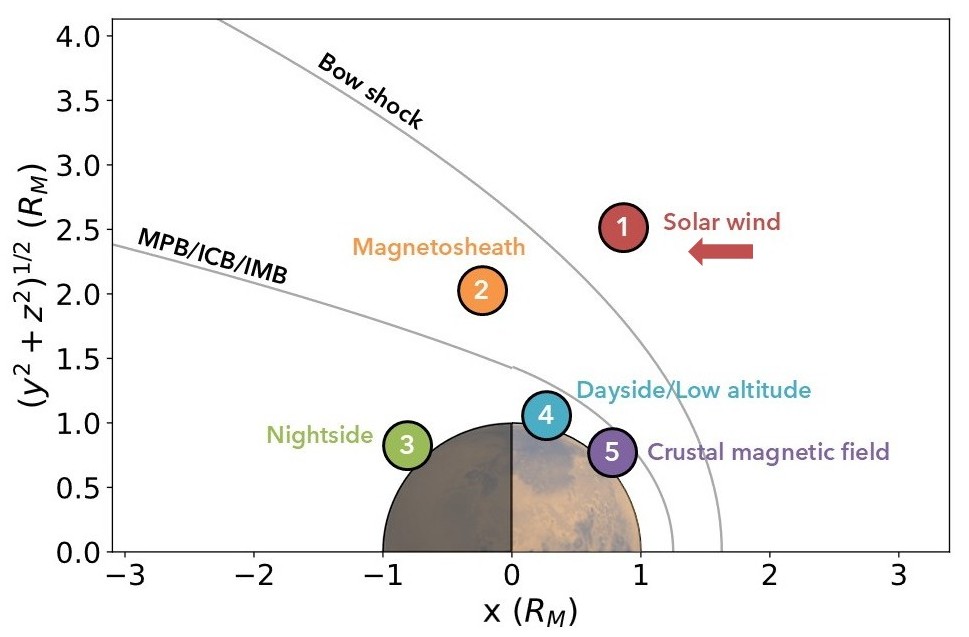
Introduction: Mars lacks an intrinsic global magnetic field, unlike Earth. Instead, the solar wind interacts directly with the upper atmosphere, creating an induced magnetic field that is much weaker compared to a global magnetic field. Localized strong crustal magnetic fields that rotate with the planet add to the complexity of the Martian plasma environment. Some interesting physical processes operate in this complex hybrid magnetosphere, including aurorae, reconnection, and ion escape. Multi-point measurements can help resolve spatial and temporal variability on small spatial scales and shorter timescales than a single spacecraft’s orbit. NASA’s Mars Atmosphere and Volatile EvolutioN (MAVEN) mission and ESA’s Mars Express (MEX) mission has been making simultaneous measurements for over a decade, occasionally approaching each other within a few hundred kilometers. These close conjunction events enable the direct comparison of plasma measurements and cross-calibration of the instruments on the two spacecraft, while exploring the spatial scales of plasma in five different plasma regions, shown in Figure 1.

Figure 1: Five plasma regions near Mars in MSO coordinates, showing the bow shock and the magnetic pileup boundary (MPB).

Science objectives: We present a comparative analysis of electron and ion observations from MAVEN and MEX during close conjunction events. Specifically, we compare electron energy distribution measured by MAVEN’s Solar Wind Electron Analyzer (SWEA) with MEX’s Electron Spectrometer (ELS) instruments, and ion (protons and heavy ions) energy distribution measured by MAVEN’s Suprathermal and Thermal Ion Composition (STATIC) and Solar Wind Ion Analyzer (SWIA) with MEX’s Ion Mass Analyzer (IMA) instruments. We have three science objectives: (1) To determine whether the two spacecraft sample the same plasma (electron and ion) population during close conjunctions, (2) To characterize the spatial scales over which plasma properties are coherent in different plasma regions of the Martian plasma environment, and (3) To identify possible sources of systematic differences between the measurements.

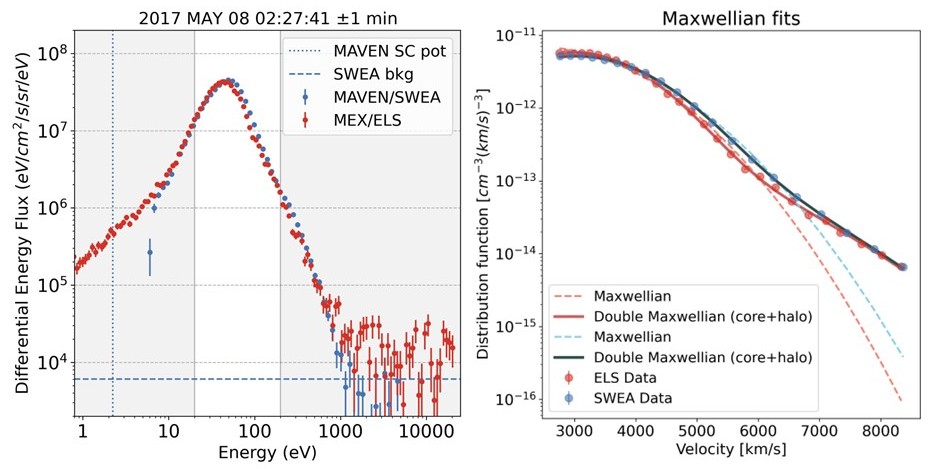
Figure 2. (left panel) Electron energy spectrum measured by MAVEN/SWEA and MEX/ELS in the magnetosheath. (right panel) Double Maxwellian distribution function fitted to the measured distribution.

  • Plasma population comparison during close conjunctions: Electron and ion distributions are compared during times when MAVEN and MEX are separated by up to 1000 km in some Martian plasma regions (magnetosheath, dayside and nightside at low altitude), and to 2000 km in the solar wind region. The separation of the spacecraft in each of these regimes is compared to the gyro radius and Debye length of each species in each region. We compare look directions of the instruments that overlap (within a small angular separation) and calculate the average energy distribution of electrons and ions over some time interval (see Figure 2. left panel). To determine the agreement between the measurements, we apply a chi-squared test to assess the differences in particle fluxes qualitatively and to reveal if the two spacecraft are probing the same plasma population. We also fit a Maxwellian to each distribution to determine plasma densities and temperatures and to assess the differences quantitatively (see Figure 2. right panel).
  • Spatial scales in different plasma regions: We investigate plasma variability in five plasma regions near Mars: upstream solar wind, magnetosheath, low-altitude dayside, low-altitude nightside, and near crustal magnetic fields (see Figure 1.). Strong crustal magnetic field regions are identified using magnetic field strength measurements from MAVEN’s magnetometer (MAG) instrument. For each event, we analyze the full energy spectrum 10 minutes before and 10 minutes after closest approach, selecting times and separations when both spacecraft are likely in the same region based on the spectra. Differences between the two measurements from the two spacecraft are then evaluated as a function of separation. The chi-squared test is used again to quantify the level of agreement. This approach provides an estimate of the spatial scales over which the plasma changes in each region.
  • Possible sources of systematic differences: We identify possible sources of systematic differences and mitigate them when possible. These include spacecraft potential that alters the measured spectra at lower energies if not corrected. Another is the percent overlap of the instrument look directions that can introduce discrepancies. Additionally, differences in instrument sensitivities and background noise can contribute to measurement disagreements. By identifying these sources and quantifying their influence, we aim to uncover the true differences in the observed plasma environment.

The results of this multi-point Martian plasma study contribute to our understanding of solar wind interaction with weakly magnetized planets and characterize the spatial variability and timescales less than a single spacecraft orbit in different plasma regions. Moreover, these methods lay the foundation for future multi-spacecraft missions to Mars that study the Martian plasma environment. 

How to cite: Bergfalk, J., Brain, D., Ramstad, R., Schnepf, N., Curry, S., Dong, Y., Mitchell, D., Xu, S., Hanley, G., McFadden, J., Holmström, M., Yoshifumi, F., Halekas, J., and Espley, J.: Comparing plasma measurements at Mars during close conjunctions of MAVEN and Mars Express, EPSC-DPS Joint Meeting 2025, Helsinki, Finland, 7–13 Sep 2025, EPSC-DPS2025-1167, https://doi.org/10.5194/epsc-dps2025-1167, 2025.

12:12–12:24
|
EPSC-DPS2025-1914
|
On-site presentation
Beatriz Sanchez-Cano, Caitlin Hanna, Mark Lester, Christina Lee, Yuki Nakamura, Yuki Harada, Hiromu Nakagawa, Quentin Nenon, Lauriane Soret, Nicholas Schneider, Jingnan Guo, Alessandro Ippolito, Olivier Witasse, and Francois Leblanc

The response of the Martian environment to Space Weather activity is not yet very well characterised as many factors from both the planet and from outside play large roles in the observed dynamics, particularly in the ionosphere. One of the most intense factor is when showers of Solar Energetic Particles (SEP) hit the planet as they are able to penetrate down to the surface and produce significant levels of aurora emissions. Moreover, both SEP protons and electrons are able to create ionospheric layers in the mesosphere, which in turn produce significant radio attenuation. In this study, we analyse data from all the active missions at Mars covering the track of the SEP particles up to the surface in order to provide the most complete characterization of the response of the Martian plasma system to Space Weather with respect to the solar cycle. We also evaluate short term responses, such as during the February 2022 and May 2024 events, when despite very large SEPs hitting Mars, the ionosphere did not absorb as many particles as it was expected. The main objective of this work is to provide the best possible characterisation of the Martian radiation environment in order to support to support the ESA M7 Mars, Magnetosphere, ATmosphere, Ionosphere, Space Weather SciencE (M-MATISSE) candidate.

How to cite: Sanchez-Cano, B., Hanna, C., Lester, M., Lee, C., Nakamura, Y., Harada, Y., Nakagawa, H., Nenon, Q., Soret, L., Schneider, N., Guo, J., Ippolito, A., Witasse, O., and Leblanc, F.: The response of the Martian ionosphere to short and long term solar energetic particles, a scientifc goal of the ESA M7 candidate M-MATISSE, EPSC-DPS Joint Meeting 2025, Helsinki, Finland, 7–13 Sep 2025, EPSC-DPS2025-1914, https://doi.org/10.5194/epsc-dps2025-1914, 2025.

Posters: Mon, 8 Sep, 18:00–19:30 | Finlandia Hall foyer

Display time: Mon, 8 Sep, 08:30–19:30
F53
|
EPSC-DPS2025-135
|
ECP
|
On-site presentation
Catherine Regan, Christopher Fowler, Oleksiy Agapitov, and Stephen Ledvina

Magnetic pumping allows the transfer of energy from magnetosonic waves (low frequency, compressive) at magnetohydrodynamical (MHD) scales, to electrons at kinetic scales in space plasmas. This can lead to significant localized heating of ambient electrons in planetary magnetospheres, and has been seen at induced (Mars, Venus) and intrinsic (Earth) magnetospheres. At Mars, the smaller scale size of the induced magnetosphere means that the underlying low frequency waves that drive the pumping can propagate into the planetary ionospheres, where the process can heat ionospheric electrons. The process can thus couple the solar wind to the ionosphere, where it can drive processes such as atmospheric loss to space via enhanced ambipolar electric fields.  

At Mars, pumping events have been identified using MAVEN data, which can resolve the MHD scales of this process. At Earth, MMS can resolve the kinetic scale physics, allowing more detailed analysis into magnetic pumping. Comparisons between the two planets allow conclusions to be drawn about the similarities and differences between this process at induced vs intrinsic magnetospheres. We present detailed case studies of magnetic pumping at both Mars and Earth.

How to cite: Regan, C., Fowler, C., Agapitov, O., and Ledvina, S.: Magnetic Pumping in Planetary Magnetospheres: Comparisons at Mars and Earth, EPSC-DPS Joint Meeting 2025, Helsinki, Finland, 7–13 Sep 2025, EPSC-DPS2025-135, https://doi.org/10.5194/epsc-dps2025-135, 2025.

F54
|
EPSC-DPS2025-302
|
On-site presentation
Niklas Edberg and the Solar Orbiter RPW & MAG team

On 18 February 2025, Solar Orbiter conducted its fourth Venus gravity assist manoeuvre, reaching a closest approach altitude of 378 km. This was significantly deeper than during previous flybys and brought the spacecraft into the topside ionosphere for the first time. The magnetometer (MAG) and Radio and Plasma Wave (RPW) instruments operated in burst mode during most of the flyby, providing high time resolution measurements. Solar Orbiter approached Venus from the tail region and entered the plasma environment without detecting a clear inbound bow shock crossing. The upstream solar wind appeared steady and calm, as inferred from stable magnetosheath conditions. The ionosphere was encountered in an unmagnetized state, characterized by generally weak magnetic fields in the ionosphere. Two ionopause crossings were observed, one inbound and one outbound, clearly seen in magnetic field, electric field and plasma density data. High-time-resolution electron density measurements, derived from spacecraft potential sampled at 256 Hz and calibrated using the plasma frequency line, revealed fine structure at the ionopause boundary on spatial scales of ~10 km. This is comparable to the local O⁺ inertial length, suggesting the influence of kinetic processes such as ion-scale waves or current sheets. The peak electron density during the flyby reached approximately 2x104 cm⁻³, corresponding to a spacecraft potential of about –45 V. Assuming pressure balance between external magnetic pressure and internal thermal pressure at the ionopause, the electron temperature is estimated to be around 0.6 eV. Near closest approach, approximately 15 magnetic flux ropes were observed, identified by strong peaks in magnetic field magnitude and characteristic rotations in LMN coordinates. These structures were accompanied by simultaneous electron density depletions. Applying a pressure balance assumption across the flux ropes (noting that this may not always be valid) yields an upper limit on the electron temperature of 0.8–2.0 eV within these features. On the outbound leg, Solar Orbiter passed through a still stable dayside magnetosheath and eventually crossed a quasi-perpendicular bow shock.

How to cite: Edberg, N. and the Solar Orbiter RPW & MAG team: Solar Orbiter in Venus ionosphere: results from the 4th flyby, EPSC-DPS Joint Meeting 2025, Helsinki, Finland, 7–13 Sep 2025, EPSC-DPS2025-302, https://doi.org/10.5194/epsc-dps2025-302, 2025.

F55
|
EPSC-DPS2025-572
|
ECP
|
On-site presentation
Feng Wanqiu, Cheng Long, and Wang Yuming

Introduction

Mars does not have a global dipole magnetic field as is the case for Earth, but it possesses localized remanent magnetic fields originating in the Martian lithosphere, which are universally accepted to have been generated by an ancient core dynamo. Satellite measurements over the past few decades have provided the necessary data for modeling these crustal fields. The most widely used crustal magnetic field models include the Equivalent Source Dipole (ESD) model and the Spherical Harmonic (SH) model.

Data Sets and Data Selection

Mars Global Surveyor (MGS) operated in Martian orbit from 1997 to 2006, providing magnetic field measurements during two distinct mission phases: the aerobraking and science phase orbit (AB/SPO, 1997-1999) with elliptical orbits, and the mapping phase orbit (MPO, 1999-2006) with near-circular orbits at approximately 400 km altitude. MAVEN (2014–present) and Tianwen-1 (2021–present) continue to operate in elliptical orbits, conducting magnetic field measurements at lower altitudes.

A key challenge in crustal field modeling is minimizing external field interference associated with solar wind interactions with Mars. Langlais et al. (2019) selected MPO datasets with minimal deviation from the mean to construct a preliminary model, and excluded MAVEN datasets with correlation coefficients below 0.4 when compared to the extrapolated field of the preliminary model. Gao et al. (2021) selected MAVEN datasets based on upstream solar wind conditions, retaining orbits when the mean interplanetary magnetic field (IMF) magnitude is below 2.6 nT. Since mean-based criteria for near-circular orbits are physically less reliable than upstream solar wind criteria for elliptical orbits, we decided to use only elliptical orbit data, refine the quiet-period identification method, and incorporate updated MAVEN and Tianwen-1 observations to develop a new crustal field model.

We utilized datasets from MGS during AB/SPO phase (1997-1999), MAVEN (2014-2024), and Tianwen-1 (2021-2023), with the following selection criteria applied to constrain the datasets:

  • The bow shock crossings of MAVEN from 2014 to 2022 were identified using the dataset provided by Wedlund et al. (2022), while those for other orbits were manually determined by examining magnetometer measurements. Quiet orbits were selected based on specific criteria: solar wind duration exceeding 0.5 hours, IMF strength below 3 nT, IMF fluctuation rate under 0.3 nT/s, electron density below 0.3 cm⁻³, and solar wind dynamic pressure below 6 nPa. For MGS and Tianwen-1, which lack electron density and dynamic pressure measurements, only the IMF criteria were applied. Only periapsis data from these quiet orbits were retained. Since the operational periods of MAVEN and Tianwen-1 overlap, if one spacecraft detected quiet solar wind conditions within a two-hour window, the periapsis data from the other spacecraft were also retained.
  • Due to greater solar wind interference on the dayside, we exclusively utilized data acquired below 350 km altitude on the dayside and below 500 km on the nightside.
  • A 60-second moving average was applied to suppress high-frequency noise.
  • Following the method described in Langlais et al. (2019) Appendix B, we performed data selection along orbits with increased sampling density in regions exhibiting strong magnetic field gradients or at lower altitudes.

Finally we obtained 0.38 million data points of the field vector, 10% for model assessment and 90% for model construction.

Model Results

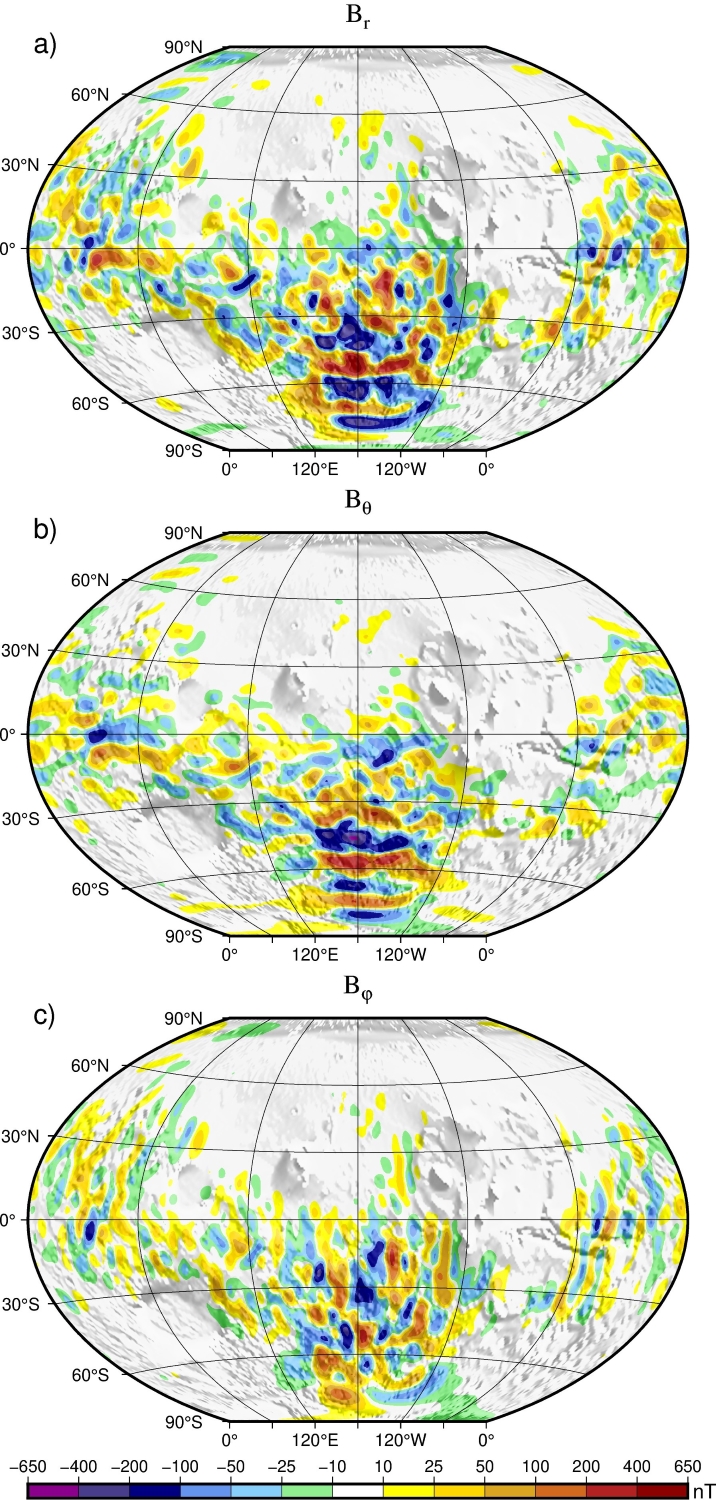
In this study, we employ the ESD modeling approach, which imposes less stringent requirements on the spatial uniformity of datasets. Then we used the ESD-derived spatially uniform magnetic field data to construct an SH model, enabling extrapolation to the surface. The calculated field distributions are shown in Figure 1.

Figure 1. Maps of the Martian magnetic field calculated by our SH model at an altitude of 200 km. (a) Br, (b) Bθ , (c) Bφ .

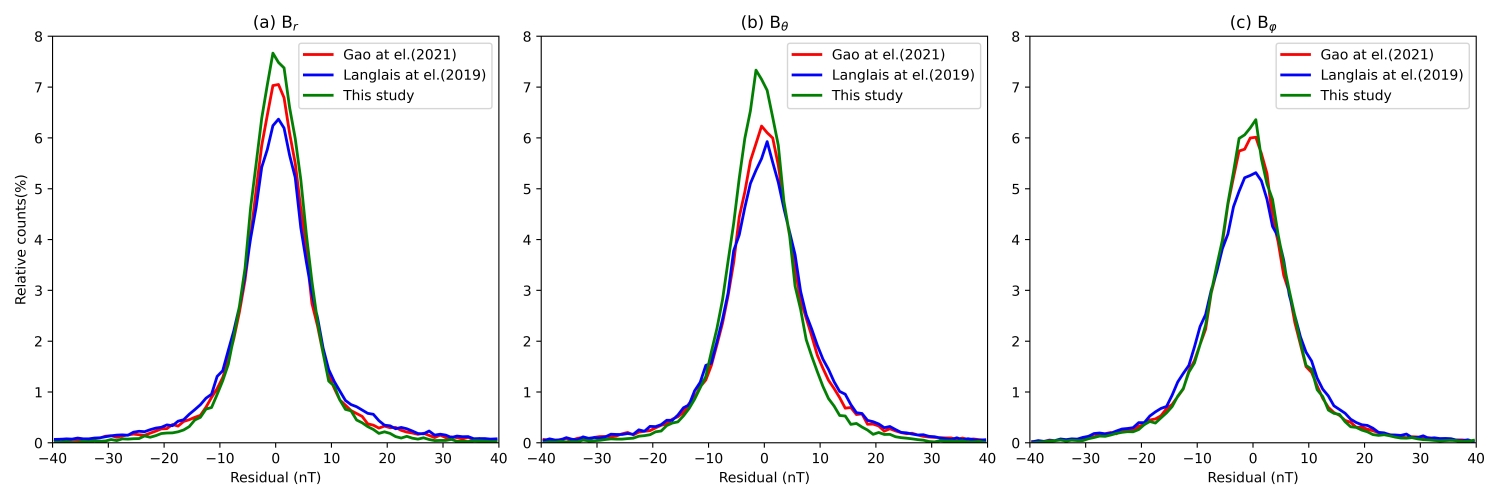
The model performance was evaluated using residuals between the assessment dataset and model predictions. As shown in Figure 2, our model demonstrates superior fitting performance compared to previous studies, indicating that the methodological improvements have enhanced model quality.

Figure 2. Residual distribution of the Langlais et al. (2019) model, the Gao et al. (2021) model, and this model for the assessment datasets.(a) Br, (b) Bθ , (c) Bφ .

Subsequent research will further refine the solar wind selection parameters to enhance model performance, and will consider incorporating relevant studies on the Martian ionospheric current system to optimize the quiet data selection method.

How to cite: Wanqiu, F., Long, C., and Yuming, W.: Modeling the Martian Crustal Magnetic Field Using Data from MGS, MAVEN, and Tianwen-1, EPSC-DPS Joint Meeting 2025, Helsinki, Finland, 7–13 Sep 2025, EPSC-DPS2025-572, https://doi.org/10.5194/epsc-dps2025-572, 2025.

F56
|
EPSC-DPS2025-663
|
ECP
|
On-site presentation
Long Cheng, Erik Vigren, Moa Persson, Hao Gu, Jun Cui, and Robert Lillis

The composition of Mars' ionosphere has been extensively characterized by MAVEN/NGIMS, and numerous photochemical models have been developed to replicate ion densities in Mars' dayside ionosphere. The molecular dication CO2++ has, as previously reported, been detected and modeled in Mars’ ionosphere; however, previous works have significantly underestimated the observations. In contrast, the noble gas ion Ar+ has received limited attention in photochemical modeling studies. In this study, we focus on modeling CO2++ and Ar+ and in Mars' dayside ionosphere. For CO2++, an extended lifetime against natural dissociation compared to what is used in earlier modeling works significantly reduces discrepancies between photochemical model predictions and MAVEN observations throughout the altitude range 160-220 km. Our findings indicate that the natural lifetime of CO2++ may require re-evaluation, which is not in conflict with results from a frequently cited experimental investigation. For Ar+, we perform both orbital and statistical comparisons between model results and observations and found reasonable model-observation agreement, particularly at altitudes below 200 km, using a higher rate coefficient for the reaction between Ar+ and CO2, and under high solar EUV conditions.

How to cite: Cheng, L., Vigren, E., Persson, M., Gu, H., Cui, J., and Lillis, R.: Photochemical Modeling of CO2++ and Ar+ in the Martian Ionosphere, EPSC-DPS Joint Meeting 2025, Helsinki, Finland, 7–13 Sep 2025, EPSC-DPS2025-663, https://doi.org/10.5194/epsc-dps2025-663, 2025.

F57
|
EPSC-DPS2025-762
|
ECP
|
On-site presentation
Shane Cupp, Chris Fowler, and Stephan Ledvina

Mars does not possess a significant, global magnetic field, and the solar wind subsequently interacts with
the gravitationally bound and electrically conducting ionosphere. This interaction produces an induced
magnetosphere, within which a plethora of dynamic processes can be active. This study focuses
specifically on the generation, propagation and impact of magnetosonic waves, which can transport
energy through the magnetosphere and into the planetary ionosphere. While these waves have been
observed by orbiting spacecraft (in particular, Mars Atmosphere and Volatile EvolutioN (MAVEN), a
satellite that has been in Mars orbit since 2013), these single point in-situ observations cannot provide
instantaneous coverage of the entire magnetosphere, thus limiting our knowledge of these waves and their
impact on the system. This work utilizes global hybrid simulations of the Mars-solar wind interaction,
specifically from the HALFSHEL code. “Complete” ion physics are included in the simulation code such
that the induced magnetosphere, magnetosonic waves and their propagation, are self consistently
captured. The code can thus be used to identify the generation mechanisms of these waves, their
propagation through the magnetosphere, and where energy carried by these waves is deposited in the
system. These features can be tracked in the full 3D spatial domain, and through time. The preliminary
results from this study are presented, focusing on the initial identification of magnetosonic waves in the
magnetosphere. Their characteristics are compared to those observed by single point MAVEN
measurements.

How to cite: Cupp, S., Fowler, C., and Ledvina, S.: The generation, propagation, and impact of magnetosonic waves in the Mars magnetosphere: analysis of global hybrid simulations, EPSC-DPS Joint Meeting 2025, Helsinki, Finland, 7–13 Sep 2025, EPSC-DPS2025-762, https://doi.org/10.5194/epsc-dps2025-762, 2025.

F58
|
EPSC-DPS2025-1267
|
On-site presentation
Kerstin Peter, Martin Pätzold, Silvia Tellmann, Janusz Oschlisniok, Yoshifumi Futaana, and Bernd Häusler

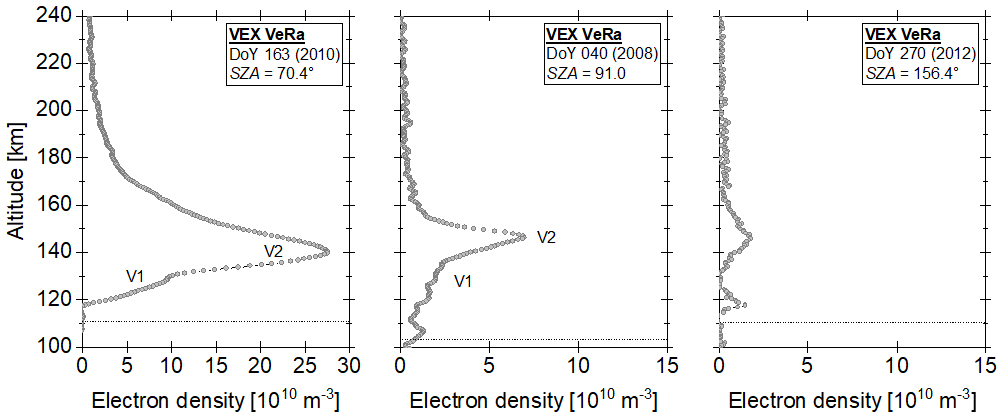
Fig. 1: Venus ionosphere observed by VEX VeRa for solar zenith angles (SZAs) on the (a) dayside, (b) terminator, and (c) nightside.The horizontal dashed line indicates the lowest valid altitude of the ionospheric observation.

The Venus Express (VEX) spacecraft orbited Venus from 2006 to 2014. The VeRa experiment [1] onboard VEX utilized radio science techniques to investigate the planet’s ionospheric electron density as well as the pressure, density and temperature of the lower neutral atmosphere.

Figure 1a presents a typical profile of the undisturbed dayside ionosphere of Venus. The lower ionosphere is dominated by photochemical processes and characterized by two major features. The ionospheric peak region (V2) mainly results from photoionization by solar EUV irradiation, while the weaker secondary V1 region originates from the primary and secondary ionization caused by solar X-rays [2]. The electron density of the lower dayside ionosphere shows a strong dependence on solar irradiation at wavelengths shorter than 95 nm [3]. Close to the planetary terminator, VeRa observes a substantial ionosphere (Fig. 1b) where the individual V2 and V1 regions can still be distinguished. On the deep nightside, VeRa observations reveal highly variable ionospheric structures when the noise level of the observations is low (Fig. 1c).

In this study, 9 years of VEX VeRa observations are used to investigate the variability of the Venus ionosphere across the dayside, terminator, and nightside regions. The derived ionospheric properties are compared with accompanying measurements of the solar wind dynamic pressure (from VEX ASPERA4 [4]), solar irradiation flux (FISM V2 model [5]), and results from a ray-tracing analysis, in order to improve our understanding of Venus’ ionospheric variability.

.

References

[1] Häusler et al. (2006)  PSS 54 (13-14)

[2] Fox (2007)  PSS 55 (12)

[3] Peter et al. (2014)  Icarus 233

[4] Barabash et al. (2007)  JGR Planets 112 (E4)

[5] Chamberlin et al. (2020) Space Weather 18 (12)


How to cite: Peter, K., Pätzold, M., Tellmann, S., Oschlisniok, J., Futaana, Y., and Häusler, B.: Exploring the variability of the Venus ionosphere with the Venus Express VeRa radio science experiment, EPSC-DPS Joint Meeting 2025, Helsinki, Finland, 7–13 Sep 2025, EPSC-DPS2025-1267, https://doi.org/10.5194/epsc-dps2025-1267, 2025.

F59
|
EPSC-DPS2025-1289
|
On-site presentation
Kerstin Peter, Christopher Fowler, Martin Pätzold, Laila Andersson, Robin Ramstad, Silvia Tellmann, and Mats Holmström

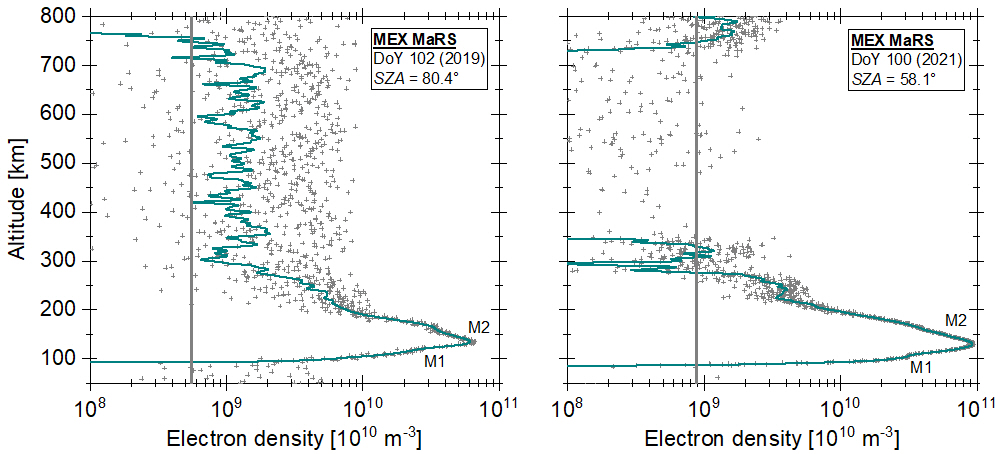
Fig. 1: MEX MaRS observation of (a) the extended Mars dayside ionosphere on Day of Year (DoY) 102 (2019) and (b) the compressed dayside ionosphere on DoY 100 (2021). Grey crosses are the original data points, while the blue line indicates the smoothed data. The vertical grey line indicates the 1ˑσ noise level of the observation.

The Mars Express (MEX) spacecraft has been orbiting Mars since December 2003. Its MaRS (Mars Radio Science) experiment uses spacecraft-Earth radio occultations to provide information about the ionospheric electron density and the pressure, density and temperature of the lower neutral atmosphere. However, due to geometrical constraints, these remote-sensing observations are never accompanied by simultaneous in-situ observations at the same position from MEX itself.

Since the arrival of the MAVEN spacecraft in 2014, new opportunities have emerged to complement MEX MaRS data with in-situ observations. This study compares the coordinates of MEX MaRS dayside ionospheric occultation events (from 2014 through the end of 2022) with MAVEN's pericenter positions to identify instances where the two datasets are spatially and temporally comparable.

The analysis shows that opportunities where MEX MaRS and MAVEN pericenter observation are comparable, are extremely rare. This work presents a detailed case study of two events where meaningful comparisons can be made under the condition that the planetary ionosphere remained sufficiently stable (Fig. 1).

Combining MEX radio science observations with MAVEN's in-situ data enables more comprehensive scientific insights into Martian ionospheric dynamics—insights that are otherwise difficult to obtain. Future and proposed multi-spacecraft missions like EscaPADE and M-MATISSE will be instrumental in expanding our understanding of planetary environments through coordinated observations.


How to cite: Peter, K., Fowler, C., Pätzold, M., Andersson, L., Ramstad, R., Tellmann, S., and Holmström, M.: Multi-spacecraft observations of the Mars dayside ionosphere: a case study with MEX and MAVEN, EPSC-DPS Joint Meeting 2025, Helsinki, Finland, 7–13 Sep 2025, EPSC-DPS2025-1289, https://doi.org/10.5194/epsc-dps2025-1289, 2025.

F60
|
EPSC-DPS2025-1321
|
On-site presentation
Emmanuel Grotheer, Mats Holmstroem, Hayley Williamson, Michel Breitfellner, James Godfrey, David Heather, Patrick Martin, Colin Wilson, Daniela Coia, Tanya Lim, Mark Bentley, Guido De Marchi, Bruno Merin, Thomas Cornet, Ruben Docasal, Joana Oliveira, Jose Osinde, Francisco Raga, Gemma Ramos, and Adrian Trejo

Abstract: The European Space Agency’s (ESA) Mars Express (MEX) mission to Mars has been returning valuable scientific data for 21+ years.  This data is available to the public for free via the Planetary Science Archive (PSA), which houses the raw, calibrated, and higher-level data returned by the ESA’s planetary missions, including data provided by the various MEX instrument teams.  The Analyzer of Space Plasma and Energetic Atoms 3 (ASPERA-3) has provided several types of datasets throughout the mission, focusing on the ions and electrons in Mars' ionosphere as well as out into the solar wind environment surrounding Mars.

      For the Ion Mass Analyzer (IMA) subinstrument, the ASPERA-3 team has provided new level 4 and level 5 datasets which cover nearly the entirety of MEX's mission lifetime.  The level 4 sets contain data products covering the differential number flux of H+, He++, O+, and O2+ (in units of m-2 s-1 sr-1 eV-1) for the various sectors of the IMA detector.  The level 5 sets contain data products combining all the IMA sectors' data to yield temperature (eV), density (cm-3), and velocity (km s-1) information on these same 4 ion species.  All this data and more can be accessed at the PSA at: https://archives.esac.esa.int/psa/

Mars Express: MEX was inserted into Mars orbit in December 2003, though several instrument test observations also exist from the cruise phase of the mission, prior to arrival at Mars.  Thus, this long-lived Mars mission covers 21+ years of data with its 7 instruments.  Later in the mission’s lifetime, the camera used for the Beagle 2 lander separation was reactivated and used for public outreach.  Over time, the camera began to be used for scientific observations as well, making  MEX an unusual mission in that with this addition of the VMC instrument it now has more scientific instruments in operation than it was launched with.

The PSA user interface: The ESA’s PSA uses the Planetary Data System (PDS) format developed by NASA to store the data from its various planetary missions.  In the case of MEX, the data is stored in the PDS3 format, which primarily uses ASCII files to store and describe the data.  Newer missions, from ExoMars onward use the PDS4 data standard, which uses XML files to store the label information. 

       There are three primary ways in which to find the data.  One is the FTP area, which houses all the public data in the PSA.  Here, there are no advanced search capabilities, but it does provide access to all the supporting files and documentation for the various datasets.  When first searching for new data, users would benefit from using the Table View search interface [1].  Here the user can search using various parameters, such as mission name, target, instrument name, processing level, observation times, etc.  The Table View is also linked to the Image View, where users can view the browse images provided by the PI teams.  The Table View interface also has a section for “Free Search”, allowing one to use Contextual Query Language (CQL) to search over additional parameters.  These various search methods rely in part on the metadata provided by the instrument teams in the labels associated with each of the data products.

       Finally, there is also a Map View for viewing the footprints of data from those instruments where such calculations can be of some utility.  This Map View is built using GIS tools.

Conclusion: The delivery of the ASPERA-3 data provides new high level data on the ion populations in the vicinity of Mars.  This data can be freely accessed at the ESA’s PSA, at https://archives.esac.esa.int/psa/.  There are multiple ways of browsing the ASPERA-3 and other instrument teams’ data, including from other planetary missions, which will be explained in this poster.  The development of the PSA’s user interface is an ongoing project, and we welcome feedback from the community for suggestions on new ways to search this wealth of data.  Feedback and suggestions can be sent via our Help Desk system at:

https://support.cosmos.esa.int/psa/

Acknowledgements: The MEX Support Archive Scientists and the entire PSA team would like to extend their thanks to the ASPERA-3 team for their effort in continuing to deliver new data from Mars to the public via ESA’s PSA.  Our thanks go also to the European taxpayers, whose contributions to the European Space Agency enable the gathering and dissemination of this scientific knowledge, and preserving it for future generations of scientists to work on.

References: [1] Besse S. et al. (2018) Planetary and Space Science, 150, 131-140.

How to cite: Grotheer, E., Holmstroem, M., Williamson, H., Breitfellner, M., Godfrey, J., Heather, D., Martin, P., Wilson, C., Coia, D., Lim, T., Bentley, M., De Marchi, G., Merin, B., Cornet, T., Docasal, R., Oliveira, J., Osinde, J., Raga, F., Ramos, G., and Trejo, A.: New MEX-ASPERA-3 Ion Mass Analyzer High-Level Data In The ESA's Planetary Science Archive, EPSC-DPS Joint Meeting 2025, Helsinki, Finland, 7–13 Sep 2025, EPSC-DPS2025-1321, https://doi.org/10.5194/epsc-dps2025-1321, 2025.

F61
|
EPSC-DPS2025-1420
|
ECP
|
On-site presentation
Katerina Stergiopoulou, Mark Lester, Simon Joyce, David Andrews, Niklas Edberg, Moa Persson, Shaosui Xu, Norberto Romanelli, Shannon Curry, Mats Holmström, Christopher Fowler, Yingjuan Ma, Robin Ramstad, Konstantin Kim, Beatriz Sánchez-Cano, Sae Aizawa, and Andrea Cicchetti

The nightside ionosphere of Mars is formed by plasma transport from the dayside and electron precipitation. Significant progress has been made in our understanding of its composition and structure at low altitudes. However, what happens at higher altitudes remains unclear. Plasma structures escaping from the nightside of Mars could reveal the plasma transport paths from the dayside and from the nightside to space. Moreover, the response of escaping plasma structures to changing solar wind conditions will shed light on the dynamic evolution of the system. Mapping the paths of escaping plasma structures will result in a better understanding of the evolution of atmospheric escape at Mars and the contribution of escaping plasma structures to the total atmospheric loss. In this study we probe escaping plasma structures utilising two special campaigns of ESA's Mars Express mission as well as observations from NASA's MAVEN mission, in the high-altitude nightside ionosphere of Mars. Mars Advanced Radar for Subsurface and Ionosphere Sounding (MARSIS) is the radar on board Mars Express and samples the ionosphere at altitudes no higher than ~1500 km. However, in our study we look at observations from consecutive orbits during two special MARSIS campaigns, each consisting of 5 orbits, that took place in September 2023 and April 2024, for which MARSIS was operated at altitudes up to ~5000 km. 
We see a variable nightside ionosphere at high altitudes that changes between consecutive MEX orbits. MARSIS detects plasma structures appearing at different altitudes or disappearing between orbits. We compare with MAVEN measurements to better evaluate both the escaping plasma structures and the solar wind conditions. MAVEN too sees plasma structures at high altitudes on the nightside, changing between orbits, confirming the variability of the high-altitude nightside ionosphere and revealing a dusk-dawn asymmetry in the observed electron densities.
 

How to cite: Stergiopoulou, K., Lester, M., Joyce, S., Andrews, D., Edberg, N., Persson, M., Xu, S., Romanelli, N., Curry, S., Holmström, M., Fowler, C., Ma, Y., Ramstad, R., Kim, K., Sánchez-Cano, B., Aizawa, S., and Cicchetti, A.: Escaping plasma structures in the Martian magnetotail as observed during two special MARSIS high-altitude campaigns, EPSC-DPS Joint Meeting 2025, Helsinki, Finland, 7–13 Sep 2025, EPSC-DPS2025-1420, https://doi.org/10.5194/epsc-dps2025-1420, 2025.

F62
|
EPSC-DPS2025-214
|
ECP
|
On-site presentation
Zhuxuan Zou, Yuming Wang, and Zhenpeng Su

We statistically analyze the power spectral density (PSD) of magnetic field turbulence in the upstream solar wind of the Martian bow shock by investigating the data from Tianwen-1 and MAVEN during November 13 and December 31, 2021. The spectral indices and break frequencies of these PSDs are automatically identified. According to the profiles of the PSDs, we find that they could be classified into three types: A, B and C. Only less than a quarter of the events exhibit characteristics similar to the 1 AU PSDs (Type A). We observe the energy injection in more than one-third of the events (Type B), and the injected energy usually results in the steeper spectral indices of the dissipation ranges. We find the absence of the dissipation range in over one third of the PSDs (Type C), which is likely due to the dissipation occurring at higher frequencies rather than proton cyclotron resonant frequencies. We also find that the two spacecraft observed different types of PSDs in more than half of the investigated episodes, indicating significant variability upstream of the Martian bow shock. For example, the Type-B PSDs are more often seen by Tianwen-1, which was near the flank of the bow shock, than by MAVEN near the nose. This statistical study demonstrates the complicated turbulent environment of the solar wind upstream of the Martian bow shock.

How to cite: Zou, Z., Wang, Y., and Su, Z.: Statistical Study on the Solar Wind Turbulence Spectra upstream of Mars, EPSC-DPS Joint Meeting 2025, Helsinki, Finland, 7–13 Sep 2025, EPSC-DPS2025-214, https://doi.org/10.5194/epsc-dps2025-214, 2025.

F63
|
EPSC-DPS2025-517
|
On-site presentation
Mats Holmstrom

When the magnetized solar wind plasma encounters a non-magnetized planet, electrical currents will be induced in the ionosphere and in the deflected plasma, forming an induced magnetosphere. 
As an example of a non-magnetized planet, we model the interaction between Mars and the solar wind using a hybrid plasma model (ions as particles, electrons as a fluid). 
We investigate the morphology of the current systems at Mars, and how they depend on upstream solar wind conditions.  Currents in the bow shock, in the magnetosheath, and in the ionosphere, are mapped.  We also study the coupling and closure of the currents and draw conclusions for other non-magnetized planets.  

How to cite: Holmstrom, M.: Current systems at non-magnetized planets, EPSC-DPS Joint Meeting 2025, Helsinki, Finland, 7–13 Sep 2025, EPSC-DPS2025-517, https://doi.org/10.5194/epsc-dps2025-517, 2025.

F64
|
EPSC-DPS2025-607
|
On-site presentation
Keshav R Tripathi and Takeshi Imamura

Understanding the dynamics of the Venusian atmosphere in the 90–110 km altitude range is critical for investigating the coupling processes between the neutral atmosphere and the lower ionosphere. Recent studies suggest that near-infrared heating due to CO₂ absorption at the subsolar point leads to significant temperature enhancements in this region ( Gilli et al., 2017). However, direct observations remain limited.

In this study, we present a new approach to estimate the neutral temperature in the atmospheric-ionospheric transition region of Venus. Assuming the atmospheric composition up to 110 km is primarily dominated by CO₂ and N₂, and that the atmosphere is in hydrostatic equilibrium, we retrieve temperature profiles from radio occultation data. As this shows a significant presence of plasma, its contributions to the radio signal are mitigated using dual-frequency measurements for Venus Express (VEX) data, while for single-frequency observations, a one-dimensional photochemical model (1D-PCM, Ambili et al. 2024) is employed to simulate and subtract the plasma effect. A boundary temperature of 200 K and 240 K at 110 km altitude is assumed based on previous model predictions (Navarro et al., 2021; Ponder et al., 2024), and the temperature profile is subsequently derived using the hydrostatic framework (Imamura et al., 2017).

Figure: The purple curve represents the result from the standard retrieval method, while the green and red curves correspond to outcomes from the newly proposed approach.

Our preliminary results indicate a temperature peak of approximately 330 K near 105 km altitude, with an uncertainty of ~50 K due to the choice of boundary conditions and frequency residual processing. Although the current method and results are early-stage, they show promising consistency with solar occultation observation by VEX (Mahieux et al. 2023), and further refinements will be presented at the conference.

Acknowledgment: This work was supported by the Japan Society for the Promotion of Science (JSPS). We thank Prof. B. Hauesler, the principal investigator of, Venus Express Radio Science payload, for archiving the frequency residual data sets. We also acknowledge the effort of the Akatsuki radio science team in Japan and India for making the dataset available to us.


References:

  • Gilli, G., Lebonnois, S., González-Galindo, F., López-Valverde, M.A., Stolzenbach, A., Lefèvre, F., Chaufray, J.Y., Lott, F., 2017. Thermal structure of the upper atmosphere of Venus simulated by a ground-to-thermosphere GCM. Icarus 281, 55–72. http://dx.doi.org/10.1016/j.icarus.2016.09.016.

  • Imamura, T., Ando, H., Tellmann, S., Pätzold, M., Häusler, B., Yamazaki, A., Sato, T.M., Noguchi, K., Futaana, Y., Oschlisniok, J. and Limaye, S., 2017. Initial performance of the radio occultation experiment in the Venus orbiter mission Akatsuki. Earth, Planets and Space69, pp.1-11.

  • Ambili, K.M., Choudhary, R.K. and Tripathi, K.R., 2024. Exploring sensitivity: Unveiling the impact of input parameters on Venus ionosphere V2 layer characteristics. Icarus408, p.115839.

  • Navarro, T., Gilli, G., Schubert, G., Lebonnois, S., Lefèvre, F. and Quirino, D., 2021. Venus’ upper atmosphere revealed by a GCM: I. Structure and variability of the circulation. Icarus366, p.114400.

  • Ponder, B.M., Ridley, A.J., Bougher, S.W., Pawlowski, D. and Brecht, A., 2024. The Venus global ionosphere‐thermosphere model (V‐GITM): A coupled thermosphere and ionosphere formulation. Journal of Geophysical Research: Planets129(7), p.e2023JE008079.

How to cite: Tripathi, K. R. and Imamura, T.: Thermal Structure of Venus’s Upper Atmosphere (90–110 km) Derived from Radio Occultation Data, EPSC-DPS Joint Meeting 2025, Helsinki, Finland, 7–13 Sep 2025, EPSC-DPS2025-607, https://doi.org/10.5194/epsc-dps2025-607, 2025.

F65
|
EPSC-DPS2025-689
|
ECP
|
On-site presentation
Long Cheng, Erik Vigren, Jun Cui, Shane Stone, and Mehdi Benna

We make use of photochemical modelling and measurements by the Neutral Gas and Ion Mass Spectrometer (NGIMS) onboard the Mars Atmosphere and Volatile EvolutioN mission (MAVEN) in an attempt to identify the ion species that dominate the sub-population of ions in the Martian ionosphere characterized by a mass of 41 atomic mass units (amu). Previous photochemical reaction networks used for the ionospheres of Mars and Venus include only a single species, namely ArH+, to account for ions with that mass. We highlight that the straightforward photochemical modeling of ArH+ yields predicted concentrations that are two orders of magnitude lower than the observed 41 amu ions densities in the dayside ionosphere of Mars. We hypothesize that the 41 amu ion population is instead dominated by protonated dicarbon monoxide, HC2O+, and we advocate for experimental investigations into relevant ion-neutral reactions.

How to cite: Cheng, L., Vigren, E., Cui, J., Stone, S., and Benna, M.: Reviewing 41 amu ions in the Martian Ionosphere, EPSC-DPS Joint Meeting 2025, Helsinki, Finland, 7–13 Sep 2025, EPSC-DPS2025-689, https://doi.org/10.5194/epsc-dps2025-689, 2025.

F66
|
EPSC-DPS2025-832
|
ECP
|
On-site presentation
Russell Mapaye and Luke Moore

We calculate unattenuated photoionization and photodissociation rate coefficients using solar spectral irradiance (SSI) measurements from the TIMED/SEE mission (Woods et al., 2005) over a full solar cycle (2004–2014). These coefficients are parameterized by the solar activity index F₁₀.₇P, defined as F₁₀.₇P = ½(F₁₀.₇ + F₁₀.₇A), where F₁₀.₇ (10.7 cm solar radio flux) acts as a proxy for solar extreme ultraviolet (EUV) variability, and F₁₀.₇A represents its 81-day running average. Combining high-resolution (1 nm) SSI data with cross-sections from the PHIDRATES database (Huebner & Mukherjee 2015; http://phidrates.space.swri.edu/), we derive power-law relationships (j = A0[F₁₀.₇P]A1) for 48 reactions involving 12 species critical to Solar System atmospheres and cometary comae: H, H₂, OH, H₂O, O, O₂, C, CO, CO₂, N₂, N, and CH₄. 

Whereas prior estimates are limited to a subset of solar conditions (e.g., solar minimum or maximum), the photo rate coefficients derived here are broadly consistent with those results while extending them to span the full range of solar activity. This work establishes an efficient, observational approach to estimate photoionization rates requiring access to SSI or cross-section data. By utilizing F₁₀.₇P, a widely available and historical solar proxy, the power laws allow for easier modeling of atmospheric and cometary chemistry under diverse solar conditions. Applications include simulating tenuous exospheres (e.g., Mercury, Moon) and analyzing in situ data from outer planets and comets. The method is anchored in publicly accessible PHIDRATES cross-sections and TIMED/SEE SSI records (http://lasp.colorado.edu/home/see/data/daily-averages/level-3), ensuring utility for a variety of studies. Future work will address uncertainties for resolution-sensitive reactions and expand the species/reaction inventory, advancing our capacity to model solar-driven photochemistry throughout the Solar System.


How to cite: Mapaye, R. and Moore, L.: Photoionization and photodissociation rates across a solar cycle , EPSC-DPS Joint Meeting 2025, Helsinki, Finland, 7–13 Sep 2025, EPSC-DPS2025-832, https://doi.org/10.5194/epsc-dps2025-832, 2025.

F67
|
EPSC-DPS2025-906
|
On-site presentation
Yoshifumi Futaana, Manabu Shimoyama, Stefan Karlsson, Walter Puccio, Martin Berglund, Maximilian Wecker, Anders Eriksson, David Andrews, Stas Barabash, Mats Holmstrom, Konstantin Kim, Adel Malatinszky, Neil Menpara, Dan Ohlsson, and Hayley Williamson

The 3DVI (3-D Velocity of Ions) sensors that are under development for the ESA M7 candidate M-MATISSE mission are designed to address two fundamental questions about the Martian plasma environment:

  • How are thermal ions accelerated beyond escape velocity in the ionosphere?
  • How is ion escape controlled? Is it source-limited or energy-limited?

To answer these questions, precise measurements of ion bulk parameters in the upper ionosphere, where the initial acceleration processes are ongoing, shall be conducted. Our dedicated low-energy ion sensor will regularly measure the ionospheric thermal ions for the first time at Mars.

Building upon the success of ASPERA-3 on Mars Express as well as other Mars missions, M-MATISSE's 3DVI measurements will provide insights into the Martian upper atmosphere. The simultaneous measurements from two spacecraft with full plasma suites onboard will address energy transfers from the solar wind to the ionosphere. This will allow us to monitor the ionospheric ions in detail, shedding light on the thermosphere-ionosphere coupling that governs the first acceleration of ionospheric ions, which eventually escape to space.

3DVI instrument is based on the well-established techniques of RPA (Retarding Potential Analyzer) and IDM (Ion Drift Meter). The instrument consists of two sensor heads, RPA and IDM. Both have fields-of-view of 45° (half cone), with their boresight directions pointing to the ram direction of the spacecraft. The RPA head is to determine the velocity distribution function along the line of sight by using retarding potential in front of the cathode plate. The IDM head determines the incoming ion directions (i.e., two angles) by measuring the current differences between the prepared cathodes of the sensor. The measurement principle has been used in various space missions since 60–70s, but 3DVI is optimized for the Martian upper ionosphere environment.

In this talk, we will present the scientific background for the 3DVI instrument and report its current design and development status.


How to cite: Futaana, Y., Shimoyama, M., Karlsson, S., Puccio, W., Berglund, M., Wecker, M., Eriksson, A., Andrews, D., Barabash, S., Holmstrom, M., Kim, K., Malatinszky, A., Menpara, N., Ohlsson, D., and Williamson, H.: How do ionospheric ions get escape energy at Mars? M-MATISSE/3DVI science and instrument, EPSC-DPS Joint Meeting 2025, Helsinki, Finland, 7–13 Sep 2025, EPSC-DPS2025-906, https://doi.org/10.5194/epsc-dps2025-906, 2025.

F68
|
EPSC-DPS2025-1394
|
On-site presentation
Stas Barabash, Mats Holmström, Xiao-Dong Wang, and Qi Zhang

The structure and dynamics of induced magnetospheres around non-magnetized planets such as Mars and Venus are entirely driven by upstream conditions. These are defined by the solar wind density and velocity, as well as the magnitude and direction of the interplanetary magnetic field (IMF). Certain extreme values of these upstream parameters or specific combinations of them can result in distinct interaction regimes that are morphologically different from the nominal case.

The best-studied examples to date are the degenerate induced magnetosphere (DIM) and the disappearing magnetosphere. The former corresponds to cases where the IMF cone angle is very small (typically <5°-10°), while the latter is associated with extremely low solar wind densities (as low as ~0.05 cm⁻³).

We review extreme cases of morphologically distinct induced magnetospheres, with a focus on the DIM. We also propose a physics-based classification of these extreme cases and outline the main open scientific questions relevant to each category.

Finally, we discuss the importance of studying such interaction regimes, as insights gained may be applicable to understanding:

  • Stellar wind–exoplanet interactions
  • The space environments of exotic objects (e.g., free-floating planets)
  • Past or future solar system conditions
  • Moon–magnetosphere interactions around outer planets

How to cite: Barabash, S., Holmström, M., Wang, X.-D., and Zhang, Q.: Extreme induced magnetospheres , EPSC-DPS Joint Meeting 2025, Helsinki, Finland, 7–13 Sep 2025, EPSC-DPS2025-1394, https://doi.org/10.5194/epsc-dps2025-1394, 2025.

F69
|
EPSC-DPS2025-1819
|
On-site presentation
Lorenzo Biasiotti and Stavro Lambrov Ivanovski

Introduction: Solar flares are among the most powerful manifestations of magnetic activity, characterized by sudden, violent eruptions in the solar atmosphere, ranging from 1019 erg in nanoflares up to 1032 erg in large two-ribbon flares. Since their first detection (Peterson and Winckler, 1959), a significant body of data have been collected, thanks to the advent of spacecraft observations of solar flares (e.g. OSO 7, Explorer, SMM, GRANAT, ICE/ISEE 3, GOES). The latter enabled detailed statistical investigations of flare properties and underlying physical mechanisms (e.g., Temmer et al. 2001; Veronig et al. 2002; Lee et al. 2012; Joshi et al. 2015).

This work presents a comprehensive statistical analysis of the size and temporal characteristics of soft X-ray (SXR) flares across four solar cycles (SC21–SC24), covering the period from September 1975 to June 2017. More in detail, we investigate the distribution characteristics of solar flares, shedding light on their statistical properties and their relationship with the solar activity. Our analysis provides valuable insights into the distribution patterns, offers estimates for the occurrence of intense solar flare events, and proposes a monitoring framework.

Results: Flare data were obtained from the GOES satellite archive, using the 1–8 Å flux channel to identify start, peak, and end times.

We first explore the relationship between flare occurrence rates and solar activity. Temporal properties (duration, waiting time) and energetic properties (peak flux) are analyzed through their frequency distributions. Results indicate a clear correlation between flare duration and peak intensity with the level of solar activity, while waiting time appears largely uncorrelated.

Additionally, we investigate correlations among these parameters, confirming that flare duration increases with flare importance class. Notably, the distribution of durations for X-class flares reveals a secondary peak at ∼100 minutes for SC21 and SC22 and ∼80 minutes for SC23 and SC24 (Figure 1), referring to extremely long duration events (LDE).

Figure 1. Probability density functions (PDFs) of the observed flare duration data, during SC23 and SC24, compared with fitted unimodal and bimodal distribution models. The red solid line represents the fitted bimodal Gaussian mixture model.

Finally, we assess time–energy correlations in flare sequences to test the hypothesis, proposed by Rosner and Vaiana (1978), that energy builds up progressively prior to major events. Analyzing precursor flares from the same active region preceding X-class events, we find no monotonic increase in energy, suggesting a limited role for precursors in triggering major flares. Overall, no significant correlation is found between waiting time and peak intensity for flares in SC23 and SC24 (Figure 2).

Figure 2. Correlation scatter plot of flare peak-intensity and the waiting time for SC23 (red dots) and SC24 (blue dots).

This study highlights key statistical features of solar flare behavior that may constrain the plausible physical mechanism that generated them. Future work will focus on linking these statistical signatures to the underlying physical processes responsible for flare generation.

References: Joshi, B., Bhattacharyya, R., Pandey, K.K., Kushwaha, U., Moon, Y.-J.: 2015, Evolutionary aspects and north-south asymmetry of soft X-ray flare index during solar cycles 21, 22, and 23. Astron. Astrophys. 582, A4.

Lee, K., Moon, Y.-J., Lee, J.-Y., Lee, K.-S., Na, H.: 2012, Solar Flare Occurrence Rate and Probability in Terms of the Sunspot Classification Supplemented with Sunspot Area and Its Changes. Sol. Phys. 281, 639.

Rosner, R., Vaiana, G.S.: 1978, Cosmic flare transients: constraints upon models for energy storage and release derived from the event frequency distribution. Astrophys. J. 222, 1104.

Temmer, M., Veronig, A., Hanslmeier, A., Otruba, W., Messerotti, M.: 2001, Statistical analysis of solar Hα flares. Astron. Astrophys. 375, 1049.

Veronig, A., Temmer, M., Hanslmeier, A., Otruba, W., Messerotti, M.: 2002, Temporal aspects and frequency distributions of solar soft X-ray flares. Astron. Astrophys. 382, 1070.

Acknowledgements We acknowledge support by the INAF with the mini-grant, ‘Space WEather Analysis of Rogue events (SWEAR)’ (F.O. 1.05.23.04.03).

How to cite: Biasiotti, L. and Ivanovski, S. L.: Statistical Analysis of Solar Flare Properties from 1975 to 2017, EPSC-DPS Joint Meeting 2025, Helsinki, Finland, 7–13 Sep 2025, EPSC-DPS2025-1819, https://doi.org/10.5194/epsc-dps2025-1819, 2025.

F70
|
EPSC-DPS2025-202
|
On-site presentation
Christopher Fowler, Hassan Akbari, and David Newman

The planet Mars does not possess an intrinsic global dipole magnetic field. As a result, the solar wind interacts with the gravitationally bound and electrically conducting ionosphere to form an induced magnetosphere that acts to decelerate and deflect the incident solar wind flow about the planet. An important aspect of such an induced magnetosphere is the “draping” of interplanetary magnetic field lines about the obstacle. This draping can lead to field lines having one end anchored within the planetary ionosphere while the other end connects to the solar wind (then known as “open” field lines). On the nightside of the planet within the magnetotail region, these open field lines can provide a pathway for cold low-energy ionospheric ions to flow tailward and escape to space.

                  The MAVEN spacecraft commonly observes low frequency (<100 Hz) electric field waves in conjunction with this cold ion outflow. In this work, we discuss several characteristics of the observed waves; discuss possibilities for the underlying wave growth mechanism(s), and source(s) of free energy; and evaluate their impact on the outflowing plasma. Candidate instability mechanisms include the two stream instability between outflowing ionospheric protons and heavier O+ and O2+ ions or wave growth due to specific features within the energy and pitch-angle distributions of precipitating sheath electrons: when drawn out of the ionosphere by an ambipolar electric field, for example, the ions will be accelerated through the same electric potential, flowing at the same energy but different velocity, leading to instability.

                  The observed plasma waves coincide with modifications of the ion distribution functions (namely, emergence of energetic tails), suggesting the possibility that the waves act to decelerate protons and accelerate the heavier ions. We evaluate the impact of such a process on heavy ion escape rates. In particular, we evaluate how effective the process can be in shifting the heavy ion distribution function from initially just below escape energy, to just above it.

How to cite: Fowler, C., Akbari, H., and Newman, D.: Plasma instabilities driven by cold ion outflow in the Mars magnetotail region, EPSC-DPS Joint Meeting 2025, Helsinki, Finland, 7–13 Sep 2025, EPSC-DPS2025-202, https://doi.org/10.5194/epsc-dps2025-202, 2025.