
 1,1,1,1,1,2,3,3,
- 1Laboratory for Atmospheric and Space Physics, University of Colorado Boulder, Boulder, CO, USA (judit.bergfalk@colorado.edu)
- 2Space Science Laboratory, University of California, Berkeley, CA, USA
- 3Swedish Institute of Space Physics/IRF, Kiruna, Sweden
- 4University of Iowa, Iowa City, IA, USA
- 5NASA Goddard Space Flight Center, Greenbelt, MD, USA
Introduction: Mars lacks an intrinsic global magnetic field, unlike Earth. Instead, the solar wind interacts directly with the upper atmosphere, creating an induced magnetic field that is much weaker compared to a global magnetic field. Localized strong crustal magnetic fields that rotate with the planet add to the complexity of the Martian plasma environment. Some interesting physical processes operate in this complex hybrid magnetosphere, including aurorae, reconnection, and ion escape. Multi-point measurements can help resolve spatial and temporal variability on small spatial scales and shorter timescales than a single spacecraft’s orbit. NASA’s Mars Atmosphere and Volatile EvolutioN (MAVEN) mission and ESA’s Mars Express (MEX) mission has been making simultaneous measurements for over a decade, occasionally approaching each other within a few hundred kilometers. These close conjunction events enable the direct comparison of plasma measurements and cross-calibration of the instruments on the two spacecraft, while exploring the spatial scales of plasma in five different plasma regions, shown in Figure 1.
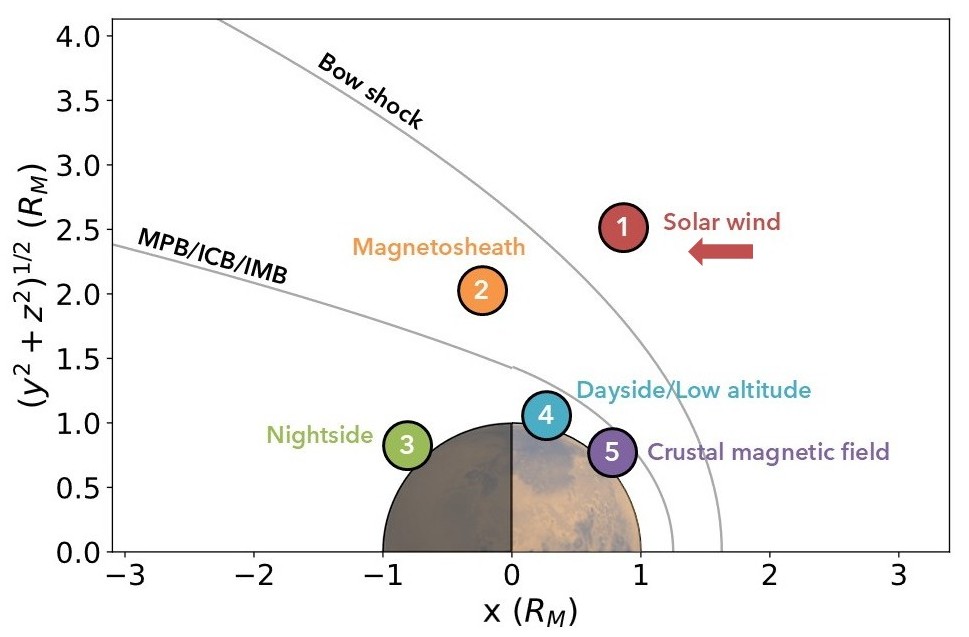
Figure 1: Five plasma regions near Mars in MSO coordinates, showing the bow shock and the magnetic pileup boundary (MPB).
Science objectives: We present a comparative analysis of electron and ion observations from MAVEN and MEX during close conjunction events. Specifically, we compare electron energy distribution measured by MAVEN’s Solar Wind Electron Analyzer (SWEA) with MEX’s Electron Spectrometer (ELS) instruments, and ion (protons and heavy ions) energy distribution measured by MAVEN’s Suprathermal and Thermal Ion Composition (STATIC) and Solar Wind Ion Analyzer (SWIA) with MEX’s Ion Mass Analyzer (IMA) instruments. We have three science objectives: (1) To determine whether the two spacecraft sample the same plasma (electron and ion) population during close conjunctions, (2) To characterize the spatial scales over which plasma properties are coherent in different plasma regions of the Martian plasma environment, and (3) To identify possible sources of systematic differences between the measurements.
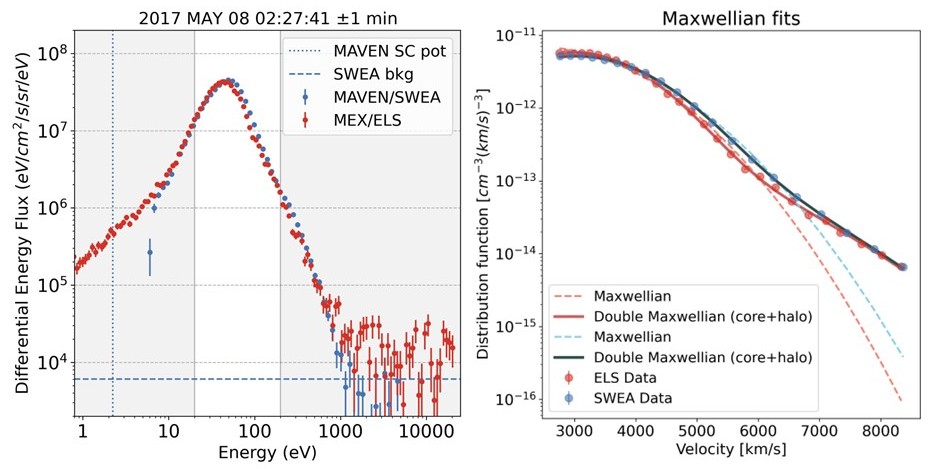
Figure 2. (left panel) Electron energy spectrum measured by MAVEN/SWEA and MEX/ELS in the magnetosheath. (right panel) Double Maxwellian distribution function fitted to the measured distribution.
- Plasma population comparison during close conjunctions: Electron and ion distributions are compared during times when MAVEN and MEX are separated by up to 1000 km in some Martian plasma regions (magnetosheath, dayside and nightside at low altitude), and to 2000 km in the solar wind region. The separation of the spacecraft in each of these regimes is compared to the gyro radius and Debye length of each species in each region. We compare look directions of the instruments that overlap (within a small angular separation) and calculate the average energy distribution of electrons and ions over some time interval (see Figure 2. left panel). To determine the agreement between the measurements, we apply a chi-squared test to assess the differences in particle fluxes qualitatively and to reveal if the two spacecraft are probing the same plasma population. We also fit a Maxwellian to each distribution to determine plasma densities and temperatures and to assess the differences quantitatively (see Figure 2. right panel).
- Spatial scales in different plasma regions: We investigate plasma variability in five plasma regions near Mars: upstream solar wind, magnetosheath, low-altitude dayside, low-altitude nightside, and near crustal magnetic fields (see Figure 1.). Strong crustal magnetic field regions are identified using magnetic field strength measurements from MAVEN’s magnetometer (MAG) instrument. For each event, we analyze the full energy spectrum 10 minutes before and 10 minutes after closest approach, selecting times and separations when both spacecraft are likely in the same region based on the spectra. Differences between the two measurements from the two spacecraft are then evaluated as a function of separation. The chi-squared test is used again to quantify the level of agreement. This approach provides an estimate of the spatial scales over which the plasma changes in each region.
- Possible sources of systematic differences: We identify possible sources of systematic differences and mitigate them when possible. These include spacecraft potential that alters the measured spectra at lower energies if not corrected. Another is the percent overlap of the instrument look directions that can introduce discrepancies. Additionally, differences in instrument sensitivities and background noise can contribute to measurement disagreements. By identifying these sources and quantifying their influence, we aim to uncover the true differences in the observed plasma environment.
The results of this multi-point Martian plasma study contribute to our understanding of solar wind interaction with weakly magnetized planets and characterize the spatial variability and timescales less than a single spacecraft orbit in different plasma regions. Moreover, these methods lay the foundation for future multi-spacecraft missions to Mars that study the Martian plasma environment.
How to cite: Bergfalk, J., Brain, D., Ramstad, R., Schnepf, N., Curry, S., Dong, Y., Mitchell, D., Xu, S., Hanley, G., McFadden, J., Holmström, M., Yoshifumi, F., Halekas, J., and Espley, J.: Comparing plasma measurements at Mars during close conjunctions of MAVEN and Mars Express, EPSC-DPS Joint Meeting 2025, Helsinki, Finland, 7–12 Sep 2025, EPSC-DPS2025-1167, https://doi.org/10.5194/epsc-dps2025-1167, 2025.


