
 1,1,1,3,4,5,3,6,6,6,7,8,
- 1Instituto de Astrofísica de Andalucía (IAA/CSIC), Granada, Spain
- 2Institute for Basic Science, Daejeon, South Korea
- 3IKI, Moscow, Rusia
- 4Dept of Physics, Oxford Univ., UK
- 5LATMOS, Goyencourt, France
- 6Royal Belgian Institute for Space Aeronomy (IASB-BIRA), Brussels, Belgium
- 7School of Physical Sciences, The Open University, Milton Keynes, UK
- 8Agenzia Spaziale Italiana (ASI), Rome, Italy
- *A full list of authors appears at the end of the abstract
Carbon monoxide (CO) has extensively been monitored in the martian atmosphere due to its dual significance: it provides insights into the dymanics and into photochemical processes between this molecule with others in the Martian atmosphere. CO is primarily produced through the CO2 photolysis in the upper atmosphere; it is then transported downward to the lower atmosphere where is destroyed by OH radicals - which are more abundant in water-rich regions - completing a recycling loop back to CO2. Initial monitoring of CO was carried out using ground-based observations [1,2], followed by space-based measurements with orbiters [3,4]. The ExoMars Trace Gas Orbiter, a joint mission by ESA and ROSCOSMOS was launched in 2016, and it carries two instruments capable of detecting CO via solar occultation observations: NOMAD [5] and ACS [6]. These multi-channel spectrometers began scientific operations in 2018, and their solar occultation modes (SO and MIR, respectively) observe the Infrared (2325-4348 cm-1), with a spectral resolution of 0.08 cm-1, and an SNR of ~4000.
In this work, we focus on ACS MIR observations targeting the overtone CO (2-0) absorption band located between 4150 and 4350 cm-1 (see figure 1). Before performing retrievals, the dataset provided by ACS MIR was first processed through a pipeline made at IAA-CSIC that include corrections in the spectral shift, continuum spectral bending, and a separation of random and systematic components of the measurement noise. [7,8] A critical part of this preprocessing involved characterizing the Instrumental Line Shape (ILS). For ACS MIR, the ILS presents a double peak response. The resulting lines can be modeled as a double gaussian, whose parameters can vary accross diffraction orders. We studied this evolution for the ACS MIR diffraction orders where the CO band is located and the resulting ILS chracterization will be presented in this work (see figure 2).
After the preprocessing, the spectra were analyzed using the KOPRA radiative transfer model coupled with the RCP inversion code [9], enabling the retrieval of CO VMR vertical profiles from ~8 to 90 km. This study presents the results of these inversions for CO using the detector position 7, which contains information for part of the Martian Years 34, 36 and the complete MY 37. The varying line intensities within the CO band facilitate profiling of both the upper and lower atmosphere while avoiding spectral saturation. Our results using ACS MIR will be finally compared with those previously retrieved using NOMAD [10], with previous ACS MIR and NIR retrievals [11,12], and we also provide a detailed analysis of the seasonal evolution of CO during the more recent MY 37.
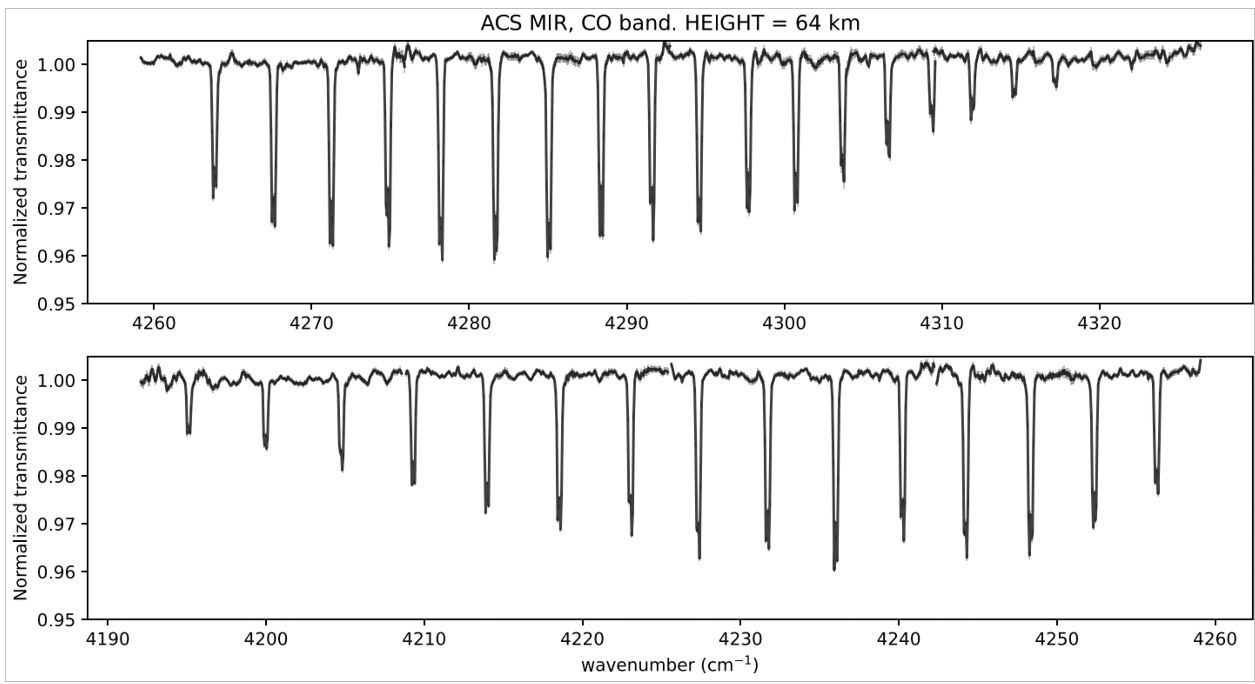
Figure 1. ACS MIR position 7 transmittance spectrum of CO for a tangent height of 64 km, located at 56.9 oN, 56.7 oW, Ls = 212.6o. This spectrum corresponds to the TGO orbit “019665”. The error is presented as grey vertical lines.
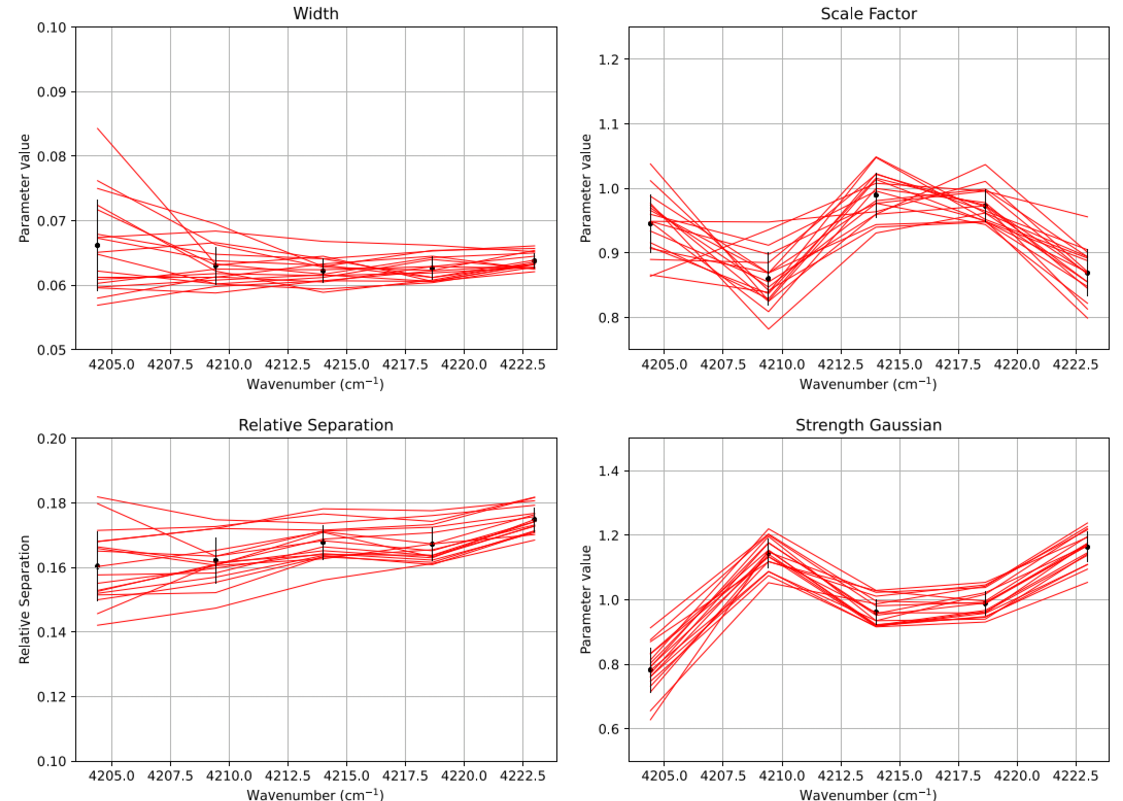
Figure 2. ILS parametrization for a subset of 20 orbits for order 251. The variation of the different parameters used for the double gaussian fitting are presented in red. The mean value and standard deviation are shown in black.
[1] Encrenaz, T. et al. (2006). Seasonal variations of the Martian CO over Hellas as observed by ground-based infrared spectroscopy. Astronomy & Astrophysics, 459, 265–270. https://doi.org/10.1051/0004-6361:20065984
[2] Krasnopolsky, V. A. (2007). Long-term spectroscopic observations of Mars using ground-based telescopes: Detection of CO and its seasonal variations. Icarus, 190(1), 93–102. https://doi.org/10.1016/j.icarus.2007.02.015
[3] Smith, M. D. (2004). Interannual variability in TES atmospheric observations of Mars during 1999–2003. Icarus, 167(1), 148–165. https://doi.org/10.1016/j.icarus.2003.09.010
[4] Bertaux, J.-L., et al. (2006). SPICAM on Mars Express: Observing modes and overview of UV spectrometer data and scientific results. Journal of Geophysical Research: Planets, 111, E10S90. https://doi.org/10.1029/2006JE002690
[5] Vandaele, A. C., et al. (2018). NOMAD, an integrated suite of three spectrometers for the ExoMars Trace Gas Mission: Technical description, science objectives and expected performance. Space Science Reviews, 214, 80. https://doi.org/10.1007/s11214-018-0517-2
[6] Korablev, O., et al. (2018). The Atmospheric Chemistry Suite (ACS) of three spectrometers for the ExoMars 2016 Trace Gas Orbiter. Space Science Reviews, 214, 7. https://doi.org/10.1007/s11214-017-0437-6
[7] López‐Valverde et al. (2023). Martian atmospheric temperature and density profiles during the first year of NOMAD/TGO solar occultation measurements. Journal of Geophysical Research: Planets, 128 (2), https://doi.org/10.1029/2022JE007278
[8] Brines et al. (2023). Water vapor vertical distribution on Mars during perihelion season of MY 34 and MY 35 with ExoMars‐TGO/NOMAD observations. Journal of Geophysical Research: Planets, 128 (11), https://doi.org/10.1029/2022JE007273
[9] Stiller, G. P. (2000). The Karlsruhe Optimized and Precise Radiative Transfer Algorithm (KOPRA), Vol. FZKA 6512, Forschungszentrum Karlsruhe.
[10] Modak A. et al. (2022). Retrieval of Martian Atmospheric CO Vertical Profiles From NOMAD Observations During the First Year of TGO Operations. J. Geophys. Res. Planets 128, 3. https://doi.org/10.1029/2022JE007282
[11] Olsen, K. et al. (2021). The vertical structure of CO in the Martian atmosphere from the exoMars trace gas orbiter. Nature Geoscience, 14(2), 67–71. https://doi.org/10.1038/s41561-020-00678-w
[12] Fedorova, A. et al. (2022). Climatology of the CO vertical distribution on Mars based on ACS TGO measurements. Journal of Geophysical Research: Planets, 127(9), e2022JE007195. https://doi.org/10.1029/2022je007195
Acknowledgements
The NOMAD experiment is led by the Royal Belgian Institute for Space Aeronomy (IASB-BIRA) with co-PI teams from Spain (IAA-CSIC), Italy (INAF-IAPS) and the United Kingdom (Open University). This project acknowledges funding by: the Belgian Science Policy Office (BELSPO) with the financial and contractual coordination by the ESA Prodex Office (PEA 4000103401, 4000121493, 4000140753, 4000140863); by the Spanish Ministry of Science and Innovation (MCIU) and European funds “ERDF A way of making Europe”, from the Severo Ochoa (CEX2021-001131-S) and from MCIN/AEI/10.13039/501100011033 (grants PID2022-137579NB-I00, RTI2018-100920-J-I00 and PID2022-141216NB-I00); by the UK Space Agency (grants ST/V002295/1, ST/V005332/1, ST/X006549/1, ST/Y000234/1 and ST/R003025/1); and by the Italian Space Agency (grant 2018-2-HH.0). This work was supported by the Belgian Fonds de la Recherche Scientifique – FNRS (grant 30442502; ET_HOME). US investigators were supported by the National Aeronautics and Space Administration. Canadian investigators were supported by the Canadian Space Agency
The ACS and NOMAD team members
How to cite: Rodriguez-Ovalle, P., Lopez-Valverde, M. A., Modak, A., Gonzalez-Galindo, F., Brines, A., Trokhimoskiy, A., Belyaev, D., Olsen, K., Montmessin, F., Baggio, L., Fedorova, A., Korablev, O., Daerden, F., Thomas, I. R., Vandaele, A. C., Patel, M., and Bellucci, G. and the ACS and NOMAD teams: Martian CO vertical distribution combining 3 Martian Years of TGO/ACS MIR solar occultation data, EPSC-DPS Joint Meeting 2025, Helsinki, Finland, 7–12 Sep 2025, EPSC-DPS2025-1177, https://doi.org/10.5194/epsc-dps2025-1177, 2025.


