TP2 | Atmospheres and Exospheres of Terrestrial Bodies

TP2

Atmospheres and Exospheres of Terrestrial Bodies
Convener: Anni Määttänen | Co-conveners: Francisco González-Galindo, Gabriella Gilli, Orkun Temel, Tanguy Bertrand
Orals WED-OB2
| Wed, 10 Sep, 09:30–10:30 (EEST)
 
Room Sun (Finlandia Hall)
Orals WED-OB3
| Wed, 10 Sep, 11:00–12:30 (EEST)
 
Room Sun (Finlandia Hall)
Orals WED-OB5
| Wed, 10 Sep, 15:00–16:00 (EEST)
 
Room Sun (Finlandia Hall)
Orals WED-OB6
| Wed, 10 Sep, 16:30–18:30 (EEST)
 
Room Sun (Finlandia Hall)
Orals THU-OB3
| Thu, 11 Sep, 11:00–12:30 (EEST)
 
Room Sun (Finlandia Hall)
Orals THU-OB5
| Thu, 11 Sep, 15:00–16:00 (EEST)
 
Room Sun (Finlandia Hall)
Posters TUE-POS
| Attendance Tue, 09 Sep, 18:00–19:30 (EEST) | Display Tue, 09 Sep, 08:30–19:30
 
Finlandia Hall foyer, F1–38
Wed, 09:30
Wed, 11:00
Wed, 15:00
Wed, 16:30
Thu, 11:00
Thu, 15:00
Tue, 18:00
Space missions have provided a wealth of data on the atmospheres and aeronomy of rocky planets and moons, from the lower layers up to the external envelopes in direct contact with the solar wind. This session solicits contributions that investigate processes at work (chemistry, energetics, dynamics, electricity, escape, surface-atmosphere interactions, etc...) in the lower, middle and upper atmosphere of the terrestrial bodies of the Solar System. Contributions based on analysis of recent spacecraft and ground- based observations, comparative planetology studies, numerical modelling and relevant laboratory investigations are particularly welcome. In view of the three future Venus missions selected by ESA and NASA, papers discussing contemporary Venus atmospheric science in preparation for these missions are also encouraged. The session will consist of invited and contributed oral talks as well as posters.

Session assets

Orals WED-OB2: Wed, 10 Sep, 09:30–10:30 | Room Sun (Finlandia Hall)

Chairpersons: Elise Wright Knutsen, Gabriella Gilli
Venus
09:30–09:42
|
EPSC-DPS2025-280
|
On-site presentation
Marina Patsaeva, Igor Khatuntsev, Nikolay Ignatiev, and Dmitrij Titov

The UVI camera onboard the JAXA Akatsuki mission provided long-term series of images of the Venus cloud tops at 283 nm and 365 nm – two wavelength that correspond to the spectral bands of gaseous sulfur dioxide and unknown UV absorber. We used the automated correlation method to track motions of the cloud features and derive wind speed and its variations for two observation intervals one Venusian year each:  October 2019 – April 2020 (S07) and April 2022 – September 2022 (S11). The mean zonal velocity derived from 283 nm images at noon is by up to 5 m/s higher than the speed measured at 365 nm. Also the afternoon peak of zonal velocity at 283 nm is shifted towards evening terminator with respect to that measured at 365 nm. Zonal velocity increases with phase angle that implies positive altitude gradient of the wind velocity. This might suggest that the radiation at 283 nm forms in slightly higher layers than that at 365 nm that can explain the difference in velocity measured in two spectral bands.    


How to cite: Patsaeva, M., Khatuntsev, I., Ignatiev, N., and Titov, D.: Variability of the cloud top wind speed from the UVI/ Akatsuki imaging at 283 and 365 nm, EPSC-DPS Joint Meeting 2025, Helsinki, Finland, 7–13 Sep 2025, EPSC-DPS2025-280, https://doi.org/10.5194/epsc-dps2025-280, 2025.

09:42–09:54
|
EPSC-DPS2025-918
|
On-site presentation
Heinz-Wilhelm Hübers, Urs Graf, Rolf Güsten, Bernd Klein, Ekkehard Kührt, Jürgen Stutzki, and Helmut Wiesemeyer

Atomic oxygen is important for the photochemistry in the mesosphere and thermosphere of Venus and can be used as tracer for atmospheric dynamics. The altitude range where it predominantly occurs is between 90 km and 130 km with a peak at 100 km – 110 km. Atomic oxygen is mainly generated through photolysis of CO2 on the dayside. From there it is transported to the nightside by the subsolar to antisolar circulation. It accumulates near the antisolar point and recombines to molecular oxygen [1, 2 ,3, 4]. The region between 90 km and 120 km altitude is the transition region from superrotation to subsolar-antisolar flow and is not yet well understood. This is the altitude range probed in this work.

We have detected atomic oxygen on the dayside as well as on the nightside of Venus by measuring its ground-state transition at 4.74 THz (63.2 µm) with the upGREAT (German Receiver for Astronomy at Terahertz Frequencies) heterodyne spectrometer on board SOFIA (Stratospheric Observatory for Infrared Astronomy) [5]. This is a direct detection in contrast to most past and current detection methods, which are indirect and rely on photochemical models to obtain atomic oxygen concentrations [1, 2]. We have used this transition to determine Doppler shifts and the corresponding wind velocities. Due to the high spectral resolution of the upGREAT heterodyne spectrometer of 0.2 MHz it is possible to measure the speed at which the atomic oxygen is moving towards the observer [6]. The observations were made on Nov. 10, Nov. 11 and Nov. 13 2021. The 2.5-m diameter telescope of SOFIA was pointing at Venus. The telescope provides a diffraction-limited beam with 6.3 arcsec, which is about five times smaller than the apparent diameter of Venus (29 arcsec). The phase of Venus was 42%.

The 4.7-THz channel of upGREAT has seven pixels in a hexagonal pattern separated by 13.6 arcsec. While most of the pixels were on Venus, three pixels were pointing at its limb. At these positions the component of the wind vector which points towards the observer is sufficiently large to be measured with upGREAT. As a reference we take the transition frequency measured by a pixel which points towards the center of the disk of Venus where the wind vector component towards the observer is negligible. The measurements at 45° and 15° north don’t show a wind speed component which is significantly different from zero (13±38 m/s and 2±31 m/s, respectively) while the measurement close to the south pole exhibits a wind speed component of 120±75 m/s. These values are in agreement with the global circulation model (GCM) of Navarro et al. [6].

For those spectra which are not close to the Venus limb, the wind component towards the observer is too small to be measured by upGREAT. However, the variation of column density and temperature of atomic oxygen may serve as an indicator for the dynamics. When comparing the column density determined by upGREAT with the wind velocity provided by the GCM of Navarro et al. [7] it stands out that on the night side the column density peaks at the time between 19 and 20 hour local time where the gradient of the wind speed is strongest (Fig. 1). This might be an indication of an adiabatic flow of an air parcel in the atmosphere of Venus which leads to an increased density when the wind speed drops sharply.

Fig. 1: Column density of atomic oxygen measured by upGREAT (dots, data from [5]) and zonal wind speeds in the region between 90 km and 130 km (from [6]). The dashed line marks the terminator at the surface of Venus. The grey lines are streamlines showing the circulation (from [7]).

References

[1] A. S. Brecht et al., Atomic oxygen distributions in the Venus thermosphere: Comparisons between Venus Express observations and global model simulations. Icarus 217, 759–766 (2012).

[2] L. Soret et al., Atomic oxygen on the Venus nightside: Global distribution deduced from airglow mapping. Icarus 217, 849–855 (2012).

[3] J.-C. Gérard, Aeronomy of the Venus upper atmosphere. in: Space Sci Rev. Venus III edited by B. Bézard et al., Springer Dordrecht (2017).

[4] G. Gilli, et al., Venus upper atmosphere revealed by a GCM: II. Model validation with temperature and density measurements. Icarus 366, 114432 (2021).

[5] H.-W. Hübers et al., Direct detection of atomic oxygen on the dayside and nightside of Venus, Nature Communications, 14:6812 (2023).

[6] C. Risacher et al., The upGREAT dual frequency heterodyne arrays for SOFIA, J. Astron. Instrum. 7, 1840014 (2018).

[7] T. Navarro et al., Venus´ upper atmosphere revealed by a GCM: I. Structure and variability of the circulation, Icarus 366, 114400 (2021).

How to cite: Hübers, H.-W., Graf, U., Güsten, R., Klein, B., Kührt, E., Stutzki, J., and Wiesemeyer, H.: Wind measurements and dynamics in Venus’ upper atmosphere measured by high-resolution terahertz spectroscopy of atomic oxygen, EPSC-DPS Joint Meeting 2025, Helsinki, Finland, 7–13 Sep 2025, EPSC-DPS2025-918, https://doi.org/10.5194/epsc-dps2025-918, 2025.

09:54–10:06
|
EPSC-DPS2025-1424
|
ECP
|
On-site presentation
Antoine Martinez, Gabriella Gilli, Aurélien Stolzenbach, Thomas Navarro, Sébastien Lebonnois, Francisco González-Galindo, Franck Lefevre, Nicolas Streel, and Luisa M. Lara

Introduction

In this study which is a follow-up of [1], we use the most recent version of the ground-to-thermosphere VPCM [2] that includes an ionosphere model, ambipolar diffusion and nitrogen chemistry [3]. This tool allows us to investigate and identify in 3D potential mechanisms responsible for the observed variability in Venus’s atmosphere, in the region between 80 km and 130 km altitude.  NO and O2(Δg) airglows, are commonly used to shed light on the global dynamics and circulation patterns above 90 km. Their characteristics are a combination of horizontal, vertical transport and chemical net reactions [1,4].

We performed sensitivity tests of unconstrained parameters (e.g. gravity waves drag and eddy diffusion vertical profile) to evaluate the impact on the dynamical structures, O number density, temperature and O2(Δg) nightglow characteristics. These results depict possible scenarios useful to interpret future EnVision observations of trace compounds in those mesosphere layers currently poorly constrained, and not fully explained by current 3D models.


Motivation of this study

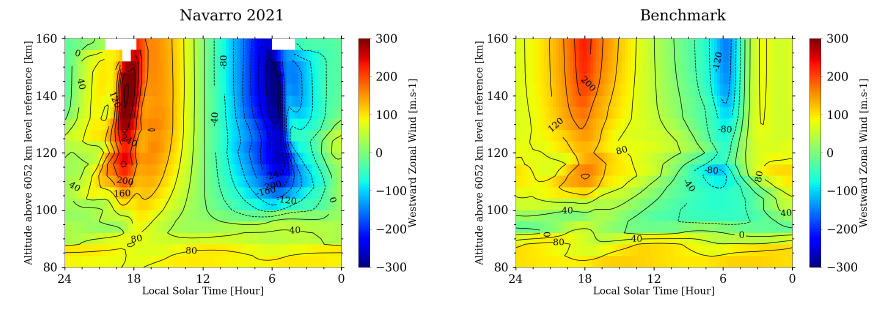
Modeling the region between 80 and 130 km, that marks the transition between superrotation regime in the deep atmosphere and the day-to-night circulation in the thermosphere, is a key step towards understanding the processes governing Venusian dynamics. Recent V-PCM improvements presented in [2] and [3] focused on Venus’s atmosphere above 130 km, and performed a comprehensive validation of model results with PVO, Magellan and VEX observations in the thermosphere and ionosphere. However, those model developments, together with ad-hoc tuning of parameters (see [2] for details) to fit observational data, changed dramatically the global circulation in the transition region in comparison to [1], as illustrated in Fig. 1. It was therefore necessary to carry out a follow-up to the study by [1].

Figure 1: Zonal wind around the equator (latitude 20ºS-20ºN) in local time and altitude predicted by the V-PCM in [1] (leftside) and [2,3] (rightside).


Sensitivity tests of unconstrained parameters of gravity waves

Among the processes studied here, gravity waves are an important source of variability, but they remain extremely poorly constrained by observations. Non-orographic gravity waves are generated in the convective layer of clouds. They will propagate upwards where they will eventually break above 90 km, injecting their momentum into the mesosphere/thermosphere, which will affect wind circulation. In this abstract, we present the cases of two key parameters: the initial amplitude of the GW and the dissipation parameter. In our scheme, the dissipation parameter ensures that the waves are dissipated before reaching the top of the model, and is intended to mimic the dissipation of GW at high altitude.

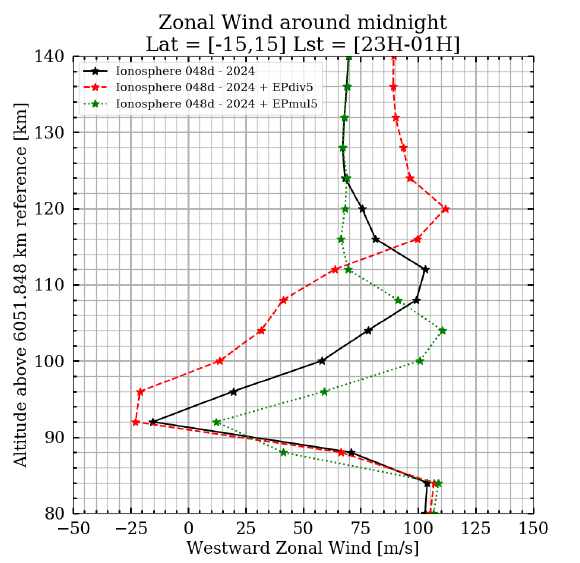
We found that this region (80-130 km) is very sensitive to the unconstrained parameters used in the non-orographic gravity wave parameterization implemented in the V-PCM [2,4]. For instance, the remnant superrotation (~100 m/s) simulated by the V-PCM peaks between 100 and 125 km, depending on the amplitude of non-orographic GW (see Figure 2). Decreasing the initial GW amplitude seems to reduce the retrograde supperrotative component between 90 and 110 km altitude.

Figure 2:  Zonal wind profiles around the anti-solar point simulated with the reference V-PCM [2,3] (in black) and varying the maximum EP-flux amplitude in the GW parameterization by a factor x5 (EPmul5) and /5 (EPdiv5).

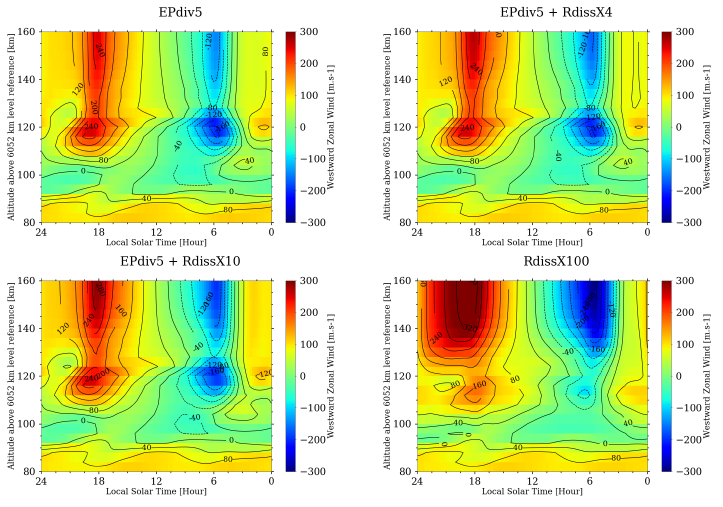
Figure 3 shows simulated zonal wind between 80 and 160 km in the equatorial region as function of local time for several GW configurations. By varying this diffusion parameter by a factor of 0.1 to 100 around our reference value, we see that the larger this parameter, the lower the altitude at which gravity waves begin to dissipate, as expected. However, this explored range of Rdiss values had no effect on the horizontal and vertical positioning of the O2(Δg) emission peak around 100 km. We found, however, a reduction in RSZ remanent around 110 km and larger zonal winds at the terminators with increasing Rdiss (see Fig. 3). This is also associated with an increase in temperature around the antisolar area, linked to an increase in adiabatic heating caused by a stronger downward vertical wind.


Figure 3: Zonal wind in local time and altitude predicted by VPCM tuning GW parameters (Rdiss is the diffusion parameter and EPflux is the amplitude of the non-orographic GW).


Acknowledgements

G.G. and A.M. acknowledge financial support from Junta de Andalucía through the program EMERGIA 2021 (EMC21 00249). AS and LML are funded by the Spanish MCIU, the AEI and EC-FEDER funds under project PID2021-126365NB-C21. IAA-team also acknowledges financial support from the Severo Ochoa grant CEX2021-001131-S funded by MCIN/AEI/ 10.13039/501100011033. This work was partly funded by project AST22_00001_23 from the European Union- NextGenerationEU, the Spanish Ministry of Science, Innovation and Universities, the Plan de Recuperación y Resiliencia, the Agencia Estatal Consejo Superior de Investigaciones Científicas and the Consejería de Universidad, Investigación e Innovación de la Junta de Andalucía. 


References:

[1] Navarro et al. Icarus, 366:114400, https://doi.org/10.1016/j.icarus.2021.114400

[2] Martinez et al. 2023 Icarus, 389, 115272, https://doi.org/10.1016/j.icarus.2022.115272

[3] Martinez et al. 2024, Icarus 415, 116035, https://doi.org/doi:10.1016/j.icarus.2024.116035.

[4] Gilli et al. 2021, Icarus, 366:114432, https://doi.org/10.1016/j.icarus.2021.114432

How to cite: Martinez, A., Gilli, G., Stolzenbach, A., Navarro, T., Lebonnois, S., González-Galindo, F., Lefevre, F., Streel, N., and Lara, L. M.: Impact of unconstrained parameters on the global dynamics in the “transition region” of Venus atmosphere with the Venus PCM, EPSC-DPS Joint Meeting 2025, Helsinki, Finland, 7–13 Sep 2025, EPSC-DPS2025-1424, https://doi.org/10.5194/epsc-dps2025-1424, 2025.

10:06–10:18
|
EPSC-DPS2025-1791
|
ECP
|
On-site presentation
Chizuru Nose, Kei Masunaga, Fuminori Tsuchiya, Shotaro Sakai, Yasumasa Kasaba, Ichiro Yoshikawa, Atsushi Yamazaki, Go Murakami, Tomoki Kimura, Hajime Kita, Jean-Yves Chaufray, and Francois Leblance

Introduction

One of the outstanding questions regarding Venus is whether the planet once retained a significant amount of water. Observations of hydrogen atoms provide critical insights into atmospheric escape processes. Previous studies using Venus Express/SPICAV indicate that the Venusian hydrogen atmosphere consists of two distinct components characterized by different scale heights: a hot component and a cold component [1]. The hot hydrogen component primarily arises from charge exchange reactions and momentum transfer between cold hydrogen atoms and ionospheric ions [2]. Conversely, the cold component originates from the dissociation of sulfuric acid in the lower atmosphere. It is well known that, due to the absence of an intrinsic magnetic field, Venusian atmosphere interacts directly with the solar wind. However, it remains unclear whether the Venusian hydrogen corona dynamically responds to variations in solar wind conditions.

Observation

To address this question, we analyzed variations in global hydrogen column densities derived from the brightness of resonantly scattered Ly-α (121.6 nm) and Ly-β (102.6 nm) emissions observed by Hisaki[3-5], solar wind velocities and densities measured by ASPERA-4 on Venus Express[6], and solar UV irradiance at Ly-α and Ly-β wavelengths obtained from the Flare Irradiance Spectral Model (FISM) for Planets[7]. The analysis periods spanned March 9 to April 3, 2014 (Period1), and April 25 to May 23, 2014 (Period2). High-speed solar wind events were confirmed during Period1 but not during Period2.

Result

We derived variations in hydrogen column density at altitudes above approximately 310 km and 90 km from the observed Ly-α and Ly-β airglow brightness. Figure 1 shows that after the arrival of high-speed solar wind originating from a corotating interaction region (CIR) in Period1, the hydrogen column density derived from Ly-α increased by approximately 18% within a few days and subsequently remained nearly constant for several weeks. In contrast, the hydrogen column density derived from Ly-β remained relatively stable throughout the same period. Differences between Ly-α and Ly-β brightness suggest an increase in hydrogen atom abundance at higher altitudes during high-speed solar wind events. In Period 2, when no significant increase in both solar wind velocity and density was observed, there was no clear indication of the arrival of a corotating interaction region. During this period, the hydrogen column density remained nearly constant for both Ly-α and Ly-β.

Figure1 (a and b)Times series of column densities of Venusian hydrogen atoms derived from Ly-α and Ly-β observed by Hisaki respectively. The red line indicates the 1-day moving average. (c and d) Solar wind velocity and density respectively observed by Venus Express.


Discussion

A possible explanation for the observed ~18% variation in Ly-α emission is an increase in high altitude hot hydrogen abundance due to charge exchange reactions and momentum transfer between neutral hydrogen and ionospheric ions. By considering charge exchange between cold hydrogen and ionospheric ions as a production process, and charge exchange between hot hydrogen and the solar wind as a loss process, we estimated the reaction timescales and found consistency with the observed variation. Alternative explanations include an increase in low-altitude cold hydrogen abundance or a rise in hydrogen temperature. These findings provide important implications for understanding non-thermal hydrogen escape mechanisms, thus contributing significantly to our knowledge of the atmospheric evolution of Venus.


[1] Chaufray, J. Y., et al., Icarus, 217, 2, 767, 2012

[2] Hodges, R. R., and E. L. Breig, Journal of Geophysical Research: Space Physics, 96, 7697, 1991

[3] Yoshikawa, I., et al., Space Science Reviews, 184, 237, 2014

[4] Yoshioka, K., et al., Planetary and Space Science, 85, 250, 2013

[5] Yamazaki, A., et al., Space Science Reviews, 184, 259, 2014

[6] Barabash, S., et al., Planetary and Space Science, 55, 12, 1772, 2007

[7] Chamberlin, P. C., et al., Space Weather, 6., S05001, 2008


How to cite: Nose, C., Masunaga, K., Tsuchiya, F., Sakai, S., Kasaba, Y., Yoshikawa, I., Yamazaki, A., Murakami, G., Kimura, T., Kita, H., Chaufray, J.-Y., and Leblance, F.: Influence of the solar wind on the Venusian hydrogen in upper atmosphere observed by Hisaki, EPSC-DPS Joint Meeting 2025, Helsinki, Finland, 7–13 Sep 2025, EPSC-DPS2025-1791, https://doi.org/10.5194/epsc-dps2025-1791, 2025.

10:18–10:30
|
EPSC-DPS2025-768
|
On-site presentation
Jean-Yves Chaufray, Shane Carberry Mogan, and Justin Deighan

Abstract

We present a new derivation of the hot oxygen density in the Venusian upper exosphere from Pioneer Venus Orbiter ultraviolet spectrometer, considering the effect of the solar photons backscattered by the oxygen atoms below ~ 300 km (Venus shine), not included in past analysis. The Venus shine increases the volume emissivity of the hot oxygen corona by ~60% compared to the direct illumination and the O I 130.4 nm brightness measured by PVO with a hot oxygen is reproduced with adensity reduced by 1.6 compared to the density derived without the Venus shine.

Introduction

At the surface of Venus, the atmosphere is predominantly composed of CO2 but, above ~150 km,  O, generated through the photodissociation of CO2 [1] and dissociative recombination of O2+ becomes dominant [2]. Solar EUV photons not only dissociate neutral molecules in the thermosphere but also ionize them, driving the formation of Venus’ ionosphere. The dominant ion in the Venusian ionosphere is O2+ produced from reactions between CO2+ and O [3]. The major sink of O2+ is dissociative recombination, which produced two energetic atoms. These energetic atoms were first observed in the exosphere of Venus by the PVO ultraviolet spectrometer (UVS) between ~400 – 1600 km [4]. However, these values were derived considering only the direct solar illumination of the oxygen corona above 400 km as the source of O I 1304 emission not the photons resonantly backscattered by the cold oxygen atoms (Venus shine) [5]. In this work, we include the Venus shine.

Model

We use a radiative transfer model, used in the past to study the Martian hot oxygen corona [6]. This model considers spherically symmetric cold and hot oxygen densities and use a Monte Carlo approach to compute the O I 1304 resonant scattering. Test particles, representative of the solar photons in the 130.4 nm triplet [7] are followed inside the Venusian thermosphere and exosphere. The spectral emission volume rate ε(r,λ,i) at the position r and wavelength λ of each line i of the triplet is the sum of five terms:

ε(r,λ,i)=ε0,c(r,λ,i)+εm,c(r,λ,i)+ε0,h(r,λ,i)+εs,h(r,λ,i)+εm,h(r,λ,i)

The two first terms are the single scattering and multiple scattering terms of the cold oxygen. The three last terms are the single scattering (photons scattered for the first time by a hot oxygen atom and not before), “shine term” (photons scattered for the first time by a hot oxygen atom but scattered one or several times by a cold oxygen before) and multiple scattering terms (photons scattered several times by a hot oxygen atom) for the hot oxygen.

Results and discussion

The shine term of the hot population, using the density profiles from [4] and normalized by the g-factor is not negligible compared to the single scattering term on the dayside below 2000 km but decreases faster with altitude (Fig. 1)

Fig. 1 (left) Altitude profile for the single-scattering (blue), multiple-scattering (red), and shine from the cold oxygen (green) volume emission rate (normalized by the g-factor) at SZA=0° of the hot oxygen. The hot oxygen density is indicated by the black line. (right) Variations of the same volume emission rates with the solar zenith angle for an altitude near 600 km.


Above ~400 km, the volume emission rate of the cold population is negligible and the brightness I(z) along the line of sight can be simplified by

I(z) ≈∑∫∫[ε0,h(r,λ,i)+εs,h(r,λ,i)]dsdλ ≈gexc∫[1+Gc(s)]nhot(s)ds,

where Gc is the ratio between the “shine” term and the single scattering term, and nhot(s) the density of hot oxygen.

The simulated brightness using the hot oxygen density derived by [4] with and without the shine term are compared to the observed brightness, showing that when the shine term is considered, the hot oxygen density derived by [4] is not in agreement with the observations. This hot density must be reduced by ~ 1.6 to agree with the observations when the shine term is considered (Fig. 2)

Figure 2. Simulated brightness vertical profile, when the shine term is neglected (solid green line) and included (solid red line) obtained with the hot oxygen density from [3]. The simulated profile including the shine term but with a hot oxygen density divided by 1.6 is also represented (red dashed line). The PVO-UVS data fit from [4] is represented by the black diamonds and the fit from [5] is represented by the black triangles.

This reduced density underscores the need to revisit previous models of hot oxygen corona [8, 9, 10]. Indeed, as shown by [8], the inclusion of non-elastic collisions can lead to a more efficient thermalization. These authors found that the simulated hot oxygen was underestimated compared to the PVO observations [3]. The new inferred density, including the Venus shine, could help to reconcile this simulation with the observation.

Conclusion

We revised the hot oxygen density in the Venusian upper atmosphere derived from Pioneer Venus Orbiter by using an updated radiative transfer model including the Venusian shine emission. This correction increases the excitation frequency of the hot atoms. Then, the oxygen density needed to reproduce the observations is reduced by 1.6 compared to the past derived density. This reduction requires reassessing key assumptions in exospheric models, particularly the roles of inelastic collisions of the hot oxygen with the atmosphere. Indeed, these collisions would increase the thermalization of the hot oxygen and then reduce their density that could match better the new derived density.

Acknowledgements

JYC is supported by the Programme National de Planétologie (PNP, France) of CNRS-INSU co-funded by CNES and Programme National Soleil Terre (PNST, France) of CNRS-INSU co-funded by CNES and CEA

References

[1] Martinez, A., et al. (2023), Icarus, 389, 115272, doi:10.1016/j.icarus.2022.115272

[2] Martinez, A., et al. (2024), Icarus, 415, 116035, doi :10.1016/j.icarus/2024.116035

[3] Fox, J., and Sung, K.Y., (2001) JGR, 106, 21,305-21,336, doi:10.1029/2001JA000069

[4] Nagy, A..F., et al., (1981), Geophys. Res. Lett., 8, 629-632

[5] Paxton, L.J., and Anderson, D.E., (1992), Geophysical Monograph, 66

[6] Chaufray, J-Y et al. (2016), JGR, 121, 11,413-11,421, doi:10.1002/2016JA023273

[7] Gladstone, G.R., (1992), J. Geophys. Res., 97, 19,519-19,525

[8] Gröller, H., et al. (2010), J. Geophys. Res., 115, E12017, doi:10.1029/2010JE003697

[9] Tenishev, V. et al. (2022), JGR : Space Phys., 127 ,doi:10.1029/2021JA030168

[10] Hodges Jr., R.R, (2000), J. Geophys. Res., 105, 6971-6981

How to cite: Chaufray, J.-Y., Carberry Mogan, S., and Deighan, J.: Effect of the planet shine on the corona: Application to the Venusian hot oxygen, EPSC-DPS Joint Meeting 2025, Helsinki, Finland, 7–13 Sep 2025, EPSC-DPS2025-768, https://doi.org/10.5194/epsc-dps2025-768, 2025.

Orals WED-OB3: Wed, 10 Sep, 11:00–12:30 | Room Sun (Finlandia Hall)

Chairpersons: Fabrizio Oliva, Anni Määttänen
Mars water cycle and clouds
11:00–11:12
|
EPSC-DPS2025-1352
|
ECP
|
On-site presentation
Ananya Krishnan and Özgür Karatekin

The existence of carbon dioxide (CO₂) clouds in the Martian atmosphere necessitates extremely low temperatures for formation and was initially observed during polar night at low altitudes. Later observations revealed similar clouds at higher altitudes near the equator, especially during spring and summer [1]. Further evidence has shown their occurrence at northern mid-latitudes and in the southern hemisphere during late autumn. Unlike water vapour clouds, which form from a minor atmospheric component, CO₂ clouds are composed of a major atmospheric constituent. The polar CO₂ clouds are convective in nature. Data from multiple missions indicate that the temperature profiles in the polar regions often align with the CO₂ saturation curve up to 30 km, implying that CO₂ condensation helps regulate these temperatures. Significant cloud opacity between 0 and 25 km altitude also supports the presence of CO₂ clouds.

Figure 1: Formation of CO2 clouds in the Martian atmosphere [2].

Data from the Pathfinder mission indicate that CO₂ exceeded saturation levels during equatorial descent phases at altitudes near 80 km, implying that CO₂ cloud formation in equatorial regions may occur at significantly higher altitudes compared to polar regions [3]. The genesis of these high-altitude equatorial CO₂ clouds is modulated by conditions in the Martian mesosphere. Notably, mesospheric temperatures can drop well below the CO₂ condensation threshold, particularly near aphelion, when diurnal atmospheric tides promote additional cooling conducive to cloud formation. Furthermore, high-altitude CO₂ cloud formations were detected at solar longitudes between 264° and 330°, located above 90 km in altitude [4]. These clouds exhibit limited horizontal extent, spanning approximately 500 to 700 km.

This study investigates Martian CO2 cloud formations and their duration during the Northern Hemisphere winter and dust season. For this, we use the open-access data from the Mars Climate Sounder (MCS) on board the Mars Reconnaissance Orbiter (MRO) as well as Mars Express (MEX) and Mars Atmosphere and Volatile EvolutioN (MA VEN) radio occultation (RO) to detect clouds in the atmosphere. We also explore the inter-annual variations to see the impact of dust storms on CO2 cloud formation.

Figure 2: Examples of MCS temperature profiles (blue) with the CO2 saturation curve [5].

References:

[1] Määttänen A. et al. (2010), Icarus, 209(2) :452–469.

[2] Mars Climate Modelling Centre. GCM overview: Lecture, November 2021.

[3] Schofield J. T. et al. (1997), Science, 278(5344) :1752–1758.

[4] Jiang F. Y. et al. (2019), GRL, 46(14) :7962–7971.

[5] Mathilde V. (2024), Master Thesis, Université Catholique de Louvain, Belgium.

How to cite: Krishnan, A. and Karatekin, Ö.: Martian CO2 cloud formation as observed by MCS and radio occultation, EPSC-DPS Joint Meeting 2025, Helsinki, Finland, 7–13 Sep 2025, EPSC-DPS2025-1352, https://doi.org/10.5194/epsc-dps2025-1352, 2025.

11:12–11:24
|
EPSC-DPS2025-932
|
On-site presentation
Franck Montmessin, Anna Fedorova, Loïc Verdier, Oleg Korablev, Franck Lefèvre, Alexander Trokhimovskiy, Elise W. Knutsen, Gaétan Lacombe, Lucio Baggio, Marco Giuranna, and Paulina Wolkenberg

Water vapor has long been a key target in Martian exploration, as its detection confirmed the existence of an active water cycle driven by dynamic exchanges between surface ice reservoirs and the atmosphere. Since its first spectroscopic identification in 1963, ongoing observations—most notably from orbiting spacecraft—have significantly advanced our understanding of the spatial and temporal behavior of water on Mars.

In this study, we present a comprehensive climatology of water vapor column abundances spanning 11 Martian years (MY), derived from observations by the Spectroscopy for the Investigation of the Characteristics of the Atmosphere of Mars (SPICAM) instrument aboard the European Space Agency’s Mars Express mission [1]. Operating in nadir, SPICAM measures the near-infrared sunlight reflected from the Martian surface and atmosphere, providing daytime water vapor data with broad seasonal and latitudinal coverage. However, due to its reliance on solar illumination, SPICAM is unable to probe the polar night, where water vapor is predicted to be extremely scarce and mostly below the instrument’s detection threshold.

Despite the limitations imposed by the orbital configuration of Mars Express—which results in uneven spatial and temporal coverage—SPICAM has successfully monitored the Martian atmosphere across nearly all seasons and latitudes during local daytime conditions. This long-term dataset offers a unique opportunity to study interannual variability in the water cycle, including responses to major atmospheric perturbations.

Our climatology includes two Martian years that experienced Global Dust Events (GDEs), allowing us to conduct a preliminary assessment of how such planet-encircling storms impact water vapor distribution. We also perform cross-comparisons with water vapor datasets from other past and ongoing missions, addressing a long-standing challenge in reconciling inter-mission measurements.

To enhance the completeness of the climatology, we apply the kriging method—a well-established geostatistical interpolation method based on Gaussian process regression—to estimate water vapor values in regions and seasons with sparse coverage. This gap-filling enables a more continuous picture of the Martian water cycle and facilitates the analysis of year-to-year variability.

Finally, by averaging over the full 11-MY dataset, we construct a reference annual cycle of water vapor on Mars, which serves as a baseline for future comparisons, model validation, and the identification of anomalous behavior.

To further improve the accuracy and vertical sensitivity of water vapor retrievals, we also incorporate results from a synergistic retrieval approach developed by [2] and [3] This method combines simultaneous nadir-pointing observations from SPICAM (in the near-infrared) and the Planetary Fourier Spectrometer (PFS, in the thermal infrared), both aboard Mars Express. Individually, each instrument is sensitive to different portions of the atmospheric column—SPICAM to the lower atmosphere under illuminated conditions, and PFS to higher altitudes through thermal emission. When used together in a joint retrieval framework, they offer a more complete and vertically constrained view of water vapor distribution than either instrument alone.

The synergy method thus yields more accurate water vapor column abundances and enables the first nadir-based estimates of vertical partitioning of water vapor—an aspect traditionally inaccessible to single-instrument nadir retrievals. The resulting composite dataset, which spans almost the entire SPICAM survey, has proven to be highly robust and serves as an important reference for climatological studies. Notably, the synergy also reveals significant discrepancies with predictions from the Mars Climate Database, especially in the northern hemisphere during summer, highlighting potential limitations in current models of water vapor transport and vertical confinement.

Finally, in addition to nadir observations, SPICAM also conducted measurements in solar occultation mode [4], which allowed the retrieval of vertical profiles of water vapor at high vertical resolution (~1–2 km), primarily during the twilight terminator. These observations complement the nadir dataset by providing a window into the vertical structure of water vapor in the lower and middle atmosphere (typically from 10 to 70 km), including its diurnal variations and seasonal evolution. Solar occultation data are especially valuable in characterizing the hygropause altitude, tracking the seasonal ascent and descent of water vapor, and capturing sharp vertical gradients during northern summer, when water transport to high altitudes is most active.

This work not only contributes to a more detailed understanding of Mars’ water cycle dynamics but also provides critical observational constraints for atmospheric models and climate evolution studies.

[1] Montmessin, F., Korablev, O., Lefèvre, F., Bertaux, J.-L., Fedorova, A., Trokhimovskiy, A., et al. (2017). SPICAM on Mars Express: A 10 year in-depth survey of the Martian atmosphere. Icarus, 297, 195–216. https://doi.org/10.1016/j.icarus.2017.06.022 

[2] Montmessin, F., & Ferron, S. (2019). A spectral synergy method to retrieve martian water vapor column-abundance and vertical distribution applied to Mars Express SPICAM and PFS nadir measurements. Icarus, 317, 549–569. https://doi.org/10.1016/j.icarus.2018.07.022

[3] Knutsen, E. W., Montmessin, F., Verdier, L., Lacombe, G., Lefèvre, F., Ferron, S., et al. (2022). Water Vapor on Mars: A Refined Climatology and Constraints on the Near‐Surface Concentration Enabled by Synergistic Retrievals. Journal of Geophysical Research: Planets, 127(5). https://doi.org/10.1029/2022JE007252

[4] Fedorova, A., Montmessin, F., Korablev, O., Lefèvre, F., Trokhimovskiy, A., & Bertaux, J. (2021). Multi‐Annual Monitoring of the Water Vapor Vertical Distribution on Mars by SPICAM on Mars Express. Journal of Geophysical Research: Planets, 126(1). https://doi.org/10.1029/2020JE006616

How to cite: Montmessin, F., Fedorova, A., Verdier, L., Korablev, O., Lefèvre, F., Trokhimovskiy, A., Knutsen, E. W., Lacombe, G., Baggio, L., Giuranna, M., and Wolkenberg, P.: Mars water cycle: an 11 Mars year climatology of water vapor by SPICAM on Mars Express, EPSC-DPS Joint Meeting 2025, Helsinki, Finland, 7–13 Sep 2025, EPSC-DPS2025-932, https://doi.org/10.5194/epsc-dps2025-932, 2025.

11:24–11:36
|
EPSC-DPS2025-834
|
ECP
|
On-site presentation
Mirai Kobayashi, Takeshi Kuroda, François Forget, Arihiro Kamada, Hiroyuki Kurokawa, Shohei Aoki, Akira Kazama, Hiromu Nakagawa, and Naoki Terada

Water is an important component of the atmosphere. Most of the water vapor of Mars exists in its lower atmosphere, including the planetary boundary layer, where the water vapor exchanges between the surface and the atmosphere. The regolith, which is a loose, unconsolidated material consisting of fine dust, sand, and fragmented rock at the planetary surface, has a water-adsorbing property (Fanale & Cannon, 1971; Zent & Quinn, 1995). 1-D model simulations suggest that the water vapor exchange between the regolith and the atmosphere through adsorption affects the diurnal variations of water vapor near the surface and obtain good agreement with lander observations (Zent et al., 1993; Savijärvi et al., 2016, 2019; Savijärvi & Harri, 2021). However, the observation of the daytime water vapor column map suggests that water is not well mixed in the atmosphere, with a significant part of the water vapor column apparently not influenced by the topography (Smith, 2002, Fouchet et al., 2007) as it should be if it were well mixed. This could be explained by an enrichment near the surface, possibly related to water exchanges with the regolith, or by an enrichment well above the surface, for instance, below the cloud level where ice sublimes (Fouchet et al., 2007). This study investigates the effects of the water vapor exchange between the regolith and the atmosphere to explain the observed spatial distribution of the atmospheric water vapor column.

This study uses a Mars Global Climate Model (MGCM) fully coupled with a regolith model. Our MGCM traces the Martian seasonal water cycle, including seasonal water ice caps and frost formation, turbulent flux in the atmospheric boundary layer (Kuroda et al, 2005, 2013), and simple cloud formation based on the large-scale condensation (Montmessin et al., 2004). The regolith model calculates water vapor diffusion, adsorption, and condensation in the regolith, using an adsorption coefficient as a free parameter (Kobayashi et al., 2025). The adsorption isotherm of Jakosky et al. (1997) is used to obtain the adsorbed water amount in the regolith, and the isotherm assumes palagonite on Mars. We examine several adsorption coefficients including zero (only considering pore ice) and the inhomogeneous adsorption coefficient using the regolith property model (Kobayashi et al., 2025). The annual mean water flux in high latitudes, where stable ice tables thermodynamically exist, is less than 10-10 kg m-2 s-1 because pore ice fills pores and prevents water transport. We use the atmospheric water vapor column abundance normalized to a fixed pressure of 610 Pa to remove the effect of topography (Smith, 2002).

The subsurface layers are initialized with the subsurface water amount obtained from a spin-up run without the regolith-atmosphere interaction for approximately tens of thousands of Martian years. With the globally homogeneous adsorption coefficient, the subsurface adsorbed water amount increases with latitudes up to ±60° (corresponding to the annual mean surface temperature of 195 K) and rapidly decreases in higher latitudes. With the inhomogeneous adsorption coefficient, the subsurface adsorbed water amount is strongly controlled by the adsorption coefficient, leading to higher adsorbed water in areas of higher adsorption coefficient. We used those results as initial conditions of the subsurface water amount for the following simulations of the regolith-atmosphere interaction.

Our results show that a larger source of adsorbed water in the regolith supplies more water vapor into the atmosphere, with a small adsorption coefficient dependence. The daytime water vapor normalized to 610 Pa anti-correlates with the surface pressure and with thermal inertia in some seasons. The anti-correlations with the surface pressure and with thermal inertia are very slightly strengthened by the regolith-atmosphere interaction. There results indicate that the regolith adsorption contributes to the not-well mixed condition in the Martian lower atmosphere, and the effect is smaller than expected. The exchanged water flux at the surface in our simulation is approximately 10-10-10-9 kg m-2 s-1, corresponding to 10-2-10-1 pr-µm per 1 sol and increasing polewards, for any adsorption coefficient. Thus, we estimate that the regolith-atmosphere interaction integrated over hundreds of sols affects the change of up to several precipitable microns, and the amount becomes smaller due to transport. The magnitude is small or comparable to the sensitivity of the orbital observations nowadays (Fouchet et al., 2007). We conclude that the anti-correlation of water vapor with the surface pressure and with thermal inertia would not be fully explained by the regolith-atmosphere interaction alone, and it would be necessary to focus on transport near the ground surface.

How to cite: Kobayashi, M., Kuroda, T., Forget, F., Kamada, A., Kurokawa, H., Aoki, S., Kazama, A., Nakagawa, H., and Terada, N.: Effects of regolith-adsorption on the spatial distribution of the atmospheric water vapor simulated with a Mars GCM, EPSC-DPS Joint Meeting 2025, Helsinki, Finland, 7–13 Sep 2025, EPSC-DPS2025-834, https://doi.org/10.5194/epsc-dps2025-834, 2025.

11:36–11:48
|
EPSC-DPS2025-1600
|
ECP
|
On-site presentation
Jorge Hernandez-Bernal, Anni Määttänen, Aymeric Spiga, and François Forget

Homogeneous nucleation has not been considered a possibility in cloud formation processes in the atmosphere of Mars (e.g. Clancy et al., 2017), since Määttänen et al. (2005) made a careful analysis that indicated that extreme supersaturations in the order of 10⁵ were required. Such extreme supersaturations were considered unlikely, especially because the abundant dust in the atmosphere of Mars was expected to deplete water in excess of saturation very quickly by heterogeneous nucleation.

The Arsia Mons Elongated Cloud (AMEC) is an eye-catching and mysterious cloud occurring recurrently every morning during the perihelion season over the Arsia Mons volcano on Mars (Hernández-Bernal et al., 2021). It shows a peculiar elongated shape that in only 3 hours expands up to 1800 km from its origin point. Hernández-Bernal et al. (2022) investigated this cloud based on the LMD Mars Mesoscale model (Spiga and Forget, 2009). The tail of the cloud was not reproduced in the model, but a cold pocket with temperatures down to 30K below the environment and supersaturation up to 105 appeared next to Arsia Mons, in a position, altitude, and local time and season coincident with the origin point of the AMEC in observations. 

In this work we show that these are conditions conducive to homogeneous nucleation, and when we introduce this process as a new cloud formation process in the LMD Mars Mesoscale model, we obtain a good representation of the AMEC, and its long tail.

This provides an excellent explanation for this mysterious cloud and shows that homogeneous nucleation is possible and can have significant effects in the atmosphere of Mars, contrary to the widespread assumptions during the last twenty years of Mars exploration. The finding of supersaturations up to 108 in the surveys performed by Fedorova et al. (2020; 2023) observationally supports that these extreme supersaturations can indeed happen in the atmosphere of Mars and homogeneous nucleation could be happening in other clouds. As a first example, we find that the Perihelion Cloud Trails (Clancy et al., 2009; 2021) could be the result of homogeneous nucleation, as our mesoscale model also predicts cold pockets spatially coincident with locations where Clancy et al. observed cloud trails. We intend to explore these and other clouds on Mars possibly involving homogeneous nucleation.


References:

  • Clancy, R. T., Wolff, M. J., Cantor, B. A., Malin, M. C., & Michaels, T. I. (2009). Valles Marineris cloud trails. Journal of Geophysical Research: Planets, 114(E11). https://doi.org/10.1029/2008JE003323 
  • Clancy, R., Montmessin, F., Benson, J., Daerden, F., Colaprete, A., & Wolff, M. (2017). Mars Clouds. In R. Haberle, R. Clancy, F. Forget, M. Smith, & R. Zurek (Eds.), The Atmosphere and Climate of Mars (Cambridge planetary science (pp. 76–105). Cambridge: Cambridge University Press. https://doi.org/10.1017/9781139060172.005 
  • Clancy, R. T., Wolff, M. J., Heavens, N. G., James, P. B., Lee, S. W., Sandor, B. J., ... & Spiga, A. (2021). Mars perihelion cloud trails as revealed by MARCI: Mesoscale topographically focused updrafts and gravity wave forcing of high altitude clouds. Icarus, 362, 114411. https://doi.org/10.1016/j.icarus.2021.114411 
  • Määttänen, A., Vehkamäki, H., Lauri, A., Merikallio, S., Kauhanen, J., Savijärvi, H., & Kulmala, M. (2005). Nucleation studies in the Martian atmosphere. Journal of Geophysical Research: Planets, 110(E2). https://doi.org/10.1029/2004JE002308 
  • Fedorova, A. A., Montmessin, F., Korablev, O., Luginin, M., Trokhimovskiy, A., Belyaev, D. A., ... & Wilson, C. F. (2020). Stormy water on Mars: The distribution and saturation of atmospheric water during the dusty season. Science, 367(6475), 297-300. https://doi.org/10.1126/science.aay9522 
  • Fedorova, A., Montmessin, F., Trokhimovskiy, A., Luginin, M., Korablev, O., Alday, J., ... & Shakun, A. (2023). A two‐Martian years survey of the water vapor saturation state on Mars based on ACS NIR/TGO occultations. Journal of Geophysical Research: Planets, 128(1), e2022JE007348. https://doi.org/10.1029/2022JE007348 
  • Hernández‐Bernal, J., Sánchez‐Lavega, A., del Río‐Gaztelurrutia, T., Ravanis, E., Cardesín‐Moinelo, A., Connour, K., ... & Hauber, E. (2021). An extremely elongated cloud over Arsia Mons volcano on Mars: I. Life cycle. Journal of Geophysical Research: Planets, 126(3), e2020JE006517. https://doi.org/10.1029/2020JE006517 
  • Hernández‐Bernal, J., Spiga, A., Sánchez‐Lavega, A., del Río‐Gaztelurrutia, T., Forget, F., & Millour, E. (2022). An extremely elongated cloud over Arsia Mons volcano on Mars: 2. Mesoscale modeling. Journal of Geophysical Research: Planets, 127(10), e2022JE007352. https://doi.org/10.1029/2022JE007352 
  • Spiga, A., & Forget, F. (2009). A new model to simulate the Martian mesoscale and microscale atmospheric circulation: Validation and first results. Journal of Geophysical Research: Planets, 114(E2). https://doi.org/10.1029/2008JE003242 

How to cite: Hernandez-Bernal, J., Määttänen, A., Spiga, A., and Forget, F.: Homogeneous nucleation on Mars. An unexpected process that deciphers mysterious elongated clouds, EPSC-DPS Joint Meeting 2025, Helsinki, Finland, 7–13 Sep 2025, EPSC-DPS2025-1600, https://doi.org/10.5194/epsc-dps2025-1600, 2025.

11:48–12:00
|
EPSC-DPS2025-1495
|
ECP
|
On-site presentation
Aurélien Stcherbinine, Franck Montmessin, Lucio Baggio, Mathieu Vincendon, Michael Wolff, Oleg Korablev, Anna Fedorova, Alexander Trokhimovskiy, and Gaetan Lacombe

Introduction

Water ice clouds play an important role in the Martian water cycle and climate as they are a major actor in the inter-hemispheric water exchange, and impact the atmospheric structure and temperature by absorbing and scattering the incoming solar radiation [1,2 and references contained within]. Thus, monitoring the spatial and temporal evolution of the Martian water ice clouds, along with their physical properties (crystal effective radius, opacity, and altitude) is of importance to improve our understanding and modeling of the current Martian climate.

Plus, we showed in [3] that the vertical structure of the clouds has a non-negligible impact on cloud optical depth retrievals performed from nadir measurements; and in [4] that the current climate models such as the Planetary Climate Model (PCM) [5] still tends to slightly underestimate the altitude of the water ice clouds. Thus, there is a need for a climatology of the vertical structure of the clouds to improve both the atmospheric models, and the nadir clouds surveys that are the main way to perform spatial and temporal surveys of water ice clouds on Mars [e.g., 6,7,8].

Data & Methods

The Atmospheric Chemistry Suite (ACS) Mid-InfraRed (MIR) channel is a high-resolution spectrometer dedicated to Solar Occultation geometry onboard the ExoMars Trace Gas Orbiter (TGO) ESA-Roscosmos spacecraft [9,10]. This observing geometry provides detailed vertical profiles of the atmospheric transmission. In this study, we use ACS-MIR observations acquired in the so-called position 12 of the secondary grating, which covers the 3.1–3.4 μm spectral range to retrieve the properties of the Martian water ice clouds from their 3 μm absorption band. Following the method described in [11,4], we extract the spectral continuum of the atmospheric transmission at each altitude observed by ACS-MIR (typical vertical resolution of ~2.5 km), then we perform an onion-peeling vertical inversion to retrieve the spectral extinction of each atmospheric layer, and we compare these spectra with models for water ice and dust particles of various sizes to identify the layers where water ice crystals are present, and get constraints on their effective radii.

At the time of the publication of [4] in 2022, we had a dataset containing 514 observations acquired between Ls=163° (MY 34) and Ls=181° (MY 36). Now, with two more years of data, we processed an extended dataset of ~1500 observations running until Ls=72° (MY 38). In addition, we use new data for ACS-MIR observations processed at LATMOS that provide better corrections from instrumental effects, which will help to strengthen again our results.

Results

The ACS-MIR clouds dataset now encompasses four Martian Years (MY 34 to 38), including the Global Dust Storm (GDS) event in the end of MY 34, and three "regular" years (i.e., without GDS) with several local dust storms. This allows us to monitor the behavior of the clouds as a function of season and latitude for several MY, and conduct inter-annual comparisons between the regular MY and the GDS of MY 34.

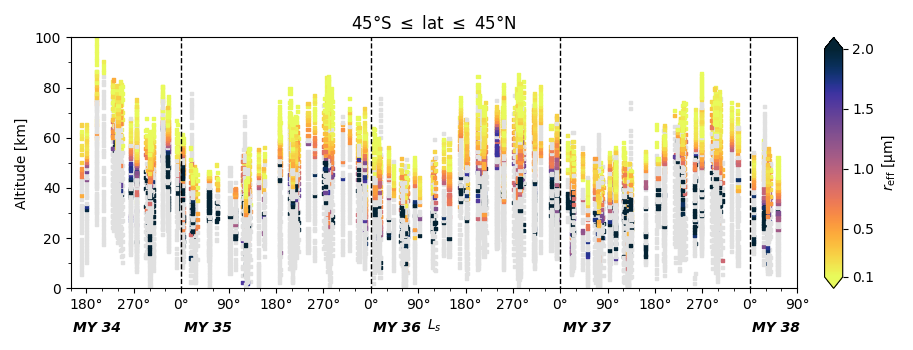
Figure 1 shows the vertical profiles of the water ice clouds obtained in the equatorial regions from Ls=163° (MY 34) to Ls=72° (MY 38). We can see that the altitude of the clouds typically varies by about 30–40 km over the year: they do not extend over 45 to 50 km around aphelion (Ls ~ 90°) but they can easily reach 80 km around perihelion (Ls ~ 270°). This pattern and altitudes are observed for MY 35 to 38, which highlights the unusual altitudes of the clouds during the GDS, where water ice crystals have been detected up to 100 km at Ls ~ 180°.

Figure 1 – Vertical profiles of water ice clouds in the Martian atmosphere as observed by ACS-MIR over mid-MY 34 (Ls=163°) to the beginnirg of MY 38 (Ls=72°) in the equatorial regions (latitudes between 45°S and 45°N), with their crystal size determined using the method described in [4]. Observations without water ice detections are in gray.

Conclusion & Perspectives

To conclude, we present here the results of the monitoring of the vertical distribution and properties of the Martian water ice clouds over more than three Martian Years by ACS-MIR, since the beginning of the science phase of TGO in April 2018. We now have access to a unique and rich dataset for the Martian clouds and climate science, which allows us to discuss the multi-annual evolution of the Martian water ice clouds, and to derive a new climatology of the vertical structure of the clouds in the atmosphere that will be of significant interest for helping to improve both the climate models and the retrievals performed using radiative transfer algorithm that currently relies on assumptions on the vertical distribution of the ice and aerosols in the atmosphere.

Acknowledgments

ExoMars is a space mission of ESA and Roscosmos. The ACS experiment is led by IKI Space Research Institute in Moscow. The project acknowledges funding by Roscosmos and CNES. Science operations of ACS are funded by Roscosmos and ESA. Science support in IKI is funded by Federal agency of science organization (FANO). Raw ACS data are available on the ESA PSA at https://archives.esac.esa.int/psa/#!Table%20View/ACS=instrument. ACS-MIR level 2B data are available on the LATMOS servers, as described at https://acs.projet.latmos.ipsl.fr/en/data. A. S. also acknowledges funding by CNES.

References

[1] Clancy et al. (2017) The Atmosphere and Climate of Mars, 76–105. [2] Montmessin et al. (2017) The Atmosphere and Climate of Mars, 338–373. [3] Stcherbinine et al. (2025) Icarus, 425, 116335. [4] Stcherbinine et al. (2022) JGR: Planets, 127, e2022JE007502. [5] Forget et al. (2022) 7th MAMO workshop. [6] Wolff et al. (2022) GRL, 49, e2022GL100477. [7] Smith et al. (2022) GRL, 49, e2022GL099636. [8] Atwood et al. (2024) Icarus, 418, 116148. [9] Korablev et al. (2018) SSR, 214(1), 7. [10] Trokhimovskiy et al. (2015) SPIE, 960808. [11] Stcherbinine et al. (2020) JGR: Planets, 125, e2019JE006300.

How to cite: Stcherbinine, A., Montmessin, F., Baggio, L., Vincendon, M., Wolff, M., Korablev, O., Fedorova, A., Trokhimovskiy, A., and Lacombe, G.: A three Martian years climatology of the vertical properties of Martian water ice clouds TGO/ACS-MIR, EPSC-DPS Joint Meeting 2025, Helsinki, Finland, 7–13 Sep 2025, EPSC-DPS2025-1495, https://doi.org/10.5194/epsc-dps2025-1495, 2025.

12:00–12:12
|
EPSC-DPS2025-626
|
On-site presentation
Juan Alday, Manish R. Patel, Franck Montmessin, Anna A. Fedorova, James Holmes, Guillaume Petzold, Lucio Baggio, Alexander Trokhimovskiy, Kevin S. Olsen, Denis Belyaev, Jonathon P. Mason, and Oleg Korablev

Introduction: Isotope ratios in water vapour provide key insights about the history of water on Mars and can help us unravel the fate of the large amounts of liquid water that once existed on the surface of early Mars [1]. A five-fold enrichment of the deuterium-to-hydrogen (D/H) ratio in Martian water vapour with respect to Earth suggests that a substantial amount of the water inventory escaped to space, but more quantitative estimates rely on a rigorous understanding of the relative escape between the light and heavy isotopes (e.g., [2]).

Atmospheric processes such as condensation or photolysis shape the vertical distribution of the water vapour isotopes [3,4] and in turn impact the relative supply of isotopes to the upper atmosphere, where they can escape through thermal and non-thermal processes [5]. Therefore, an in-depth understanding of the vertical distribution of the water vapour abundance and its isotopic fractionation is crucial for reconstructing the escape history of water on Mars.

In this study, we measure and model the vertical distribution of D/H and 18O/16O on Martian water vapour using infrared solar occultation observations from the Atmospheric Chemistry Suite (ACS) aboard the ExoMars Trace Gas Orbiter (TGO), together with simulations of the D/H and 18O/16O cycles on Mars from the Mars Planetary Climate Model (PCM).

TGO/ACS solar occultation observations: The mid-infrared (MIR) channel of ACS monitors the Martian atmosphere at high spectral resolution (λ/Δλ ≈ 30,000) within the spectral range 2.3-4.2 μm (~2400-4300 cm-1) in solar occultation mode [6]. To achieve high spectral resolution within the whole range, ACS MIR incorporates a secondary movable grating that allows the simultaneous selection of 7-25 diffraction orders.

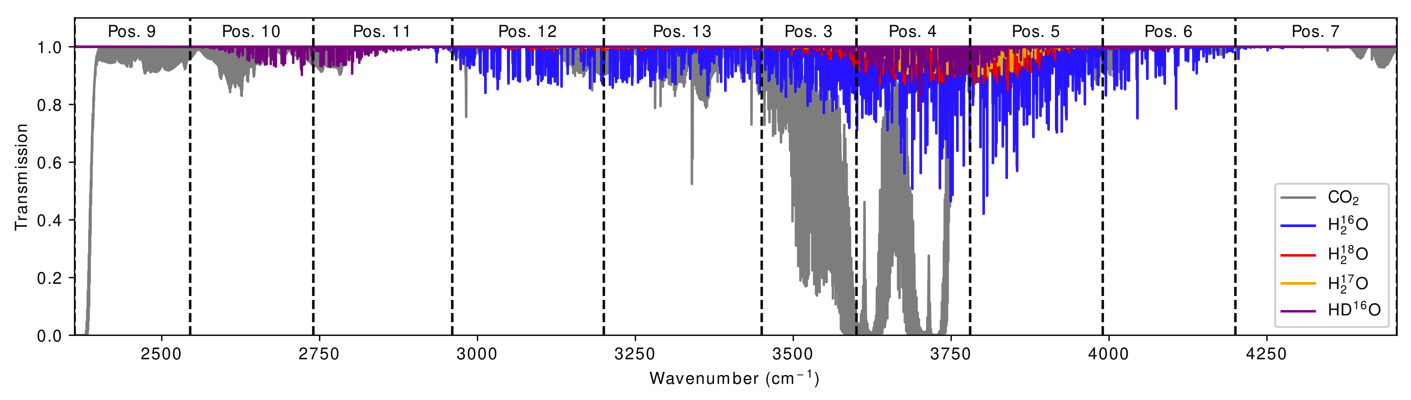
In this work, we analyse observations made with secondary grating positions #5 and #11, which allow the selection of diffraction orders covering a spectral range of 3780-3990 cm-1 and 2650-2950 cm-1, respectively (see Figure 1). These spectral ranges include the most suitable absorption features to measure the vertical distribution of D/H and 18O/16O from the ACS spectra.

We will present the retrieved vertical profiles of D/H and 18O/16O using this experimental setup and following a retrieval methodology previously validated for the derivation of other isotopic ratios with TGO/ACS [7,8]. In particular, we will focus our analysis on the observations made close to aphelion (LS ~ 70˚) and perihelion (LS ~ 250˚), when the water vapour vertical distribution is particularly different, and discuss the vertical variability of the D/H and 18O/16O isotopic ratios during these two distinct seasons. 

Figure 1: Synthetic transmission spectrum of the Martian atmosphere within the spectral range of ACS MIR. The figures shows the instantaneous spectral range covered by ACS MIR when using different secondary grating positions (black dashed lines), as well as the contribution by CO2 and different H2O isotopes to the spectrum (coloured lines) [7].


Simulations with the Mars PCM:  Several studies have been conducted to model the variations of the D/H ratio in the atmosphere of Mars (e.g., [3,4,9]), but the variability of the 18O/16O isotopic ratio remains largely unexplored.

In this work, we include the condensation-induced fractionation effect of 18O/16O to the most recent version of the HDO scheme on the Mars Planetary Climate Model [4,10], aiming to simulate the simultaneous fractionation of both water isotopic ratios. This scheme includes the implementation of equilibrium fractionation due to the different saturation vapour pressures of the water isotopes [11,12], as well as the implementation of kinetic effects due to their different diffusivities [13].

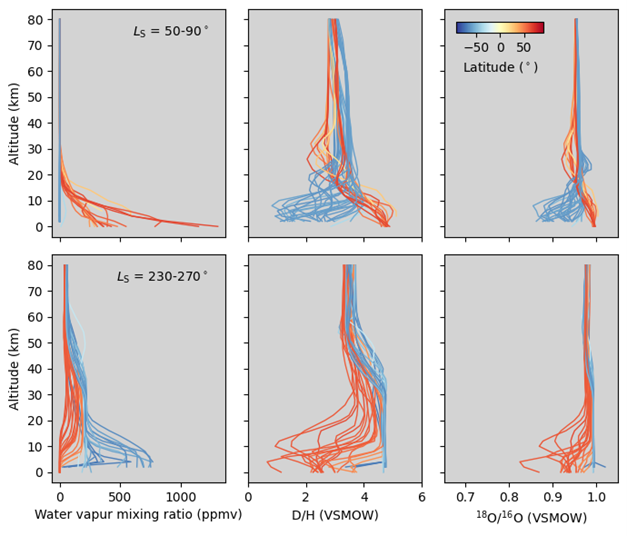
Figure 2 shows the vertical distribution of the D/H and 18O/16O isotopic ratios modelled with the Mars PCM at the locations and times of ACS MIR measurements made during the aphelion and perihelion seasons of Martian Year 35. The altitudinal profiles of these isotopic ratios are driven by the condensation of water, either on the ground in the winter hemispheres, or through the formation of water ice clouds, which form at much higher altitudes during the warmer perihelion season than close to aphelion. While the distribution of both isotopic ratios from the model is very similar, the amplitude of the variations in the 18O/16O isotopic ratio are much smaller than those in D/H.

We will compare the simulations of the D/H and 18O/16O ratios from the Mars PCM with the measured profiles from TGO/ACS, aiming to investigate the relative supply of water isotopes to the Martian upper atmosphere.

Figure 2: Vertical distribution of the water vapour volume mixing ratio, D/H and 18O/16O modelled with the Mars PCM at the locations and times of the ACS MIR during the aphelion (top) and perihelion (bottom) seasons in Martian Year 35. The lines in the different panels are coloured based on the latitude of the locations.

 References:

[1] Scheller et al., Science, 2021, eabc7717. [2] Villanueva et al., Science, 2015, 348, 218. [3] Montmessin et al., J. Geophys. Res., 2005, 110, E03006. [4] Vals et al., JGR Planets, 2022, 127. [5] Cangi et al., JGR Planets, 2023, 128, e2022JE007713. [6] Korablev et al., Space Sci. Rev., 2018, 214, 7. [7] Alday et al., Nat. Astron., 2021, 5, 943. [8] Alday et al., Nat. Astron., 2023, 7, 867. [9] Daerden et al., JGR Planets, 2022, 127. [10] Rossi et al., JGR Planets, 2022, 127. [11] Lamb et al., PNAS, 2017, 114, 5612. [12] Majoube, Nature, 1970, 226, 1242. [13] Hellmann & Harvey, JGR Planets, 2021, 126.


How to cite: Alday, J., Patel, M. R., Montmessin, F., Fedorova, A. A., Holmes, J., Petzold, G., Baggio, L., Trokhimovskiy, A., Olsen, K. S., Belyaev, D., Mason, J. P., and Korablev, O.: The vertical distribution of water vapour isotopes on Mars from the Atmospheric Chemistry Suite aboard the ExoMars Trace Gas Orbiter, EPSC-DPS Joint Meeting 2025, Helsinki, Finland, 7–13 Sep 2025, EPSC-DPS2025-626, https://doi.org/10.5194/epsc-dps2025-626, 2025.

12:12–12:24
|
EPSC-DPS2025-957
|
ECP
|
On-site presentation
Guillaume Petzold, Franck Montmessin, Juan Alday, Loïc Verdier, Ehouarn Millour, Tyler Robinson, and Lily Robinthal

Context : The deuterium/hydrogen isotopic ratio, D/H, is one of the keys to understand the origin of water on terrestrial bodies within the Solar System and its evolution over time in their atmospheres.

In the atmosphere of Mars, this D/H ratio is on average 5 to 6 times higher than the Vienna Standard Mean Ocean Water (VSMOW), the Earth’s oceans reference. Although water vapor is present only in very low quantities on Mars (100 ppmv on average), it is rich in deuterium, which points to a wetter past for the Red Planet, a fact corroborated by various geological indicators (valleys, ancient lakes, shorelines). This enrichment is understood as a cumulative effect of differential escape between H and D atoms, the latter being more prone to gravity than its lighter isotopologue. This differential escape is deeply rooted into the seasonal behavior of HDO and H₂O, sole precursors of D and H on Mars, which release H and D at high altitude, when climatic conditions allow photochemistry. [1, 2]

Model : The Mars PCM (Planetary Climate Model) simulates the physical, chemical and dynamical processes in the Martian atmosphere, including water ice cloud-related phenomena [3], such as condensation, that fully control the relative behavior of HDO [4, 5]. This model, coupled with observations and data from ACS (Atmospheric Chemistry Suite), has shed light on the HDO cycle recently. However, differences still exist between the model and the observations. This is particularly the case for the vertical distribution of water vapor in the upper atmosphere [5, 6]. Some improvements to the Mars PCM, namely new dust injection scheme and non-orographic gravity waves [7] have been implemented.

Results : This study presents a 12-Martian-year simulation, covering Martian Years 26 to 37, with a focus on interannual variations in the HDO and H₂O cycles. The results from the model are compared with multiple observations from instruments such as ACS and SPICAM, capturing a wide range of dust events and revealing key processes to which the HDO and H₂O cycles are particularly sensitive and predicted by the Mars PCM. A third moment is being implemented in the dust particles size distribution to improve its vertical distribution with respect to observations. The first outcomes of this modification will also be addressed.

This study is part of a broader effort to better understand the origin and the long-term evolution of the water on Mars. By investigating the processes behind the Mars’ deuterium enrichment, it contributes to unraveling the history of atmospheric escape and climate change on the Red Planet.

References

[1] Villanueva, G. et al. (2015), Strong water isotopic anomalies in the martian atmosphere: probing current and ancient reservoirs, Science

[2] Owen, T. et al. (1988), Deuterium on Mars: The Abundance of HDO and the Value of D/H, Science

[3] Navarro, T. et al. (2014), Global climate modeling of the Martian water cycle with improved microphysics and radiatively active water ice clouds, JGR Planets

[4] Bertaux, J-L. & Montmessin, F. (2001), Isotopic fractionation through water vapor condensation: The Deuteropause, a cold trap for deuterium in the atmosphere of Mars, JGR Planets

[5] Vals, M. et al. (2022), Improved Modeling of Mars' HDO Cycle Using a Mars' Global Climate Model, JGR Planets

[6] Rossi, L. et al. (2022), The HDO cycle on Mars : Comparison of ACS observations with GCM simulations, JGR Planets

[7] Gilli, G. et al. (2020), Impact of Gravity Waves on the Middle Atmosphere of Mars: A Non-Orographic Gravity Wave Parameterization Based on Global Climate Modeling an

How to cite: Petzold, G., Montmessin, F., Alday, J., Verdier, L., Millour, E., Robinson, T., and Robinthal, L.: A twelve-year survey of the HDO and H2O cycles using the Mars Planetary Climate Model from MY26 to MY37, EPSC-DPS Joint Meeting 2025, Helsinki, Finland, 7–13 Sep 2025, EPSC-DPS2025-957, https://doi.org/10.5194/epsc-dps2025-957, 2025.

12:24–12:30

Orals WED-OB5: Wed, 10 Sep, 15:00–16:00 | Room Sun (Finlandia Hall)

Chairpersons: Kevin Olsen, Francisco González-Galindo
Mars aurora, exosphere, escape, plasma
15:00–15:12
|
EPSC-DPS2025-1314
|
ECP
|
On-site presentation
Elise Wright Knutsen, Timothy H. McConnochie, Mark Lemmon, Shayla Viet, Agnes Cousin, Roger C. Wiens, and James F. Bell

Mars is known to host a variety of auroral processes (Bertaux et al. 2005, Schneider et al. 2015, Lillis et al. 2022) despite the planet’s tenuous atmosphere and lack of a global magnetic field. The first detection of visible-wavelength aurora at 557.7 nm was made in 2024 by the SuperCam and Mastcam-Z instruments on the Mars 2020 Perseverance rover (Knutsen et al. 2025 (in press)), which represented the first observation of aurora from any planetary surface other than Earth, the first detection of visible-wavelength aurora at Mars, and demonstrates that auroral forecasting at Mars is possible. During events with higher particle precipitation, or under less dusty atmospheric conditions, green aurorae will be visible to future astronauts. 

 Here we present the results of all detection attempts made to date using the Mars 2020 Perseverance rover. We describe the selected solar storms as they were forecasted, and compare with orbital particle and plasma measurements from MAVEN and Mars Express leading up to and during each event, along with the resulting surface aurora detection attempts.

 A total of eight detection attempts have been made between May 2023 and August 2024. Two of the targeted solar storms led to successful identification of green aurora at Mars with the SuperCam and Mastcam-Z instruments on the Mars 2020 Perseverance rover.

 References

Bertaux, J.-L., et al. "Discovery of an aurora on Mars." Nature 435.7043 (2005): 790-794.

Schneider, N. M., et al. "Discovery of diffuse aurora on Mars." Science 350.6261 (2015): aad0313.

Lillis, R. J., et al. "First synoptic images of FUV discrete aurora and discovery of sinuous aurora at Mars by EMM EMUS." Geophysical Research Letters 49.16 (2022): e2022GL099820.

Knutsen, E. W., et al. (in press), “First detection of visible-wavelength aurora on Mars”, Science Advances (2025).

How to cite: Knutsen, E. W., McConnochie, T. H., Lemmon, M., Viet, S., Cousin, A., Wiens, R. C., and Bell, J. F.:  Green-line aurora detection attempts from the surface of Mars , EPSC-DPS Joint Meeting 2025, Helsinki, Finland, 7–13 Sep 2025, EPSC-DPS2025-1314, https://doi.org/10.5194/epsc-dps2025-1314, 2025.

15:12–15:24
|
EPSC-DPS2025-800
|
On-site presentation
Valentin Steichen, François Leblanc Leblanc, and Mehdi Benna

Argon (Ar) is a chemically inert noble gas used as a tracer to investigate transport processes and energy deposition in the Martian upper atmosphere. Its high atomic mass makes it sensitive to both thermal and non-thermal mechanisms, while its chemical stability ensures that its distribution reflects physical processes occurring in the thermosphere. NGIMS, the Neutral Gas and Ion Mass Spectrometer aboard NASA’s MAVEN spacecraft, has been measuring neutral species including Ar since late 2014, enabling systematic monitoring of the Martian atmosphere from ~150 to over 1000 km in altitude. First studies of Ar densities reflect that below 350 km the population is dominated by thermal processes, whereas above this altitude, detected Ar is primarily attributed to suprathermal components (Mahaffy et al., 2014; Leblanc et al., 2019).

Over its seven years of operation, MAVEN has collected more than 25,000 orbits with NGIMS in neutral mode, including over 1,100 orbits dedicated to high-cadence observations of argon. These targeted campaigns increase vertical resolution and sampling near periapsis and provide enhanced sensitivity up to 1200km. The compiled dataset spans a broad range of local times, solar zenith angles (SZA), seasons (solar longitudes), and latitudes, offering extensive spatial and temporal coverage.

This study investigates the dependence of Ar density on SZA using both standard and high-cadence NGIMS measurements. The resulting profiles indicate systematic variations with SZA, particularly in the 300–1000 km altitude range. Ar densities tend to decrease with increasing SZA, with the strongesat gradients observed above the nominal exobase.

A subset of high-cadence profiles is also examined in greater detail to contextualize vertical structure in terms of MAVEN's orbital geometry, local time, latitude, and season. Particular attention is given to trajectories passes occurring near the morning and evening terminators. These profiles are analyzed individually to assess variability in Ar density structure and its possible relationship to viewing geometry and seasonal conditions. In several cases, localized enhancements in Ar density are detected at altitudes above 700 km. The origin of these features remains under investigation but may be consistent with the influence of waves or perturbations propagating upward from lower atmospheric layers. The apparent asymmetry between dusk and dawn sectors, as previously noted in global maps, is also investigated through this targeted approach.

How to cite: Steichen, V., Leblanc, F. L., and Benna, M.:  Vertical Structure and Variability of Argon in Mars’ Exosphere from High-Resolution NGIMS Data, EPSC-DPS Joint Meeting 2025, Helsinki, Finland, 7–13 Sep 2025, EPSC-DPS2025-800, https://doi.org/10.5194/epsc-dps2025-800, 2025.

15:24–15:36
|
EPSC-DPS2025-32
|
On-site presentation
Lauriane Soret, Sabine Lejeune, and Jean-Claude Gérard

Nightglow emissions in the Mars atmosphere provide critical insights into its composition and dynamics, allowing remote evaluation of atmospheric constituents and photochemical processes. The UVIS spectrometer aboard ESA’s ExoMars Trace Gas Orbiter (TGO) recently detected a new emission in Mars' atmosphere—the Herzberg II bands of molecular O₂—particularly intense around the winter poles. Additionally, NASA’s CRISM instrument aboard the Mars Reconnaissance Orbiter (MRO) has recorded the infrared counterpart of this emission: the O₂ (a¹Δ) emission at 1.27 µm.

This study aims to merge these two datasets (UVIS and CRISM) to create the most comprehensive map of nocturnal oxygen emissions on Mars to date. By integrating observations in both the visible and infrared domains, this novel approach will enhance our understanding of oxygen transport and distribution in the Martian atmosphere.

The final dataset will be compared to 3D global circulation models to provide unprecedented constraints on atmospheric dynamics, improving our knowledge of photochemical and transport processes on Mars.

How to cite: Soret, L., Lejeune, S., and Gérard, J.-C.: Mapping of the Atomic Oxygen Nightglow Emissions on Mars in the Visible and Infrared Domains, EPSC-DPS Joint Meeting 2025, Helsinki, Finland, 7–13 Sep 2025, EPSC-DPS2025-32, https://doi.org/10.5194/epsc-dps2025-32, 2025.

15:36–15:48
|
EPSC-DPS2025-1833
|
On-site presentation
Hot Hydrogen in the Exosphere of Mars: Characterizing Supra-thermal Escape
(withdrawn after no-show)
Majd Mayyasi, John Clarke, and Jean-Yves Chaufray and the MAVEN Team
15:48–16:00
|
EPSC-DPS2025-1276
|
ECP
|
Virtual presentation
Multi Model Analysis of Helium Bulges during the Martian Year 34 Global Dust Storm: M-GITM vs. Mars-PCM
(withdrawn after no-show)
Neha Gupta, Bijay Kumar Guha, Claus Gebhardht, Shaikha Al Daheri, Bhaskar Sharma, Stephen Bougher, Roland M.B Young, Ehouarn Millour, Luca Montabone, Narukull Venkateswara Rao, and Piyush Sharma

Orals WED-OB6: Wed, 10 Sep, 16:30–18:30 | Room Sun (Finlandia Hall)

Chairpersons: Luca Montabone, Gabriella Gilli
Mars chemistry and middle/upper atmosphere
16:30–16:42
|
EPSC-DPS2025-484
|
On-site presentation
Ian Thomas, Ann Carine Vandaele, Loïc Trompet, Shohei Aoki, Adrian Brines, Yannick Willame, Arianna Piccialli, François Hendrick, Zachary Flimon, Frank Daerden, Lori Neary, Bojan Ristic, Séverine Robert, Jean-Claude Gérard, Jon Mason, Miguel Angel Lopez Valverde, Manish Patel, and Giancarlo Bellucci and the The NOMAD Team

The ExoMars Trace Gas Orbiter has been operating around Mars since April 2018, amassing a wealth of knowledge about the atmosphere and surface of the Red Planet. Onboard are two spectrometer suites, NOMAD and ACS, a surface camera, CASSIS, and a neutron detector, FREND.

NOMAD consists of three spectrometers: two observe in the infrared, in the 2-4 µm region, and one observes the 200-650 nm region. The two infrared spectrometers [1] are named “SO”, which is designed for solar occultation observations, and “LNO”, which is primarily designed for nadir observations, but also can measure solar occultations and occasionally observes Phobos. The ultraviolet-visible spectrometer can do all the above: solar occultation, limb, nadir, and Phobos and Deimos observations [2]. At the time of writing all three spectrometers continue to operate nominally.

In this presentation we will give a summary of recent results and ongoing projects within the NOMAD team: results have recently been published looking at dust and aerosol particle sizes [3], water vapour pumping to high altitudes [4], ultraviolet and visible dayglow [5] and nightglow [6]; plus there are upcoming joint observation campaigns with the iSHELL instrument on IRTF, EUVM on MAVEN, and ACS (also on TGO). Also, the climatologies of the principal atmospheric constituents measured by NOMAD are regularly updated - for example ozone, water vapour, carbon monoxide, carbon dioxide (for temperature and pressure retrievals), hydrogen chloride, water ice and CO2 ice clouds.


Acknowledgements

The NOMAD experiment is led by the Royal Belgian Institute for Space Aeronomy (IASB-BIRA) with co-PI teams from Spain (IAA-CSIC), Italy (INAF-IAPS) and the United Kingdom (Open University). This project acknowledges funding by: the Belgian Science Policy Office (BELSPO) with the financial and contractual coordination by the ESA Prodex Office (PEA 4000103401, 4000121493, 4000140753, 4000140863); by the Spanish Ministry of Science and Innovation (MCIU) and European funds (grants PGC2018-101836-B-I00 and ESP2017-87143-R; MINECO/FEDER), from the Severo Ochoa (CEX2021-001131-S) and from MCIN/AEI/10.13039/501100011033 (grants PID2022-137579NB-I00, RTI2018-100920-J-I00 and PID2022-141216NB-I00); by the UK Space Agency (grants ST/V002295/1, ST/V005332/1, ST/X006549/1, ST/Y000234/1 and ST/R003025/1); and by the Italian Space Agency (grant 2018-2-HH.0). This work was supported by the Belgian Fonds de la Recherche Scientifique – FNRS (grant 30442502; ET_HOME).


References

  • E. Neefs,. A.C. Vandaele , R. Drummond, I. Thomas, S. Berkenbosch, R. Clairquin, S. Delanoye, B. Ristic, J. Maes, S. Bonnewijn, G. Pieck, E. Equeter, C. Depiesse, F. Daerden, E. Van Ransbeeck, D. Nevejans, J. Rodriguez, J.-J. Lopez-Moreno, R. Sanz, R. Morales, G.P. Candini, C. Pastor, B. Aparicio del Moral, J.M. Jeronimo, J. Gomez, I. Perez, F. Navarro, J. Cubas, G. Alonso, A. Gomez, T. Thibert, M.R. Patel, G. Belucci, L. De Vos, S. Lesschaeve, N. Van Vooren, W. Moelans, L. Aballea, S. Glorieux, A. Baeke, D. Kendall, J. De Neef, A. Soenen, P.Y. Puech, J. Ward, J.F. Jamoye, D. Diez, A. Vicario, and M. Jankowski; NOMAD spectrometers on the ExoMars trace gas orbiter mission: part 1 - design, manufacturing and testing of the infrared channels. (2015) Applied Optics 54 (28), 8494- 8520
  • M. R. Patel, P. Antoine, J. Mason, M. Leese, B. Hathi, A. Stevens, D. Dawson, J. Gow, T. Ringrose, J. Holmes, S. Lewis, D. Beghuin, P. Van Donink, R. Ligot, J.-L. Dewandel, D. Hu, D. Bates, R. Cole, R. Drummond, I.R. Thomas, C. Depiesse, E. Neefs, E. Equeter, B. Ristic, S. Berkenbosch, D. Bolsée, Y. Willame, A.C. Vandaele , S. Lesschaeve, L. De Vos, N. Van Vooren, T. Thibert, E. Mazy, J. Rodriguez-Gomez, R. Morales, G.P. Candini, C. Pastor-Morales, R. Sanz, B. Aparicio del Moral, J.-M. Jeronimo-Zafra, J.M. Gomez-Lopez, G. Alonso-Rodrigo, I. Pérez-Grande, J. Cubas, A. Gomez-Sanjuan, F. Navarro-Medina, A. Ben Moussa, B. Giordanengo, S. Gissot, G. Bellucci, and J.J. Lopez-Moreno; The NOMAD spectrometer on the ExoMars Trace Gas Orbiter mission: part 2—design, manufacturing and testing of the ultraviolet and visible channel . (2017) Applied Optics 56(10), 2771-2782
  • Z. Flimon, J. Erwin, S. Robert, L. Neary, A. Piccialli, L. Trompet, Y. Willame, F. Vanhellemont, F. Daerden, S. Bauduin, M. Wolff, I. R. Thomas, B. Ristic, J. P. Mason, C. Depiesse, M. R. Patel, G. Bellucci, J.-J. Lopez-Moreno, A. C. Vandaele; Aerosol Climatology on Mars as Observed by NOMAD UVIS on ExoMars TGO (2025) J. Geophys. Res. Planets
  • A. Brines, M A. López-Valverde, B. Funke, F. González-Galindo, S. Aoki, G. L. Villanueva, J. A. Holmes, D. A. Belyaev, G. Liuzzi, I. R. Thomas, J. T. Erwin, U. Grabowski, F. Forget, J. J. Lopez-Moreno, J. Rodriguez-Gomez, F. Daerden, L. Trompet, B. Ristic, M. R. Patel, G. Bellucci, A. C. Vandaele; Strong Localized Pumping of Water Vapor to High Altitudes on Mars During the Perihelion Season. (2024) Geophys. Res. Letters
  • L. Soret, H. Robin, J.-C. Gérard, L. Gkouvelis, I. Thomas, B. Ristic, Y. Willame, B. Hubert, A. C. Vandaele, J. P. Mason, F. Daerden, M. R. Patel; The Martian oxygen green line dayglow: response to solar activity. (submitted to Icarus 2025)
  • L. Soret, F. González-Galindo, J.-C. Gérard, I. R. Thomas, B. Ristic, Y. Willame, A. C. Vandaele, B. Hubert, F. Lefèvre, F. Daerden, M. R. Patel; Ultraviolet NO and Visible O2 Nightglow in the Mars Southern Winter Polar Region: Statistical Study and Model Comparison. (2024) J. Geophys. Res. Planets

How to cite: Thomas, I., Vandaele, A. C., Trompet, L., Aoki, S., Brines, A., Willame, Y., Piccialli, A., Hendrick, F., Flimon, Z., Daerden, F., Neary, L., Ristic, B., Robert, S., Gérard, J.-C., Mason, J., Lopez Valverde, M. A., Patel, M., and Bellucci, G. and the The NOMAD Team: The ExoMars 2016 Trace Gas Orbiter: Recent Results from NOMAD, EPSC-DPS Joint Meeting 2025, Helsinki, Finland, 7–13 Sep 2025, EPSC-DPS2025-484, https://doi.org/10.5194/epsc-dps2025-484, 2025.

16:42–16:54
|
EPSC-DPS2025-370
|
ECP
|
On-site presentation
Elisa Dong, John Moores, Madeline Walters, Grace Bischof, Germán Martínez, and Mark Gordon

The observation of temporal and spatial variability in methane concentration on Mars is puzzling, as the current 300-year photochemical lifetime of methane should ensure that it is well mixed throughout the atmosphere (Atreya et al., 2007; Wong et al., 2003). For instance, the spectrometer onboard the Mars Science Laboratory (MSL) rover has observed a significantly higher methane concentration near the surface of Mars than has been observed above 5 km by the instruments aboard the Trace Gas Orbiter (TGO). Near the surface, MSL sees approximately a 0.4 ppbv concentration of background methane that varies on diurnal and seasonal timescales with periodic spikes of over 20 ppbv (Webster et al., 2018, 2021). By contrast, in the middle and upper atmosphere, no methane is observed by TGO to below the detection threshold of ~0.02 ppbv (Korablev et al., 2019; Montmessin et al., 2021).

Previously, these differences were explained by considering the different timing and airmasses being sampled by these measurements – at night and near the surface for MSL and at sunset or sunrise and at altitude for TGO (Moores, et al., 2019). This framework required that the methane decrease from its relatively high surface concentration to a much lower concentration at altitude. While this is possible purely through atmospheric mixing and dilution, if the amount of methane being injected into the atmosphere near the surface is sufficiently large this methane will eventually build up in the upper atmosphere.

In this work, we consider the effect of a recently quantified destruction mechanism described by Zhang et al., (2022). Their derived destruction rates using a simplified model of the atmosphere suggest that methane adsorbed onto a surface with UV-activated perchlorate can contribute to the destruction of methane on the order of hours to days. This model is appealing for several reasons: (1) it can rapidly destroy methane, (2) it operates only during the day when both MSL and TGO observe methane to be low and not at night when MSL observes methane concentration to be high, and (3) destruction occurs on the surfaces of dust grains which are in abundance in the lower atmosphere. To evaluate the effects of this destruction mechanism with a more realistic representation of the Martian atmosphere, we couple its effects into a martian vertical diffusion model (VDM) that was previously developed by Walters et al (2024).  

Walters et al. (2024) previously investigated methane flux from the surface of Mars in a 1-D VDM that incorporated eddy diffusivity coefficients derived from GEM-Mars, a global climate model, to model the effects of transport and diffusion of methane in the VDM (Neary & Daerden, 2018; Stroud et al., 2005). The methane is injected at the surface, and the methane mixing ratio is tracked throughout the vertical column using 1 m layers in half-hour time steps for select sols. While Walters et al. (2024) were able to closely replicate the required flux to replicate the SAM-TLS measurements, the diffusion and removal at the top layer was insufficient to decrease methane below 0.02 ppbv at the top of their model at 5 km above the surface.

As part of the inclusion of a destruction mechanism in the VDM simulation procedure (Fig. 1), we made the following changes to the model of Walters et al. (2024): (1) we incorporated a Conrath profile to describe the dust distribution in the atmosphere (Conrath, 1975), (2) we added in a radiative transfer model to estimate the available UVC for the destruction mechanism (Smith & Moores, 2020) at each step in the VDM, and (3) we also added a simple box model on top of the VDM to track the methane concentration in the portion of the atmosphere that is visible to TGO. Diffusion into this upper box is dependent on the relative concentration of methane in the top layer in the VDM and the box.

Figure 1. Plots showing the concentration of methane in the atmosphere repeated over Ls=180o in MY 35 between 0 and 6000 m above the surface. The y-axis shows the height in the simulation, and the x-axis shows the time during the sol after a 1-day spinup. On the left, we show the simulation using the method produced by Walters et al. (2024) where methane can build up in the atmosphere if methane is continuously provided into the system. This model demonstrates the effect of diffusion alone, where there is a build up at night, and diffusion throughout the atmosphere. On the right, we show the same simulation with the inclusion of the destruction mechanism from Zhang et al. (2022).

We report our preliminary results incorporating the effects of oxidation of activated perchlorate surfaces as our methane destruction mechanism for select sols and compare them to the available methane measurements.

References

Atreya, S. K., Mahaffy, P. R., & Wong, A. S. (2007). PSS, 55(3), 358–369.
Conrath, B. J. (1975). Icarus, 24(1), 36–46.
Korablev, O., Vandaele, A. C., et al. (2019). Nature, 568(7753), 517–520.
Montmessin, F., Korablev, O. I., et al. (2021). A&A, 650, A140.
Moores, J. E., Gough, R. V., et al. (2019). Nature Geoscience, 12(5), 321–325.
Moores, J. E., King, P. L., et al. (2019). GRL, 46(16), 9430–9438.
Neary, L., & Daerden, F. (2018). Icarus, 300, 458–476.
Smith, C. L., & Moores, J. E. (2020). Icarus, 338, 113497.
Stroud, C., Makar, P., et al. (2005). JGR D: Atmospheres, 110(17), 149–162.
Walters, M. E., Dong, E. et al. (2024). 10th Mars.
Webster, C. R., Mahaffy, P. R., et al (2018). Science, 360(6393), 1093–1096.
Webster, C. R., Mahaffy, P. R., et al. (2021). A&A, 650, A166.
Wong, A. S., Atreya, S. K., & Encrenaz, T. (2003). JGR: Planets, 108(E4), 5026.
Zhang, X., Berkinsky, D., et al. (2022). Icarus, 376, 114832.

How to cite: Dong, E., Moores, J., Walters, M., Bischof, G., Martínez, G., and Gordon, M.: Diffusion of Martian Methane in Concert with Destruction Via Adsorption Onto UV-Activated Perchlorate in Martian Dust, EPSC-DPS Joint Meeting 2025, Helsinki, Finland, 7–13 Sep 2025, EPSC-DPS2025-370, https://doi.org/10.5194/epsc-dps2025-370, 2025.

16:54–17:06
|
EPSC-DPS2025-571
|
ECP
|
On-site presentation
Paul Streeter, Stephen Lewis, Manish Patel, Kylash Rajendran, and Kevin Olsen

Introduction: Atmospheric hydrogen chloride (HCl) was first detected in the martian atmosphere in 2021 by the ExoMars Trace Gas Orbiter (TGO) [1], and more recently also studied by ground-based telescopes [2]. Observed HCl occurs in abundances of parts per billion by volume (ppbv) and shows strong seasonal and spatial variation. The vast majority of confirmed detections have been during Mars’ dustier perihelion season and there is a notable paucity of detections during the clearer aphelion season; HCl abundances show steep increases/decreases at the corresponding equinoxes [3,4].

When confirmed to be present, observed atmospheric HCl shows a bias towards higher abundances in the southern (summer) hemisphere. Measured HCl profiles also display vertical structure across their retrieved altitudes (generally 10-50 km above the surface), including sharp drops in abundance coinciding with the presence of water ice clouds [5].

Analysis of observed profiles has indicated a weak positive correlation between HCl abundance and dust loading and a stronger positive correlation between HCl and water vapour abundance [6]; similar correlations are apparent from analysis of ground telescope measurements [2].

Consideration of the observed sharp temporal and spatial gradients in HCl, together with its apparent relationship to aerosol and vapour abundances, has led to the idea that heterogeneous chlorine chemistry might explain these strong variations. This is supported by modelling of gas-phase chlorine chemistry in a Mars global climate model (GCM), which shows that in the absence of heterogeneous reactions the HCl distribution remains more uniformly mixed in time, latitude, and height [7].

Candidate heterogeneous chlorine chemical reactions, involving dust and water ice aerosol, have recently been incorporated into both 1D models [8,9] and a GCM [10]. The resulting modelled HCl profiles and global distributions show a marked improvement relative to observations and are able to reproduce important aspects of the observed distribution including the southern hemisphere bias, enhanced abundances during the perihelion season, and strong vertical structure. However, modelling also reveals features which either conflict with observations or have not yet been observed, and the exact nature of the significant reactions involved remains an open question.

Results & Discussion: We discuss results of our recently published GCM modelling work [7,10] and the gas-phase and heterogeneous reactions involved. We also discuss results from ongoing GCM modelling to better constrain the nature of proposed heterogeneous chlorine reactions.


Figure 1. Comparison of atmospheric HCl profiles for TGO/ACS observations, gas-phase only model outputs, and heterogeneous model outputs. All model data is masked to best match the observation times and locations. Subplot (a) shows mean (solid lines) and population standard deviation (shaded area) for all observations/data within the perihelion seasons of MY 34–36. Subplots (b–d) show comparisons for individual observed profiles in MY 34–36, with error bars representing standard errors. Adapted from [10].


Our results show that gas-phase chlorine chemistry alone cannot reproduce the observed global HCl distribution in a GCM [7]. Inclusion of idealised heterogeneous chlorine chemistry improves representation of HCl abundance and is able to reproduce key features of the observed distribution, suggesting a crucial role for heterogeneous chemistry in the contemporary chlorine cycle on Mars [10]. Figure 1 displays selected model profiles (with and without the idealised heterogeneous reactions) compared to TGO observations, showing the more realistic vertical structure obtained when heterogeneous chemistry is considered.

Further investigation of more specific and realistic potential heterogeneous reactions, adapted from [8] and [9] for our GCM, indicates that some reactions are more plausible than others as significant drivers in the contemporary Mars chlorine cycle. In the wait for further laboratory and observational work to better characterise these reactions under martian conditions, we discuss which reactions are more likely to be prominent based on analysis of their structural effects.

References: [1] Korablev et al. (2021). Science. 7(7). [2] Aoki et al. (2024). Planet. Sci. J. 5 (158). [3] Olsen et al. (2021). Astronom. & Astrophys. 647 (161). [4] Aoki et al. (2021). Geophys. Res. Lett. 48 (11). [5] Luginin et al. (2024). Icarus. 411 (115960). [6] Olsen et al. (2024). JGR Planets. 129 (8). [7] Rajendran et al. (2025). JGR Planets. 130 (3). [8] Krasnopolsky (2022). Icarus. 374 (114807). [9] Taysum et al. (2024). Astronom. & Astrophys. 687 (191). [10] Streeter et al. (2025). Geophys. Res. Lett. 52 (6).

How to cite: Streeter, P., Lewis, S., Patel, M., Rajendran, K., and Olsen, K.: Gas-phase and heterogeneous chlorine chemistry in the contemporary martian atmosphere, EPSC-DPS Joint Meeting 2025, Helsinki, Finland, 7–13 Sep 2025, EPSC-DPS2025-571, https://doi.org/10.5194/epsc-dps2025-571, 2025.

17:06–17:18
|
EPSC-DPS2025-985
|
On-site presentation
Daniel Mège, Alexander Trokhimovskiy, Oleg Korablev, Kevin Olsen, Anna Fedorova, Sandrine Guerlet, Benjamin Taysum, Pierre-Antoine Tesson, Mikhail Luginin, and Franck Montmessin and the HCl aphelion detection team

One of the primary objectives of the ExoMars Trace Gas Orbiter (TGO) mission was to search for previously undetected trace gases that could be diagnostic of active geology or a biosphere [1]. The first such gas was hydrogen chloride (HCl) [2], detected with the mid infrared channel of the Atmospheric Chemistry Suite (ACS MIR) [3]. The presence of HCl on Mars was expected to be an indication of active magmatic processes. However, HCl was found to be widespread and we quickly identified a pronounced seasonal cycle in HCl [4-7]. These aspects indicated that its behaviour was mainly governed by strong photochemical interactions linked to water vapour. The original source of HCl, its sinks, and how its abundance is regulated over time remain a mystery.

ACS is a suite of three spectrometers used to study the composition and chemistry of the Martian atmosphere in detail. ACS MIR is a cross-dispersion spectrometer operating in solar occultation geometry, which provides excellent sensitivity to weak absorption signatures and vertical structure. HCl was discovered in data from shortly after the 2018 Mars Global Dust Storm (solar longitude 220° in Mars year 34) and its signal disappeared shortly after the late season storm that occurred around solar longitude (Ls) 220°. A similar trend has since been observed in the following Mars years (MYs), with HCl returning alongside warm atmospheric temperatures, increasing water vapour content, and dust activity - all driven by southern summer occurring at perihelion. Modeling work to define HCl behaviour [8-10] leave the unanswered question: if HCl has a limited photochemical lifetime, what sources are replenishing atmospheric chlorine?

In MY35, two exceptional observations were made in northern summer, near aphelion, to the north of Alba Mons, on the northern side of the elevated Tharsis plateau [4,6,7]. No other HCl detections have been made during the aphelion period, during southern fall and winter, during which the entire Mars atmosphere is characterised as cold and dry, and has limited dust activity. We performed a dedicated search for HCl using ACS in MY 37. As presented here, several observations detected HCl again in the Alba Mons area. The atmospheric conditions below 10 km are not inconsistent with those during perihelion, with the northern summer raising atmospheric temperatures, introducing water vapour, and limited dust aerosols. However, HCl detections remain rare, it is not well-mixed, and its residence time is short. Many ACS observations made at other latitudes and other times exhibit very good viewing conditions and similar atmospheric states, but no HCl absorption features.

This leads to the idea that perhaps there is a localized source of HCl over the region. We have used high resolution imagery recorded by TGO's Colour and Stereo Imaging System (CaSSIS), Mars Reconnaissance Orbiter's (MRO's) High Resolution Imaging Science Experiment (HiRISE), and MRO's Context Camera (CTX) to characterise the terrain beneath the ACS HCl detections over the Alba Mons region. Below some of the detection sites, we identified linear swarms of tens to hundreds of fissures less than 1 m wide and up to hundreds of meters long, unreported in previous works, which affect the ice-rich latitude-dependent mantle and the periglacial polygons east and north of Alba Mons. They are therefore thought to be younger than 1 million years [11]. Some are located on top of linear uplifts marked by bright and dark deposits, denoting possible diffusion of chemically modified subsurface fluids to the surface. The swarms are aligned with Tantalus Fossae, and in particular, Phlegeton Catena, above which similar fissures are observed and the other HCl detections were made.

1. Vago, J. et al. (2015). ESA ExoMars program: The next step in exploring Mars. Solar Syst. Res., 49(7), 518–528.

2. Korablev, O. et al. (2021). Transient HCl in the atmosphere of Mars. Sci. Adv., 7(7), eabe4386.

3. Korablev, O. et al. (2018). The atmospheric chemistry suite (ACS) of three spectrometers for the ExoMars 2016 trace gas orbiter. Space Sci. Rev., 214(1), 7.

4. Olsen, K. S. et al. (2021). Seasonal reappearance of HCl in the atmosphere of Mars during the Mars year 35 dusty season. Astron. Astrophys., 647, A161.

5. Aoki, S. et al. (2021). Annual appearance of hydrogen chloride on Mars and a striking similarity with the water vapor vertical distribution observed by TGO/NOMAD. Geophys. Res. Lett., 48(11).

6.Olsen, K. S. et al. (2024b). Relationships between HCl, H2O, aerosols, and temperature in the Martian atmosphere: 1. Climatological outlook. J. Geophys. Res., 129(8).

7. Olsen, K. S. et al. (2024b). Relationships between HCl, H2O, aerosols, and temperature in the Martian atmosphere: 2. Quantitative correlations. J. Geophys. Res., 129(8).

8. Krasnopolsky, V. A. (2022). Photochemistry of HCl in the Martian atmosphere. Icarus, 374, 114807.

9. Taysum, B. M. et al. (2024). Observed seasonal changes in Martian hydrogen chloride explained by heterogeneous chemistry on atmospheric dust and ice. Astron. Astrophys., 687, A191.

10. Streeter, P. M., et al. (2024). Global distribution and seasonality of Martian atmospheric HCl explained through heterogeneous chemistry. Geophys. Res. Lett., 52(6).

11. Schon, S. C. et al. (2012). Recent high-latitude resurfacing by a climate-related latitude-dependent mantle: Constraining age of emplacement from counts of small craters. Planet. Space Sci., 69, 49–61.

How to cite: Mège, D., Trokhimovskiy, A., Korablev, O., Olsen, K., Fedorova, A., Guerlet, S., Taysum, B., Tesson, P.-A., Luginin, M., and Montmessin, F. and the HCl aphelion detection team: On HCl in the Martian atmosphere during northern summers, EPSC-DPS Joint Meeting 2025, Helsinki, Finland, 7–13 Sep 2025, EPSC-DPS2025-985, https://doi.org/10.5194/epsc-dps2025-985, 2025.

17:18–17:30
|
EPSC-DPS2025-1687
|
ECP
|
On-site presentation
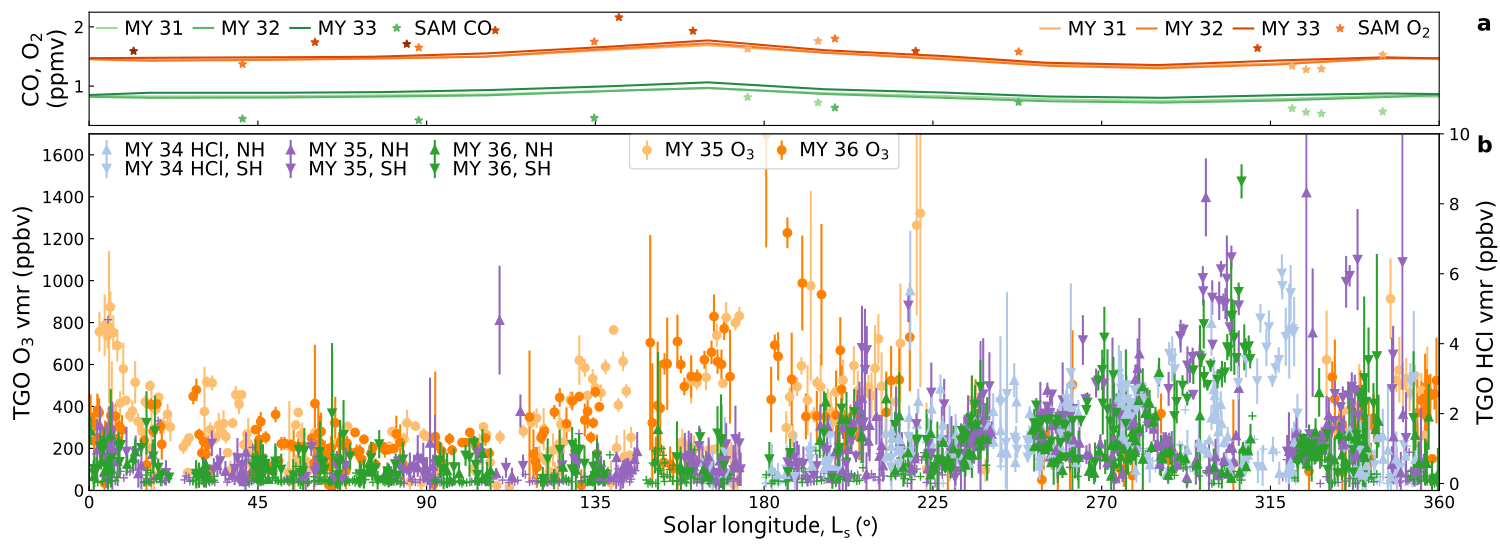
Bethan Gregory, Kevin Olsen, Ehouarn Millour, and Megan Brown

In this presentation, we will show efforts made to include accurate photochemical modelling of hydrogen chloride (HCl) and ozone (O3) in the Mars Planetary Climate Model in order to reconcile recent observations.

The ExoMars Trace Gas Orbiter (TGO) has detected and characterised trace gases in the Martian atmosphere over several Mars years. With its data, upper limits of potential constituents have been constrained, the accuracy of species’ concentration measurements has been improved, and seasonal and spatial variations in the atmosphere have been observed. The wealth of data obtained has addressed several open questions about the nature of Mars’ atmosphere, while other measurements have revealed much that remains poorly understood. For example, models continue to struggle to reproduce ozone distributions, both spatially and temporally, as well as seasonal variations in atmospheric oxygen (O2), suggesting that some key photochemical interactions may be being overlooked. As another example, despite seven years of dedicated observations producing very low upper limits on atmospheric methane levels, there remains no unifying hypothesis that simultaneously explains the detections reported by other Mars assets at Gale Crater [e.g., 1-4].

Hydrogen chloride—the first new gas detected by TGO [5,6]—has been investigated recently using the mid-infrared channel on TGO’s Atmospheric Chemistry Suite (ACS MIR) [7,8]. Observations show a strong seasonal dependence of HCl in the atmosphere, with almost all detections occurring during the latter half of the year between the start of dust activity and the southern hemisphere autumnal equinox. There are also unusual measurements of HCl, localised in both time and space, during the aphelion season. Chlorine-bearing species such as HCl are important to understand in the Mars atmosphere because on Earth they are involved in numerous processes throughout the planetary system, including volcanism, from which HCl on Earth ultimately originates. Further, chlorine species play a key role in atmospheric chemistry: they influence oxidative chemistry and variations in the aforementioned O2 and O3 concentrations (e.g., by catalysing the destruction of ozone), and by extension, potential CH4 in the Martian atmosphere [9]. However, much remains unknown about original source and sinks of HCl, as well as the factors controlling its distribution and variation.

Here, we use the Mars Planetary Climate Model—a 3-D global climate model that includes a photochemical network—to investigate potential mechanisms accounting for patterns in ozone and HCl detections and interactions between them. We begin with the role of heterogeneous chemistry involving ice and dust aerosols, by implementing modelling developed for the Open University Mars Global Climate Model [10] and building on existing chlorine photochemical model networks [11,12,13]. Heterogeneous chemistry affects the abundances of oxidative species such as OH and HO2, and by extension, O and O3. In addition, we investigate how such processes can potentially serve as a mechanism for direct release and sequestration of HCl from the atmosphere. We also explore potential mechanisms behind the annual occurrence of spatially-constrained aphelion HCl, including volcanic sources, and we investigate the interplay between chlorine-bearing species and OH, HO2,O, and O3. Figure 1 shows the way that HCl appears during spring and summer in the southern hemisphere (solar longitudes 180-360°) when water vapour is present in the Martian atmosphere. Ozone behaves in the opposite manner and is present when water vapour abundances are low. As shown, these species are anti-correlated; we explore the important chemical pathways connecting them.

Understanding the role of oxidative chemistry on HCl and other trace gases is key to achieving a more complete picture of processes occurring in the present-day Mars atmosphere, as well as processes that have shaped its evolution and habitability.

Figure 1: Observations of CO, O2, O3 and HCl seasonally and across multiple Mars Years. Upper panel: CO and O2 observations from Curiosity’s Sample Analysis at Mars (SAM) instrument (stars; [14]) and the Mars Climate Database (lines; [15]). Lower panel: O3 and HCl observations from TGO’s ACS instrument [8]. MY=Mars Year; NH/SH=northern/southern hemisphere. Figure from Kevin Olsen.

References:

[1] Giuranna, M., et al. (2019). Nat. Geosci. 12, 326–332. [2] Korablev, O. et al. (2019). Nature 568, 517–520. [3] Montmessin, F. et al. (2021). Astron. Astrophys. 650, A140. [4] Webster, C. R. et al. (2015). Science 347, 415-417. [5] Korablev O. I. et al. (2021). Sci. Adv., 7, eabe4386. [6] Olsen K. S. et al. (2021). Astron. Astrophys., 647, A161. [7] Olsen K. S. et al. (2024a). JGR, 129, e2024JE008350. [8] Olsen K. S. et al. (2024b). JGR, 129, e2024JE008351. [9] Taysum, B. M. et al. (2024). Astron. Astrophys., 687, A191. [10] Brown M. A. J. et al. (2022). JGR, 127, e2022JE007346. [11] Rajendran, K. et al. (2025). JGR: Planets 130(3), p.e2024JE008537. [12] Streeter, P. M. et al. (2025). GRL 52(6), p.e2024GL111059. [13] Benne, B. et al. (2024). EPSC, pEPSC2024-1037. [14] Trainer, M. G. et al. (2019). JGR 124, 3000. [15] Millour, E. et al. (2022). Mars Atmosphere: Modelling and Observations, p. 1103.

How to cite: Gregory, B., Olsen, K., Millour, E., and Brown, M.: Modelling the Influence of Oxidative Chemistry on Trace Gases in Mars' Atmosphere., EPSC-DPS Joint Meeting 2025, Helsinki, Finland, 7–13 Sep 2025, EPSC-DPS2025-1687, https://doi.org/10.5194/epsc-dps2025-1687, 2025.

17:30–17:42
|
EPSC-DPS2025-1341
|
ECP
|
On-site presentation
Benjamin Benne, Paul Palmer, Kevin Olsen, and Franck Lefèvre

The photochemistry of ozone in the Martian atmosphere is generally considered to be well understood. Ozone forms through a three-body reaction involving O and O₂, both products of CO₂ photolysis, and it is destroyed by odd-hydrogen species (HOₓ) generated from water vapour photolysis, which helps to explain the observed anticorrelation between ozone and water vapour [1,2]. However, current photochemical models cannot reproduce ozone observations from various missions (e.g., Trace Gas Orbiter (TGO), Mars Express), with models generally suffering from a negative bias [2,3]. This discrepancy highlights gaps in our knowledge of the photochemical links between odd-oxygen (Oₓ), odd-hydrogen, and water vapour in the Martian atmosphere. A recent study investigated different factors that could influence the ozone content and concluded that the underestimation of ozone in the MPCM might be due to heterogeneous uptake of HOₓ species on water ice clouds or an overestimation of HOₓ photochemistry efficiency in the model [2].

We build on that explorative study and use the latest configuration of the Mars Planetary Climate Model (MPCM) with initial conditions from the Mars Climate Database (MCD) v6.1 [4] to investigate how different parameters could influence the ozone vertical profiles. We study data collected in MYs 34 and 35, including Ox, HOx, CO, and water vapour retrievals from the ACS (Atmospheric Chemistry Suite) and NOMAD (Nadir and Occultation for MArs Discovery) instruments aboard TGO. This approach allows us to examine any altitude-dependent changes in chemistry. We will present the results from a systematic investigation into the impact of various assumed model parameters, e.g., absorption cross sections, reaction rates, and heterogeneous chemistry, on these species. We will also consider the impact of introducing new chemistry into the model, e.g., chlorine photochemistry that was recently implemented in the MPCM by Benne et al. (2025) (in review). We will conclude our presentation by highlighting the parameters with the greatest impact on model ozone, the interactions and variations of ozone and its precursors across the two MYs, and prioritising the future research required to bridge the gap between model and observed Martian ozone.


References:

[1] Lefèvre, F., and Krasnopolsky V. “Atmospheric Photochemistry.” In The Atmosphere and Climate of Mars, 1st ed., 405–32. Cambridge University Press, (2017).

[2] Lefèvre, F., A. Trokhimovskiy, A. Fedorova, L. Baggio, G. Lacombe, A. Määttänen, J.‐L. Bertaux, et al., JGR: Planets 126, no. 4 (2021)

[3] Olsen, K. S., A. A. Fedorova, A. Trokhimovskiy, F. Montmessin, F. Lefèvre, O. Korablev, L. Baggio, et al., JGR: Planets 127, no. 10 (2022)

[4] Millour, E, Forget F., Spiga A., Pierron T., Bierjon A., Montabone L., Vals M., et al., Copernicus Meetings, (2022).

How to cite: Benne, B., Palmer, P., Olsen, K., and Lefèvre, F.: Investigating the discrepancy between observed and modelled ozone on Mars using ACS and NOMAD data, EPSC-DPS Joint Meeting 2025, Helsinki, Finland, 7–13 Sep 2025, EPSC-DPS2025-1341, https://doi.org/10.5194/epsc-dps2025-1341, 2025.

17:42–17:54
|
EPSC-DPS2025-1177
|
ECP
|
On-site presentation
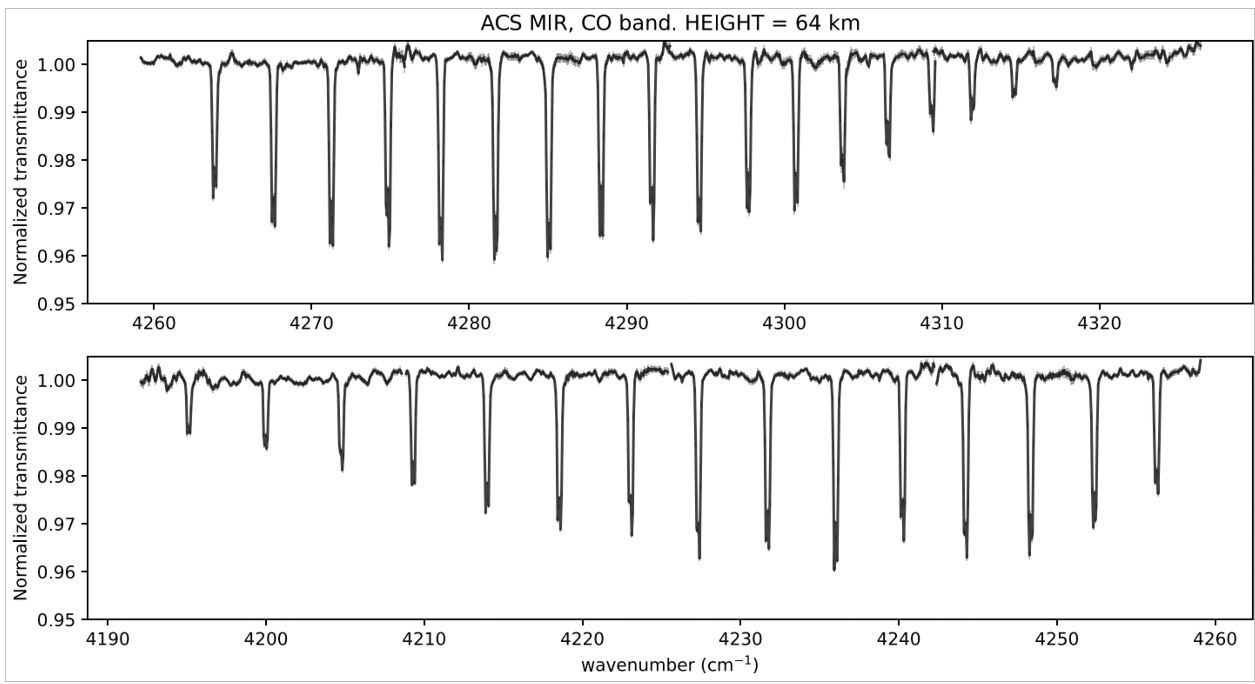
Pablo Rodriguez-Ovalle, Miguel Angel Lopez-Valverde, Ashimananda Modak, Francisco Gonzalez-Galindo, Adrian Brines, Alexander Trokhimoskiy, Denis Belyaev, Kevin Olsen, François Montmessin, Lucio Baggio, Anna Fedorova, Oleg Korablev, Frank Daerden, Ian R. Thomas, Ann Carine Vandaele, Manish Patel, and Giancarlo Bellucci and the ACS and NOMAD teams

Carbon monoxide (CO) has extensively been monitored in the martian atmosphere due to its dual significance: it provides insights into the dymanics and into photochemical processes between this molecule with others in the Martian atmosphere. CO is primarily produced through the CO2 photolysis in the upper atmosphere; it is then transported downward to the lower atmosphere where is destroyed by OH radicals - which are more abundant in water-rich regions - completing a recycling loop back to CO2. Initial monitoring of CO was carried out using ground-based observations [1,2], followed by space-based measurements with orbiters [3,4]. The ExoMars Trace Gas Orbiter, a joint mission by ESA and ROSCOSMOS was launched in 2016, and it carries two instruments capable of detecting CO via solar occultation observations: NOMAD [5] and ACS [6]. These multi-channel spectrometers began scientific operations in 2018, and their solar occultation modes (SO and MIR, respectively) observe the Infrared (2325-4348 cm-1), with a spectral resolution of 0.08 cm-1, and an SNR of ~4000.

In this work, we focus on ACS MIR observations targeting the overtone CO (2-0) absorption band located between 4150 and 4350 cm-1 (see figure 1). Before performing retrievals, the dataset provided by ACS MIR was first processed through a pipeline made at IAA-CSIC that include corrections in the spectral shift, continuum spectral bending, and a separation of random and systematic components of the measurement noise. [7,8] A critical part of this preprocessing involved characterizing the Instrumental Line Shape (ILS). For ACS MIR, the ILS presents a double peak response. The resulting lines can be modeled as a double gaussian, whose parameters can vary accross diffraction orders. We studied this evolution for the ACS MIR diffraction orders where the CO band is located and the resulting ILS chracterization will be presented in this work (see figure 2).

After the preprocessing, the spectra were analyzed using the KOPRA radiative transfer model coupled with the RCP inversion code [9], enabling the retrieval of CO VMR vertical profiles from ~8 to 90 km. This study presents the results of these inversions for CO using the detector position 7, which contains information for part of the Martian Years 34, 36 and the complete MY 37. The varying line intensities within the CO band facilitate profiling of both the upper and lower atmosphere while avoiding spectral saturation. Our results using ACS MIR will be finally compared with those previously retrieved using NOMAD [10], with previous ACS MIR and NIR retrievals [11,12], and we also provide a detailed analysis of the seasonal evolution of CO during the more recent MY 37.

Figure 1. ACS MIR position 7 transmittance spectrum of CO for a tangent height of 64 km, located at 56.9 oN, 56.7 oW, Ls = 212.6o. This spectrum corresponds to the TGO orbit “019665”. The error is presented as grey vertical lines.

Figure 2. ILS parametrization for a subset of 20 orbits for order 251. The variation of the different parameters used for the double gaussian fitting are presented in red. The mean value and standard deviation are shown in black.


[1] Encrenaz, T. et al. (2006). Seasonal variations of the Martian CO over Hellas as observed by ground-based infrared spectroscopy. Astronomy & Astrophysics, 459, 265–270. https://doi.org/10.1051/0004-6361:20065984

[2] Krasnopolsky, V. A. (2007). Long-term spectroscopic observations of Mars using ground-based telescopes: Detection of CO and its seasonal variations. Icarus, 190(1), 93–102. https://doi.org/10.1016/j.icarus.2007.02.015

[3] Smith, M. D. (2004). Interannual variability in TES atmospheric observations of Mars during 1999–2003. Icarus, 167(1), 148–165. https://doi.org/10.1016/j.icarus.2003.09.010

[4] Bertaux, J.-L., et al. (2006). SPICAM on Mars Express: Observing modes and overview of UV spectrometer data and scientific results. Journal of Geophysical Research: Planets, 111, E10S90. https://doi.org/10.1029/2006JE002690

[5] Vandaele, A. C., et al. (2018). NOMAD, an integrated suite of three spectrometers for the ExoMars Trace Gas Mission: Technical description, science objectives and expected performance. Space Science Reviews, 214, 80. https://doi.org/10.1007/s11214-018-0517-2

[6] Korablev, O., et al. (2018). The Atmospheric Chemistry Suite (ACS) of three spectrometers for the ExoMars 2016 Trace Gas Orbiter. Space Science Reviews, 214, 7. https://doi.org/10.1007/s11214-017-0437-6

[7] López‐Valverde et al. (2023). Martian atmospheric temperature and density profiles during the first year of NOMAD/TGO solar occultation measurements. Journal of Geophysical Research: Planets128 (2), https://doi.org/10.1029/2022JE007278

[8] Brines et al. (2023). Water vapor vertical distribution on Mars during perihelion season of MY 34 and MY 35 with ExoMars‐TGO/NOMAD observations. Journal of Geophysical Research: Planets128 (11), https://doi.org/10.1029/2022JE007273

[9] Stiller, G. P. (2000). The Karlsruhe Optimized and Precise Radiative Transfer Algorithm (KOPRA), Vol. FZKA 6512, Forschungszentrum Karlsruhe.

[10] Modak A. et al. (2022). Retrieval of Martian Atmospheric CO Vertical Profiles From NOMAD Observations During the First Year of TGO Operations. J. Geophys. Res. Planets 128, 3. https://doi.org/10.1029/2022JE007282

[11] Olsen, K. et al. (2021). The vertical structure of CO in the Martian atmosphere from the exoMars trace gas orbiter. Nature Geoscience, 14(2), 67–71. https://doi.org/10.1038/s41561-020-00678-w

[12] Fedorova, A. et al. (2022). Climatology of the CO vertical distribution on Mars based on ACS TGO measurements. Journal of Geophysical Research: Planets, 127(9), e2022JE007195. https://doi.org/10.1029/2022je007195


Acknowledgements

The NOMAD experiment is led by the Royal Belgian Institute for Space Aeronomy (IASB-BIRA) with co-PI teams from Spain (IAA-CSIC), Italy (INAF-IAPS) and the United Kingdom (Open University). This project acknowledges funding by: the Belgian Science Policy Office (BELSPO) with the financial and contractual coordination by the ESA Prodex Office (PEA 4000103401, 4000121493, 4000140753, 4000140863); by the Spanish Ministry of Science and Innovation (MCIU) and European funds “ERDF A way of making Europe”, from the Severo Ochoa (CEX2021-001131-S) and from MCIN/AEI/10.13039/501100011033 (grants PID2022-137579NB-I00, RTI2018-100920-J-I00 and PID2022-141216NB-I00); by the UK Space Agency (grants ST/V002295/1, ST/V005332/1, ST/X006549/1, ST/Y000234/1 and ST/R003025/1); and by the Italian Space Agency (grant 2018-2-HH.0). This work was supported by the Belgian Fonds de la Recherche Scientifique – FNRS (grant 30442502; ET_HOME). US investigators were supported by the National Aeronautics and Space Administration. Canadian investigators were supported by the Canadian Space Agency

How to cite: Rodriguez-Ovalle, P., Lopez-Valverde, M. A., Modak, A., Gonzalez-Galindo, F., Brines, A., Trokhimoskiy, A., Belyaev, D., Olsen, K., Montmessin, F., Baggio, L., Fedorova, A., Korablev, O., Daerden, F., Thomas, I. R., Vandaele, A. C., Patel, M., and Bellucci, G. and the ACS and NOMAD teams: Martian CO vertical distribution combining 3 Martian Years of TGO/ACS MIR solar occultation data, EPSC-DPS Joint Meeting 2025, Helsinki, Finland, 7–13 Sep 2025, EPSC-DPS2025-1177, https://doi.org/10.5194/epsc-dps2025-1177, 2025.

17:54–18:06
|
EPSC-DPS2025-430
|
On-site presentation
Shohei Aoki, Hideo Sagawa, Akira Arai, Masato Kagitani, Geronimo Villanueva, Sara Faggi, Giuliano Liuzzi, Frank Daerden, Sebastien Viscardy, Severine Robert, and AnnCarine Vandaele

Recent observations by NASA’s Curiosity Rover have revealed unexpected seasonal changes in molecular oxygen (O2) levels in the Martian atmosphere at Gale Crater, its landing site [1]. This finding is puzzling, as the atmospheric lifetime of O2 is expected to be much longer—at least 10 years [2]. Although O2 is generally stable, its volume mixing ratio is influenced by the seasonal sublimation and condensation of CO2 between the polar ice caps and the atmosphere. However, the observed O2 variability is significantly greater than predicted, with increases of up to 30%. These changes peak in late spring and early summer and decline in mid-winter, exceeding the variability that can be explained by known chemical processes.

O2 was first detected in the Martian atmosphere through ground-based observations in 1971–1972 [3,4] and again in 1982 [5]. Using high spectral resolution (R > 100,000) instruments in the visible range on 2–3 meter-class telescopes, faint O2 spectral lines were detected near 762 nm. These measurements yielded a globally averaged O2 mixing ratio of 1300 (±130) ppm. Later observations using the Herschel Space Telescope in the sub-millimeter range confirmed a similar average of 1400 (±200) ppm [6]. However, these earlier studies provided only disk-averaged values and did not resolve spatial distribution, and the measurement uncertainties remained relatively large.

In this study, we report new measurements of Martian oxygen using the High Dispersion Spectrograph (HDS) on the Subaru Telescope. Subaru/HDS offers high spectral resolving power (R > 100,000) in the visible range and features a long slit (~14"), which enables spatially resolved measurements of O2. This allows us to map the distribution of oxygen across latitude, longitude, and local time—helping to determine whether the seasonal O2 variations observed by Curiosity are global or localized. An additional advantage of Subaru/HDS is its wide spectral coverage, enabling simultaneous observation of ~13 O2 lines between 762–765 nm. This improves the accuracy of the retrieved O2 mixing ratios and enables a more detailed analysis of seasonal variability. Furthermore, CO2 lines at 869 nm—whose strengths are comparable to those of O2—can be used to estimate the effective airmass and assess the influence of atmospheric aerosols.

Observations were conducted on 15 February and 11 April 2025, corresponding to solar longitudes (Ls) of 44° and 68° in Martian Year 38. The latter coincides with the O2 enrichment period reported by Curiosity, while the former precedes it. The angular diameters of Mars during the observations were 12.3" and 7.6", respectively. The Doppler shifts between Mars and Earth were 11 km/s and 16 km/s, sufficient to separate Martian O2 lines from strong telluric O2 features. We present the resulting global O2 distribution maps and compare them with predictions from a Mars climate model.

References:
[1] Trainer et al. 2019, Journal of Geophys. Res.: Planets, 124, 3000. 
[2] Lefèvre & Krasnopolsky, 2017, Cambridge University Press. 
[3] Barker, E. S. 1972, Nature, 238, 447.            
[4] Carleton, N. P., & Traub, W. A. 1972, Science, 177, 988. 
[5] Trauger & Lunine, 1983, Icarus, 55, 272. 
[6] Hartogh et al., 2010, Astron. & Astro., 521, L49. 

How to cite: Aoki, S., Sagawa, H., Arai, A., Kagitani, M., Villanueva, G., Faggi, S., Liuzzi, G., Daerden, F., Viscardy, S., Robert, S., and Vandaele, A.: Global mapping of molecular oxygen on Mars, EPSC-DPS Joint Meeting 2025, Helsinki, Finland, 7–13 Sep 2025, EPSC-DPS2025-430, https://doi.org/10.5194/epsc-dps2025-430, 2025.

18:06–18:18
|
EPSC-DPS2025-1746
|
On-site presentation
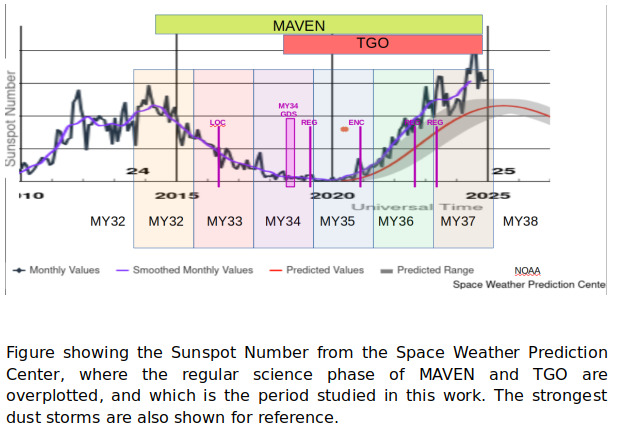
Miguel Angel Lopez-Valverde, Ed Thiemann, Juan Alday, Nicholas Jones, Scott Evans, Shane W. Stone, Francisco Gonzalez-Galindo, Denis A. Belyaev, Anna A. Fedorova, Loic Trompet, Sonal Jain, Sumedha Gupta, Marcin Pillinski, Lori Neary, Ehouarn MIllour, and Francois Forget

The upper atmosphere of Mars, including the mesosphere (60-120 km) and thermosphere (120 up to the exobase, around 180-230 km), is no doubt the less explored region of the red planet. Two recent and on-going missions to Mars are investigating these altitudes with new instrumentation and unprecedented detail: (1) the NASA Mars Atmosphere and Volatile EvolutioN (MAVEN), entirely devoted to the uppermost layers and the escape to space, started its science measurements in 2014; and (2) the ESA-Roscosmos Trace Gas Orbiter (TGO), which started its routine science operations in 2018 after a long period of aerobraking, and which contains two solar occultation instruments, NOMAD and ACS, which permit sounding from the ground up to upper thermosphere, about 180 km.

This work is devoted to the ambitious goal of combining datasets from diverse instruments on board these two missions, of exploiting the sinergy and complemetariety between them, and of obtaining a joint picture of the thermal structure of the whole Martian atmosphere, from the ground up to the exobase. This is part of an ISSI project entitled “A multi-mission approach to close the gaps in understanding of the structure and variability in the Mars upper atmosphere”. We will present the results of a broad team of scientists working for the past two years on this project, with focus on the global, planet encircling climatology of the Mars thermal structure (temperature and CO2 densities), and also its variability. The combination of MAVEN and TGO data permits to obtain the regular patterns of the Martian temperature profiles and how these vary with season, latitude, longitude and local time at different altitudes. Also we can combine the two missions’ datasets to explore year-to-year variations, dust storm impacts and solar-rotation effects at such a wide range of altitudes as those covered jointly by MAVEN and TGO, for the first time.

This work combining MAVEN and TGO is also very informative for the validation of Mars Global Climate Models, given the complementariety of the two missions from the observational point of view, with very different coverage and sampling in the key magnitudes like local time, longitude, latitude and season. A small number of other companion contributions to this conference tackle some of these specific aspects.


How to cite: Lopez-Valverde, M. A., Thiemann, E., Alday, J., Jones, N., Evans, S., Stone, S. W., Gonzalez-Galindo, F., Belyaev, D. A., Fedorova, A. A., Trompet, L., Jain, S., Gupta, S., Pillinski, M., Neary, L., MIllour, E., and Forget, F.: The Martian upper atmosphere’ thermal structure and variability as revealed by Maven & TGO combined datasets, EPSC-DPS Joint Meeting 2025, Helsinki, Finland, 7–13 Sep 2025, EPSC-DPS2025-1746, https://doi.org/10.5194/epsc-dps2025-1746, 2025.

18:18–18:30
|
EPSC-DPS2025-619
|
ECP
|
On-site presentation
Francisco Brasil, Pedro Machado, Gabriella Gilli, Daniela Tirsch, Alejandro Cardesin-Moinelo, José E. Silva, Daniela Espadinha, John Carter, Colin Wilson, and Patrick Martin

Atmospheric gravity waves (AGWs) significantly influence Mars’ climate by facilitating energy and momentum exchanges, thus modulating atmospheric circulation, cloud formation, and dust distribution processes [1]. Despite recent advances in the characterization of Martian AGWs using observations from Mars Express/OMEGA [2], this study was limited by the narrow field of view and restricted spatial coverage. Here, we present an extended analysis using data from the High-Resolution Stereo Camera (HRSC) [3], likewise onboard Mars Express (MEx), benefiting from its higher spatial coverage, resolution (map scales between 200-800 m/px), and consistent imaging quality.

We examined HRSC high-altitude imagery covering Mars Years (MY) 34-37 [4], identifying and characterizing over 100 distinct wave packets, nearly doubling the number previously analyzed. Our refined cloud-altitude measurement technique significantly improved the accuracy and robustness of cloud height retrievals, resulting in estimated altitudes of 15-40 km for water-ice clouds and 60–100 km for CO2-ice clouds, with uncertainties around ±2 km. Wind speeds were determined through precise cloud displacement analyses from HRSC double-broom imagery, taken with an interval of 30 minutes apart, consistently yielding values between 5-20 m/s and uncertainties of approximately ±1 m/s, though these uncertainties likely underestimate the total error due to unresolved spacecraft pointing inaccuracies. Additionally, by retrieving the wind speeds of wave packets and the background, we derived preliminary phase speed estimates for the detected wave packets. Comparison with local background winds suggests a range of intrinsic wave behaviours, which reflect differences in their generation mechanisms or propagation environments.

Our enhanced dataset allows us to establish seasonal and spatial patterns of gravity wave occurrence, highlighting a prominent hemispheric asymmetry with significantly more wave observations in the northern hemisphere. This raises new questions about observational biases potentially related to spacecraft observational strategies. Additionally, the measured wind speeds remain consistently lower than mesoscale model predictions from the Mars Climate Database [5,6], suggesting that current atmospheric models may inadequately represent mesoscale dynamics associated with gravity waves.

Collaborations with the OMEGA and TGO/CaSSIS teams are now extending this analysis further, incorporating spectral information for cloud composition (OMEGA) and complementary observational geometries (CaSSIS), crucial for addressing the limitations identified in this work. These multi-instrument synergies will allow better discrimination of physical processes involved in wave formation, propagation, and dissipation.

This comprehensive analysis using HRSC data provides critical insights into Martian atmospheric dynamics, which can be used to improve current atmospheric models using the parameterization of gravity waves characterized in this work.


Acknowledgments: This work was supported by the Portuguese Fundação Para a Ciência e a Tecnologia of reference PTDC/FIS-AST/29942/2017, through national funds and by FEDER through COMPETE 2020 of reference POCI-01-0145-FEDER-007672, and a grant of reference 2021.05455.BD. GG acknowledges financial support from Junta de Andalucia through the program EMERGIA 2021 (EMC21_00249) and from the Severo Ochoa grant CEX2021-001131-S funded by MCIN/AEI/ 10.13039/501100011033. IAA is also supported by grant ID2022-137579NB-I00 funded by MCIN/AEI/10.13039/501100011033 and by “ERDF A way of making Europe”, funded by the ESA Faculty Research Contract and Science Exchange Programme, which is in the frame of the MWWM - Mars Wind and Wave Mapping project of reference ESA RFP/3-17570/22/ES/CM. We also thank Lucie Riu, Aurélien Stcherbinine, and the Mars Express Team for their support and encouragement in this work.


References

[1] Fritts et al., 2003. Reviews of Geophysics, 41(1).

[2] Brasil et al., 2025. JGR: Planets, 130(3), e2024JE008726.

[3] Jaumann et al., 2007. Planetary and Space Science 55, 928-952

[4] Tirsch, et al. 2024. EPSC2024-44, DOI:10.5194/epsc2024-44.

[5] Forget et al., 1999. JGR: Planets, 104(E10), 24155-24175.

[6] Millour et al., 2017, EGUGA, 12247

How to cite: Brasil, F., Machado, P., Gilli, G., Tirsch, D., Cardesin-Moinelo, A., E. Silva, J., Espadinha, D., Carter, J., Wilson, C., and Martin, P.: Morphological and dynamical analysis of Martian Gravity Waves using MEx/HRSC observations, EPSC-DPS Joint Meeting 2025, Helsinki, Finland, 7–13 Sep 2025, EPSC-DPS2025-619, https://doi.org/10.5194/epsc-dps2025-619, 2025.

Orals THU-OB3: Thu, 11 Sep, 11:00–12:30 | Room Sun (Finlandia Hall)

Chairpersons: Jorge Hernandez-Bernal, Francisco González-Galindo
Mars dust 1
11:00–11:15
|
EPSC-DPS2025-724
|
ECP
|
On-site presentation
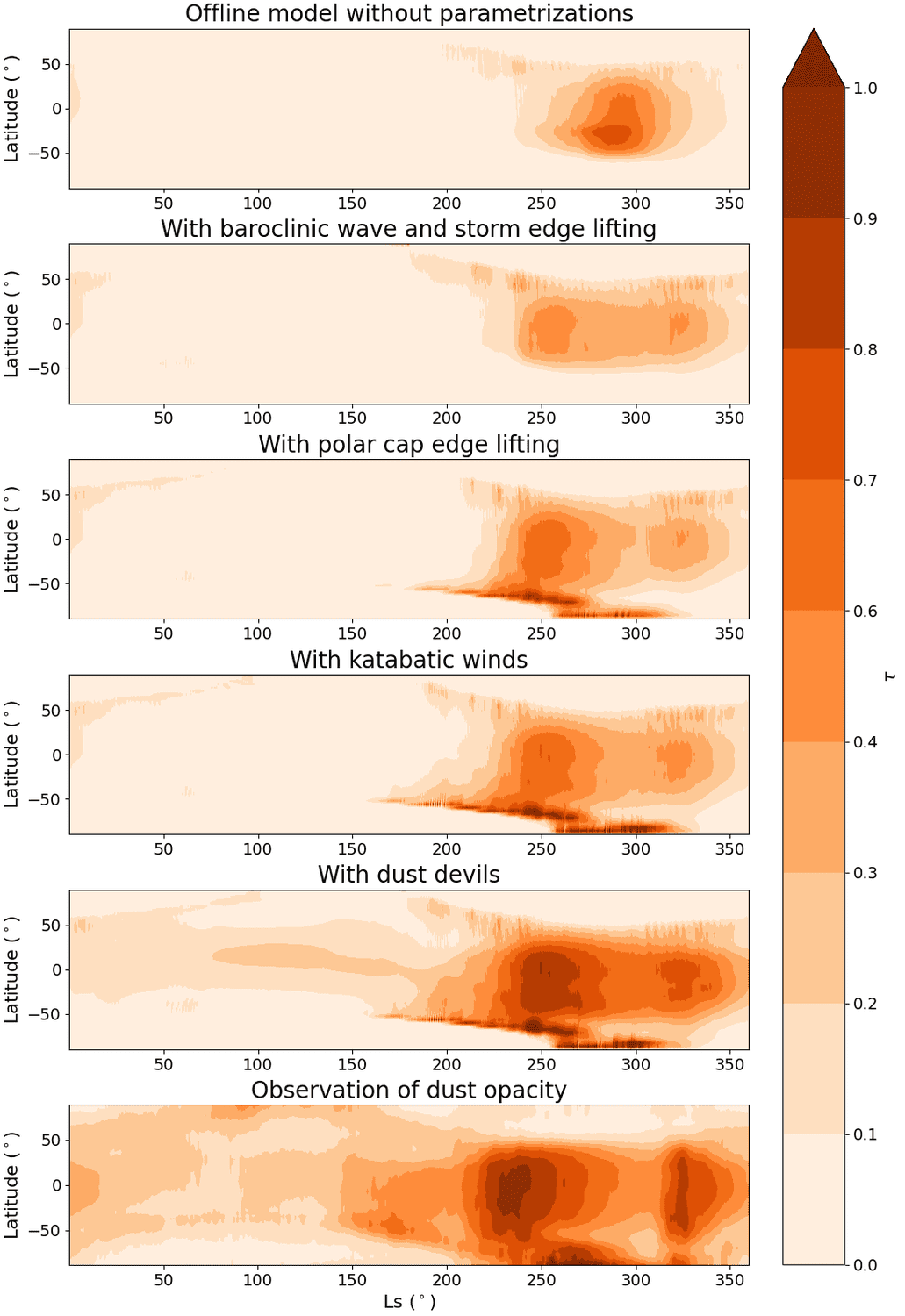
Thomas Pierron, Francois Forget, and Tanguy Bertrand

Introduction : Dust storms strongly influence the current Martian climate, yet their seasonal cycle and the interannual variability of Global Dust Storms (GDS) remain poorly understood. General circulation models (GCMs) often fail to reproduce both solsticial and equinoctial GDS, as well as the recurring seasonal pattern of regional Z, A, B and C storms (Montabone et al. (2015), Kass et al. (2016)). We present an offline dust model based on Mars Planetary Climate Model (Mars PCM) (Forget et al. (1999)) simulations with prescribed opacity and subgrid-scale parameterizations informed by high-resolution models. This approach captures key features of the dust cycle, including both types of GDS, while enabling multi-decadal simulations at low computational cost.

Preliminary GCM simulations : We perform six simulations of one Martian year with the Mars PCM, varying visible dust opacity from τ=0.05 to τ=5, kept constant throughout the year. The surface wind stress in the offline model is computed by interpolating wind data from these GCM simulations, adjusted for the mean dust opacity in the offline model and weighted by large zonal dust gradients, as strong zonal dust contrasts can enhance surface winds.

Dust Lifting, Transport, and Deposition : Dust lifting on Mars is driven by two main mechanisms: saltation by surface wind stress, dominant during the storm season (late northern summer to winter), and dust devils, active in spring and early summer. The offline model uses two tracers (mass and number) to represent dust, allowing diagnosis of loading and particle size under a log-normal distribution. Saltation flux is computed from surface wind stress and a lifting threshold, with subgrid wind variability captured using a Weibull distribution, following Lorenz (1996). Dust devil lifting is also included, with the flux computed as a function of vertical wind variance, based on insights from LES simulations. Advection is handled using a mass-conserving Van Leer scheme, while sedimentation is computed by discretizing the dust size distribution into 12 bins and applying mean fall speeds from Rossow (1978).

Dust sinks and sources : A key challenge in dust cycle modeling is the formation of dust sinks, where dust accumulates in low-wind or high-threshold regions, leading to a gradual depletion of atmospheric dust. To counter this, erosion is introduced: empty reservoirs can still lift dust if the wind exceeds a fixed erosion threshold.

Baroclinic waves : Baroclinic waves are included in the offline model's wind fields, but the coarse resolution limits the proper resolution of wave fronts. High-resolution GCMs show stronger winds and sharper contrasts during high baroclinic activity. Parameterizing these features is crucial to improve the dust cycle simulation, especially for capturing A and C storms.

Storm edge lifting : Dust storms often evolve as fronts with sharp opacity contrasts over short distances, which can enhance winds and trigger additional lifting, creating a positive feedback loop (Wu et al., (2021); Spiga and Lewis, (2010)). Due to model resolution limitations, these strong winds at storm edges must be parameterized.

Cap Edge Lifting: Strong winds near the polar cap edge, driven by temperature contrasts between Martian soil and CO2 ice caps, are better captured in mesoscale models (Smith and Spiga, (2018)). To simulate this in our model, we add a surface wind stress term proportional to the thermal contrast between adjacent grid cells, accurately representing the B storm near the South polar cap.

Wind stress thresholds : In the offline model, we use a distribution of wind stress thresholds instead of a single value per grid cell. Each cell contains subgrid reservoirs with unique lifting thresholds and limited dust supplies, which are replenished equally by sedimentation, allowing rapid recovery of low-threshold reservoirs. This setup introduces interannual variability in GDS activity by modulating local dust availability over time.

Results : The offline model reproduces both solstitial and equinoctial GDS with a realistic interannual variability, some years producing GDS, others not, as observed (see Figure 2). In the absence of GDS, the model captures the main features of the seasonal dust cycle, with recurring regional storms matching the observed pattern of the Z, A, B, and C storms, as illustrated in Figure 1. On average, the simulated dust cycle closely resembles the climatology derived from observations, supporting the model's capacity to represent the baseline seasonal behavior of Martian dust.

Figure 1: Effect of different parameterizations in the offline model compared to observations (last panel)

Figure 2: Planetary mean of visible dust column optical depth in the offline model as a function of season.

References :

Montabone, L., Forget, F., Millour, E., Wilson, R. J., Lewis, S. R., Cantor, B., Kass, D.Kleinböhl, A., Lemmon, M.T., Smith, M.D & Wolff, M. J. (2015). Icarus, 251, 65-95.

Kass, D. M., Kleinböhl, A., McCleese, D. J., Schofield, J. T., & Smith, M. D. (2016). Geophysical Research Letters, 43(12), 6111-6118

Forget, F., Hourdin, F., Fournier, R., Hourdin, C., Talagrand, O., Collins, M., Lewis, S.R., Read, P.L. & Huot, J. P. (1999). Journal of Geophysical Research: Planets, 104(E10), 24155-24175.

Lorenz, R. D. (1996). Journal of Spacecraft and Rockets, 33(5), 754-756

Rossow, W. B. (1978). icarus, 36(1), 1-50.

Wu et al. (2021). Journal of Geophysical Research: Planets, 126(9), e2020JE00675

Spiga, A., & Lewis, S. R. (2010). Mars, 5, 146-158.

Smith, I. B., & Spiga, A. (2018). Icarus, 308, 188-196.


How to cite: Pierron, T., Forget, F., and Bertrand, T.: An Offline Model for long-term Martian Dust Storm Simulations and Interannual Variability, EPSC-DPS Joint Meeting 2025, Helsinki, Finland, 7–13 Sep 2025, EPSC-DPS2025-724, https://doi.org/10.5194/epsc-dps2025-724, 2025.

11:15–11:27
|
EPSC-DPS2025-575
|
ECP
|
On-site presentation
Demetrius Ramette, Lena Noack, and Kerstin Schepanski

Global dust events (GDEs), occurring every few Martian years, are certainly the most impressive wheather phenomena on Mars and have been investigated by numerous studies. The reasons why GDEs occur in some Mars years, and not in others, remain challenging to unveil and many hypotheses have been set up, including that dust reservoirs need to be replenished after a GDE before the next one can occur. However, to our knowledge, the question of whether surface dust redistribution on Mars follows such a cyclic behavior was not adressed by mutli-year modeling studies yet.

In order to follow the time evolution of dust emission and deposition fluxes at the surface of Mars, we use the Mars Planetary Climate Model in its newest version 6 (Mars PCM6) (Bierjon et al., 2022), where dust injection is prescribed by observations, while transport and sedimentation freely follow the model winds. For prescribing dust injection, the Mars PCM6 uses daily global maps from observations of the Column Dust Optical Depth (CDOD) (Montabone et al., 2015). We further complete these maps with daily dust storm obervations from the Mars Dust Storm Sequences Database (MDSSD) (Wang et al., 2023), to take into account the intense dust storm activity near the Martian polar caps.

We thus obtain maps of the surface dust redistribution in the time frames covered by these observations (MY24-35 for the CDOD maps and MY28-33 for the MDSSD). We validate our modeling results with surface dust redistribution patterns from the literature, derived from remote-sensing observations of the Martian surface. Finally, we will analyse whether we find a periodic redistribution pattern of surface dust, in order to test the hypothesis of replenishing dust reservoirs between GDEs. This will utlimately help improving our understanding of Martian GDEs, on the road towards reliable weather prediction on Mars.


References

A. Bierjon, E. Millour, F. Forget, Finalization of the GCM version 6 - Improving the Dust Cycle, Laboratoire de Météorologie Dynamique, CNRS, IPSL, Paris, France, 2022, https://www-mars.lmd.jussieu.fr/esa/contract2020_2022/deliverables/MS3/D2.1_dust_cycle.pdf

L. Montabone, F. Forget, E. Millour, R.J. Wilson, S.R. Lewis, B. Cantor, D. Kass, A. Kleinböhl, M.T. Lemmon, M.D. Smith, M.J. Wolff, Eight-year climatology of dust optical depth on Mars, Icarus, Volume 251, 2015, doi:10.1016/j.icarus.2014.12.034

H. Wang, M. Saidel, M.I. Richardson, A.D. Toigo, J.M. Battalio, Martian dust storm distribution and annual cycle from Mars daily global map observations, Icarus, Volume 394, 2023, doi:10.1016/j.icarus.2022.115416

How to cite: Ramette, D., Noack, L., and Schepanski, K.: Investigating inter-annual dust redistribution at the surface of Mars with planetary climate model simulations, EPSC-DPS Joint Meeting 2025, Helsinki, Finland, 7–13 Sep 2025, EPSC-DPS2025-575, https://doi.org/10.5194/epsc-dps2025-575, 2025.

11:27–11:39
|
EPSC-DPS2025-1681
|
On-site presentation
Improved MarsWRF modeling of Martian dust storms.
(withdrawn)
Claire Newman, Mark Richardson, Yuan Lian, and Christopher Lee
11:39–11:51
|
EPSC-DPS2025-1051
|
On-site presentation
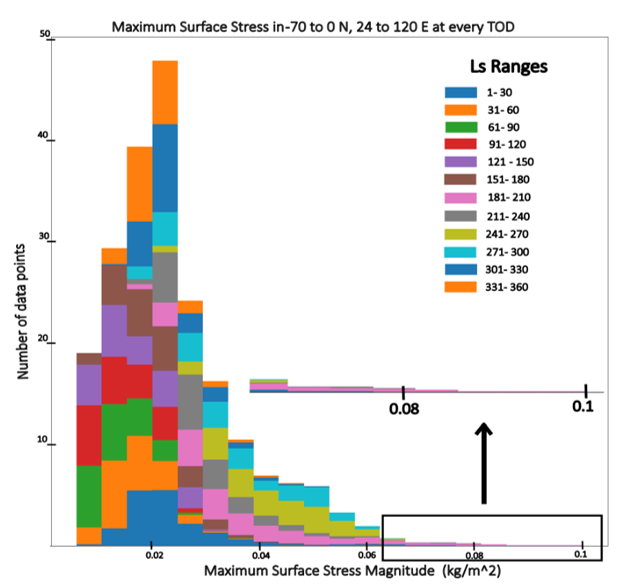
Scot Rafkin, Samantha Dolski, and Melinda Kahre

1.    Introduction and Motivation

Regional to large-scale dust storms are climatologically favored in the Hellas Basin region, especially during the northern fall equinox.  The dust storms, while often occurring in the same general season year after year, do not occur repeatedly sol after sol. It follows that the wind stress must cross an initial threshold above which dust lifting occurs and then fall below that threshold in two sols or less. Prior to and after that peak, the wind stress must be below the lifting threshold as the canonical scenario. The most common scenario is for an absence of storms.

The Hellas region exhibits numerous superimposed atmospheric circulations of different spatial and temporal scales: The seasonally-varying large-scale mean meridional (Hadley) circulation; large-scale stationary waves, the ubiquitous large-scale tidal circulations (primarily diurnal and semi-diurnal); traveling/transient eddies primarily associated with large-scale baroclinic instabilities; standing waves within Hellas itself (e.g., basin-wide gyres); and mesoscale direct thermal circulations associated with topographic slopes, ice/ice-free boundaries, and thermal inertia and albedo variations. All these individual circulations sum in non-linear ways to produce the total net circulation in the Hellas region. Except for traveling baroclinic waves, all the other circulations should have nearly repeatable amplitude and phase from sol to sol at a given season.  Therefore, these quasi-constant circulations likely are not the source of dust storm genesis since constant amplitude and constant phase circulations are unlikely to add together to exceed the dust lifting threshold. 

2.    Hypothesis

Prior work suggests that baroclinic storm systems circling along the ice cap edge are an important mechanism for the generation of dust events.  Although the baroclinic activity is ubiquitous around Ls 180, only a small number of dust events occur each year. Baroclinic waves typically have a period of several days, but dust lifting in the region is stochastic and not periodic. Therefore, if traveling baroclinic waves are responsible for the dust lifting, only a handful of these systems per year trigger dust lifting events while most of the waves do not. We hypothesize that only special and rare types of baroclinic systems can push the wind stress beyond the lifting threshold. These rare systems, perhaps only one or two per year, explain the stochastic and infrequent nature of dust storms. However, the storms depend on a climatologically strong non-baroclinic background circulation to generate a high surface wind stress condition that is, by itself, below the lifting threshold. 

3.    Hypothesis Testing Methodology

Statistical analysis is performed on 10 years of NASA Ames Mars General Circulation Model  output in the Hellas Basin region to identify the most intense surface wind stress events (Figure 1).  From this catalog of events, the highest stress events are analyzed to decompose the circulation into separate background and traveling (mostly baroclinic) components and to characterize and correlate baroclinic characteristics with high surface wind stress events.  


4.    Results

The highest stress events all occur around Ls 180 and are associated with extratropical (baroclinic) storm system. Further synoptic analysis shows that there are three types of systems that are conducive to producing the highest surface wind stress.  In each type, the strength and orientation of the high and low pressure systems align to constructively add to the background circulation. These three storm types are rare and are clearly distinguishable from the far more common baroclinic storm systems that regularly evolve and traverse the Hellas region.

There are shared characteristics of the maximum wind stress events in the model analysis. Maximum stress events consistently occur at 0000 – 0600 LT when downslope flows are strongest. Only one case occurs at 1500 LT. The strongest events also occur in a localized area in southwest Hellas from 45 to 55 S and 54 to 66 E. This region corresponds to the strongest non-baroclinic surface stresses, thus setting the stage for a transient baroclinic eddy to trigger a dust storm (Figure 2). Systems that do not fall into one of the three categories, even though they may be deep and intense baroclinic storms, do not produce the highest wind stresses.

An example of a baroclinic system responsible for the highest stress case in year 3 is shown in Figure 3.  This event was produced by a baroclinic low pressure in South Hellas and a strong anticyclone moving from the West into the Western Hellas ridge between latitudes -30 to -50 N. The result was an anomalous pressure gradient perturbation driving strong perturbation winds that aligned with the mean wind. Although large wind speeds are collocated with maximum stress, high speeds are also recorded west of Hellas Basin. However, the lower density at higher elevations reduces the wind stress compared to lower elevations.

The other two types of baroclinic systems have different high/low pressure configurations compared to Figure 3, but all result in an anomalous pressure gradient that drives strong perturbation winds that constructively add to the mean. The vast majority of baroclinic systems, even those with strong pressure gradients, do not align with the background circulation and do not contribute to high stress events.  The analysis of the GCM model output is consistent with the hypothesis invoking rare and special baroclinic events as the source of Hellas Basin dust storms near Ls 180.


Figure 1.  Histogram of the maximum surface stress events in 10 years of model data within the Hellas Basin region.  There are a very small number of high stress events (1 to 2 per year).


Figure 2.  The mean Hellas Basin circulation from Ls 180-193.  The averaging effectively removes the baroclinic eddy component of the circulation.  Surface stress is contoured in green showing a maximum on the southwest slope of Hellas.

Figure 3.  An example of a Type 2 event where the baroclinic system occurs at just the right time, in just the right place, at just the right time to produce a strong perturbation pressure gradient and strong winds aligned with the mean circulation.

How to cite: Rafkin, S., Dolski, S., and Kahre, M.: The Association of Hellas Basin Dust Storms to Specific Types of Baroclinic Storm Systems, EPSC-DPS Joint Meeting 2025, Helsinki, Finland, 7–13 Sep 2025, EPSC-DPS2025-1051, https://doi.org/10.5194/epsc-dps2025-1051, 2025.

11:51–12:03
|
EPSC-DPS2025-1209
|
On-site presentation
Michael Battalio, Juan Lora, Sandro Lubis, and Pedram Hassanzadeh

Annular modes represent some of the largest sources of climate variability for Earth and Mars.  Annular modes are zonally symmetric patterns of variability that represent the jet stream shifting north and south in time and are associated with anomalous occurrences of atmospheric eddies, clouds, and dust.  Mars's Northern Annular Mode (MNAM) develops as anomalies of zonal-mean zonal wind emerging near the subtropics and migrating towards the pole.  New anomalies appear in the subtropics and begin propagating with a period of ~150 sols, as diagnosed from the OpenMARS reanalysis.  The propagation is induced by the interaction of the two leading empirical orthogonal functions that define the MNAM, which can be predicted using a pair of simple prognostic equations similar to what is done for Earth.  The shifting jet stream coincides with bands of anomalous surface wind stress and encourages anomalous dust optical depth.  The MNAM's internally forced periodicity on the surface wind stress combined with the seasonally forced dust cycle may help explain the inter-annual variability of global dust events, as suggested by a Monte Carlo estimate that correctly approximates the observed incidence of global dust events.  Further quantification of the other modes of internal climate variability of Mars may be possible as the record of Mars's present-day climate surpasses a decade of measurement.

How to cite: Battalio, M., Lora, J., Lubis, S., and Hassanzadeh, P.: Periodicity of Mars's Northern Annular Mode May Help Explain Global Dust Storm Frequency, EPSC-DPS Joint Meeting 2025, Helsinki, Finland, 7–13 Sep 2025, EPSC-DPS2025-1209, https://doi.org/10.5194/epsc-dps2025-1209, 2025.

12:03–12:15
|
EPSC-DPS2025-725
|
ECP
|
On-site presentation
Julia Martikainen, Olga Muñoz, Juan Carlos Gómez Martín, María Passas Varo, Teresa Jardiel, Marco Peiteado, Yannick Willame, Lori Neary, Tim Becker, and Gerhard Wurm

1. Introduction

Aerosol dust particles are an important component in planetary atmospheres, influencing energy balance, thermal structure, weather systems, and remote observations. Despite their importance, radiative-transfer models and climate simulations for planets are often limited by assumptions of oversimplified particle shapes and fixed complex refractive indices for aerosol dust, which hinders the interpretation of observational data. To address this gap, we present an experimentally validated database of aerosol dust optical properties derived from Martian dust analogs. The work combines laboratory measurements with advanced light-scattering modeling and provides a transferable methodology for studying aerosols in a variety of planetary environments.

2. Sample Preparation and Characterization

We selected three spectrally and mineralogically distinctive Martian dust analogs representative of different Martian terrains: JSC Mars-1, MGS-1, and MMS-2 (see Figure 1). The samples were processed at Instituto de Cerámica y Vidrio (ICV) to produce narrow particle size distributions in the geometric optics domain for the retrieval of complex refractive indices, as well as narrow size distributions representative of airborne dust aerosols for the computation of optical properties. Detailed morphological and compositional characterization was performed using SEM imaging, laser diffraction particle sizing, and X-ray diffraction (XRD) (see Martikainen et al. 2023).

Figure 1: The JSC Mars-1, MGS-1, and MMS-2 analogs.


3. Experimental Data

Diffuse reflectance spectra were measured from 200 to 2000 nm using a Varian Cary 5000 UV-vis-NIR spectrophotometer for samples with narrow particle size distributions in the geometric optics domain (Martikainen et al. 2023). The scattering matrix measurements at 488 and 640 nm were carried out at the Cosmic Dust Laboratory (CODULAB, Muñoz et al. 2010) of the Instituto de Astrofísica de Andalucía (IAA), covering scattering angles from 3° to 177° using analogs with narrow size distributions representative of airborne dust (Martikainen et al. 2024). The measurements include the phase function (F₁₁), degree of linear polarization (−F₁₂/F₁₁), and, where possible, additional scattering matrix elements (F₂₂, F₃₃, F₃₄, F₄₄). Together, these datasets provide the experimental basis for retrieving the complex refractive indices and computing bulk optical properties for radiative-transfer modeling.

4. Light-scattering modeling

The complex refractive indices were retrieved using the SIRIS4 ray-tracing model (Muinonen et al. 2009), which accounts for the irregular shapes of real dust grains. The model was applied to the measured diffuse reflectance spectra and corresponding narrow particle size distributions in the geometric optics domain. In this regime, the scattering behaviour of large particles is highly sensitive to the complex refractive index, allowing it to be reliably constrained from the measurements.

Bulk optical properties were computed using the TAMUdust2020 database of irregular hexahedral particles (Saito et al. 2021), based on the retrieved complex refractive indices and narrow size distributions representative of airborne dust. The modeled phase matrices were compared with measurements at 488 and 640 nm to validate both the retrieved complex refractive indices and the hexahedra particle model. The final set of calculated properties includes single-scattering albedo, extinction efficiency, extinction cross-section, asymmetry factor, and phase matrix elements across the 200–2000 nm spectral range.

5. Broader Applications
While the database is based on Martian dust analogs, both the experimental approach and the modeling framework are designed to be transferable. Similar methods can be applied to characterize aerosols in other planetary atmospheres, such as those of Venus or exoplanets. Our work demonstrates the value of combining controlled laboratory measurements with advanced numerical scattering models to improve the realism of aerosol dust optical data. Moreover, our derived optical properties reproduce the key spectral features of observed Martian regolith. This confirms the physical relevance of the results and supports their use in forward modeling and data interpretation.

6. Conclusions
We provide a validated, multi-wavelength database of aerosol dust optical properties derived from Martian dust analogs (Martikainen et al. 2025), intended for use in radiative-transfer modeling and observational retrievals across the planetary sciences. The methodology is designed for adaptation to other planetary atmospheres and dust compositions. The full dataset is available at the Granada-Amsterdam Light Scattering Database (Muñoz et al. 2025).

References: Martikainen et al. (2023), ApJS 268; Martikainen et al. (2024), ApJS 273; Martikainen et al.(2025), MNRAS 537; Muñoz et al. 2011, JQSRT 111; Muñoz et al. (2025), JQSRT 331; Muinonen et al. (2009), JQSRT 110; Saito et al. (2021), JAS 78.

How to cite: Martikainen, J., Muñoz, O., Gómez Martín, J. C., Passas Varo, M., Jardiel, T., Peiteado, M., Willame, Y., Neary, L., Becker, T., and Wurm, G.: Aerosol Dust Optical Properties from Martian Analogs in the UV-vis-NIR, EPSC-DPS Joint Meeting 2025, Helsinki, Finland, 7–13 Sep 2025, EPSC-DPS2025-725, https://doi.org/10.5194/epsc-dps2025-725, 2025.

12:15–12:27
|
EPSC-DPS2025-1632
|
ECP
|
On-site presentation
Anirban Mandal and Jagabandhu Panda

Introduction

Dust is an essential part of the Martian atmosphere, and the notable dynamic phenomena of dust storms are quite intriguing on the planet. These storms significantly modify the dynamics and thermodynamics of the Martian atmosphere. Due to the lifted dust in the atmosphere, a layer is created that blocks the sunlight from reaching the surface and consequently generates a cooling effect. At the same time, it heats the atmosphere at higher altitudes due to the absorption and scattering of solar radiation [1]. Dust storms can also alter the atmospheric circulation and vertical structure [2, 3]. Thus, studying Martian dust storms can help us understand the comprehensive behavior of the Martian atmosphere. Studies have used both observational and numerical modeling datasets to analyze the characteristics of dust storms [3, 4]. The dust availability, dust lifting centers, trajectories, and several other features of the dust storms are identified through such analysis. But they are a bit time-consuming and often require high computational resources. However, several characteristics of dust storms can be statistically interpreted through probability distributions or polynomial functions. This study uses the Landau distribution to analyze several dust storms and investigate the peak, dust availability, duration, etc.

Data and Methodology

During the growth phase of a dust storm, a rapid increase in dust is observed, which continues till the peak, followed by an elongated decay phase. So, a time series analysis of dust opacity will indicate a right-skewed variation. Thus, right-skewed probability distribution, like the Landau type, is used here to fit the time series plot and get a statistical interpretation of dust storms. The dust opacity (d) for a storm can be fitted using the distribution as:

                                                                                                                                                      d = τ + αL( μ, σ)                                                                                                                                   (1)

where L is the Landau distribution. τ, α, μ, and σ are constants that signify several physical characteristics of the storm. Column dust optical depth (CDOD) is a measure of the total amount of dust over the entire atmospheric column, and it is used in the current analysis as it incorporates all the pressure levels. CDOD data obtained from the Montabone dust scenario [5, 6] is used to fit the probability distribution.

Results

The dust availability is determined by the background dust (τ). The strength and maximum opacity during the storm are determined through the intensity parameter (α). The peak of the dust storm is specified by the location parameter (μ). The duration of the storm is signified by the scale parameter (σ). In this study, four storms are considered across different Martian years (MY) and seasons. The storms happened around LS=180°-270° in MY 34 (DS1); LS=310°-340° (DS2) in MY 35; LS=150°-170° (DS3), and LS=250°-280° (DS4) in MY 36. DS1 is a global dust storm, and DS2 is a large regional storm. Notably, DS3 is a small regional storm, and DS4 is a regional storm near the southern polar cap. The Landau distribution fit seems to capture the growth of the dust storm very well (Figure 1). However, there are slight deviations around the peak, and underestimation is observed in most instances. The exact peak for all the storms is not properly realized. The distribution usually overestimates in the early stage of the decay phase and underestimates in the later stages. However, if the decay phase is prolonged, like that for a global dust storm (DS1), it follows closely the Landau distribution (Figure 1a). However, if the dust storm has a slow growth phase (Figure 1d), it fails to capture the trend completely, as the slow-growth dust storms show a symmetrical distribution.

Figure 1. The Landau distribution fits (red line) with the actual data (black dots) for DS1 (a), DS2 (b), DS3 (c), and DS4 (d).

The background dust (τ) is strictly dependent on the season and provides an idea about the dust availability (Table 1). For the global storm (DS1), the τ value is greater, hinting at higher dust availability, which is the probable reason for the growth of the storm into a global one. A high τ value for DS4 signifies the greater dust availability due to the southern summer. As DS3 happens in the early part of the dust season, it shows the lowest τ. The larger value of α indicates a higher intensity of the storm, which is realized through the maximum CDOD values. DS1, being a global event, shows the highest α. And DS3, being an early-season storm with lower dust availability, shows the lowest α. However, any empirical relationship between the peak CDOD and α could not be established. The peak of the dust storms can be estimated as  , which is found to match with peaks of DS2 and DS3, but deviates a lot for DS1 and DS4. The Landau distribution fit captured the peak of DS1 much earlier (Figure 1a), and it did not show a good fit for DS4, indicating a mismatch. The higher σ value represents the longer duration of the storm. As DS1 is a global storm, it has the longest duration, and with DS4, a storm with a slow growth phase, an overall extended duration is realized. In terms of LS, the approximate duration (initiation to decay) is estimated to be 4.338σ.

Table 1. The parameters for the dust storms obtained from the Landau distribution.


Conclusions

The Landau distribution greatly helps in understanding several characteristics of the Martian dust storms. The growth phase is captured well, and the decay phase is more or less followed, whereas the exact peak is not properly captured. The proposed approach can be useful to study the dust storms alongside the conventional analysis. Although this study has used CDOD values, the distribution is expected to work with dust opacity for different pressure levels. However, altitudes near the surface would not perform well due to non-uniform dust-lifting.

References

[1] Panda et al. (2025). New Astronomy Reviews, 101723. [2] Haberle (1986). Science, 234(4775). [3] Kass et al. (2016). GRL, 43(12). [4] Bertrand et al. (2020). JGR: Planets, 125(7). [5] Montabone et al. (2015). Icarus, 251, 65-95. [6] Montabone et al. (2020). JGR: Planets, 125(8).

How to cite: Mandal, A. and Panda, J.: A statistical analysis of Martian dust storms using the Landau probability distribution, EPSC-DPS Joint Meeting 2025, Helsinki, Finland, 7–13 Sep 2025, EPSC-DPS2025-1632, https://doi.org/10.5194/epsc-dps2025-1632, 2025.

12:27–12:30

Orals THU-OB5: Thu, 11 Sep, 15:00–16:00 | Room Sun (Finlandia Hall)

Chairpersons: Thomas Pierron, Anni Määttänen
Mars dust II, exoplanets, Pluto
15:00–15:12
|
EPSC-DPS2025-1672
|
ECP
|
On-site presentation
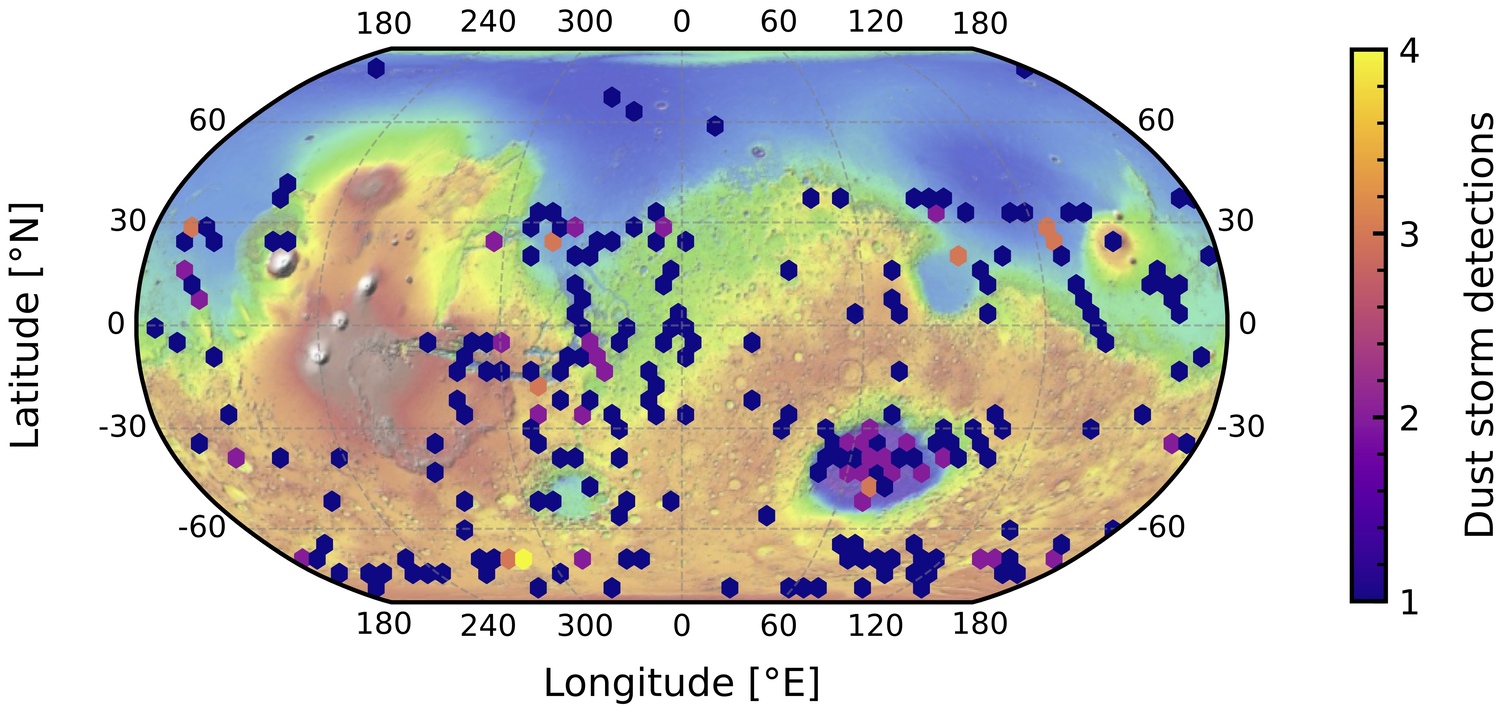
Yann Leseigneur, Tanguy Bertrand, Thomas Gautier, and Aymeric Spiga

            Martian dust, composed of micrometer-sized mineral particles, is a key parameter of the Martian atmosphere because of its high mobility and capacity to form dust storms and alter the heat balance of the atmosphere. These dust storms are part of the Martian dust cycle and can occur over a wide range of spatial and time scales (from sub-km to planetary scale, and from the minute to months). The dust studies are mostly concentrated on regional storms (> 2000 km), which are detected using UV-VIS global imagers [1, 2] or thermal-IR spectrometers [3]. These observations provide information about the frequency and size of the storms. However, some characteristics of the dust cycle remain uncertain, such as the exact mechanisms of storm formation and growth processes, with implications for the predictability of dust storms and Global Dust Storms (GDS, storm at a planetary scale).

            Thus, it is important to study dust activity at a local scale, such as the local dust storms (< 2000 km) which have not been massively detected (some detections by [2] and a few individual storm characterisations as [4]). We focus our work on detecting dust storms in the OMEGA/Mars Express (near-IR imaging spectrometer) dataset, which has a high enough spatial resolution (0.36-4.8 km/px) to detect local dust storms. More precisely, we develop a method to detect automatically dust storms using dust optical depth computation (at 0.9 µm) made by [5] from late Martian Year 26 to early MY 30 (including the MY 28 GDS). The 1st-level detection is to exclude OMEGA observations that are least likely to contain dust storms (dust optical depth < 1.25). Then the 2nd-level detection principle is to identify pixel clusters of high optical depth within individual observations to identify storms, to confirm the detection using different criteria (e.g., decrease of surface reflectance) and to extract key characteristics of the storm (e.g., size, centroid, local time).


Figure 1: Spatial distribution of the dust storms (local and regional) detected with OMEGA/MEx from late MY 26 to early MY 30 (without MY 28 GDS period). The background corresponds to a topography map (MOLA/MGS).

            With this 2-level method, we detected 287 dust storms (excluding the MY 28 GDS period during which 114 detections have been made) composed of 283 local and 4 regional. Here we summarised our results that will be presented in detail during the conference (notably by separating the local and regional dust storms). From the spatial distribution of the detections (Figure 1), we notice some known preferential areas such as the flushing dust storm channels (e.g., Acidalia-Chryse, Utopia-Isidis, see [1]) or Hellas Planitia, as well as next to the southern polar cap. The seasonal distribution of the detected storms (Figure 2) shows many detections in the Ls=240-270° period, particularly in MY 27, and also during the Ls=330-360° period, notably in MY 29. Interestingly, only a few storms were reported during these periods using UV-VIS imagery [1], suggesting that our method may be capturing local-scale events that were previously undetected. Another strength of OMEGA data is the local time coverage during the Mars Express mission, allowing the study of the time dependence. We noticed many detections from 10:00 to 18:00 with an increase (compared to the OMEGA local time coverage) at the end of the afternoon (16:00-18:00), and also some detections early in the morning (04:00-06:00).


Figure 2: Seasonal distribution of the dust storms (local and regional) detected with OMEGA/MEx from late MY 26 to early MY 30 (without MY 28 GDS period).

            We also worked on the MY 28 GDS onset, for which one doubt remains about the formation area, specifically, whether it originated in Noachis (southern hemisphere) or Chryse (northern hemisphere). More precisely, the question is whether the precursory storm observed in Noachis initiated the GDS independently, or whether it was dependent on the one in Chryse. The consecutive OMEGA observations of these two areas (during the storms) show high dust optical depth values for Noachis and Chryse, but separated from each other by low optical depths, which could be interpreted as two separate clouds, and therefore a GDS onset in Noachis. We are currently working to evaluate the dust altitude by comparing dust optical depth retrievals at different wavelengths [6].

References:
[1] Battalio M. & Wang H. (2021) Icarus, 354, 114059.
[2] Guha B. K. et al. (2024) JGR Planets, 129, e2023JE008156.
[3] Lombard T. & Montabone L. (2024), 10th International Conference on Mars, abstract #3041.
[4] Määttänen A. et al. (2009) Icarus, 201 Issue 2, 504-516.
[5] Leseigneur Y. and Vincendon M. (2023) Icarus, 392, 115366.
[6] Kazama A. (2025) EPSC-DPS2025, abstract #547.

How to cite: Leseigneur, Y., Bertrand, T., Gautier, T., and Spiga, A.: OMEGA/Mars Express dust storm catalogue: a local dust storm survey, EPSC-DPS Joint Meeting 2025, Helsinki, Finland, 7–13 Sep 2025, EPSC-DPS2025-1672, https://doi.org/10.5194/epsc-dps2025-1672, 2025.

15:12–15:24
|
EPSC-DPS2025-574
|
On-site presentation
Akira Kazama, Shohei Aoki, Yann Leseigneur, Mathieu Vincendon, Yasumasa Kasaba, Hiromu Nakagawa, Thomas Gautier, Aymeric Spiga, Tanguy Bertrand, Franck Montmessin, Kazunori Ogohara, Takeshi Imamura, Isao Murata, and John Carter

Understanding the Martian dust cycle is essential for clarifying the atmospheric circulation and meteorological phenomena. Unlike Earth, Mars has a thin atmosphere primarily composed of CO2, where atmospheric dust plays a dominant role in regulating the energy balance and driving atmospheric motion. Among various dust-related phenomena, Local Dust Storms (LDS), defined as storms that span less than 1.6 × 10⁶ km2 or last fewer than three Martian days (Cantor et al., 2001), are particularly important for studying localized dust lifting and its potential connection to regional or global dust events (Martin and Zurek, 1993; Cantor et al., 2001; Hinson and Wang, 2010; Wang and Richardson, 2015). However, due to their limited spatial extent and short lifetimes, LDS have remained challenging to detect and characterize comprehensively.

In this study, we developed a method for identifying LDS using data from the OMEGA (Observatoire pour la Minéralogie, l'Eau, les Glaces et l'Activité) imaging spectrometer onboard Mars Express (Bibring et al., 2004). Specifically, we used the strong CO₂ absorption band at 2.77 µm to retrieve dust optical depth. This band is sensitive to altitudes around 20–30 km and offers the critical advantage of being largely insensitive to surface reflectance properties. Applying this retrieval method to data from Martian Years (MY) 27 through 29, we detected 146 LDS events. Our statistical analysis revealed clear seasonal and diurnal patterns. LDS occurrences were most frequent during southern summer (Ls = 270°–360°), consistent with past findings that identify this season as conducive to dust activity (e.g., Smith, 2004; Montabone et al., 2015). However, we also observed an anomalously high frequency of LDS during northern summer in MY27 (Ls = 130°–150°), a period not typically associated with elevated dust activity. Furthermore, a noticeable increase in LDS activity was detected just before the onset of the Global Dust Storm (GDS) in MY28. Diurnally, LDS were most often observed near noon, implying that storm initiation may begin in the morning hours. Their spatial distribution varied significantly with season. During Ls = 0°–180°, LDS tended to be confined to specific regions such as Chryse Planitia and southern Acidalia. In contrast, during Ls = 180°–360°, LDS appeared more widely across mid-latitudes, with a notable absence in the northern high-latitude region (above 40°N). These results offer new insight into the role of LDS in the broader Martian dust cycle, particularly their potential influence on triggering regional or global events.

Building on these findings, we are working on two additional research directions. The first involves estimating the vertical structure of dust by multiple spectral bands with different CO2 absorption strengths. For example, the 2.01 µm band is sensitive to lower altitudes than the 2.77 µm. By comparing dust optical depth values retrieved from the 2.01 µm (Leseigneur and Vincendon, 2023) and the 2.77 µm (Kazama et al., under review), we aim to characterize whether the dust is well-mixed throughout the column or exists as a detached layer. Preliminary results have demonstrated the feasibility of this technique in distinguishing between detached and uniform dust layers, suggesting the potential for more detailed three-dimensional analyses of dust transport.

The second one concerns the retrieval of surface pressure, which is typically retrieved from the 2.01 µm CO2 absorption feature (Forget et al., 2007). However, this approach is strongly influenced by dust conditions, which introduces systematic uncertainties under dusty conditions. By incorporating independently retrieved dust optical depth from the 2.77 µm band as a fixed input, we can better decouple atmospheric and surface effects. This improvement may help us better explore potential interactions between dust storms and surface pressure variations, including possible pressure drops or wave-like features linked to thermal tides and gravity waves.

We plan to extend these techniques to data from upcoming Mars missions, including the Martian Moons eXploration (MMX) mission, set to launch in 2026. The MIRS (MMX InfraRed Spectrometer) instrument onboard MMX features high spatial resolution and broad coverage, making it well-suited for continuous monitoring of atmospheric dust and surface pressure at global scales (Barucci et al., 2021; Ogohara et al., 2022; Kuramoto et al., 2022). We aim to investigate seasonal and interannual variability in Martian dust activity from a long-term perspective using MIRS data.

In conclusion, this work integrates high-resolution imaging spectroscopy, retrieval techniques, and statistical analysis to provide a multi-scale understanding of Martian dust dynamics. 

How to cite: Kazama, A., Aoki, S., Leseigneur, Y., Vincendon, M., Kasaba, Y., Nakagawa, H., Gautier, T., Spiga, A., Bertrand, T., Montmessin, F., Ogohara, K., Imamura, T., Murata, I., and Carter, J.: Integrated Study of Martian Dust: Detection of Local Dust Storms, Estimation of Vertical Distribution, and Surface Pressure Analysis Using OMEGA Observations, EPSC-DPS Joint Meeting 2025, Helsinki, Finland, 7–13 Sep 2025, EPSC-DPS2025-574, https://doi.org/10.5194/epsc-dps2025-574, 2025.

15:24–15:36
|
EPSC-DPS2025-1725
|
Virtual presentation
A dust storm database prepared from the EMM camera EXI for Martian years 36 and 37
(withdrawn)
Bijay Guha, Claus Gebhardt, Neha Gupta, Roland Young, Michael Wolff, and Luca Montabone
15:36–15:48
|
EPSC-DPS2025-580
|
ECP
|
On-site presentation
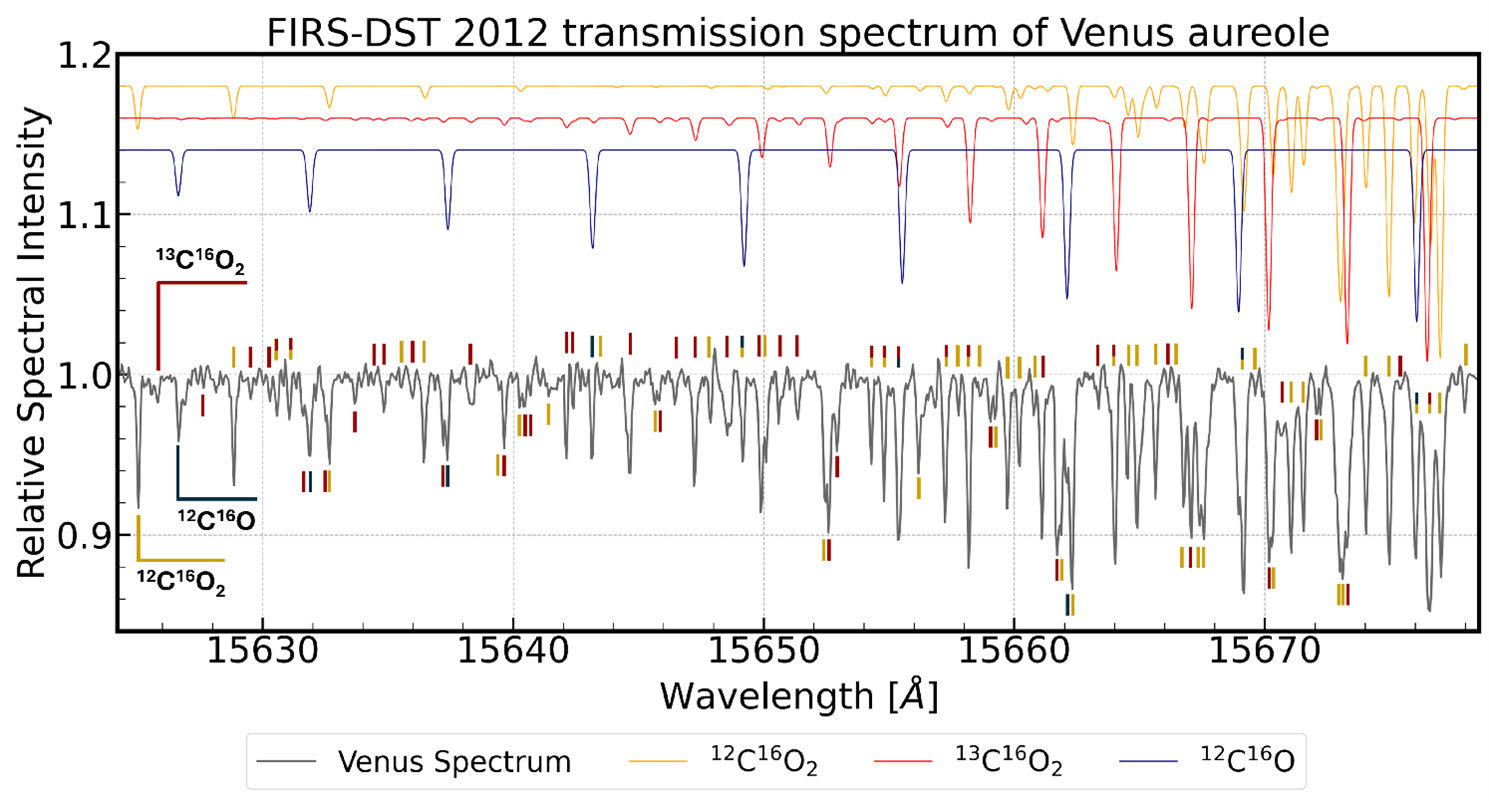
Alexandre Branco, Pedro Machado, Olivier Demangeon, Tomás Azevedo Silva, Clara Sousa-Silva, Sarah A. Jaeggli, Thomas Widemann, Paolo Tanga, and Lauren Mendoza

The great diversity of detected exoplanets offers a wealth of opportunities for atmospheric characterization studies. Transmission spectroscopy has proven effective in probing the chemical composition and dynamics of hot gas giants, and is now beginning to deliver the first insights into the atmospheres of Super-Earths and terrestrial exoplanets. The extension of this technique to rocky worlds, however, has revealed fundamental challenges to atmospheric characterization, associated with their shallow atmospheres and the impact of stellar contamination on observational data [1,2].

The prospect of retrieving the atmospheric chemical composition of an Earth-sized exoplanet is currently beyond reach. Importantly, as these environments begin to be characterized, the most favourable targets for transmission spectroscopy are expected to host atmospheres more akin to Venus than to a truly Earth-like composition [3]. With the goal of informing future observation campaigns of a potential population of Venus-analogues in our galaxy (e.g., using the next-generation facility ELT-ANDES), this work analysed near-infrared transmission spectra from Venus, between 15,624-15,680 Å, as observed with DST-FIRS during the planet’s solar transit of 5–6 June 2012.

Benefiting from a high resolving power (R ~ 90,000), we could resolve distinct molecular absorption lines and disentangle between spectral features from the main isotopologues of carbon dioxide, 12C16O2 and 13C16O2, and carbon monoxide, 12C16O (Figure 1). We performed cross-correlation analyses with spectral templates from petitRADTRANS [4], enabling detections of both CO2 isotopologues and CO, together with a tentative signal for atmospheric ozone on Venus (Figure 2 and Figure 3). Our results highlight potential spectral observables to be expected for Venus-like exoplanet atmospheres, and showcase how current line lists offer sufficient precision to perform such detections with the cross-correlation technique.

This study provides a clear motivation to explore the synergy between Solar System research and the rapidly growing field of exoplanetary science, by enabling direct comparison between ground-based high-resolution data and transmission spectroscopy datasets from space probes [5,6]. Such a comparison provides a valuable calibration template to strengthen the interpretation of transmission spectra from Earth-sized exoplanets near the habitable zone.

Figure 1: Average transmission spectrum of Venus extracted from the atmospheric aureole as observed during the solar transit of 2012 (in gray). Synthetic transmission spectra for CO2 and CO isotopologues were generated with petitRADTRANS and are shown for comparison. The absorption lines identified upon visual inspection of the observed spectrum have been marked: 12C16O2 (yellow), 13C16O2 (red), 12C16O (dark blue).

Figure 2: Cross-correlation functions for (a) 12C16O2, (b) 13C16O2, (c) 12C16O (dark blue line). The best-fit Gaussian profiles are shown for each CCF (red dashed line). All panels show the CCFs resulting from the self cross-correlation of the templates (light orange area), which are scaled arbitrarily.

Figure 3: Cross-correlation function for 16O3 (dark blue line) along with the best-fit Gaussian profile (red dashed line). The CCF resulting from the self cross-correlation of the template is shown as a light orange area, arbitrarily scaled for comparison.

References:

[1] Moran, S.; et al. High Tide or Riptide on the Cosmic Shoreline? A Water-rich Atmosphere or Stellar Contamination for the Warm Super-Earth GJ 486b from JWST Observations. Astrophys. J. Lett. 2023, 948, L11

[2] Lim, O.; et al. Atmospheric Reconnaissance of TRAPPIST-1 b with JWST/NIRISS: Evidence for Strong Stellar Contamination in the Transmission Spectra. Astrophys. J. Lett. 2023, 955, L22

[3] Kane, S.; et al. A potential super-Venus in the Kepler-69 System. Astrophys. J. Lett. 2013, 770, L20

[4] Mollière, P.; et al. petitRADTRANS. A Python radiative transfer package for exoplanet characterization and retrieval. Astron. Astrophys. 2019, 627, A67.

[5] Ehrenreich, D.; et al. Transmission spectrum of Venus as a transiting exoplanet. Astron. Astrophys. 2012, 537, L2

[6] Hedelt, P.; et al. Venus transit 2004: Illustrating the capability of exoplanet transmission spectroscopy. Astron. Astrophys. 2011, 533, A136

How to cite: Branco, A., Machado, P., Demangeon, O., Azevedo Silva, T., Sousa-Silva, C., A. Jaeggli, S., Widemann, T., Tanga, P., and Mendoza, L.: High-Resolution Transmission Spectroscopy of Venus: A Proxy for Atmospheric Characterization of Earth-Sized Exoplanets, EPSC-DPS Joint Meeting 2025, Helsinki, Finland, 7–13 Sep 2025, EPSC-DPS2025-580, https://doi.org/10.5194/epsc-dps2025-580, 2025.

15:48–16:00
|
EPSC-DPS2025-638
|
ECP
|
On-site presentation
Bruno de Batz de Trenquelléon, Tanguy Bertrand, Aurélien Falco, Emmanuel Lellouch, Ehouarn Millour, and François Forget

Introduction:

New Horizons revealed that complex processes of photochemistry and microphysics are taking place in Pluto’s N2 atmosphere [1, 2]. Similarly to Titan, the presence of CH4 in Pluto’s atmosphere leads to the UV photochemical production of more complex molecules such as C2H2, C2H4, and C2H6, as well as nitriles like HCN at high altitudes. These compounds can aggregate through collisions to form increasingly larger spherical particles, creating a haze of solid organic aerosols that encompasses Pluto [1]. The resulting haze particles can continue to grow through coagulation, forming fractal aggregates that lead to a bimodal distribution near the surface [3]. In addition, photochemical-microphysical modeling by [4] shows that condensation of HCN and various hydrocarbons occurs in Pluto’s atmosphere on the tholin-like particles.

Our objective is to investigate the thermal balance of Pluto’s atmosphere using the Pluto Planetary Climate Model (Pluto PCM). We focus on three aspects of the thermal profile:

  • (1) The strong negative gradient between the stratosphere at 110 K and the upper atmosphere at 70 K.
  • (2) The strong thermal gradient (7 ± 3.5 K) from equator to North Pole tentatively observed (2) with ALMA [5], and the differences in temperatures observed by New Horizons between the entry and exit profiles above 5 km altitude [6].
  • (3) The 3 km-deep cold layer observed by New Horizons.

The thermal profile of Pluto’s atmosphere has been measured from ground-based observations and from the REX instrument on-board New Horizons [6, 7]. It has been proposed by [8] that the thermal structure is primarily regulated by the heating and cooling properties of tholin-type haze, whose heating/cooling rates could exceed that of gases by two orders of magnitude. However, in scenarios where the haze is dominated by icy components, its radiative impact on the atmosphere is expected to be more limited [4]. Therefore, the main cooling mechanism responsible for the observed vertical thermal gradient remains uncertain.

The Pluto PCM:

The Pluto PCM is an ideal tool for understanding the thermal balance of Pluto's atmosphere and the role of hazes in its heating and cooling properties. This model is an updated version of the Legacy Pluto PCM described in [9, 10]. It now includes a microphysical model for organic haze, accounting for its formation (through methane photolysis), evolution (via coagulation), and transport (by sedimentation). This microphysical model has been coupled with the radiative transfer scheme of the Pluto PCM in order to assess the impact of the haze on Pluto’s climate and to study their radiative effects on the atmosphere.

Preliminary results:

In this presentation we will present the results obtained with our model and compare them to observations (e.g. [5, 6]). Initially, we will focus on the spatial distribution of the haze and its physical properties predicted by the model. We will then examine the impact of the haze on the global climate, particularly on the heating and cooling rates of the atmosphere. Figure 1 illustrates the radiative, dynamic, and total heating/cooling rates of the atmosphere during the year 2015. Our model supports the findings of [8], showing haze heating/cooling rates between 10-8 and 10-6 W.m-3 below 100 km — about 100 times higher than those of the gases. The switch to the 3D model allows us to observe that the Northern Hemisphere is heated by the absorption of solar flux by CH4 and haze during the Northern summer, while the Southern Hemisphere, in winter, is cooled by the infrared emission of gas (CH4 and CO) and haze. The dynamic trend acts in opposition to the radiative trend, redistributing energy throughout the atmosphere, so that the heating and cooling rates become nearly uniform across the entire atmosphere.

Figure 1: Radiative (left), dynamical (center), and total (right) heating/cooling rates predicted by the Pluto PCM for the year 2015 in Pluto’s atmosphere. The radiative component is related to the absorption and emission by atmospheric constituents, while the dynamic component is associated with general circulation and atmospheric transport.

Future work:

In a future study, we will couple the haze microphysical model with a cloud microphysical model, allowing atmospheric hydrocarbons (CH4, C2H2, C2H4, and C2H6) and nitriles (HCN) to condense onto haze particles. Accounting for the effects of condensation and the resulting new optical properties of the particles in the Pluto PCM’s radiative transfer will provide us with a comprehensive understanding of the haze’s impact on Pluto’s global climate.

References: [1] Gladstone G. R. et al (2016) Science, 351, 6279. [2] Cheng A. F. et al (2017) Icarus, 290, 112-133. [3] Fan S. et al (2022) Nature Communications, 13, 240. [4] Lavvas P. et al (2021) Nature Astronomy, 5, 289-297. [5] Lellouch E. et al (2022) Icarus, 372, 114722. [6] Hinson D. P. et al (2017) Icarus, 290, 96-111. [7] Dias-Oliveira A. et al (2015) The Astrophysical Journal, 811, 1. [8] Zhang X. et al (2017) Nature, 511, 7680. [9] Forget F. et al (2017) Icarus, 287, 54-71. [10] Bertrand T. et al (2020) Journal of Geophysical Research (Planets), 125, 2.

How to cite: de Batz de Trenquelléon, B., Bertrand, T., Falco, A., Lellouch, E., Millour, E., and Forget, F.: Investigating the Radiative Balance of Pluto's Atmosphere, EPSC-DPS Joint Meeting 2025, Helsinki, Finland, 7–13 Sep 2025, EPSC-DPS2025-638, https://doi.org/10.5194/epsc-dps2025-638, 2025.

Posters: Tue, 9 Sep, 18:00–19:30 | Finlandia Hall foyer

Display time: Tue, 9 Sep, 08:30–19:30
Chairpersons: Anni Määttänen, Gabriella Gilli, Francisco González-Galindo
F1
|
EPSC-DPS2025-122
|
On-site presentation
Tanguy Bertrand, Bernard Schmitt, Oliver White, Victoire Pautet, Aurelien Falco, Victor Belissa, Bruno de Batz de Trenquelleon, Ehouarn Millour, and Francois Forget

Introduction: East Tombaugh Regio is a bright highland region located east of Sputnik Planitia. Together, these regions form the iconic heart-shaped feature in Pluto’s equatorial zone (Fig. 1). East Tombaugh Regio is interpreted as a relatively high-elevation region with arcuate and bladed terrain deposits [1,2]. The region seems to be currently experiencing mantling by a continuous veneer of volatile ices, with nitrogen-rich ice accumulating in local depressions forming smooth plains and methane-rich deposits appearing on more elevated surfaces [1-5].  The region is geologically young (<300 Ma based on crater counts) and exhibits a remarkably high reflectivity, with a bolometric albedo exceeding 0.95, comparable to that of Sputnik Planitia [6,7]. While nitrogen ice is known to be stable within the deep depressions of this region [8], the origin and mechanism of the methane-rich mantling remain unclear. This is especially puzzling given that the adjacent methane-rich bladed terrains (at similar latitudes) are significantly darker (albedo ~0.5–0.6) and appear to be shaped primarily by sublimation processes [1,2,5].

The timing of bright deposits formation in East Tombaugh Regio also remains poorly constrained. A general brightening of both low and high areas of the surface is known to produce a strong albedo feedback effect [9], likely sufficient to induce yet further methane and nitrogen ice deposition in this region.  In this way, the bright deposits may have been established themselves as a permanent feature since soon after emplacement of the bladed terrain deposits [1,2]. 


Science question: Why is East Tombaugh Regio dominated by CH4 condensation considering that the CH4-rich bladed terrains seem to be dominated by sublimation and that Cthulhu is overall depleted in volatile ice ?


Method: We use a new version of the Pluto Planetary Climate Model to simulate Pluto as observed in 2015. The PCM takes into account the sublimation and condensation cycles of N2, CH4, and CO, their thermal and dynamical effects, cloud formation, vertical turbulent mixing, molecular thermal conduction, and a detailed surface thermal model with different thermal inertia for various timescales (diurnal, seasonal). The PCM includes the latest bolometric albedo map [7] and topography data [6]. Perennial CH4 deposits were added on the sub-Charon side of Pluto (covered by low-resolution New Horizons imaging) wherever terrain with diagnostic characteristics of the bladed terrain was detected.


The initial state of the simulation was obtained for Earth year 1984 from a 30-million-year simulation performed with the Pluto volatile transport model, thus allowing a steady state for ice distribution, surface and soil temperatures to be reached. We used a high resolution of 2.5° in latitude and 3.75° in longitude (i.e. ~50 km).

Figure 1. Left: Part of the mosaic color map of Pluto. North is up; Pluto’s equator roughly bisects the band of dark red terrains running across the map. Sputnik Planitia glacier is at the center of this map (NASA/JHAPL/SwRI). Middle: Map of East Tombaugh Regio showing methane frost forming in the PCM in 1 Earth year (2015). Right: Map of the nighttime difference CH4 mixing ratio (QCH4) minus the saturation mixing ratio (Qsat), with near surface winds (at 5 m above local surface) superimposed.


Preliminary results: In 2015, the bladed terrain deposits were the main source for gaseous CH4 in the equatorial regions, according to the model. Overall, sublimated CH4 is transported westward by the winds (Fig. 2) but this transport is also strongly influenced by local topography in the first few hundred meters (particularly by katabatic winds, Fig. 1, right). The model predicts the formation of CH4-rich frost in East Tombaugh Regio in 2015 (Fig. 1, left), driven by the following mechanisms :


1.     Large amounts of gaseous CH4 are transported near the surface into East Tombaugh Regio, especially onto mountain tops. This is due to (1) the region’s proximity to and alignment with the bladed terrain deposits (a major CH4 source) and (2) the general circulation carrying sublimated CH4 westward and downward (Fig. 2).

  • As a result, the CH4 mixing ratio (QCH4) exceeds the saturation mixing ratio (Qsat) during the night (Fig. 1, right), at latitudes where the bright deposits are observed.


  • Consequently, nighttime condensation occurs in East Tombaugh Regio and in particular at higher elevations (where QCH4 is greater) and in areas with enhanced near-surface turbulence.


CH₄ condensation is also predicted to occur for a large part of the day between 30°S and 10°S. However, this is inconsistent with observations, which show dark, volatile-free terrains in these regions. This discrepancy may stem from an overestimation of gaseous CH₄ in the model, or from limitations in the representation of albedo feedback, surface properties, and near-surface wind dynamics.

Figure 2. Snapshot of CH4 mixing ratio transported in the atmosphere in the equatorial regions, as predicted by the PCM in 2015.

Contrasts with the dark-volatile free Cthulhu: As highlighted by Fig. 2, CH4 deposition is less likely in Cthulhu because upward transport of CH4 west of Sputnik reduces the amount of near-surface gaseous CH4 in Cthulhu. Detailed analysis of the dynamics behind this upward transport will be presented at the meeting.


Further work: We are currently working on high-resolution simulations of East Tombaugh Regio, extending over a full annual cycle. These simulations include localized N₂ ponding and a more realistic treatment of albedo feedback. In parallel, a more detailed analysis of the atmospheric dynamics is also underway.


Acknowledgments: This work was supported by funding from ANR "Programme de Recherche Collaborative" 2024-2028 (ANR-23-CE49-0006).


References:

[1] White, O. L., et al. (2021). The Pluto System After New Horizons, 55.

[2] Singer, K. N., et al. (2025). JGR: Planets, 130(1).

[3] Schmitt, B., et al. (2017). Icarus, 287, 229-260.

[4] Protopapa, S., et al. (2017). Icarus, 287, 218-228.

[5] Earle, A. M., et al. (2018). Icarus, 314.

[6] Schenk, P. M., et al. (2018). Icarus, 314, 400-433.

[7] Hofgartner, J. D., et al. (2023). PSJ, 4(7), 132.

[8] Bertrand, T., et al. (2020). Nature communications, 11(1), 5056.

[9] Earle, A. M., et al. (2018). Icarus, 303, 1-9.

How to cite: Bertrand, T., Schmitt, B., White, O., Pautet, V., Falco, A., Belissa, V., de Batz de Trenquelleon, B., Millour, E., and Forget, F.: Volatile Deposition in East Tombaugh Regio: What are the Origins of Pluto's Cold Heart ? , EPSC-DPS Joint Meeting 2025, Helsinki, Finland, 7–13 Sep 2025, EPSC-DPS2025-122, https://doi.org/10.5194/epsc-dps2025-122, 2025.

F2
|
EPSC-DPS2025-551
|
ECP
|
On-site presentation
Robert Skog, Theo Kurtén, and Benjamin Frandsen

Sulfur dioxide (SO2) is an important part of the chemical processes occurring in the Venusian atmosphere, such as being responsible for the formation of sulfuric acid clouds.[1] As a part of the atmospheric sulfur cycle on Venus, SO2 is also a key player in the formation of other sulfur-containing species, some of which could possibly explain the enigmatic absorption feature seen between 320-400 nm in the atmosphere.[2]

Recently published computational and experimental work showed that SO2 can abstract hydrogens from water and hydrocarbons.[3,4] However, the ground state of SO2 is not reactive in this way; instead, SO2 must be electronically excited for these reactions to occur. This opens a world of new and exciting bimolecular photochemistry, especially in the context of the atmosphere on Venus.

In this work we investigate the bimolecular reactions of electronically excited SO2 with other species found in the atmosphere of Venus. Our results provide reaction rate constants, ready to be implemented into the different atmospheric models, which are currently missing photo-excited SO2 bimolecular chemistry.


[1] D.V. Titov ei al., Space Sci. Rev., 2018, 214, 126. DOI: 10.1007/s11214-018-0552-z
[2] E. Marcq et al., Icarus, 2020, 355, 113368. DOI: 10.1016/j.icarus.2019.07.002.
[3] J.A. Kroll et al., J. Phys. Chem. A, 2018, 122(18), 4465-4469. DOI: 10.1021/acs.jpca.8b03524
[4] J.A. Kroll et al., J. Phys. Chem. A, 2018, 122(39), 7782-7789. DOI: 10.1021/acs.jpca.8b04643

How to cite: Skog, R., Kurtén, T., and Frandsen, B.: Investigating the Reactivity of Excited State Sulfur Dioxide in the Atmosphere of Venus, EPSC-DPS Joint Meeting 2025, Helsinki, Finland, 7–13 Sep 2025, EPSC-DPS2025-551, https://doi.org/10.5194/epsc-dps2025-551, 2025.

F3
|
EPSC-DPS2025-1711
|
On-site presentation
Orkun Temel and Ozgur Karatekin

Venus’s cloud deck exhibits dynamically rich structures across a broad range of spatial scales, shaped by atmospheric circulation, wave activity, and radiative processes. Using multispectral images from the Akatsuki orbiter, we analyze the characteristic length scales of cloud features across ultraviolet (283–365 nm), near-infrared (2.02–2.32 μm), and thermal infrared (8–12 μm) wavelengths. We apply an image processing pipeline based on structure tensor analysis to selected images that capture global waves, the equatorial Y-feature, mesoscale vortices, and cloud streaks. We then use the predictions by the Venus Climate Database to further interpret the derived spatial scales using our structure tensor analysis method. This study provides a compact, scale-resolved characterization of Venusian cloud morphology as seen by Akatsuki.

How to cite: Temel, O. and Karatekin, O.: Length Scales of the Cloud Deck of Venus: Akatsuki Multispectral Observations, EPSC-DPS Joint Meeting 2025, Helsinki, Finland, 7–13 Sep 2025, EPSC-DPS2025-1711, https://doi.org/10.5194/epsc-dps2025-1711, 2025.

F4
|
EPSC-DPS2025-1286
|
On-site presentation
Baptiste Chide, Sylvestre Maurice, Ralph D. Lorenz, Xavier Jacob, Philippe Blanc-Benon, Tanguy Bertrand, Asier Munguira, German Martinez, Agnes Cousin, and Roger Wiens

Turbulence within the Mars Planetary Boundary layer is a crucial surface-atmosphere interaction as it drives dust lifting, heat exchange and transport, all of which having a global impact on the overall dynamics of the atmosphere. Detailed knowledge of the turbulent processes on all spatial and time scales is, therefore, key to understand the whole climate system. Yet direct measurements of the small-scall turbulent eddies remain scarce.

One of the particular advantage of the SuperCam microphone onboard the NASA’s Perseverance rover, is that it is coupled with its own reproducible sound source, the spherical acoustic waves generated by the SuperCam laser-induced plasma expansion. Fluctuations of sound travel time and amplitude develop as it propagates through the daytime buoyancy-driven turbulence or the wind-shear induced nighttime turbulence. The variances of the travel times and the scintillation index (normalized variance of the sound intensity) were studied within the formalism of the propagation of acoustic wave propagation throughout random media to infer statistical properties of the turbulence field. After two Martian Years operating on Mars (i.e. 1335 Sols, Martian Solar days), the SuperCam microphone has recorded more than 300,000 laser-induced shock waves.

This presentation will report on the diurnal and seasonal evolution of the turbulence properties, as inferred from the scintillation index of these acoustic waves. The scintillation index, which is indicative of the turbulence strength, exhibits an increase from shortly after sunrise, reaching a plateau at 10:00 Local Time. Subsequently, it begins to decrease at 19:00. The presence of low turbulence levels is typically observed in the post-sunset period. However, certain higher-level points may suggest shear-induced turbulence during nocturnal hours. A variety of variations in the seasonal progression of the scintillation index have been identified. Specifically, the low levels observed around Sol 1100 and, to a lesser extent, around Sol 600, are likely attributable to a weakening of turbulence convection resulting from an increase in global dust opacity within the atmosphere. Subsequent comparisons will be made with relevant meteorological and ground properties.

Fig. 1. Diurnal variation of the scintillation index for laser-induced shock-waves recorded with the SuperCam microphone.

Fig. 2. Seasonal evolution of the scintillation index recorded during the daytime, between 11:00 and 14:00 Local time.

How to cite: Chide, B., Maurice, S., Lorenz, R. D., Jacob, X., Blanc-Benon, P., Bertrand, T., Munguira, A., Martinez, G., Cousin, A., and Wiens, R.: Assessing diurnal and seasonal variations of near-surface turbulence through acoustic wave scintillation on Mars, EPSC-DPS Joint Meeting 2025, Helsinki, Finland, 7–13 Sep 2025, EPSC-DPS2025-1286, https://doi.org/10.5194/epsc-dps2025-1286, 2025.

F5
|
EPSC-DPS2025-147
|
On-site presentation
Joonas Leino, Ari-Matti Harri, Mark Paton, Terhi Mäkinen, and Hannu Savijärvi

Baroclinic waves are large-scale atmospheric disturbances driven by meridional temperature
gradients. While they typically form in mid-latitudes, previous studies have shown their presence
even at equatorial latitudes in the Martian atmosphere. These eastward-propagating waves have
periods of 2-10 sols and are most prevalent during the fall, winter, and spring seasons, when
temperature gradients are strongest. Surface pressure measurements offer a valuable tool for
detecting these oscillations, as they produce distinctive pressure patterns that reflect the presence,
propagation, and intensity of baroclinic waves.


In this study, we analyze in-situ surface pressure data collected by Viking Lander 1 (VL1; 22.5°N),
Viking Lander 2 (VL2; 48°N), the Mars Phoenix Lander (68.2°N), the Mars Science Laboratory
(MSL) Curiosity rover (4.6°S), and the InSight lander (4.5°N). The periods and amplitudes of
pressure oscillations over multiple Martian years were determined using spectral analysis with an
iterative mode removal method.


VL2 observed significant wave activity with periods of 2-4 sols during the northern fall, winter, and
spring. Amplitudes generally increased as the season progressed, with particularly high values (>30
Pa) during northern spring of Mars Year (MY) 13, peaking at a period of 2.23 sols. In addition,
wave activity was detected at longer periods between 5 and 12 sols.


During MY 35, InSight detected wave activity with periods of 2-3 sols during the northern fall,
winter, and spring, with the highest amplitudes during the winter season. The period gradually
increased from 2.1 sols to 2.25 sols, and then to 2.35 sols. Additionally, a clear peak with a period
of approximately 6.5 sols was observed during northern winter. In late northern spring, waves with
periods around 3.8-4.3 sols dominated, while in early northern summer, waves with periods near 3.2
sols were most prevalent. In late northern summer, waves with periods ranging from 3.9 to 4.6 sols
were most common. Similar wave activity was observed by the MSL during MY 35, although MSL
waves show some year-to-year variation. These waves detected by MSL and InSight during the
northern fall, winter, and spring exhibit periods similar to those observed by VL2 in mid-latitudes,
though with lower amplitudes, and may be associated with northern hemisphere mid-latitude
baroclinic waves. In contrast, waves detected during the northern summer are likely associated with
baroclinic waves from the southern mid-latitudes.


The wave activity observed at VL1 differs slightly from that observed at MSL and InSight. Waves
with periods of 2-3 sols exhibit higher amplitudes at VL1 during northern hemisphere fall through
spring. Additionally, waves with periods of 6-9 sols tend to have higher amplitudes at VL1
compared to those at MSL and InSight. However, amplitudes are generally similar during the winter
season. The observed differences between these locations may be attributed to VL1’s higher
latitudinal position.


Phoenix observed pressure only during the northern hemisphere summer season. Waves with
periods of 5-10 sols, 3.25-3.5 sols, 7.5-9 sols, and 5.2-5.7 sols were detected. These periods are
somewhat similar to those observed by VL2 during the same season.

How to cite: Leino, J., Harri, A.-M., Paton, M., Mäkinen, T., and Savijärvi, H.: Baroclinic Pressure Oscillations in the Martian Atmosphere Observed from Surface Platforms, EPSC-DPS Joint Meeting 2025, Helsinki, Finland, 7–13 Sep 2025, EPSC-DPS2025-147, https://doi.org/10.5194/epsc-dps2025-147, 2025.

F6
|
EPSC-DPS2025-550
|
On-site presentation
Pedro Machado, Henrique Eira, Valentin Bickel, Francisco Brasil, José Silva, Nicolas Thomas, Miguel Almeida, Daniela Tirsch, John Carter, Alejandro Cardesin-Moinelo, Patrick Martin, and Colin Wilson

Currently, there is a considerable effort from the science community to study planetary atmospheres, in order to understand the role of climate change in planetary evolution. In particular, for Mars, climate history plays a key role in understanding the conditions that could have allowed the presence of liquid water in the past and its consequences for comparative planetology and potential past habitability. However, knowledge of the mechanisms that dominate the atmospheres of planets is still limited. Current research projects have contributed significantly to understand the temporal and spatial variability of winds on Mars, the role of cloud formation, dust storms and gravity waves in atmospheric circulation [1]. The goal of this work was, then, to detect clouds in the ExoMars/TGO CaSSIS stereo camera dataset, measure cloud altitudes [2] and cloud structure, retrieve wind velocities and related wind fields, and to
detect and characterize atmospheric gravity waves in the atmosphere of Mars, in order to improve our understanding of the planet’s atmospheric dynamics. Gravity waves have already been detected by Mars Express [3], although there is still an important dataset from ExoMars/TGO CASSIs completely unexplored. Through this, we aim to build a catalogue of winds and atmospheric gravity waves using data from ExoMars’ CaSSIS enabling the comparison with Mars Express cameras’ data, namely OMEGA and HRSC. In order to have the most complete cloud catalogue possible, a Machine Learning (ML) algorithm was considered, besides manual verification, to go through the CaSSIS dataset.

Through the CaSSIS Observations website and the CaST (CaSSIS Suggestion Targeting) tool, manual verification of almost 9000 CaSSIS images – including basically all stereo pairs – was made, in order to check for the existence of clouds in each one. In the future, to complete out catalogue, the Yolov5X algorithm [4] will be trained with 1500x1500 tiles, where cloud detections were annotated with recourse to Roboflow, and then deployed on the CaSSIS dataset to signal other possible cloud images. ML has already been deployed effectively in similar research projects [5,6], so the potential in this case is exciting as we intend to present. Altitude measurements will be performed based on a work by Scholten et al. (2010) [7] and developed and fine-tuned in Brasil et al. (2024) [2], while wind measurements were made via cloud tracking in stereo pairs. Both the former and latter procedures, as well as the characterization of waves were facilitated through the navigation and processing of the images in ArcGIS Pro.

Through manual verification, to date, we have detected clouds in over 200 CaSSIS images, including more than 80 that belong to one of over 40 stereo pairs. These detections were mostly made in the northern hemisphere (Fig. 1 & 2), suggesting a contribution from the higher humidity related with a larger permanent polar cap [8], although most CaSSIS stereo pairs can be found in the southern hemisphere [9]. The peaks in cloud detection happen around the northern and southern spring equinoxes (𝐿! = 0∘ and 𝐿! = 180∘, respectively) possibly related with an intensification of the water ice and vapour sublimation cycle, whereas it dips just after the beginning of the summer season in the northern (𝐿! = 90∘) and southern (𝐿! = 270∘) hemispheres (Fig. 2.), possibly due to lesser weather activity [10].

There could also be an observational bias during the second half of the Martian year related with the Dust Storm season, with CaSSIS being actively directed away from regions with ongoing weather activity, fog or dust lifting.
We intend to continue our work in completing our cloud image catalogue, adding the images suggested by the ML model in development. Navigation of stereo pairs and wave images will be made in order to perform the measurements described earlier and to make available new data from an unexplored dataset which will enable us to better constrain our interpretation of temporal and spatial variations in the Martian atmosphere.

References: [1] A. Cardesin-Moinelo et al. “First year of coordinated science observations by Mars Express and ExoMars
2016 Trace Gas Orbiter”. Icarus 353 (2021). [2] F. Brasil et al. “Morphological and dynamical characterisation of Gravity Waves
on Mars atmosphere using the High-Resolution Stereo Camera on Mars Express”. In: Europlanet Science Congress 2024. [3]
Brasil et al., 2025. JGR: Planets, 130(3), e2024JE008726. [4] J. Glenn. Ultralytics YOLOv5. Version 7.0. 2020. [5] V. T. Bickel
et al. “Exploring CaSSIS with Machine Learning – The Search for Chloride Deposits on Mars”. Lunar and Planetary Science
Conference 2023, [6] V. T. Bickel et al. “Exploring CaSSIS with Machine Learning – The Search for Dust Devils on Mars”.
Lunar and Planetary Science 2023. [7] F. Scholten et al. “Concatenation of HRSC colour and OMEGA data for the determination
and 3D-parameterization of high-altitude CO2 clouds in the Martian atmosphere”. Planetary and Space Science 58.10 (2010). [8]
D. Davies. “The Mars water cycle”, Icarus 45.2 (1981). [9] C. Re et al. “CaSSIS-based stereo products for Mars after three years
in orbit”. Planetary and Space Science 219 (2022). [10] J. R. Barnes et al. “The global circulation”. Cambridge University Press
eBooks. 2017.

How to cite: Machado, P., Eira, H., Bickel, V., Brasil, F., Silva, J., Thomas, N., Almeida, M., Tirsch, D., Carter, J., Cardesin-Moinelo, A., Martin, P., and Wilson, C.: Winds and Waves on Mars' atmosphere using ExoMars/TGO CaSSIS, EPSC-DPS Joint Meeting 2025, Helsinki, Finland, 7–13 Sep 2025, EPSC-DPS2025-550, https://doi.org/10.5194/epsc-dps2025-550, 2025.

F7
|
EPSC-DPS2025-440
|
On-site presentation
Nozomi Kakinuma, Shohei Aoki, Hideo Sagawa, Eric Villard, Kazi Rygl, Geronimo Villanueva, Sara Faggi, Frank Daerden, and Takeshi Imamura

The wind velocity field plays a fundamental role in understanding atmospheric physics. Gaining insight into the three-dimensional structure of atmospheric circulation leads to a deeper comprehension of the mechanisms governing the transport of atmospheric constituents. On Mars, however, direct measurements of wind velocities in the middle atmosphere remain scarce due to observational limitations. A few studies have successfully obtained such measurements using high spectral resolution spectroscopy based on the Doppler shift technique (e.g., Moreno et al., 2009; Sonnabend et al., 2012). Comparisons between these observations and global circulation models (GCM) predictions revealed that GCMs tend to underestimate wind speeds and fail to reproduce the observed spatial variability (Moreno et al., 2009). Discrepancies with these earlier measurements, conducted sporadically using ground-based telescopes, highlight the need for additional observational datasets to improve our understanding of Martian middle atmospheric dynamics.


One of the most striking phenomena on Mars is the episodic planet-encircling "global dust storm." When such a storm occurs, the optical depth at visible wavelengths can increase by a factor of 10–25 compared to non-storm conditions. The suspended dust particles block sunlight from reaching the surface and absorb solar radiation, resulting in atmospheric heating. Conversely, surface temperatures drop due to the shielding effect of the dust. This dramatic alteration in the thermal structure significantly affects atmospheric dynamics and composition. GCM simulations have predicted that wind velocities in the middle atmosphere can increase by up to 100 m/s during a global dust storm compared to normal conditions (Medvedev et al., 2013). Supporting this, Miyamoto et al. (2021) reported considerably stronger zonal winds (150–200 m/s) during the global dust storm of June–July 2018. Notably, they observed that the intensified winds persisted through late August 2018, marking the end of the storm's decay phase. Further observations are essential to elucidate the evolution of middle atmospheric dynamics during and after global dust storms.


This study aims to directly measure wind velocities in the Martian middle atmosphere using data from the Atacama Large Millimeter/submillimeter Array (ALMA). Compared to previous instruments, ALMA offers superior signal-to-noise ratio and enhanced spatial, temporal, and spectral resolution, enabling a global perspective on Martian atmospheric dynamics. ALMA is composed of two arrays: a long-baseline array with 12-m diameter antennas, commonly referred to as the “12-m array”, and a compact-baseline array known as the Atacama Compact Array (ACA). The 12-m array provides higher spatial resolution, while the ACA offers moderate resolution. An intensive monitoring campaign of the Martian atmosphere using the ACA was conducted from June to September 2018, encompassing the peak and decay phases of the 2018 global dust storm.

The observations were conducted on June 21, June 30, July 11, August 12, August 17, August 24, August 28, September 3, September 5, September 10, September 15, September 19, September 23, and September 28, 2018. The rotational transition of carbon monoxide (CO) J = 2 – 1 at 230.538 GHz was observed. The spatial resolution of ACA is ~5.5 arcsec at this frequency, while the Martian apparent angular diameter changed from 16 to 23 arcsec during the observed period. We obtained Doppler wind maps derived from the CO line, which is sensitive to altitudes of approximately 55–75 km. The temporal evolution of these wind maps will be discussed in comparison with predictions from a general circulation model.


References:

Medvedev, A. S., Yiğit, E., Kuroda, T., & Hartogh, P. (2013). General circulation modeling of the Martian upper atmosphere during global dust storms. Journal of Geophysical Research: Planets, 118, 2234–2246. https://doi.org/10.1002/2013JE004429


Miyamoto, A., Nakagawa, H., Kuroda, T., Takami, K., Murata, I., Medvedev, A. S., et al. (2021). Intense zonal wind in the Martian mesosphere during

the 2018 planet-encircling dust event observed by ground-based infrared heterodyne spectroscopy. Geophysical Research Letters, 48, e2021GL092413. https://doi.org/10.1029/2021GL092413


Moreno, R., Lellouch, E., Forget, F., Encrenaz, T., Guilloteau, S., & Millour, E. (2009). Wind measurements in Mars' middle atmosphere: IRAM Plateau de Bure interferometric CO observations. Icarus, 201(2), 549–563. https://doi.org/10.1016/j.icarus.2009.01.027


Sonnabend, G., Sornig, M., Kroetz, P. J., & Stupar, D. (2012). Mars mesospheric zonal wind around northern spring equinox from infrared heterodyne observations of CO2. Icarus, 217(1), 315–321. https://doi.org/10.1016/j.icarus.2011.11.009

How to cite: Kakinuma, N., Aoki, S., Sagawa, H., Villard, E., Rygl, K., Villanueva, G., Faggi, S., Daerden, F., and Imamura, T.: Global wind map on Mars during and after the global dust storm in 2018 measured by ALMA, EPSC-DPS Joint Meeting 2025, Helsinki, Finland, 7–13 Sep 2025, EPSC-DPS2025-440, https://doi.org/10.5194/epsc-dps2025-440, 2025.

F8
|
EPSC-DPS2025-1386
|
ECP
|
On-site presentation
Sergio Jurado-Fortuna, Francisco González-Galindo, Denis Shulyak, and Luisa María Lara

While aspects such as the temperature and composition of the Martian atmosphere are relatively well known thanks to observations from numerous space missions, Martian atmospheric dynamics remain poorly constrained due to the scarcity of direct wind measurements. The use of microwave limb sounders to retrieve winds has been proposed in the past, but no such instrument has yet flown to Mars. The precision of the wind measurements by such instruments has been studied before for a handful of cases, but a thorough study taking into account current knowledge on the variability of the Martian atmosphere has not yet been conducted. In this study, we propose a cross-correlation method to retrieve winds from the Doppler shift of various emission lines as measured by a generic microwave limb sounder, and characterize the variability of the precision of the retrieved winds during a whole Mars year assuming a given instrumental configuration.

With the assumed instrument setup, and by combining CO isotopes with differing line intensities, wind measurements with a precision better than 10 m/s can be obtained at tangent altitudes between 30 km and 140 km using 2 seconds of integration time (see Fig. 1), and between 20 km and 150 km when increasing the integration time up to 10 seconds. These results are consistent during most seasons, local times, and geographical locations in the planet. Exceptions with degraded precision can be found in atmosheric layers exhibiting strong wind shear, which limits the measurements that the cross-correlation method is capable of performing in case of strong vertical gradient. The small computational burden of the proposed method, combined with its applicability to microwave limb sounder measurements, enables full characterization of the spatial and temporal atmospheric variability without dependence on external sources. Moreover, our methodology can be easily adapted to other instrumental configurations, and used as a fast operational method for wind measurement of potential future instruments.

How to cite: Jurado-Fortuna, S., González-Galindo, F., Shulyak, D., and Lara, L. M.: Precision of Wind Measurements on Mars Using a Microwave Limb Sounder, EPSC-DPS Joint Meeting 2025, Helsinki, Finland, 7–13 Sep 2025, EPSC-DPS2025-1386, https://doi.org/10.5194/epsc-dps2025-1386, 2025.

F9
|
EPSC-DPS2025-549
|
On-site presentation
Mark Paton, Tanguy Bertrand, Charlotte Segonne, Hannu Savijärvi, Peter Grindrod, Joel Davis, and Ari-Matti Harri

Abstract

We present new global and mesoscale model results for the time of the Beagle 2 landing. We compare these results to inferred wind speed and direction profiles obtained from the analyisis of the Beagle 2 lander and its surrounding landing gear as seen in images of the landing site. On Mars, like on Earth, the lower layer of the atmosphere interacts thermally and mechanically with the surrounding terrain to produce, e.g. buoyancy driven slope winds and mountain waves. Understanding the role of the surrounding terrain on regional and local winds is important for understanding the transport of moisture and dust on Mars and interpretating lander meteorological observations. It is also important to understand and determine the resolution of an atmospheric model required to resolve the effects of topography on the atmosphere. Isidis Planitia, where Beagle 2 landed, is a plain in a giant impact structure on Mars spanning over 1000 km in diameter. It makes for a convenient region for study due to its enclosed nature and because it fits nicely within the typical domain sizes of mesoscale models.

Introduction

Beagle 2 landed in the Isidis basin back in 2003. Unfortunately, it did not transmit any data, but images from orbit show the apparently intact lander surrounded by its landing gear, such as parachutes and a heat shield (Bridges et al., 2017). The distribution of this equipment contains a valuable record of the winds that were blowing during its descent and landing. The reason this information is valuable is because the amount of data on Martian winds above the surface is almost non-existent, especially in terms of vertical profiles.  We decipher the images of Beagle 2 to infer wind speed and direction profiles and compare these with atmospheric models to advance our knowledge of the atmospheric circulations in the Isidis basin and the Martian atmosphere.

Method

A lander opens its parachute just before its descent through the most dynamic region of the atmosphere. Many of the early landers on Mars, from the 1990s onwards such as Pathfinder, Spirit, Opportunity and Beagle 2, did not measure the winds during their descent. However, images of their landing sites taken from orbit provide evidence of winds due to the deviation of jettisoned hardware, such as parachutes and heat shields, from the nominally straight line of the entry trajectory. To extract the wind speed and direction from these images we fit a trajectory model of Beagle 2 to the impact locations of its landing gear on the surface. The inferred wind speed and direction are then compared to the Laboratoire de Météorologie Dynamique (LMD) mesoscale and global atmospheric models.

Results

From the mesoscale atmospheric model the circulation at the Beagle 2 landing site appears to be a complex interplay of the Hadley circulation, topography and heating at the equator. The higher resolution of the mesoscale model modified the wind profile prediction from the GCM, especially in terms of wind direction. This is most likely due to the higher resolution of the topographic influenced circulations in the mesoscale model. A similar result was found with the Perseverance landing site (Paton et al., 2024), where increasing the resolution had dramatic effects on both wind speed and direction. The GCM and mesoscale results here also support the results from mesoscale modelling efforts made by Rafkin et al. (2004) and GCM modelling results made by Bingham et al. (2003) in preparation for the Beagle 2 mission. Differences in wind direction between the atmospheric model and inferred wind profile suggest convective cell activity in the afternoon planetery boundary layer.

Conclusions

We have inferred the wind speed and direction during the Beagle 2 landing and compared these to new mesoscale atmospheric model results. The inferred wind profile appears consistent with the mesoscale atmospheric model, although initial calculations did suggest high wind speeds above the planetary boundary layer. We found an improvement in the match between the inferred wind profile and the atmospheric model if the Beagle 2 airbags were deflected, after being released from the parachute, perhaps due to the aeolian landforms apparent in images of the landing site.

The results also demonstrate the need to carefully consider the grid size of the atmospheric model when the influence of topography is suspected. This is particularly important for Mars because of the dramatic variations in topography due to impact basins and other large geological features such as the north south dichotomy.

References

Bingham, S.J., Lewis, S.R., Newman, C.E., Read, P.L., Environmental predictions for the Beagle 2 lander, based on GCM climate simulations, Planetary and Space Science, 52, 259–269 (2004)

Bridges J. C., Clemmet J., Croon M., Sims M. R., Pullan D., Muller J.-P., Tao Y., Xiong S., Putri A. R., Parker T., Turner S. M. R. and Pillinger J. M., Identification of the Beagle 2 lander on Mars, Royal Society Open Science 4170785 (2017)

Paton, M. D., Savijärvi, H., Harri, A. -M., Leino, J., Bertrand, T., Viúdez-Moreiras, D., Lorenz, R. D. and Newman, C., Inferred wind speed and direction during the descent and landing of Perseverance on Mars, Icarus, 415, 116045 (2024)

Rafkin, S. C. R., Michaels, T. I. and Haberle, R. M., Meteorological predictions for the Beagle 2 mission to Mars, Geophysical Research Letters, 31, L01703 (2004)

How to cite: Paton, M., Bertrand, T., Segonne, C., Savijärvi, H., Grindrod, P., Davis, J., and Harri, A.-M.: Inferred winds and atmospheric circulation during the descent of Beagle 2 on Mars, EPSC-DPS Joint Meeting 2025, Helsinki, Finland, 7–13 Sep 2025, EPSC-DPS2025-549, https://doi.org/10.5194/epsc-dps2025-549, 2025.

F10
|
EPSC-DPS2025-667
|
On-site presentation
Wuhu Feng, Caitlin Gough, John Plane, Daniel Marsh, Francisco González-Galindo, Juan Diego Carrillo-Sánchez, Ehouarn Millour, Matteo Crismani, Nicholas Schneider, and Mehdi Benna


Abstract

Comet siding Spring (C/2013 A1) is an Oort cloud comet discovered on 3January 2013 by Robert McNaught at Siding Spring observatory and passed extremely close to Mars (the close encounter occurred at 134000 km from the centre of Mars at a relative speed of 56 km/s)on 19 October 2014 around 18:28 UTC. The input of around 80 t of dust from the coma during a 3-hour period resulted in significant perturbation to the meteoric metal atom/ion layers, revealed by the measurements from the IUVS (Imaging UV Spectrometer) and NGIMS (Neutral Gas Ion Mass Spectrometer)) instruments on NASA’s Mars Atmosphere and Volatile Evolution Mission (MAVEN) spacecraft. This extremely event has also provided a unique nature case and a great opportunity to study how cometary dust deposit into the Mars atmosphere and investigate the impact of the significant perturbation by this record meteor shower   on the changes in the Mars whole atmosphere including the mesosphere and ionosphere. It will also help us to test the Mars’ model performance and validate the model under this unprecedent scenario.  

In order to better understanding the chemistry/dynamic/physical processes controlling the metal layers in this extreme event, we have implemented the chemistry of four metals (Mg, Na, Fe and Si) in the  Mars Planetary Climate Model (PCM-Mars-metals). The model has been developed by combining three components: the PCM model covering the whole atmosphere from the surface to the upper thermosphere (up to ~ 2 x10⁻⁸ Pa or 240 km), a description of the neutral and ion-molecule chemistry of Mg, Fe, Na and Si in the Martian atmosphere (where the high CO2 abundance produces a rather different chemistry from the terrestrial atmosphere), and a treatment of injection of the metals into the atmosphere as a result of the ablation of cosmic dust particles under normal and extreme conditions. The Mars PCM contains a detailed treatment of atmospheric physics, dynamics and chemistry from the lower atmosphere to the ionosphere. The model also includes molecular diffusion and considers the chemistry of the C, O, H and N families and major photochemical ion species in the upper atmosphere, as well as improved treatments of the day-to-day variability of the UV solar flux and 15 mm CO2 cooling under non-local thermodynamic equilibrium conditions. The Mg chemistry has 7 neutral and 8 ionized Mg-containing species, connected by 44 photo-ionization, neutral and ion-molecule reactions. The corresponding Fe chemistry has 39 reactions with 15 Fe-containing species; Na chemistry has 10 neutral and only 2 ionized Na-containing species, with 38 reactions; and Si chemistry has 8 species with 20 reactions. The injection rate of these metals as a function of latitude, solar longitude at different pressure levels is pre-calculated from the Leeds Chemical Ablation Model (CABMOD) combined with an astronomical model which predicts the dust from Jupiter Family and Long Period comets, as well as the asteroid belt, in the inner solar system. We have also generated meteoric injection rates based on a dust-flux model used for  Siding Spring (Moorhead et al., 2014). The PCM simulations are evaluated against observations of Mg+, Mg, Na+,Fe+ and Fe above 80 km from IUVS and NGIMS measurements. The enhancement of metals ions in the upper atmosphere and the other changes in atmospheric chemical species/electron density and possible atmospheric dynamic changes due to Siding spring will be reported.

How to cite: Feng, W., Gough, C., Plane, J., Marsh, D., González-Galindo, F., Carrillo-Sánchez, J. D., Millour, E., Crismani, M., Schneider, N., and Benna, M.: Enhanced Martian metal layers during a close encounter of Comet C/2013 A1 Siding Spring: Evidence from observations and model simulations, EPSC-DPS Joint Meeting 2025, Helsinki, Finland, 7–13 Sep 2025, EPSC-DPS2025-667, https://doi.org/10.5194/epsc-dps2025-667, 2025.

F11
|
EPSC-DPS2025-794
|
ECP
|
On-site presentation
Caitlin Gough, Daniel Marsh, John Plane, Wuhu Feng, Andrew Poppe, Juan Diego Carrillo-Sánchez, Diego Janches, Francisco González-Galindo, Jean-Yves Chaufray, and Francois Forget

In 2014, NASA’s Mars Atmosphere and Volatile Evolution (MAVEN) satellite made the first direct atmospheric measurements of planetary meteoric metals beyond Earth. A persistent layer of Mg+ was observed at ~90 km via the remote sensing of the Mg+ dayglow emission at 280 nm using MAVEN’s Imaging Ultraviolet Spectrograph (IUVS). This was first reported by Crismani et al. (2017) and the observed variability of the Mg+ layer was investigated by Crismani et al. (2023). Metallic species are injected into the Martian upper atmosphere via meteoric ablation, where the constituents of interplanetary dust particles (IDPs) are heated by thermal collisions and injected as metallic vapours. Ablation starts to occur at altitudes where the pressure is ~1 μbar and so the altitude of the Mg+ layer exhibits seasonal variability due to changes in the aerobraking altitude. On Mars the atmospheric density varies significantly over the Martian year due to the sublimation and deposition of CO2 at the polar caps.


The MAVEN mission has included nine ‘Deep Dip’ campaigns in which the altitude of the spacecraft was lowered from its nominal altitude range of 150-500 km to include altitudes as low as 125 km. The timing and locations of these week-long campaigns were designed such that measurements could be made over a variety of local times, longitudes, latitudes, and solar longitudes. These Deep Dip campaigns offer the unique opportunity to make in situ measurements of meteoric metal species using the Neutral Gas and Ion Mass Spectrometer (NGIMS) instrument. NGIMS has measured a variety of meteoric metal ions including Mg+, Fe+, and Na+. This study investigates the diurnal, seasonal, and latitudinal variability of these metallic species through an intercomparison of NGIMS Deep Dip data and Laboratoire de Météorologie Dynamique (LMD) Mars Planetary Climate Model (PCM) simulations. The PCM-Mars is a 3D numerical model which simulates the Martian atmosphere from the surface to the exobase modelling temperatures, dust, winds, and photochemistry, as well as neutral and ion-molecule chemical reactions.  The Leeds Chemical Ablation Model (CABMOD) of Vondrak et al. (2008) and the Meteoric Input Function (MIF) of Carrillo-Sanchez et al. (2022) have been used to simulate the injection of these metallic vapours and a full chemistry scheme of Mg, Fe, and Na reactions has been incorporated into the PCM-Mars.


Examination of the NGIMS data has shown anomalous metallic isotopic ratio values, highlighting how it is important to be cautious when analysing this data. To ensure reliable profiles are extracted from the Deep Dip dataset, this work implements a data filter which identifies orbits in which the expected isotopic ratios are observed. Generally, metals with higher atomic masses and orbits during night-time hours provide more reliable data. This intercomparison of NGIMS Deep Dip data and PCM-Mars simulations with metal chemistry is integral to constraining global models and understanding the forces driving variability in the metal layers of the Martian upper atmosphere.


References:

Crismani, M.M.J., Schneider, N.M., Plane, J.M.C., Evans, J.S., Jain, S.K., Chaffin, M.S., Carrillo-Sánchez, J. D., Deighan, J.I., Yelle, R.V., Stewart, A.I.F., McClintock, W., Clarke, J., Holsclaw, G.M., Stiepen, A., Montmessin, F., and Jakosky, B.M. Detection of a persistent meteoric metal layer in the Martian atmosphere, Nat. Geosci., 10(6): 401-405, doi:10.1038/ngeo2958, 2017.

Crismani, M.M.J., Tyo, R.M., Schneider, N.M., Plane, J.M.C., Feng, W., Carrillo-Sánchez, J. D., Villanueva, G.L., Jain, S., Deighan, J., and Curry, S. Martian Meteoric Mg+: Atmospheric Distribution and Variability From MAVEN/IUVS, J. Geophys. Res. - Planets, 128(1): e2022JE007315, doi:10.1029/2022JE007315, 2023.

Vondrak, T., Plane, J. M. C., Broadley, S., and Janches, D. A chemical model of meteoric ablation, Atmos. Chem. Phys., 8(23): 7015–7031, doi:10.5194/acp-8-7015-2008, 2008.

Carrillo-Sánchez, J. D., Janches, D., Plane, J.M.C., Pokorný, P., Sarantos, M., Crismani, M.M.J., Feng, W., and Marsh, D.R. A Modeling Study of the Seasonal, Latitudinal, and Temporal Distribution of the Meteoroid Mass Input at Mars: Constraining the Deposition of Meteoric Ablated Metals in the Upper Atmosphere, Planet. Sci. J., 3(10), art. no. 239, doi:10.3847/PSJ/ac8540, 2022.

How to cite: Gough, C., Marsh, D., Plane, J., Feng, W., Poppe, A., Carrillo-Sánchez, J. D., Janches, D., González-Galindo, F., Chaufray, J.-Y., and Forget, F.: Investigating Martian Meteoric Metal Variability Through the Intercomparison of MAVEN/NGIMS Deep Dip Data and PCM-Mars Simulations., EPSC-DPS Joint Meeting 2025, Helsinki, Finland, 7–13 Sep 2025, EPSC-DPS2025-794, https://doi.org/10.5194/epsc-dps2025-794, 2025.

F12
|
EPSC-DPS2025-755
|
ECP
|
On-site presentation
Bianca Ceragioli, John Plane, Daniel Marsh, Wuhu Feng, Joanna Egan, Juan Diego Carrillo-Sánchez, Diego Janches, and Apostolos Christou

Cosmic dust injects around 28 ± 16 tons per day of material in the atmosphere of Earth; this dust ablates between 80 and 105 km, generating neutral and ionized metal layers. These layers have been detected by space-based spectroscopy, as well as ground-based lidar observations and rocket-borne mass spectrometry. The same cosmic dust is estimated to deliver 31 ± 18 t d−1 of material in the atmosphere of Venus [Carrillo-Sanchez et al., 2020], which should ablate and form metal layers between 105 and 120 km. However, these layers have not yet been observed on Venus.  

In this study, we model the latitudinal and diurnal variability of the metal layers (Na, Mg, Fe and Si) on Venus, and we analyse the probability of their spectroscopic detection. For this investigation, we used the Venus Planetary Climate (PCM) Model; the metals are injected in the upper atmosphere of Venus through an orbitally varying Meteoric Input Function (MIF) under development for Venus with detailed neural and ion-molecule atmospheric chemistry for Fe, Mg, Na and Si. The model is run for over one Venus year.  

This work indicates there is pronounced diurnal variability in the metal layers on Venus. Our analysis shows neutral metal layers peak in concentration on the night side, with a maximum before the morning terminator – where the metals have had the longest time to accumulate. The latitudinal variability in the metal column density is highly correlated with the circulation on Venus, governed by strong meridional and zonal winds. The metal layers peak at different altitudes, resulting in varying latitudinal concentrations depending on the metal analysed. For example, Mg peaks 10 kg higher than Fe and tends to concentrate in the northern hemisphere, while Fe tends to concentrate in the southern hemisphere; this is caused by varying wind direction and speed at different altitudes. 

In conclusion, our study suggests the metal layers are present and potentially observable in the atmosphere of Venus. In particular, we focus on the Na layer as it should be detectable from a terrestrial telescope observing solar-pumped resonance fluorescence at 589 nm; Na should produce a particularly strong signal at the morning terminator in the northern hemisphere, due to the variability highlighted above. We outline a VLT ESO proposal we submitted with the aim of detecting sodium on the morning terminator on Venus, along with any available preliminary results.   

Finally, we emphasize the importance of detecting metal layers in the CO2-rich atmosphere of Venus, in contrast with the O2–rich atmosphere of the Earth. Knowledge of the metal layers on Venus is a helpful tool to probe the atmosphere of Venus exoplanet analogues, which appear to be abundant in the universe. In general, the distribution and behaviour of meteoric sodium in exoplanetary atmospheres is a field worth exploring, as indicated by the growing detections of Na in the atmospheres of Hot Jupiters and Hot Neptunes. 

How to cite: Ceragioli, B., Plane, J., Marsh, D., Feng, W., Egan, J., Carrillo-Sánchez, J. D., Janches, D., and Christou, A.: Exploring the variability of the meteoric metal layers in the Venusian atmosphere , EPSC-DPS Joint Meeting 2025, Helsinki, Finland, 7–13 Sep 2025, EPSC-DPS2025-755, https://doi.org/10.5194/epsc-dps2025-755, 2025.

F13
|
EPSC-DPS2025-769
|
On-site presentation
Takeshi Kuroda, Arihiro Kamada, Mirai Kobayashi, Hiroki Karyu, Takanori Kodama, and Norihiko Sugimoto

We are conducting climate simulations of rocky planets using a Global Climate Model (GCM) named DRAMATIC (Dynamics, RAdiation, MAterial Transport and their mutual InteraCtions). The model is based on the spectral dynamical core of MIROC (Model for Interdisciplinary Research On Climate) developed in Japan, and has been applied to a range of planetary climates, including present-day Mars (e.g., Kuroda et al., 2005, 2013, 2015, 2020), paleo-Mars (Kamada et al., 2020, 2021, 2022), and present-day Venus (Karyu et al., 2023). Applications to paleo-Venus and TRAPPIST-1 planets are currently ongoing.

Among these, the DRAMATIC Mars GCM (MGCM) has been extensively used to investigate atmospheric dynamics and material transport on present-day Mars. A recent advancement includes the implementation of regolith adsorption properties, enabling the model to simulate atmosphere-subsurface water interactions (Kobayashi et al., 2025). The MGCM has also supported collaborations with observational data, enhancing the model’s validation and utility. In addition, we are implementing a data assimilation system into the MGCM, to further improve consistency with observations and enable more comprehensive climate reconstructions.

The current version of DRAMATIC MGCM is based on MIROC6 (Tatebe et al., 2019), and we have updated the vertical layers to use a hybrid sigma-pressure coordinate. Additionally, we have implemented a dust cycle featuring 6 particle mode radii (0.0625, 0.125, 0.25, 0.5, 1, and 2 µm). Dust is injected from the surface according to three-dimensional scenarios (latitude, longitude, and time) based on past observations (Montabone et al., 2015, 2020), which also serve as nuclei for the formation of water ice clouds. The microphysics governing the formation of water ice clouds is newly implemented based on the work of Navarro et al. (2014), as well as the radiative effects of water ice clouds, CO₂ ice clouds, and water vapor. With the updated MGCM we have successfully reproduced the zonal-mean distributions of water ice clouds aligning with observations from the MRO-MCS (McCleese et al., 2010), including their day-night variations. Additionally, we have effectively replicated the seasonal changes in water vapor column densities and water ice cloud opacities observed by MGS-TES (Smith, 2008). The implementation of cloud microphysics to reproduce supersaturation is particularly important for accurately representing observed features.

Looking ahead, such cloud formation processes are expected to significantly influence the climate of Venus. Especially, our interest lies in their effects on the cooling of atmosphere from early magma-ocean state. In the presentaion our future directions and broader implications for planetary climate evolution will also be discussed.

How to cite: Kuroda, T., Kamada, A., Kobayashi, M., Karyu, H., Kodama, T., and Sugimoto, N.: DRAMATIC Planets: Simulation of water cycle on Mars with cloud microphysics, and extensions to the climate evolution of Venus and beyond, EPSC-DPS Joint Meeting 2025, Helsinki, Finland, 7–13 Sep 2025, EPSC-DPS2025-769, https://doi.org/10.5194/epsc-dps2025-769, 2025.

F14
|
EPSC-DPS2025-1115
|
ECP
|
On-site presentation
Priya Patel, Leslie Tamppari, Manuel de la Torre Juarez, Germán Martinez, Tim McConnochie, Jorge Pla-Garcia, and Felipe Gomez

Understanding the Martian water cycle is crucial for reconstructing the planet’s climatic evolution, evaluating its potential habitability, and informing future exploration strategies. A key, yet still poorly constrained, component of this cycle is the near-surface exchange of water vapour between the regolith and atmosphere. During the cold nighttime hours, water vapour from the atmosphere adsorbs onto or into the regolith, while solar-driven warming during the day triggers desorption, returning moisture to the atmosphere. This diurnal exchange mechanism has long been explored through both observations and modeling frameworks (Fanale & Cannon, 1971, 1974; Jakosky, 1983; Zent et al., 1993; Jakosky et al., 1997). More recent studies have demonstrated that current Martian conditions allow for transient processes such as salt hydration, frost deposition, and deliquescence (Martínez & Renno, 2013; Rivera-Valentín et al., 2020; Zorzano et al., 2024).

At Jezero Crater, these processes contribute to daily surface-atmosphere water exchanges estimated at 0.5–10 g/m². Notably, nighttime water activity levels can transiently exceed the threshold for microbial replication (water activity > 0.5), while daytime values remain well below limits necessary for life (≤0.02) (Zorzano et al., 2024).

Previous investigations using one-dimensional models such as the Single Column Model (SCM) have advanced our understanding of near-surface water vapour dynamics. However, key uncertainties remain regarding how specific regolith and atmospheric parameters modulate this exchange. In this study, we conduct a structured sensitivity analysis using the SCM to systematically assess the influence of thermal inertia, surface albedo, soil porosity, soil temperature, and water vapour content on near-surface water vapour behavior.

We benchmark the model against in situ observations from the Mars Environmental Dynamics Analyzer (MEDA) onboard the Perseverance rover, which provides hourly measurements of ground and air temperature, atmospheric pressure, relative humidity, and water vapour mixing ratios at Jezero Crater (Rodriguez-Manfredi et al., 2021). By aligning SCM output with MEDA observations, we iteratively refine model parameters to isolate the most influential controls on vapour fluxes and regolith-atmosphere interactions. Our findings provide insights into the role of regolith properties in shaping the Martian water cycle and have broader implications for climate modeling, transient hydration, and near-surface habitability.

References

Jakosky, B.M., & Phillips, R.J. (2001). Mars' volatile and climate history. Nature, 412(6843), 237–244.

Fanale, F.P., & Cannon, W.A. (1971). Exchange of adsorbed water between the regolith and atmosphere of Mars. Nature, 230(5293), 502–504.

Fanale, F.P., & Cannon, W.A. (1974). Mars: Adsorption of water vapour by powdery mineral surfaces. Journal of Geophysical Research, 79(23), 3397–3402.

Martínez, G.M., & Renno, N.O. (2013). Water and brines on Mars: Current evidence and implications for MSL. Space Science Reviews, 175, 29–51.

Rodríguez-Manfredi, J.A., et al. (2021). The Mars Environmental Dynamics Analyzer, MEDA: A suite of environmental sensors for the Mars 2020 mission. Space Science Reviews, 217(3), 48.

Rivera-Valentín, E.G., et al. (2020). The role of the regolith in the adsorption and desorption of water on Mars. Nature Astronomy, 4(8), 756–761.

Savijärvi, H., et al. (2024). Moisture cycles in Jezero Crater, Mars. Icarus, 423, 116283.

Zent, A.P., et al. (1993). A coupled subsurface-boundary layer model of water on Mars. Journal of Geophysical Research: Planets, 98(E2), 3319–3337.

Zorzano, M.-P., et al. (2024). Near-surface water vapour exchange at Jezero Crater: Implications for regolith hydration under current Martian conditions. Geophysical Research Letters, 51(3), e2023GL104567


How to cite: Patel, P., Tamppari, L., de la Torre Juarez, M., Martinez, G., McConnochie, T., Pla-Garcia, J., and Gomez, F.: Sensitivity Analysis of Regolith-Atmosphere Water Exchange on Mars, EPSC-DPS Joint Meeting 2025, Helsinki, Finland, 7–13 Sep 2025, EPSC-DPS2025-1115, https://doi.org/10.5194/epsc-dps2025-1115, 2025.

F15
|
EPSC-DPS2025-1332
|
ECP
|
On-site presentation
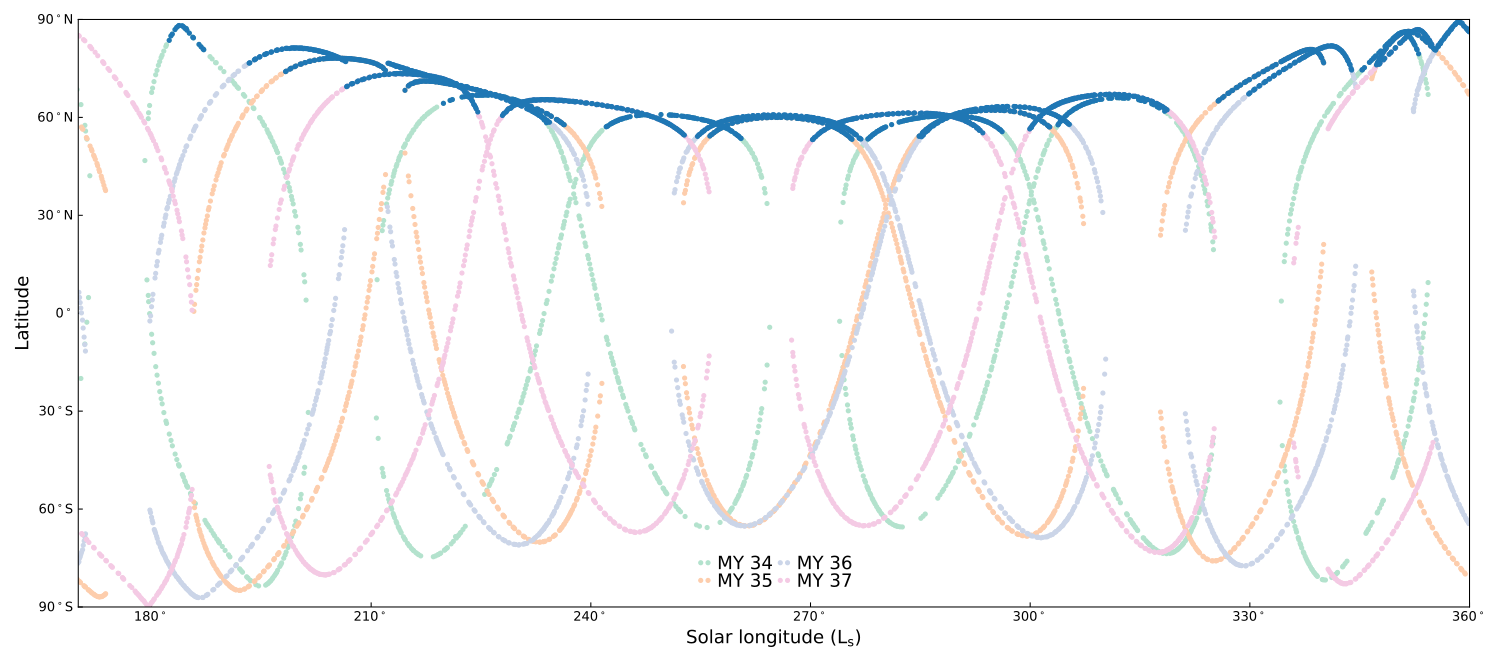
Akinori Hasebe, Naoki Terada, Tatsuya Yoshida, Yuki Nakamura, Shungo Koyaa, and Hiroki Karyu

                 The atmospheric D/H ratio on Mars is enhanced by ~5 times the value on Earth, suggesting that large amounts of water have escaped into space. Additionally, water supply processes into the atmosphere, like ablation of interplanetary dust particles (IDPs) and volcanic outgassing, are considered important to satisfy the current isotopic composition. IDPs, containing water as hydrous minerals with a relatively low D/H ratio, ablate at high altitudes and supply water into the upper atmosphere. Nevertheless, the effect of IDP ablation on the isotopic composition of planetary water is poorly understood.

               In this study, we use a 1-D atmospheric photochemical model of the Martian atmosphere (Nakamura et al., 2023) coupled with a numerical model of decomposition and dehydration of IDPs (Micca Longo et al., 2025) to clarify the effect of water supply from IDPs on the vertical D/H ratio profile. We assume a CI chondrite-like composition containing ~1 wt% of hydrogen as interlayer water or phyllosilicates -OH bonds with the same isotopic ratio as the VSMOW value. The water injection flux is given as  for the nominal model, scaled from the observed flux by the Long Duration Exposure Facility on the Earth (Love and Brownlee, 1993) to that on Mars. The vertical injection profile is given by our simple dust ablation model.

              Our results show that the water supply from IDPs significantly changes the HDO/H2O ratio in the upper atmosphere, while other species show little isotopic change. The  value decreases by ~400‰ above 100 km for the nominal model, which corresponds to a ~7% decrease in the HDO/H2O ratio. The HDO/H2O ratio change in the Martian upper atmosphere is caused by the high injection flux of water from IDPs compared to photochemical reaction rates and upward transport rate of hydrogen. The isotopic ratios of OH and H show little change even though they are the primary products of H2O photodissociation. This is because the lifetimes of OH and OD are so short that the isotopic change does not spread into the upper atmosphere. In addition, the background atmospheric densities of H and D are several orders of magnitude higher than those of H2O and HDO, high enough to make the isotopic change caused by the water supply from IDPs negligible.

                 We further investigate the sensitivity of the atmospheric isotopic profiles to parameters such as the temporal variations in the dust influx and the D/H ratio of IDPs. The sensitivity test for temporal variations in the dust influx reveals that the isotopic change overcomes the local time variation in the dust influx and persists for several days. This suggests that the water supply from IDPs changes the HDO/H2O ratio in the Martian upper atmosphere regardless of its local time and longitude. The sensitivity test for the D/H ratio of IDPs is investigated considering the experimental results that the D/H ratio of the dust particles is enriched by hydrogen implantation by the solar wind (Jiang et al., 2024), which will also be presented.

How to cite: Hasebe, A., Terada, N., Yoshida, T., Nakamura, Y., Koyaa, S., and Karyu, H.: Impact of water supply from interplanetary dust particles on the vertical D/H ratio profile of the Martian atmosphere, EPSC-DPS Joint Meeting 2025, Helsinki, Finland, 7–13 Sep 2025, EPSC-DPS2025-1332, https://doi.org/10.5194/epsc-dps2025-1332, 2025.

F16
|
EPSC-DPS2025-1438
|
On-site presentation
Kevin Olsen, Bethan Gregory, Franck Montmessin, Lucio Baggio, Franck Lefèvre, Oleg Korablev, Alexander Trokhimovsky, Anna Fedorova, Denis Belyaev, Juan Alday, and Armin Kleinböhl

Mars has an axial tilt of 25.2°, comparable to that on Earth of 23.4°. This gives rise to very similar seasons, and even leads to our definition of Martian time, aligning the solar longitudes (Ls) such that Ls 0° and 180° occur at the equinoxes. In the northern hemisphere, between the equinoxes, the north polar region experiences polar days without darkness in spring and summer, and days of total darkness in the fall and winter. The dark polar winters give rise to a polar vortex that encircles the polar region and encircles an atmosphere of very cold and dry air bound within (1-3).

The Atmospheric Chemistry Suite (ACS) mid-infrared channel (MIR) on the ExoMars Trace Gas Orbiter (TGO; 4) operates in solar occultation mode in which the Sun is used as a light source when the atmosphere lies between the Sun and TGO. The tangent point locations of ACS MIR observation necessarily lie on the solar terminator on Mars. At the poles when either polar night or polar day are experienced, there is no terminator, and solar occultations are restricted to outside such a region. The latitudinal distribution of ACS MIR solar occultations during the north polar fall and winter over four Mars years (MYs) is shown in Fig. 1. The furthest northern extent of observations occurs at the equinoxes, and falling northern boundary is seen between, as the north pole points further away from the Sun (similarly in the south, where it is polar day).

While direct observations of the north polar vortex are forbidden with solar occultations, the polar vortex is not perfectly circular (1-3) and occasionally, descends into the illuminated region where we are making observations. The characteristic signs that we are sampling the polar vortex are a sudden drop in temperature below 20 km, the almost complete reduction in water vapour volume mixing ratio (VMR) and an enhancement in ozone VMR, the latter of which is extremely rare (5).

To measure the extent of the polar vortex, we use temperature measurements from the Mars Climate Sounder (MCS; 6, 7) on Mars Reconnaissance Orbiter (MRO). We define the polar vortex as the average temperature over 10-20 km being within a boundary of 170 K (30). We introduce a novel technique to determine this boundary during a 1° Ls period using an alpha hull. We show that we can accurately measure the area of the polar vortex and achieve similar results to (3). The impact of the southern summer and dust activity is clearly visible in the time series of the northern polar vortex extent, leading to maxima occurring at the equinoxes, and shrinking toward perihelion. The impact of global dust storms and the late season dust storms are also pronounced.

We will show the vertical structure of water vapour and ozone VMRs inside and outside the north polar vortex, the results of a search for polar vortex temperatures from the near-infrared channel (NIR) of ACS (along the dark blue dots in Fig. 1), and show whether these results agree with the polar vortex extent measurements using MCS.


Figure 1: The latitudes of ACS MIR solar occultation as a function of time (solar longitude Ls) during northern fall (Ls 180-270°) and winter (Ls 270-360°). Data from Mars years (MYs) 34-37 are indicated with colours. The region of interest in searching for polar vortex excursions is highlighted in blue.

References:

(1) Streeter, P. M. et al. J. Geophys. Res. 126, e2020JE006774 (2021).

(2) Streeter, P. M., Lewis, S. R., Patel, M. R., Holmes, J. A., & Rajendran, K. Icarus 409, 115864 (2024).

(3) Alsaeed, N.R., Hayne, P. O. & Concepcion, V. J. Geophys. Res. 129, e2024JE008397 (2024).

(4) Korablev, O. et al. Space Sci. Rev. 214, 7 (2018).

(5) Olsen, K. S., et al. J. Geophys. Res. 127, e2022JE007213 (2022).

(6) Kleinböhl, A., et al. J. Geophys. Res., 114, E10006 (2009).

(7) Kleinböhl, A., Friedson, A. J., & Schofield, J. T. J. Quant. Spectrosc. Radiat. Transfer. 187, 511-522 (2017).

How to cite: Olsen, K., Gregory, B., Montmessin, F., Baggio, L., Lefèvre, F., Korablev, O., Trokhimovsky, A., Fedorova, A., Belyaev, D., Alday, J., and Kleinböhl, A.: What goes on inside the Mars north polar vortex?, EPSC-DPS Joint Meeting 2025, Helsinki, Finland, 7–13 Sep 2025, EPSC-DPS2025-1438, https://doi.org/10.5194/epsc-dps2025-1438, 2025.

F17
|
EPSC-DPS2025-555
|
On-site presentation
Manish R. Patel, Graham Sellers, Jonathon Mason, James Holmes, Juan Alday, Kylash Rajendran, Paul Streeter, Charlotte Marriner, Matthew Read, Brijen Hathi, Mark Leese, Ann Carine Vandaele, Frank Daerden, Ian Thomas, Bojan Ristic, Yannick Willame, Giancarlo Bellucci, and Migeul Angel Lopez Valverde

The Nadir and Occultation for Mars Discovery (NOMAD) instrument aboard the ExoMars Trace Gas Orbiter (TGO) has been conducting observations of the vertical profile and column abundance of ozone in the Mars atmosphere since April 2018.  NOMAD is a three-channel spectrometer suite that includes the Ultraviolet and Visible Spectrometer (UVIS) channel that performs the ozone observations. The presence of ozone provides vital constraints on HOx chemistry, given the difficulty in directly observing HOx species in the atmosphere, which in turn affects our understanding of how these chemically-relevant species are distributed in the martian atmosphere. Observing ozone therefore provides an insight into the chemical pathways arising from the photochemical processing of water vapour into odd-hydrogen species, and how those species may then be transported throughout the martian atmosphere.

Here we present observations of the vertical distribution of ozone from LS = 163° in Mars Year 34 to the present-day. We discuss the interannual variability of how ozone is distributed vertically, as a function of latitude and time of year, and the variability of high-altitude layers of ozone through successive years as a function of dust activity in the atmosphere.  Given the critical role of water vapour in chemically regulating the abundance of ozone, we present an investigation into model predictions of ozone over a full Mars year, to investigate the problem in Global Climate Model (GCM) representation of ozone abundances that has existed for many years.  While, in general, GCMs have been successful in recreating the annual relative distribution of ozone, they have not been able to reproduce the observed abundances leading to periods and areas of over- and under-prediction of ozone. Given the criticality of the role of water in the abundance of ozone, this incorrect prediction of ozone has been suggested to be related to potential incorrect representation of water abundance in GCMs at these times. We present results of GCM outputs for a full Mars year where water vapour and temperature from several instruments have been assimilated into a GCM, providing the best-possible representation of atmospheric state and therefore global water abundance and distribution.  We compare the predicted ozone abundances from this assimilation with those observed by the NOMAD-UVIS instrument on ExoMars TGO and discuss the regions of over- and under-prediction of ozone, and the use of this dataset as a platform for future investigations to resolve the problem of ozone representation in GCM simulations. 

How to cite: Patel, M. R., Sellers, G., Mason, J., Holmes, J., Alday, J., Rajendran, K., Streeter, P., Marriner, C., Read, M., Hathi, B., Leese, M., Vandaele, A. C., Daerden, F., Thomas, I., Ristic, B., Willame, Y., Bellucci, G., and Lopez Valverde, M. A.: The interannual vertical distribution of ozone in the Mars atmosphere and observation-model discrepancies, EPSC-DPS Joint Meeting 2025, Helsinki, Finland, 7–13 Sep 2025, EPSC-DPS2025-555, https://doi.org/10.5194/epsc-dps2025-555, 2025.

F18
|
EPSC-DPS2025-1477
|
On-site presentation
Jon Mason, Manish Patel, James Holmes, Michael Wolff, Juan Alday, Paul Streeter, Yannick Willame, Ian Thomas, Bojan Ristic, Frank Daerden, Jose J. Lopez-Moreno, Giancarlo Bellucci, and Ann-Carine Vandaele

Measurement of the Mars ozone column abundance provide key insights about our understanding of the planet’s photochemistry, climate dynamics, and potential habitability. Ozone acts as a tracer for odd-hydrogen offering insights into its seasonal and spatial variability —an essential factor in understanding Mars' photochemical stability. Accurate ozone measurements also support atmospheric modelling by providing a “ground truth” for Mars GCMs which currently under- or over-predict ozone abundances.

The Ultraviolet and VIsible Spectrometer (UVIS) is one of the three channels of The Nadir and Occultation for Mars Discovery (NOMAD) instrument, aboard the ExoMars Trace Gas Orbiter (TGO) [1,2]. Since April 2018, UVIS has taken near continuous nadir radiometric measurements of the Mars atmosphere from 200 to 655 nm.  Through inversion of these spectra, UVIS has produced a comprehensive dataset on the aerosol and ozone climatology from Mars Year (MY) 34 (from LS = 150°) through to MY 36 [3].

The ozone climatology for MY 34, MY 35 and MY 36 follows the well-established seasonal trends evidenced by previous investigations [4] with the largest observed abundances found at the edges of the weakly illuminated polar regions in the spring, autumn and winter hemisphere and associated with cold atmospheric temperatures and low water vapour abundance. At perihelion, a depletion in ozone at equatorial regions is seen in all Mars years where ozone abundances drop below the detection limit of UVIS (<0.7 µm-atm).  An increase in low latitude ozone during the aphelion season was seen in both MY 35 and MY 36 and coincides with the formation of the Aphelion Cloud Belt (ACB), where the freezing of water vapour to form water ice clouds confines the water vapour below the hygropause, allowing ozone to build-up above the clouds. Large variability was observed in the aphelion ozone band, with MY 35 seeing ozone abundances that were ~14% lower compared to MY 36. This reduction in ozone was attributed to the early dust storm between LS = 30° – 50° in the northern hemisphere of MY35, which led to the near global reduction in ozone around the same time.

We present an extension to the Mars ozone climatology to include MY 37 and MY 38 (present-day). We will show the ozone distribution for all Mars years measured by UVIS and discuss the observed seasonal and interannual distribution and its variability. More specifically we compare the aphelion equatorial ozone band across the four Mars years to determine if the reduced ozone in MY 35 is an isolated event or whether strong variability in ozone exists in this season.

How to cite: Mason, J., Patel, M., Holmes, J., Wolff, M., Alday, J., Streeter, P., Willame, Y., Thomas, I., Ristic, B., Daerden, F., Lopez-Moreno, J. J., Bellucci, G., and Vandaele, A.-C.: Long-Term variations in Mars’ ozone column abundances : A study from MY34 to MY38, EPSC-DPS Joint Meeting 2025, Helsinki, Finland, 7–13 Sep 2025, EPSC-DPS2025-1477, https://doi.org/10.5194/epsc-dps2025-1477, 2025.

F19
|
EPSC-DPS2025-1509
|
On-site presentation
Francisco González-Galindo, Sumedha Gupta, Ed Thiemann, Juan Alday, Denis Belyaev, Adrián Brines, Scott Evans, Anna Fedorova, Francois Forget, Miguel Ángel Gamonal, Sonal Jain, Nicholas Jones, Miguel Ángel López-Valverde, Ehouarn Millour, Lori Neary, Marcin Pilinski, Shane W. Stone, Loic Trompet, and Ann Carine Vandaele

The study of the coupling between the lower and the upper atmosphere has been hindered by the lack of continuous temperature measurements covering the whole atmosphere from the surface to the exobase. Thus, a large fraction of our knowledge on the topic relies on Global Climate Models (GCM). Here we combine temperature measurements from different instruments on board the ExoMars TGO, MAVEN, and Mars Express missions to cover altitudes from 50 to 250 km. The combined measurements are then used to validate the predictions of the Mars-PCM, a ground-to-exobase GCM. The comparison with the GCM also allows identifying potential biases and differences between datasets. We will pay special attention to the local time variation of temperatures, affected by local heating processes and by propagating tides, which previous studies have shown not to be well captured by M-PCM, at least at the mesopause.

How to cite: González-Galindo, F., Gupta, S., Thiemann, E., Alday, J., Belyaev, D., Brines, A., Evans, S., Fedorova, A., Forget, F., Gamonal, M. Á., Jain, S., Jones, N., López-Valverde, M. Á., Millour, E., Neary, L., Pilinski, M., Stone, S. W., Trompet, L., and Vandaele, A. C.: Mesospheric and thermospheric temperatures on Mars: comparing a multi-mission dataset with a Global Climate Model, EPSC-DPS Joint Meeting 2025, Helsinki, Finland, 7–13 Sep 2025, EPSC-DPS2025-1509, https://doi.org/10.5194/epsc-dps2025-1509, 2025.

F20
|
EPSC-DPS2025-1508
|
On-site presentation
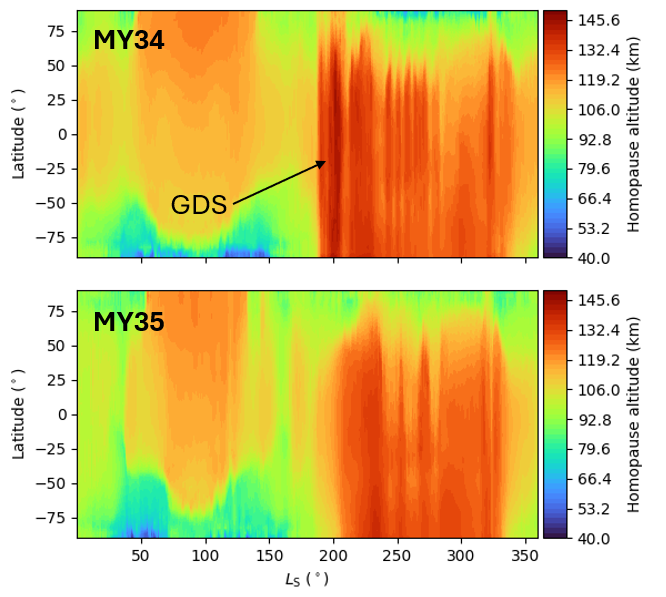
Juan Alday, Francisco González-Galindo, Shane W. Stone, Denis Belyaev, Miguel Ángel López Valverde, Ed Thiemann, Scott Evans, Nicholas Jones, Anna A. Fedorova, Sumedha Gupta, Sonal Jain, Marcin Pilinski, Lori Neary, Loïc Trompet, Manish Patel, and James Holmes

Introduction:  The homopause defines the boundary between two distinct regions of the atmosphere: the homosphere and the heterosphere. In the homosphere, located below the homopause, strong turbulent mixing causes atmospheric gases to vary vertically according to a common scale height, determined by the mean molecular mass of the atmosphere. In contrast, above the homopause, in the heterosphere, molecular diffusion dominates, resulting in the diffusive separation of species and each gas varying vertically according to its own scale height, which depends on its own molecular weight.

In one-dimensional diffusion models, the altitude of the homopause is typically defined as the level at which the eddy diffusion coefficient equals the molecular diffusion coefficient. While the eddy diffusion coefficient is a useful parameterisation of turbulent mixing in these models, it remains largely unconstrained.

The homopause from the Mars PCM: The Mars Planetary Climate Model (PCM) enables simulations of the physical, chemical and dynamical processes in the atmosphere of Mars. In this work, we estimate the value of the homopause altitude using the Ar/N2 densities in the model. The ratio of these two species, which are largely chemically inert, is approximately constant in the homosphere, while it varies due to diffusive separation above the homopause, given the different molecular weight of these two species.

Figure 1 shows the climatology of the homopause altitude as predicted from the Mars PCM for Martian Years (MY) 34 and 35. The homopause altitude shows distinct seasonal variations, peaking close to the solstice periods (LS = 90 and 270˚) and finding relative minima during the equinoxes. Latitudinally, the highest homopause altitudes are found in the summer hemispheres (i.e, northern hemisphere for LS = 90˚ and southern hemisphere for LS = 270˚), while absolute minima are found in the winter hemispheres at these solar longitudes. Additionally, these simulations suggest that the presence of dust events such as the Global Dust Storm (GDS) in MY34 can produce a substantial increase of the homopause altitude.

Figure 1: Climatology of the homopause altitude estimated using simulations of the Ar/N2 ratio from the Mars PCM for MY34 (top) and MY35 (bottom).


Estimation of the Eddy diffusion coefficient: Aiming to constrain the range of values suitable for parameterising turbulent diffusion in 1-dimensional models of the atmosphere of Mars, we use the predictions from the Mars PCM to estimate values for the Eddy diffusion coefficient (K) relevant for different times and locations. In particular, we build a 1-dimensional diffusion model and run simulations to find the value of K that provides a best fit to the Ar/N2 ratio profiles from the Mars PCM. We will present the results from this work, showing the range of values of the Eddy diffusion coefficient relevant for distinct seasons, locations, and dust loading scenarios.

How to cite: Alday, J., González-Galindo, F., Stone, S. W., Belyaev, D., López Valverde, M. Á., Thiemann, E., Evans, S., Jones, N., Fedorova, A. A., Gupta, S., Jain, S., Pilinski, M., Neary, L., Trompet, L., Patel, M., and Holmes, J.: The climatology of the homopause altitude from the Mars Planetary Climate Model, EPSC-DPS Joint Meeting 2025, Helsinki, Finland, 7–13 Sep 2025, EPSC-DPS2025-1508, https://doi.org/10.5194/epsc-dps2025-1508, 2025.

F21
|
EPSC-DPS2025-780
|
On-site presentation
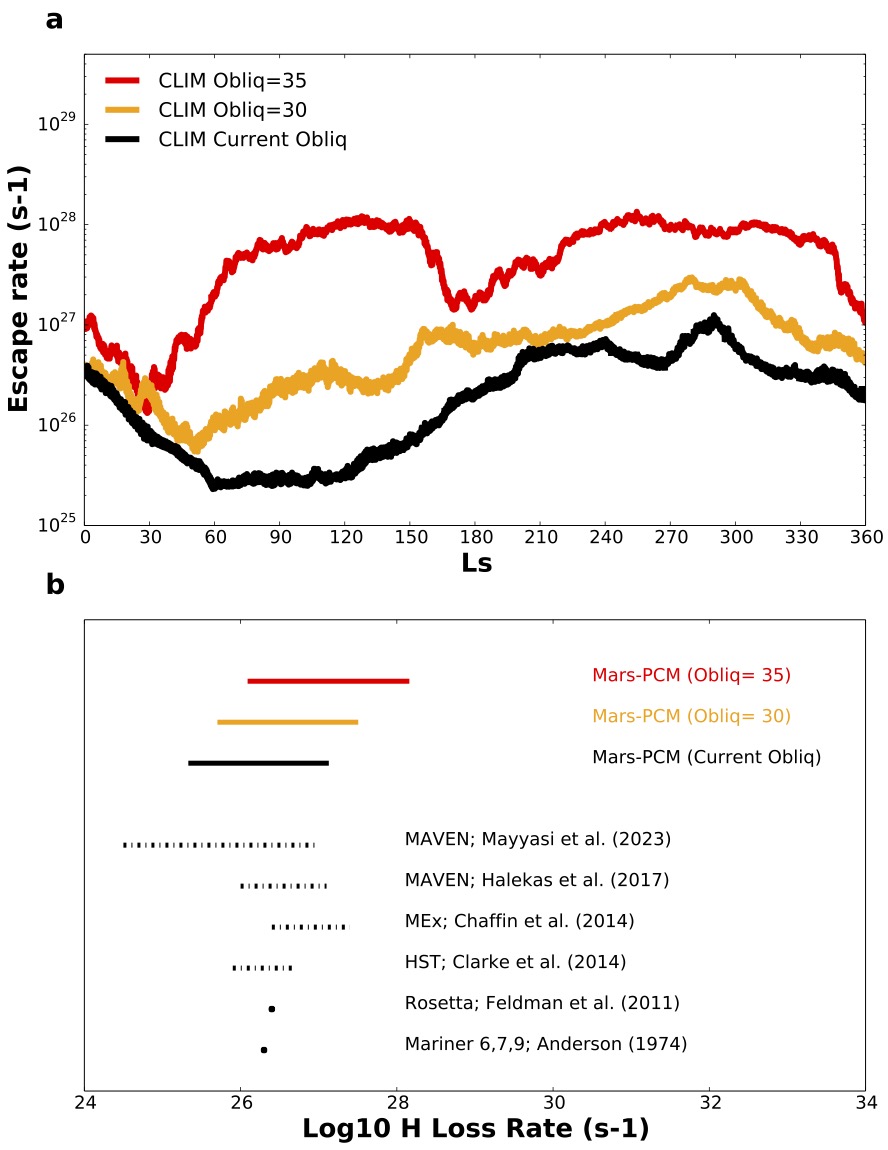
Gabriella Gilli, Francisco González-Galindo, Jean-Yves Chaufray, Ehouarn Millour, François Forget, Franck Montmessin, Franck Lefèvre, Joseph Naar, Yangcheng Luo, Margaux Vals, Loic Rossi, Miguel Angel López-Valverde, and Adrian Brines

Higher loss rate in the “recent” Mars history

Mars was not always as dry as it is today, as several geologic and mineralogical observations indicate the evidence for past liquid water [1]. Atmospheric loss to space appears to explain why the Mars atmosphere evolved from an early, warmer climate to the cold, dry climate that we see today. Substantial amounts of water could have escaped into the interplanetary medium in the form of atomic hydrogen [2]. Furthermore, observations indicate that the amount of exosphere hydrogen at Mars has important seasonal variations, with significant increases of both the water abundance in the mesosphere and the H escape rate during dust storms [3, 4, 5]. By analysing observations by SPICAM on board Mars Express and simulations with the Mars Planetary Climate Model (Mars-PCM), [6] suggested that episodic dust storms and associated enhancement at high altitude near the perihelion, averaged over one Martian year or longer period, are a major factor in the H escape estimates.

However, present-day H-loss rates (~3x1026 s-1 on average) cannot explain the geological evidence of the presence of large volumes of liquid water on ancient Mars. Both the dust and the water content of the atmosphere are expected to vary with the obliquity of the planet. Thus, the loss rate is not expected to have been constant with time and may vary significantly during Martian history.

We have used an updated and improved version of the Mars-PCM to show that H-loss rates could have increased up to more than one order of magnitude (6x1027s-1) during higher spin axis obliquity periods [7] (see Fig. 1), notably in the last millions of years when Mars’s obliquity was about 35° on average [8]. The resulting accumulated H escape over Mars history translates into ~80 m Global Equivalent Layer, which is close to the lower limit of geological estimates and confirm the important role of atmospheric H loss to remove a large fraction of Mars’ initial water.

Fig 1: Panel a: Globally integrated escape rate (atoms/s) simulated with the Mars-PCM.  A climatological dust scenario  is used with current obliquity (black), obliquity of 30º(orange), obliquity of 35º (red). Panel b: Comparison of Mars-PCM H escape rates with H-loss rates estimated for current obliquity from different spacecrafts [3,4,5, 9,10,11, 12, 13]. Figure after [7].

Processes leading to larger H-escape

In current obliquity conditions (25.2º) the water ice in the polar caps sublimes in Summer, and then it is recycled back in Winter. Large dust load in the lower atmosphere facilitates the transport of water to the upper atmosphere, where it is chemically converted into atomic H that can easily escape to space (panel A, Fig. 2). In the last 20 million year, when the obliquity of Mars was higher than today (panel B, Fig. 2), larger north pole insolation induced a more intense water cycle: the amount of sublimated water vapour in the atmosphere of Mars was much larger than today, and localised surface water ice reservoirs were created after precipitation in tropics and mid-latitudes [14].  In addition, the formation of thick clouds warmed the middle atmosphere (up to 50 K at 45 km) by absorbing both solar radiation and IR radiation emitted by the surface, inducing positive feedback. All this favoured water penetration into the mesosphere (e.g. with up to 5 order of magnitude increased water abundances at about 45 km, near the aphelion), resulting in larger H escape rate. Other processes not accounted for in our study could also contribute to further changes in the H escape rate. Buried deposits of CO2 ice within the south polar layer could have been released in the atmosphere at the time of high obliquity, producing an atmosphere with double its current pressure [15]. With higher pressure and warmer temperature conditions, is uncertain if the seasonal dust activity was more (or less) intense than today, due to higher water content and changes in the circulation patterns.

Fig.2:  The H loss rate is not expected to have been constant with time and may vary significantly during Martian history. The processes that may have led higher H-escape will be discussed in the talk. Figure after [7].

 Keywords: Mars, Atmosphere, Hydrogen loss,  General Circulation Model


References:

[1] Bibring et al. (2004), Nature, 428(6983):627–630

[2] Jakosky et al. (2018), Icarus, 315:146–157

[3] Chaffin et al. (2014), GRL, 41(2):314–320

[4] Clarke et al, (2014), GRL, 1(22):8013–8020

[5] Mayyasi et al. (2023), 393, 115293

[6] Chaufray et al. (2021), Icarus, 353, 113498

[7] Gilli et al. (2025), Nature Astronomy, in press, https://doi.org/10.1038/s41550-025-02561-3

[8] Laskar et al. (2004), Icarus, 170(2):343–364

[9] Clarke et al. (2018), Nature Astronomy, 2, 114-115

[10] Heavens et al. (2018), Nature Astronomy, 2, 126–13

[11] Helekas et al. (2017), JGR, 122 (5), 901–91

[12] Anderson et al. (1974), JGR, 79 (10), 1513–1518

[13] Feldman et al. (2011), Icarus, 214 (2), 394–39

[14] Madeleine et al. (2009), GRL, 41 (14), 4873–487

[15] Kurokawa et al (2014), Earth and Planetary Science Letters, 394


Acknowledgements

G.G. acknowledge financial support from Junta de Andalucía through the program EMERGIA 2021 (EMC21 00249). IAA-team also acknowledges financial support from the Severo Ochoa grant CEX2021-001131-S funded by MCIN/AEI/ 10.13039/501100011033.

How to cite: Gilli, G., González-Galindo, F., Chaufray, J.-Y., Millour, E., Forget, F., Montmessin, F., Lefèvre, F., Naar, J., Luo, Y., Vals, M., Rossi, L., López-Valverde, M. A., and Brines, A.: Increased Hydrogen escape from Mars atmosphere during periods of high obliquity, EPSC-DPS Joint Meeting 2025, Helsinki, Finland, 7–13 Sep 2025, EPSC-DPS2025-780, https://doi.org/10.5194/epsc-dps2025-780, 2025.

F22
|
EPSC-DPS2025-1416
|
On-site presentation
Fabrizio Oliva, Emiliano D'Aversa, Giancarlo Bellucci, Filippo Giacomo Carrozzo, Ian Thomas, Luca Ruiz Lozano, Ozgur Karatekin, Francesca Altieri, Frank Daerden, Bojan Ristic, Manish Patel, Jon Mason, Yannick Willame, Miguel Angel López-Valverde, Ann Carine Vandaele, and Giovanni Valentini

Data acquired by spaceborne spectrometers operating in the visual (VIS) and near-infrared (NIR) spectral ranges, are commonly exploited to derive the microphysical properties of planetary atmospheric aerosols (e.g. Adriani et al., 2015; Sindoni et al., 2017; Fedorova et al., 2024; Oliva et al., 2016; Oliva et al., 2018; D’Aversa et al., 2022). The precision with which these properties can be constrained, depends on several parameters (e.g. optical constants, surface albedo spectrum, particles’ shape and size distribution, ecc.) and on the spectral information content in the data.

VIS wavelengths alone (~ 0,4 – 0,7 μm) provide information on aerosols’ composition, particles’ density and sizes, allowing the estimation of the optical depth integrated along the line of sight (Oliva et al., 2016). However, in order to constrain these parameters with enhanced precision, the NIR range (~ 0,7 – 3,0 μm) is also required, since it allows to assess how the spectral shape bends towards longer wavelengths (Oliva et al., 2018).

Our goal is to exploit the combined nadir datasets of the UVIS (0.2 – 0.65 µm) and LNO (2.2 – 3.8 µm) channels of the NOMAD spectrometer (Neefs et al., 2015) to contrain the microphysical properties of Martian dust (Oliva et al., 2025). The two spectral ranges present a large gap among each other, and this introduces biases in the retrieved parameters due to the unconstrained spectral information in the missing wavelengths. In order to benchmark these biases, we exploit MEx/OMEGA (Bibring et al., 2004) VNIR (0,35 – 1,05 µm) and SWIR-C (0.93 - 2.73 µm) channels’ data. Such an extended interval allows the retrieval of Martian dust clouds’ height and microphysical properties (e.g. Oliva et al., 2018; D’Aversa et al., 2022), that can be used as a proxy for the NOMAD retrievals.

By studying dust’s densities and sizes 1) from the full OMEGA spectrum and 2) from the spectrum only covering UVIS and LNO wavelengths, we can derive the bias in the retrieved parameters. Moreover, this analysis allows to calibrate how many UVIS and LNO spectral points need to be considered in the retrieval, in order to balance the information content of the two channels.

Preliminary results suggest that dust densities are systematically overestimated (as well as grains’ sizes to a lesser degree) if NIR wavelengths are completely neglected, while such a bias is reduced if LNO range is taken into account.

References

Adriani et al., 2015. Faint luminescent Ring over Saturn’s polar hexagon. Astrophys. J. Lett. 808 (1), 5. L16.

Bibring et al., 2004. Omega: Observatoire pour La minéralogie, l’eau, Les Glaces Et l’activité. ESA SP-1240: Mars Express: The Scientific Payload. ESA Publications Division, Estec, Noordwijk, The Netherlands, pp. 37–49.

D’Aversa et al., 2022. Vertical distribution of dust in the Martian atmosphere: OMEGA/Mex limb observations. Icarus 371, 114702.

Fedorova et al., 2024. Distribution of atmospheric aerosols during the 2007 Mars dust storm (MY 28): Solar infrared occultation observations by SPICAM. Icarus 415, 116030

Oliva et al., 2016. Clouds and hazes vertical structure of a Saturn’s giant vortex from Cassini/VIMS-V data analysis. Icarus 278, 215–237.

Oliva et al., 2018. Properties of a Martian local dust storm in Atlantis Chaos from OMEGA/MEX data. Icarus.

Oliva et al., 2025. Martian dust characterization: reanalysis of TGO/NOMAD UVIS and LNO channels’ nadir data. XX Congresso Nazionale di Scienze Planetarie, Pescara, 3-7 Febbraio 2025.

Neefs et al, 2015. NOMAD spectrometer on the ExoMars trace gas orbiter mission: part 1—design, manufacturing and testing of the infrared channelsApplied Optics 54, 28, 8494-8520.

Sindoni et al., 2017. Characterization of the white ovals on Jupiter’s southern hemisphere using the first data by the Juno/JIRAM instrument. Geophys. Res. Lett. https://doi.org/10.1002/2017gl072940.

Acknowledgements

ExoMars is a space mission of the European Space Agency (ESA) and Roscosmos. The NOMAD experiment is led by the Royal Belgian Institute for Space Aeronomy (IASB- BIRA), assisted by Co-PI teams from Spain (IAA-CSIC), Italy (INAF-IAPS), and the United Kingdom (Open University). This project acknowledges funding by the Belgian Science Policy Office (BELSPO), with the financial and contractual coordination by the ESA Prodex Office (PEA 4000103401, 4000121493), by the Spanish MICINN through its Plan Nacional and by European funds under grants PGC2018-101836-B-I00 and ESP2017-87143-R (MINECO/FEDER), as well as by UK Space Agency through grants ST/V002295/1, ST/V005332/1, ST/Y000234/1 and ST/X006549/1 and Italian Space Agency through grant 2018-2-HH.0. The IAA/CSIC team acknowledges financial support from the State Agency for Research of the Spanish MCIU through the ‘Center of Excellence Severo Ochoa’ award for the Instituto de Astrofísica de Andalucía (SEV-2017-0709). This work was supported by the Belgian Fonds de la Recherche Scientifique – FNRS under grant numbers 30442502 (ET_HOME) and T.0171.16 (CRAMIC) and BELSPO BrainBe SCOOP Project. US investigators were supported by the National Aeronautics and Space Administration. Canadian investigators were supported by the Canada Space Agency.

How to cite: Oliva, F., D'Aversa, E., Bellucci, G., Carrozzo, F. G., Thomas, I., Ruiz Lozano, L., Karatekin, O., Altieri, F., Daerden, F., Ristic, B., Patel, M., Mason, J., Willame, Y., López-Valverde, M. A., Vandaele, A. C., and Valentini, G.: Biases on the retrieval of aerosols' properties from VIS-NIR data: the NOMAD case study, EPSC-DPS Joint Meeting 2025, Helsinki, Finland, 7–13 Sep 2025, EPSC-DPS2025-1416, https://doi.org/10.5194/epsc-dps2025-1416, 2025.

F23
|
EPSC-DPS2025-1662
|
ECP
|
On-site presentation
Changes to distribution of atmospheric water ice in the martian northern polar region during the 2018 global dust storm
(withdrawn)
Vinayak Shastri
F24
|
EPSC-DPS2025-1639
|
On-site presentation
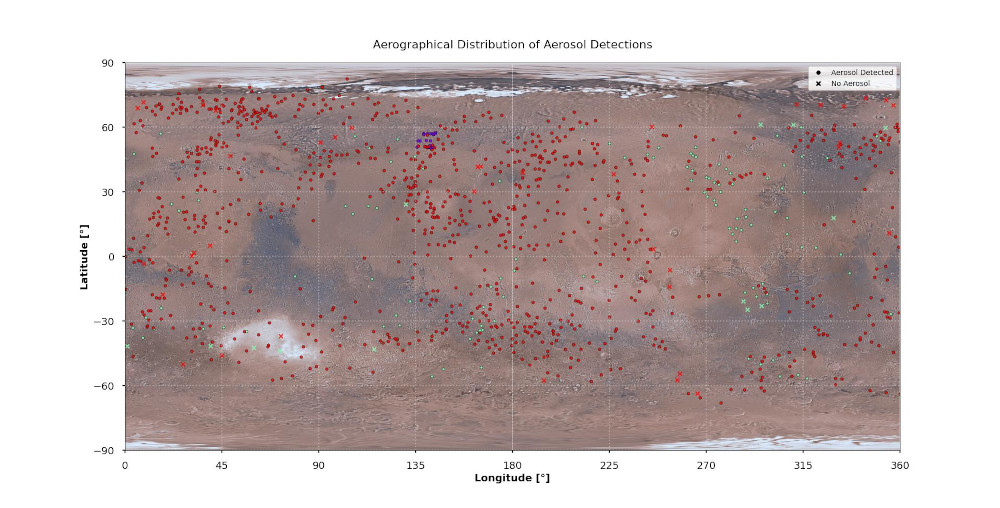
Teresa del Río-Gaztelurrutia, Agustin Sánchez-Lavega, Jorge Hernández-Bernal, and Telmo Sanz-Hernández

The Visual Monitoring Camera on board Mars Express provides images of varied resolutions, covering a wide range of locations and seasons, and has been taking images for several Martian Years. Some of these images show clear instances of aerosols layers in the limb of the planet, which allow studying their height and extension. Images close to pericenter display varying morphologies, and the extensive coverage by VMC allows determining inter-annual and areographicaI variations in occurrence.

The first years of the database were explored in Sánchez-Lavega (2018a), but this study was conditioned by the fact that there was no scientific programming of the observations until 2016. Nowadays, after several years of planning, a much more complete set of observations is available, covering four Martian years, with the added interest that a global dust storm developed in one of them (Sanchez-Lavega et al, 2018b). In this work, we will present results of a systematic analysis that aims to extend this study to MYs 33-37, analyzing the extension and height of aerosols, their aerographic distribution and dependence on season and local time.

Figure 1: Aerographic distribution of aerosol detections. Blue, green and red indicate MYs 33, 34 and 35 respectively.

Figure 2: Seasonal distribution of aerosol detections. Blue, green and red indicate MYs 33, 34 and 35 respectively.

 In Figure 1  we present the aerographic  distribution of aerosols in MYs 34-35, and in Figure 2, the seasonal dependence. The systematic survey that started with the scientific planning of the observations implies that MY35 (in red in the figures) is much better covered, as also are MY 36 and 37, which will allow a good inter-annual comparison.

References:

  • Clancy, R. Todd, et “Mars Clouds”, Chapter 5 in “The Atmosphere and Climate of Mars”. Ed. Robert M. Haberle, et al. CUP, 2017
  • Sánchez-Lavega, A. et al. “Limb clouds and dust on Mars from images obtained by the Visual Monitoring Camera (VMC) onboard Mars Express” ICARUS 299, 194-205 (2018a)
  • Sánchez-Lavega, et al. “The Onset and Growth of the 2018 Martian Global Dust Storm” Geophysical Research Letters, 46, 6101-6108 (2018b)

How to cite: del Río-Gaztelurrutia, T., Sánchez-Lavega, A., Hernández-Bernal, J., and Sanz-Hernández, T.: Aerosols and clouds in the limb of Mars: A study with the VMC camera onboard Mars Express, EPSC-DPS Joint Meeting 2025, Helsinki, Finland, 7–13 Sep 2025, EPSC-DPS2025-1639, https://doi.org/10.5194/epsc-dps2025-1639, 2025.

F25
|
EPSC-DPS2025-1583
|
ECP
|
On-site presentation
Elena A. Favaro, Manish R. Patel, Kylash Rajendran, and James A. Holmes

Introduction: For decades, global climate models (GCMs) have played a foundational role in understanding Mars’s climate system, and more recently, have become integral to mission planning and interpreting spacecraft observations of atmospheric dynamics and landscape-level evidence of the aeolian (wind-driven) environment. 

Aeolian bedforms and landforms on Mars - from centimetre-scale ripples forming atop sand dunes to kilometre-scale yardangs all pointing in a single cardinal direction - constitute vital proxies to deciphering the spatially diverse and temporally extensive influence of wind across the planet. However, the scale of the aeolian features being investigated rarely align with the scale of the GCM being used (with typical spatial resolutions of hundreds of kilometres). For studies that investigate aeolian features at local and regional scales, higher resolution models - mesoscale models - are necessary to more fully understand the climatic conditions at scales that better represent the features being studied.  

Aims of this Work: The work presented here describes this group’s commitment to providing Mars researchers access to reliable wind data at topographically relevant scales for use in targeted studies of the Martian surface. To demonstrate the validity and practicality of our approach, we compare our mesoscale model outputs with mapped aeolian features at three sites on Mars: Mawrth Vallis (dune slip faces), Ares Vallis (wind streaks), and Syrtis Major (wind streaks). 

Mapping Aeolian Features: Dune slip faces and wind streaks were mapped on the ~6 m/pixel CTX (Context Camera) global mosaic [1] in a GIS. At Mawrth Vallis, we digitized the slip faces of 80 dunes in an area of approximately 544 km2. At Ares Vallis (~41,000 km2) and Syrtis Major (~6.7 million km2), we mapped 180 and 1000 kilometre-scale wind streaks, respectively.

Setting up the Mesoscale Models: The Open access to Mars Assimilated Remote Soundings (OpenMARS) dataset [2] provides the initial and hourly-updated boundary conditions for the mesoscale simulations. OpenMARS is a reference dataset of the actual global weather occurring on Mars from 1999 to 2020 at 5° horizontal resolution in longitude and latitude that has been utilized across the globe for several different science topics [3-8]; this study is the first dedicated to interpretation of aeolian surface features. The OpenMARS dataset combines the Mars Planetary Climate Model UK-spectral version (that has identical physics packages with the mesoscale model for optimal coupling) with temperature and dust retrievals from the Mars Climate Sounder instrument [9] to provide the most accurate global atmospheric representation possible.  Boundary conditions are updated for the mesoscale simulations every hour to guide the near-surface atmosphere that undergoes a strong daily cycle.

Mesocale simulations were performed using the Laboratoire de Météorologie Dynamique Mars Mesoscale Model [10]. This model combines the compressible non-hydrostatic dynamical core of the Advanced Research Weather Research and Forecasting model, adapted for Mars, with a comprehensive set of physics routines for simulating the CO2, dust, water and photochemical cycles of the Martian atmosphere. We configured the mesoscale model to run with 40 unevenly spaced levels from the surface up to 50 km. A 3000 by 3000 km domain was evaluated at Syrtis Major at a horizontal resolution of 14 km; a 1000 by 1000 km domain was used at the other locations at a horizontal resolution of 5 km. At each location, we performed four sets of simulations, each lasting 12 sols and starting at a different time of year (initialised at LS= 0°, 90°, 180° and 270°), to capture seasonal variability. The data from the four simulations were combined and mean eastward and northward winds calculated for each grid point. 

Results: Detailed results of our modelling exercises at these sites will be presented at this meeting. Briefly, our outputs show good agreement between aeolian feature orientation and the mesoscale near-surface annual mean wind flow and confirms that the modelling described here is appropriate for investigating contemporary aeolian features on Mars. 

[1] Dickson, J. L. et al. (2024) Earth and space Sci., 11(7); [2] Holmes, J. A. et al. (2020) Planet. Space Sci., 188, 104962; [3] Wang, H. et al. (2021) Geosci. J., 11 (8), 324; [4] Battalio, J. M. (2022) J. Atmos. Sci., 79(2), 361–382; [5] Bowen, A.P. et al. (2022) Planet. Space Sci., 214, 105429; [6] Nasr, C.-R. C. et al. (2022) Planet. Sci. J., 3, 165; [7] Bo, L. et al. (2024) JGR.-Planets, 129(2), e2023JE007937; [8] Hinson, D., and Wilson, R. J. (2024) Icarus, 412, 115998; [9] Kleinböhl, A. et al. (2017) JQSRT, 187, 511–522; [10] Spiga, A. and Forget, F. (2009) JGR-Planets, 114(E2). 

How to cite: Favaro, E. A., Patel, M. R., Rajendran, K., and Holmes, J. A.: A Mesoscale Modelling Approach to understanding Mars’ Aeolian Landscapes, EPSC-DPS Joint Meeting 2025, Helsinki, Finland, 7–13 Sep 2025, EPSC-DPS2025-1583, https://doi.org/10.5194/epsc-dps2025-1583, 2025.

F26
|
EPSC-DPS2025-1760
|
On-site presentation
Claus Gebhardt, Bijay Kumar Guha, Neha Gupta, Roland M. B. Young, and Michael J. Wolff

The Emirates Mars Mission (EMM) started its science phase in Martian Year 36, solar longitude 49 (May 2021) [1,2]. EMM observes the Mars atmosphere and surface. These observations are unique because of the high-altitude orbit of EMM. The EMM spacecraft has the camera EXI (Emirates Exploration Imager). The EXI camera observes various dust storms on Mars [3]. The result are (sub-)hourly image sequences of dust storms. That is the basis for exploring episodic dust storms. That includes episodic dust storms in Martin Year 36 [4,5]. This conference contribution is follow-on study. The focus are episodic dust storms in Martian Year 37.

We present recent EMM observations of dust storms in Martian Year 37. We select episodic dust storms for detailed study. That includes the formation and evolution of dust storms. Also, we present related study of dust storm dynamics. We explore dust storm characteristics, such as winds, surface dust lifting, and large-scale meteorology.

Acknowledgments: Funding for the development of the Emirates Mars Mission (EMM) mission was provided by the UAE government. CG, BKG, NG, RMBY, and MJW would like to acknowledge EMM science management by the UAE Space Agency. CG, BKG, NG, and RMBY were supported by the UAE University (UAEU). They would like to acknowledge the Department of Physics and the Planetary Science Team of the National Space Science and Technology Center (NSSTC) in the UAEU.

References: [1] Almatroushi, H., et al. (2021). Space Science Reviews, 217(8), 1-31. [2] Amiri, H. E. S., et al. (2022). Space Science Reviews, 218, 4 (2022). [3] Guha, B. K., et al. (2024). Journal of Geophysical Research: Planets, 129(4), e2023JE008156. [4] Gebhardt, C., et al. (2022). Geophysical Research Letters. 49, e2022GL099528. [5] Gebhardt, C., et al. (2023). Geophysical Research Letters, 50(24), e2023GL105317.

How to cite: Gebhardt, C., Guha, B. K., Gupta, N., Young, R. M. B., and Wolff, M. J.: The observation of episodic dust storms in Martian Year 37, by the EXI camera of the Emirates Mars Mission, EPSC-DPS Joint Meeting 2025, Helsinki, Finland, 7–13 Sep 2025, EPSC-DPS2025-1760, https://doi.org/10.5194/epsc-dps2025-1760, 2025.

F27
|
EPSC-DPS2025-1694
|
ECP
|
On-site presentation
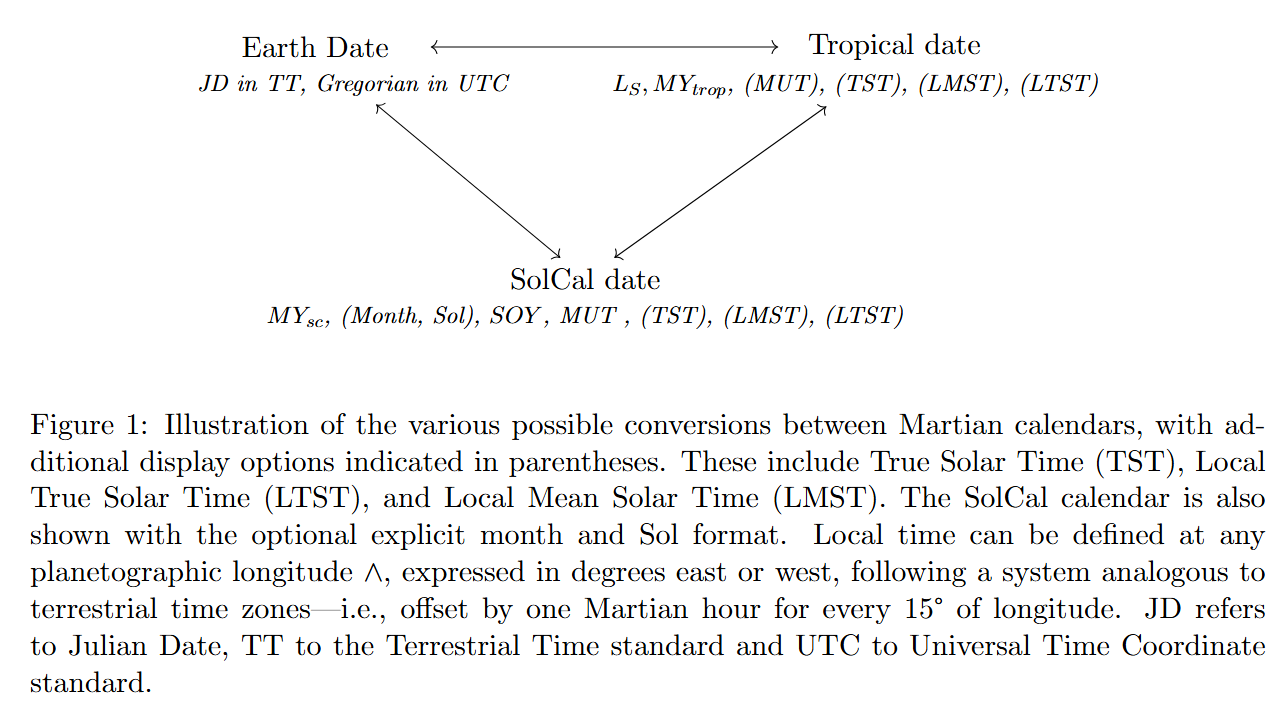
Victorien Guyon, Luca Montabone, Timoté Lombard, François Forget, Ehouarn Millour, Jorge Hernández Bernal, and Thomas Pierron

 1  Introduction

This abstract is a continuation of Monitoring Dust in the Martian Atmosphere: Recent Advances and Applications in Column Dust Optical Depth Processing by Lombard et al. [8], and focuses on the temporal data conversion tool introduced therein and the current development in the dust map processing. The tool enables translation between various calendar systems used across different datasets, including the sol-based calendar described in Appendix A of Montabone et al. (2015) [1].

As noted in [8], more than 25 years of atmospheric observations on Mars have been compiled into CDOD (Column Dust Optical Depth) maps, which are categorized into two types: gridded maps and kriged maps. Given that these maps are produced on a daily basis, the standard method of time labeling using tropical dates—defined by the areocentric solar longitude (Ls) and the current tropical Martian year—is not ideal. A sol-based calendar was proposed in [1], using integer year lengths of either 668 or 669 sols, following a repeating 5-Martian-Year cycle. To make practical use of this sol-based calendar (SolCal), it was necessary to implement it within a dedicated conversion program, allowing for proper definition, testing, and evaluation of its structure and benefits. Such a tool facilitates the temporal synchronization of datasets that rely on different calendar systems. Additionally, SolCal’s structural resemblance to the Gregorian calendar makes it easier to intuitively represent time-based observations on Mars.

2  Calendar conversion tools

We developed a Python 3.11 program that enables precise and user-friendly conversion between various Earth and Martian calendars. Built using the astropy, datetime, and SciPy libraries, the algorithm supports transformations between the Gregorian calendar (UTC), Julian dates (including from epoch J2000), the Martian tropical calendar (defined by the areocentric solar longitude, and the tropical Martian year count, MY), and the sol-based Martian calendar, SolCal (see figure 1). The method is based on the Mars24 Sunclock algorithm, particularly its Ls computation, which we use to derive tropical dates from Earth dates [2]. Sol counting relies on the Martian Mean Solar Time at the prime meridian (Martian Universal Time, MUT), ensuring high accuracy across 134 Mars orbits—corresponding to Gregorian years 1874 to 2126—using well-fitted astronomical models. The MUT is expressed in fraction of sol to the hour (1 divided by 24) or to the microsecond (1 sol divided by 86400000000). The vernal equinoxes on Mars do not coincide with MUT midnights. To account for this, we introduce a distinct Martian Year count for the SolCal calendar, denoted MYsc, beginning at the MUT midnight nearest to the start of MY1 (as defined by Clancy et al., 2000 [7]) and lasting 668 or 669 sols. This convention emphasizes the slight offset between the beginning of the tropical year and that of the SolCal year. A SolCal date is defined by three fundamental elements: the current MYsc, the Sol of the Year (SOY), and the Martian Universal Time (MUT).

We included several options to enhance both the accuracy and usability of the calendar. For improved precision, users can opt to switch the equations calculating the Ls from Mars24 Sunclock to the one from Piqueux et al. (2015) [6], which refines the method used in the first [3]. To make the calendar more intuitive, we introduced an alternative representation of SolCal dates based on a twelve-month system, functioning as a distinct calendar format to which dates can be converted (see table 6 of [11]). Additionally, the program allows the display of both true and mean local solar time at any specified longitude on Mars. Our analysis of the offset between Mars’s vernal equinox and SolCal’s New Year reveals a linearly increasing discrepancy over time (see figure 2). To mitigate this drift, we implemented a calendar correction mechanism.

 3  Future developments in CDOD processing

As previously described in [8], the CDOD maps are provided in both gridded and kriged forms, the latter being a weighted spatial interpolation of the former. The main limitation of the current method is that it relies solely on spatial interpolation and does not account for the temporal evolution of the CDOD. Our goal is to develop an interpolation approach that incorporates both spatial and temporal dimensions, while being grounded in the underlying dynamics of the system. To improve this data completion process in this direction, we are considering a simplified data assimilation scheme. More specifically, we are currently exploring a hybrid data assimilation approach inspired by the hybrid nudging–ensemble Kalman filter method proposed by Lilli Lei et al. (2012) [9], using simulations from the Mars Planetary Climate Model (PCM) [10] as background data. This approach aims to combine the strengths of the ensemble Kalman filter—such as improved error covariance representation—with the stabilizing effects of nudging, in order to reduce error spikes and spatial discontinuities.


4  Acknowledgment

VG, LM, and TL gratefully acknowledge the support provided by CNES and the ESA MCD project. We would like to thank Dr. Jorge Bernal for his assistance in providing NASA’s SPICE data to test our program, and Thomas Pierron for his valuable insights into the treatment of dust distribution in the atmosphere by the GCM. We also plan to make the time conversion algorithm publicly available in the near future.

 References 

[1]    L. Montabone et al. Eight-year climatology of dust optical depth on Mars Icarus 251 65–95 2015.
[2]    Allison, M., and M. McEwen A post-Pathfinder evaluation of aerocentric solar coordinates with improved timing recipes for Mars seasonal/diurnal climate studies Planet. Space Sci., 48, 215-235 2000 
[3]    NASA Goddard Institute for Space Studies Mars24 Sunclock — Time on Mars, Algorithm and  Worked  Examples  https://www.giss.nasa.gov/tools/mars24/help/algorithm. html 2023
[4]    Michael Allison, Robert Schmunk Technical Notes on Mars Solar Time as Adopted by the Mars24 Sunclock https://www.giss.nasa.gov/tools/mars24/help/notes.html 2023
[5]    NASA GISS Mars24 Sunclock — Time on Mars https://www.giss.nasa.gov/tools/ mars24/ 2023
[6]    Piqueux et al. Enumeration of Mars years and seasons since the beginning of telescopic exploration Icarus 251 332–338 2015
[7]    Clancy et al. An intercomparison of ground-based millimeter, MGS TES, and Viking at- mospheric temperature measurements: Seasonal and interannual variability of temperatures and dust loading in the global Mars atmosphere J.Geophys. Res. 105, 9553–9571. 2000
[8]    T.Lombard et al. Monitoring Dust in the Martian Atmosphere: Recent Advances and Appli- cations in Column Dust Optical Depth Processing EPSC-DPS2025-1765 2025
[9]    Lili Lei et al. A hybrid nudging-ensemble Kalman filter approach to data assimilation. Part I: application in the Lorenz system 2012
[10]    F. Forget et al. Challenges in mars climate modelling with the LMD mars global climate model, now called the mars “planetary climate model” (PCM) 2022
[11]    L. Montabone et al. Mars Global Surveyor/Thermal Emission Spectrometer Atmospheric Column Dust and Water Ice Optical Depth Planetary Data System Bundle User’s guide 2023

How to cite: Guyon, V., Montabone, L., Lombard, T., Forget, F., Millour, E., Hernández Bernal, J., and Pierron, T.: Monitoring Dust in the Martian Atmosphere : Tools and Future developments in Column Dust Optical Depth Processing, EPSC-DPS Joint Meeting 2025, Helsinki, Finland, 7–13 Sep 2025, EPSC-DPS2025-1694, https://doi.org/10.5194/epsc-dps2025-1694, 2025.

F28
|
EPSC-DPS2025-943
|
ECP
|
On-site presentation
Kevin Axelrod, Brian Jackson, and John Moores

               Dust studies are of interest to the Martian science community as they reveal important information on the spatial and temporal variability of dust loading in the atmosphere. This dust concentration information, in turn, illuminates atmospheric circulation and boundary layer height. To monitor dust in the atmosphere on Mars, NASA’s Martian Science Laboratory rover’s Mastcam and Navigation Camera (NavCam) have probed the atmosphere in Gale Crater since its landing in 2012. To determine dust loading in the Martian atmosphere, line-of-sight (LOS) optical depth has been used in previous studies using Mastcam (e.g. Smith et al. (2019)). These studies calculate optical depth per km, a quantity known as extinction, that is directly proportional to the number of dust particles per unit volume. However, due to the MSL rover’s inability to move significantly in vertical space before dust conditions change, elevation-dependent studies are limited to elevation angle studies, resulting in the inability to constrain the spatial position of dust features (such as dust devils) and the inability to get optical depth along a constant-elevation line of sight. 

               The goal of this work is to develop and demonstrate a framework in which the spatial variation in extinction can be observed and calculated via a camera mounted on a drone flight, which can be applied to a future drone-based Mars mission. To test this, footage from a drone-mounted camera flown in the Alvord Desert, Oregon, United States in 2024 was used to determine optical depth as a function of elevation in RGB color channels. The drone flew above a desert salt pan over the course of several minutes. Two frames from one of the drone videos, one near-ground and one elevated, is given in Figure 1.

               To calculate the line-of-sight optical depth in the region of interest, the mountainous region far away from the camera, a similar method to what is used in Smith et al. (2019), will be used, but will be further improved via geometric transformations to obtain a horizontal-layered altitude profile of line-of-sight optical depth.  These improvements, and how they can be used in a Mars-like setting to construct a full vertical profile of line-of-sight optical depth, will be discussed in this conference presentation. 


References

Moores et al. 2015. Icarus. https://doi.org/10.1016/j.icarus.2014.09.020

Smith et al. 2019. Geophys. Res. Lett. https://doi.org/10.1029/2019GL083788

How to cite: Axelrod, K., Jackson, B., and Moores, J.: Simulating optical depth studies on a Martian helicopter via a drone-based field study in the Alvord Desert, Oregon, EPSC-DPS Joint Meeting 2025, Helsinki, Finland, 7–13 Sep 2025, EPSC-DPS2025-943, https://doi.org/10.5194/epsc-dps2025-943, 2025.

F29
|
EPSC-DPS2025-1765
|
ECP
|
On-site presentation
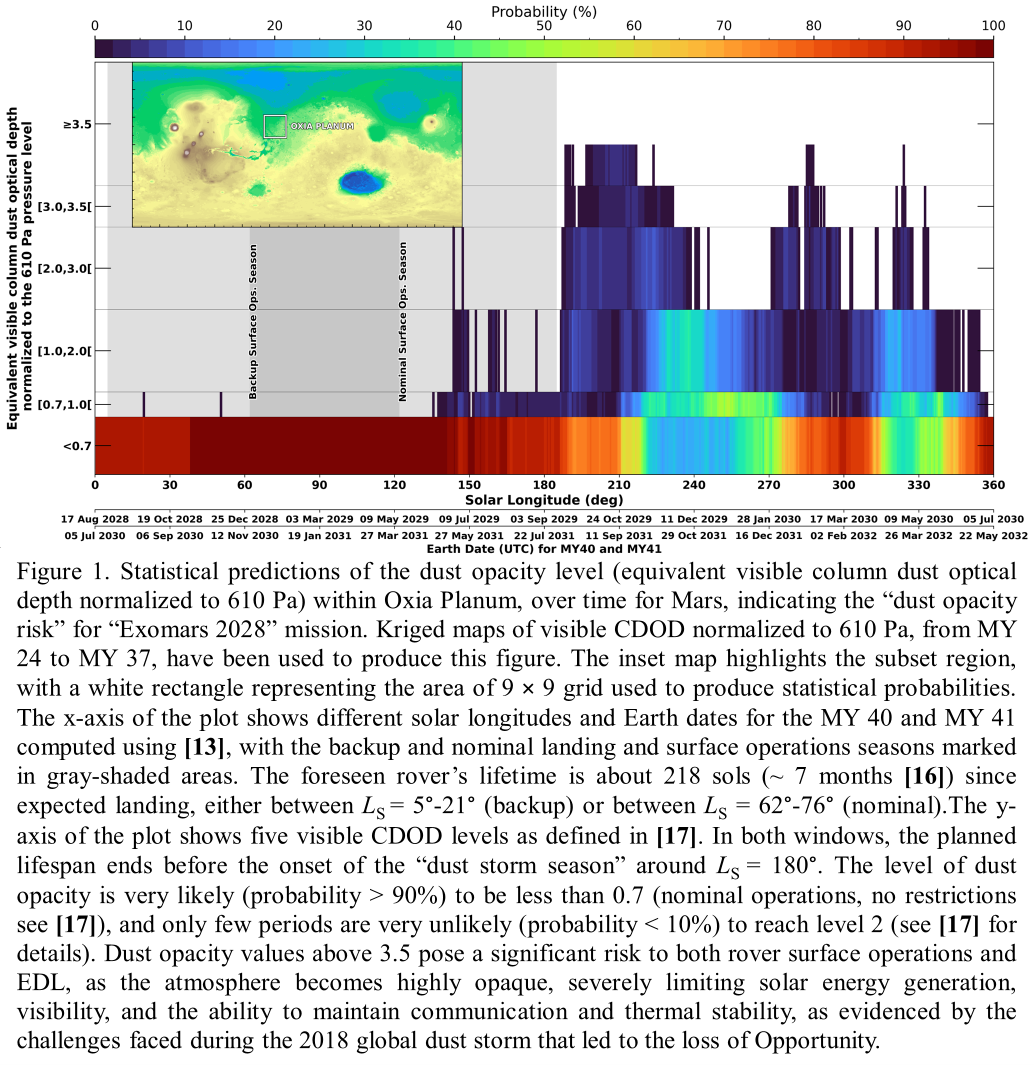
Timoté Lombard, Luca Montabone, Victorien Guyon, Ehouarn Millour, François Forget, Michael J. Battalio, Christopher S. Edwards, David M. Kass, Armin Kleinboehl, Bijay K. Guha, Michael D. Smith, and Michael J. Wolff

Introduction: We have captured Martian dust and weather over 25 years of continuous satellite observations. Using thermal infrared (IR) data from instruments like TES (Mars Global Surveyor), THEMIS (Mars Odyssey), MCS (Mars Reconnaissance Orbiter), and EMIRS (Emirates Mars Mission), we have produced diurnal maps of column dust optical depth (CDOD) covering 13 Martian years (MY 24–37) [1–5]. Two types of maps are available: gridded maps (incomplete) and kriged maps (complete). These maps, normalized to 610 Pa or expressed as total CDOD, are mainly used as “dust scenarios” in the Mars Climate Database [6] and are publicly available (see the links to the datasets in the acknowledgments section). While they have helped study dust seasonality and large-scale storms, their use in multi-annual and daily-scale analyses remains limited.

Latest advances: Starting from retrievals provided by the TES, MCS, and EMIRS science teams, we use two processing chains (gridding and kriging) to produce daily quasi-complete gridded CDOD maps and fully complete kriged CDOD maps. These chains were technically improved and scientifically enhanced with the following changes:

1. We have used a new tool for Earth – Mars datetime conversion [13] to define a sol of the year for each daily map using a sol-based Mars calendar, as described in [1, Appendix A].

2. We have changed the computation of the total CDOD (defined in [1]) by using a lookup table of surface pressure extracted from the MCD v5.3, interpolated at the required time and location.

3. We have improved the gridding of retrievals by implementing an automatic method to detect data gaps (when instruments are inactive for several sols or weeks) and dynamically extend the time window (see [1] for details about the time window). This enables continuous generation of daily maps, even if sparse – essential inputs for the kriging process.

4. We have used data from the Compact Reconnaissance Imaging Spectrometer for Mars (CRISM, onboard Mars Reconnaissance Orbiter) to validate CDOD maps together with rover/lander data as in [1]. This might correct a recurring bias, especially during the Low Dust Loading Season (LS = 10°-140°; see [14]), where earlier CDOD maps underestimate dust opacity level. This also might aid in merging data from different instruments.

5. We have analyzed the differences between MCS- and EMIRS-based maps, as both instruments observed Mars quasi-simultaneously during MY 36 and 37 – except for a few periods when one of the instruments was not functioning nominally. Despite differences in spatial and temporal coverage, we have attempted to properly integrate CDOD data from MCS and EMIRS to produce combined daily maps for MY 36 and 37 and to deliver a single dataset for each year that reflects the contributions of one or more instruments.

Applications: To support characterization of the Martian atmosphere for the ExoMars rover’s Entry, Descent, and Landing (EDL), we have used daily CDOD maps to assess dust opacity risks. Figure 1 presents predicted dust opacity levels for both EDL and surface operations during the nominal (LS = 62°-76°) and backup (LS = 5°-21°) seasons, based on criteria from [17].

From daily CDOD maps, it is also possible to identify large-scale dust events (“storms”) that reach regional or planetary scales, track their evolution and key characteristics (trajectory, area, optical depth), and build statistics comparable to dust storm statistics from visible images (e.g. [12, 15]), which are also useful for CDOD maps validation. Due to the volume of daily maps and the lack of prior systematic CDOD maps analysis, a new method is in development to detect and track large-scale dust events using unsupervised machine learning algorithms [9]. A key outcome is the production of a catalog of historic large-scale dust events, which can be routinely updated with new events as new dust maps become available.

Finally, the mid-term to long-term objective is to establish a real-time processing chain that spans from receiving the retrievals to producing and processing CDOD maps. Real-time capability is currently hindered by the time required for data downlink and the availability of quasi real-time retrievals. The goal is to develop an early warning meteorological tool capable of daily monitoring of atmospheric dust and issuing alerts if dust levels are rising, potentially signaling the onset of a dust storm. We consider, as an illustrative case, the unexpected early dust storm during MY 35 around LS ≈ 35°. Let us assume that daily data acquisition and processing are feasible between SOY 70 and 75. In this context, if we imagine that ExoMars has successfully landed at Oxia Planum during MY 41, LS ≈ 35°, we could then monitor the daily dust levels near the landing site and issue warnings if a large-scale or regional dust storm emerges nearby (see Figure 2). Following this example, from SOY 73, a warning would have been raised because the mean of the dust core (see [9]) exceeds 0.7 (see [17]). This would allow the mission operations team to take appropriate actions such as suspending scientific activities or entering safe mode (see [17]).


Acknowledgments: TM, LM, and VG acknowledge support from CNES and ESA MCD project. BKG was supported by UAE University Grant G00003407. Work at the Jet Propulsion Laboratory, California Institute of Technology, is supported by NASA. The multi-annual dataset of daily gridded and kriged maps v2.x for MY24 through MY36 is available on the MCD webpage (NetCDF format) at https://www-mars.lmd.jussieu.fr/mars/dust_climatology/ and on the VESPA repository (FITS format) at https://bit.ly/3QMFfIf (shortened link). The latest v3.0 of the daily gridded maps for MY24 through part of MY27, together with corresponding TES CDOD retrievals in the infrared and in the visible, are available on the NASA PDS (atmosphere node) at: https://atmos.nmsu.edu/data_and_services/atmospheres_data/MARS/montabone.html

References: [1] Montabone et al., 2015, doi: 10.1016/j.icarus.2014.12.034. [2] Montabone et al., 2020, doi: 10.1029/2019JE006111. [3] Smith, 2009, doi: 10.1016/j.icarus.2009.03.027. [4] Smith, 2004, doi: 10.1016/j.icarus.2003.09.010. [5] Kleinboehl et al., 2009, doi: 10.1029/2009JE003358. [6] Millour et al., 2022, EPSC2022-786, https://doi.org/10.5194/epsc2022-786. [7] Smith et al, 2022, doi : 10.1029/2022GL099636. [8] Guha et al., 2023, doi: 10.1029/2023JE008156. [9] Lombard & Montabone, 2024, EPSC2024-1334, https://doi.org/10.5194/epsc2024-1334. [10] Allison, 1997, doi:10.1029/97GL01950. [11] Allison and McEwen, 2000, doi:10.1016/S0032-0633(99)00092-6. [12] Battalio and Wang, 2019, https://doi.org/10.7910/DVN/F8R2JX. [13] Guyon et al., 2025, EPSC-DPS2025-1694. [14] Forget & Montabone, 2017, http://hdl.handle.net/2346/72982. [15] Guha et al., 2024, https://doi.org/10.1029/2023JE008156. [16] Vago et al., 2017, https://doi.org/10.1089/ast.2016.1533. [17] Staab et al., 2020, doi: 10.1109/AERO47225.2020.9172528.

How to cite: Lombard, T., Montabone, L., Guyon, V., Millour, E., Forget, F., Battalio, M. J., Edwards, C. S., Kass, D. M., Kleinboehl, A., Guha, B. K., Smith, M. D., and Wolff, M. J.: Monitoring Dust in the Martian Atmosphere: Recent Advances and Applications in Column Dust Optical Depth Processing, EPSC-DPS Joint Meeting 2025, Helsinki, Finland, 7–13 Sep 2025, EPSC-DPS2025-1765, https://doi.org/10.5194/epsc-dps2025-1765, 2025.

F30
|
EPSC-DPS2025-1408
|
ECP
|
On-site presentation
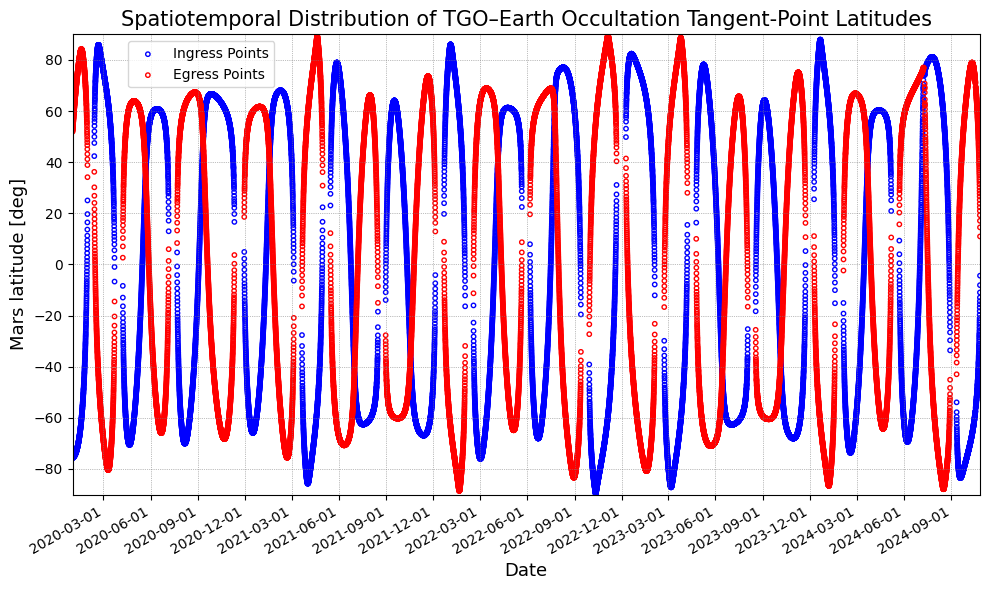
Michaela Benthaus, Colin Wilson, and Kerstin Peter

Radio occultation is a powerful remote sensing technique used to probe planetary atmospheres. By analysing the bending of a spacecraft’s radio signal as it passes through the atmosphere, this method provides detailed vertical profiles of atmospheric temperature, pressure and density [1]. This technique has been successfully applied at Mars by missions including the European Space Agency’s Mars Express (MEX) mission, which began Earth-based radio occultation measurements in 2004. These observations, conducted as part of the Mars Express Radio Science experiment (MaRS), provided valuable vertical profiles of both the neutral atmosphere and the ionosphere [1].

Another mission capable of utilising this technique is the ExoMars Trace Gas Orbiter (TGO), also led by the European Space Agency (ESA), which began its scientific operations around Mars in March 2018. While TGO has already been used to perform crosslink radio occultation measurements with Mars Express (TGO–MEX) [2] in the UHF band, it also holds a significant, yet largely unexplored, dataset obtained from radio occultations using the TGO-Earth X-band link. Once analysed, these data could significantly enhance our understanding of the Martian atmospheric structure and dynamics. In these experiments, different frequency bands are employed: the UHF band (400 MHz) for the TGO–MEX crosslink and the X-band (7.2 GHz/ 8.4 GHz) for the TGO–Earth uplink/ downlink. The UHF band is relatively more sensitive to the ionosphere [2], while the X-band link is better suited for probing the neutral atmosphere.

This study focuses on a preliminary investigation of the currently available TGO-Earth radio occultation dataset. To determine the number of possible occultation events observable from Earth, geometrical calculations are conducted using the SPICE toolkit to simulate spacecraft-Earth occultation geometries.

Figure 1: Latitudes of the tangent points during ingress and egress events for TGO–Earth occultations, shown over a five-year period (01/2020 –12/2024), as viewed from Earth.

Figure 1 shows the latitude of the tangent points at the times of ingress and egress during TGO–Earth occultation events on Mars, computed for the time period spanning 1/2020 to 12/2024. Although the scientific phase of the TGO mission started in 2018, archived ground station occultation data are only available from 2020 onward. Each point corresponds to the latitude of the tangent point in Mars-fixed coordinates at the time when the impact parameter crosses the planetary radius, indicating the start or end of an occultation event. During ingress, the impact parameter drops below the radius as TGO enters occultation. During egress, it rises back above it as the spacecraft leaves occultation. With an orbital period of approximately two hours, TGO completes about 12 orbits per Earth Day, providing up to 24 potential occultation opportunities daily. Due to its low-altitude, near-circular orbit, TGO provides a far greater number of occultations compared to missions in highly elliptical orbits, such as MEX, for which occultation events are less frequent. As shown in Figure 1, this results in a good opportunity to study how the latitude dependence of the neutral atmosphere varies throughout the year. Further analysis of the scientific potential of this dataset is ongoing.

References:

[1] Pätzold, M., Häusler, B., Tyler, G. L., et al. 2016, Planet. Space Sci., 127, 44, "Mars Express 10 years at Mars: Observations by the Mars Express Radio Science Experiment (MaRS)"

[2] Parrott, J., Svedhem, H., Witasse, O., et al. 2024, Radio Sci., 59, e2023RS007873, "First Results of Mars Express–ExoMars Trace Gas Orbiter Mutual Radio Occultation"

How to cite: Benthaus, M., Wilson, C., and Peter, K.: TGO-Earth radio occultation: a new data source for Mars neutral atmosphere profiling, EPSC-DPS Joint Meeting 2025, Helsinki, Finland, 7–13 Sep 2025, EPSC-DPS2025-1408, https://doi.org/10.5194/epsc-dps2025-1408, 2025.

F31
|
EPSC-DPS2025-1432
|
ECP
|
On-site presentation
Loïc Trompet, Filip Vanhellemont, Ian Thomas, Séverine Robert, and Ann Carine Vandaele

The atmosphere of Mars is the second most sounded atmosphere after the one of Earth. The wealth of datasets is now important enough to make direct comparisons of retrieved atmospheric parameters. Those comparisons can reveal biases that can arise from natural differences due to time and location, but also due to instrumental differences, or due to the different forward models used for the retrievals. Associated with the latter, “regularisation” must not be overlooked.

Deriving localised atmospheric parameters from remote sensing is often an ill-posed problem. In practice, ill-posed problems lead to a substantial increase in the level of noise when passing from the measurements to the retrieved values. Several ways to regularise ill-posed problems have been proposed. Amongst them, the most common ones are the Tikhonov method (TM)1,2, and the optimal estimation method (OEM)3. TM is mainly used to smooth the solution while the OEM relies on an “a priori” on the parameter to be retrieved and a covariance matrix on this “a priori”. The latter serves to limit the allowed discrepancy between the “a priori” and the solution, in addition to smoothing the solution. One needs to be careful that the covariance matrix is often itself singular. Nowadays, the most cited method is OEM, but from a mathematical viewpoint, TM and OEM, are very similar.

The “a priori” and its covariance matrix are crucial information for understanding the “regularisation” applied to the solution. Another important piece of information reflecting the “regularisation” is provided by the averaging kernel matrix. The latter equals the identity matrix if no regularisation is applied, while the kernels resemble bell-curved functions with full-width at half maximum (FWHM) increasing as the amount of regularisation increases.

Most of the comparisons between datasets are possible thanks to the now common practice of providing the data described within a publication. Comparisons are crucial to the validation of results. For the Earth's atmosphere, no comparison is possible without taking into account the averaging kernels4,5. The full averaging kernel matrix size equals the square of the size of the solution, and it is thus not always possible to provide the whole matrix. We propose to provide three parameters that permit the reconstruction of the averaging kernels: their FWHMs, the values of the peaks, and the area of each averaging kernel.

This talk aims to recall all the assertions above in particular for limb or occultation sounding and to show the importance of providing the averaging kernels associated with the retrieved profiles, as it permits assessing the reliability of a retrieved parameter. The examples in this presentation will be kept very general so that the concepts described here can be used for any other remotely sensed dataset.

References:

  • Doicu, A., Trautmann, T. & Schreier, F. Numerical Regularization for Atmospheric Inverse Problems. Numerical Regularization for Atmospheric Inverse Problems (Springer Berlin Heidelberg, 2010). doi:10.1007/978-3-642-05439-6.
  • Tikhonov, A. N. & Arsenin, V. Y. Solutions of Ill-Posed Problems. (V. H. Winston & Sons, Washington, D.C.: John Wiley & Sons, New York, 1977).
  • Rodgers, C. D. Inverse Methods for Atmospheric Sounding. vol. 2 (WORLD SCIENTIFIC, 2000).
  • Rodgers, C. D. & Connor, B. J. Intercomparison of remote sounding instruments. J. Geophys. Res. Atmospheres 108, (2003).
  • Von Clarmann, T. et al. Overview: Estimating and reporting uncertainties in remotely sensed atmospheric composition and temperature. Atmospheric Meas. Tech. 13, 4393–4436 (2020).

How to cite: Trompet, L., Vanhellemont, F., Thomas, I., Robert, S., and Vandaele, A. C.: Parameters to assess the impact of regularisation on remotely sensed atmospheric profiles., EPSC-DPS Joint Meeting 2025, Helsinki, Finland, 7–13 Sep 2025, EPSC-DPS2025-1432, https://doi.org/10.5194/epsc-dps2025-1432, 2025.

F32
|
EPSC-DPS2025-910
|
ECP
|
On-site presentation
Frances Gomez, Robert Hargreaves, and Iouli Gordon

The 2024 edition of the HITRAN database represents a major advancement in the curation and dissemination of molecular spectroscopic data. A major aspect of HITRAN2024 is the expansion of line-by-line spectroscopic parameters. This now encompasses 61 molecules and includes “planetary” gases such as S2, CH3 and H3+. These line lists feature improved accuracy and broader spectral coverage compared to HITRAN2020 [1]. Enhancements are especially relevant for interpreting high-resolution observations from state-of-the-art space telescopes such as the James Webb Space Telescope and the Atacama Large Millimeter/submillimeter Array, which require highly accurate spectroscopic data for the remote characterization of planetary atmospheres.

The HITRAN2024 update also marks a dramatic expansion in the absorption cross section dataset. Absorption cross sections for over 260 molecules not previously represented in HITRAN have been added to the database, including many from the Pacific Northwest National Laboratory [2]. These additions have been made possible thanks to a wealth of newly available experimental data and extend the range of temperatures, pressures, broadening gases, and spectral resolutions covered.

Furthermore, new experimental works have also allowed for an update of the collision-induced absorption data in HITRAN, and the inclusion of new collisional pairs. Additionally, a major new component added to the database in HITRAN2024 is the MT_CKD water vapor continuum model. This complements the existing five core areas of the HITRAN database and the data allows for more accurate simulations of water vapor’s contribution to atmospheric opacity. This update is particularly important in climate modeling and remote sensing applications.

The HITRAN2024 edition will be available through the HITRAN website (https://hitran.org) and through the HITRAN Application Programming Interface (HAPI), which supports the expanded dataset. The upcoming publication describing the new edition is in preparation. Overall, HITRAN2024 delivers extensive improvements that reinforce its role as a dependable resource in atmospheric, terrestrial, and astronomical spectroscopic research.

 References
[1] Gordon, I., Rothman, L., Hargreaves, R., Hashemi, R., Karlovets, E., Skinner, F., Conway, E., Hill, C., Kochanov, R., Tan, Y., Wcislo, P., Finenko, A., Nelson, K., Bernath, P., Birk, M., Boudon, V., Campargue, A., Chance, K., Coustenis, A., Drouin, B., Flaud, J., et al. (2022). The HITRAN2020 molecular spectroscopic database. Journal of Quantitative Spectroscopy and Radiative Transfer, 277:107949.
[2] Sharpe, S. W., Johnson, T. J., Sams, R. L., Chu, P. M., Rhoderick, G. C., and Johnson, P. A. (2004). Gas-Phase Databases for Quantitative Infrared Spectroscopy. Applied Spectroscopy, 58(12):1452–1461.

How to cite: Gomez, F., Hargreaves, R., and Gordon, I.: From Earth to Exoplanets: HITRAN2024 Molecular Spectroscopic Data, EPSC-DPS Joint Meeting 2025, Helsinki, Finland, 7–13 Sep 2025, EPSC-DPS2025-910, https://doi.org/10.5194/epsc-dps2025-910, 2025.

F33
|
EPSC-DPS2025-583
|
On-site presentation
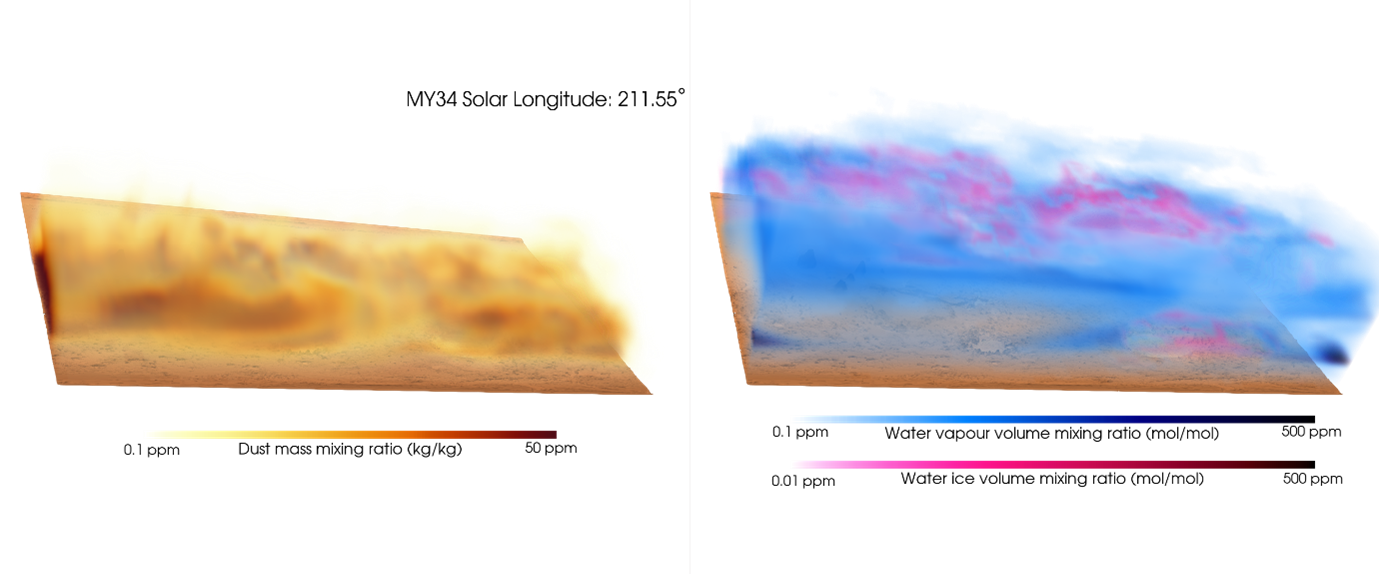
James A. Holmes, Kylash Rajendran, Paul M. Streeter, Manish R. Patel, and Stephen R. Lewis

We present the OpenMARS reanalysis dataset (https://doi.org/10.21954/ou.rd.c.4278950), a publicly available resource developed to support the planetary science community in atmospheric and climate studies of Mars. The OpenMARS dataset combines a state-of-the-art Martian Global Circulation Model (MGCM) with data assimilation techniques to produce a dynamically consistent, gridded record of the Martian atmosphere over multiple Mars years. Data assimilation—routinely used in terrestrial weather and climate studies—offers a powerful framework for Mars by combining sparse, irregular satellite observations with a physically based model. This yields a complete and coherent picture of the atmospheric state that cannot be derived from observations or models alone.

OpenMARS utilises observations from multiple spacecraft and has been used to support a wide array of research topics, such as atmospheric dynamics, dust and water ice transport (Figure 1), chemical cycles, surface-atmosphere interactions, and climate variability. Studies leveraging OpenMARS have explored phenomena ranging from regional dust storms and polar processes to planetary waves and seasonal cycles, making it a valuable resource for both modelling and observational studies of the Martian climate system. These reanalyses are not only critical for advancing our scientific knowledge but are increasingly valuable for operational planning, especially as Mars exploration enters a new phase that includes long-duration robotic missions and future human exploration. Accurate atmospheric data are essential for entry, descent, and landing (EDL) planning, surface operations, and understanding environmental hazards.

Figure 1: Sample output from the OpenMARS reanalysis dataset during the global dust storm in 2018.

We are actively working to update the OpenMARS dataset through multiple avenues including upgrading to the latest MCS v6 retrievals, which provide improved vertical coverage and retrieval quality. In response to feedback from the community, we are also exploring the inclusion of additional output variables and diagnostics relevant to current research needs. We encourage the community to make use of OpenMARS in their investigations and welcome suggestions for future enhancements. As a community-driven resource, OpenMARS aims to support the broad goals of planetary science and the practical requirements of future Mars missions.

How to cite: Holmes, J. A., Rajendran, K., Streeter, P. M., Patel, M. R., and Lewis, S. R.: OpenMARS: A Global Reanalysis Dataset for Martian Atmospheric Studies and Exploration, EPSC-DPS Joint Meeting 2025, Helsinki, Finland, 7–13 Sep 2025, EPSC-DPS2025-583, https://doi.org/10.5194/epsc-dps2025-583, 2025.

F34
|
EPSC-DPS2025-988
|
On-site presentation
Peter Read, Luca Montabone, Kylash Rajendran, and Alex Valeanu

Recent studies of the climate and weather on Mars have benefitted greatly from the development of publicly available “reanalysis” datasets. These are quantitative reconstructions of the three-dimensional, multivariate, time-varying state of the Martian atmosphere, obtained by combining observations of atmospheric variables, usually from remote sensing platforms in orbit around the planet, with a numerical model simulation of the entire atmospheric circulation and surface, using a statistical-dynamical algorithm known as an “assimilation”. The result represents an estimate of the evolving state of the entire global weather and climate that makes optimal use of both direct observations and physical knowledge of the physics and chemistry of the atmosphere and surface (as contained in the design of the numerical model), taking into account statistical uncertainties in both measurements and model simulations. This approach thereby takes account of measurement uncertainty, the incomplete coverage of observations in both space and time and enables the estimation of variables that cannot be measured directly through the internal dynamical consistency of the numerical model. 

At least four such datasets have been produced during the past decade or so [1-6], based on recent spacecraft observations from the Thermal Emission Spectrometer (TES) on NASA’s Mars Global Surveyor (MGS), the Mars Climate Sounder (MCS) instrument on NASA’s Mars Reconnaissance Orbiter (MRO), the Atmospheric Chemistry Suite thermal infrared channel (ACS-TIRVIM) on ESA's Trace Gas Orbiter and the Emirates Mars InfraRed Spectrometer (EMIRS) on the Emirates Mars Mission (EMM), using different assimilation algorithms. In most cases so far, the data assimilated has been limited to retrieved surface temperature and atmospheric temperature profiles, together with column integrated dust opacities (CIDO) and certain other trace gases. Although this leads to reasonable agreement between different assimilations and with independent, out of sample measurements, the neglect of measurements of the vertical structure of atmospheric dust loading leads to significant errors in modelled radiative heating and cooling rates that temperature assimilation is then required to correct. Such a correction is highly undesirable, quite apart from misrepresenting the structure and transport of dust aerosol by the circulation, and increases the likelihood of systematic errors in the reconstructed circulation. 

In recent work [4], the Analysis Correction system used for the Mars Analysis Correction Assimilation (MACDA) reanalysis [1] has been extended to enable the assimilation of both CIDO and profiles of dust opacity obtained from limb-sounding instruments such as MCS. The results have enabled phenomena such as the climatological elevated dust layers during northern hemisphere summer to be captured in a reanalysis (see Fig. 1), which has been elusive in previous work. In new work presented here, this approach has now been applied to more than 12 Mars years of observations, from early MY24 to the beginning of MY36 (to date), based mainly on retrievals of temperature and dust opacity from the MGS/TES and MRO/MCS instruments that have been assimilated into the UK version of the LMD Mars Planetary Climate Model. This dataset will shortly be available publicly via the UK Centre for Environmental Data Analysis (https://www.ceda.ac.uk/). Here we present an overview of the new reanalysis and illustrate some of its results with the aim of alerting researchers to this new resource for future studies. 

PLR and AV acknowledge support from the UK Space Agency. The authors are grateful to Armin Kleinböhl and the MCS science team for advice and early access to retrieved data.

Figure 1: Snapshots of the zonally averaged structure of the Martian atmosphere during northern late summer in Mars Year 28, showing the zonal and vertical wind, temperature and dust distribution, showing the presence of a persistent elevated dust layer from the MACDA2 reanalysis.

[1] Montabone, L., Marsh, K., Lewis, S. R., Read, P. L., Smith, M. D., Holmes, J., et al. (2014). The Mars Analysis Correction Data Assimilation (MACDA) dataset V1.0. Geoscience Data Journal, 1(2), 129–139. https://doi.org/10.1002/gdj3.13
[2] Greybush, S. J., Kalnay, E., Wilson, R. J., Hoffman, R. N., Nehrkorn, T., Leidner, M., et al. (2019). The Ensemble Mars Atmosphere Reanalysis System (EMARS) version 1.0. Geoscience Data Journal, 6(2), 137–150. https://doi.org/10.1002/gdj3.77
[3] Holmes, J. A., Lewis, S. R., & Patel, M. R. (2020). OpenMARS: A global record of Martian weather from 1999 to 2015. Planetary and Space Science, 188, 104962. https://doi.org/10.1016/j.pss.2020.104962
[4] Ruan, T., Young, R. M. B., Lewis, S. R., Montabone, L., Valeanu, A., & Read, P. L. (2021). Assimilation of both column- and layer-integrated dust opacity observations in the Martian atmosphere. Earth and Space Science, 8(12), e2021EA001869. https://doi.org/10.1029/2021EA001869
[5] Young, R. M. B., Millour, E., Guerlet, S., Forget, F., Ignatiev, N., Grigoriev, A. V., et al. (2022). Assimilation of temperatures and column dust opacities measured by ExoMars TGO-ACS-TIRVIM during the MY34 Global Dust Storm. Journal of Geophysical Research: Planets, 127, e2022JE007312. https://doi.org/10.1029/2022JE007312
[6] Young, R. M. B., Millour, E., Forget, F., Smith, M. D., Aljaberi, M., Edwards, C. S., et al. (2022). First assimilation of atmospheric temperatures from the Emirates Mars InfraRed Spectrometer. Geophysical Research Letters, 49, e2022GL099656. 

How to cite: Read, P., Montabone, L., Rajendran, K., and Valeanu, A.: MACDA2: A new reanalysis for the Martian atmosphere with vertically resolved dust , EPSC-DPS Joint Meeting 2025, Helsinki, Finland, 7–13 Sep 2025, EPSC-DPS2025-988, https://doi.org/10.5194/epsc-dps2025-988, 2025.

F35
|
EPSC-DPS2025-2067
|
On-site presentation
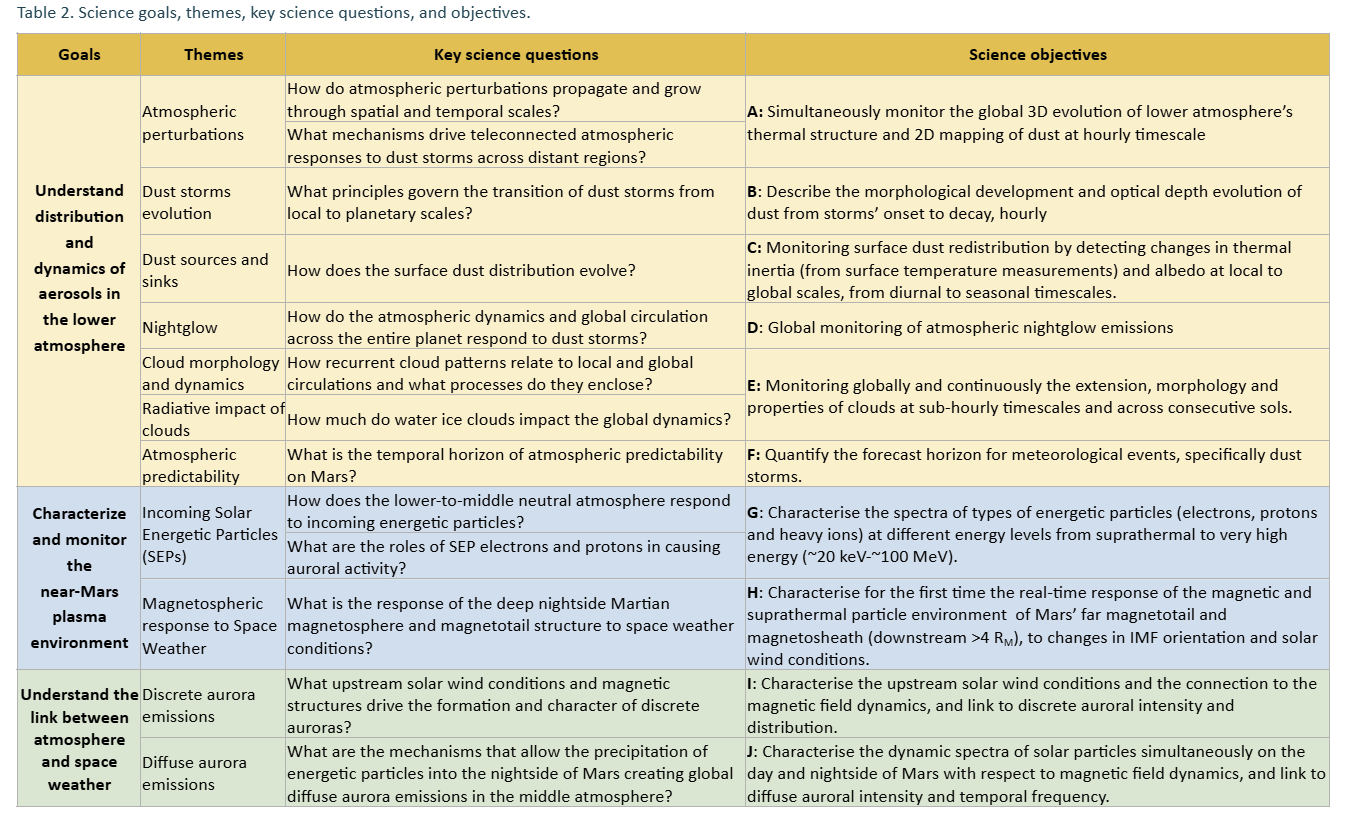
Luca Montabone, Alejandro Cardesin-Moinelo, Claire Newman, Lori Neary, Jorge Hernandez-Bernal, Ian Thomas, Giuliano Liuzzi, Manish Patel, Beatriz Sanchez-Cano, Miguel Lopez-Valverde, Robert Lillis, and Hiromu Nakagawa and the MACAWS team

Scientific Rationale

Despite two decades of orbital observations, many fundamental questions about Mars’ atmosphere remain unanswered—especially regarding vertical coupling between atmospheric layers, diurnal and sub-diurnal variability, and interactions with the space environment. Existing missions, all based on single-point orbiter platforms, have lacked the capability to resolve these processes simultaneously at local and global scales across all local times.

We have elaborated the MArs Constellation for Atmosphere and space Weather (MACAWS) mission concept to address these limitations using a novel constellation of three identical spacecraft in high altitude orbit (~17,000 km). MACAWS will, for the first time, enable global, simultaneous, high-cadence monitoring of Mars’ atmosphere and near-space environment over the full diurnal cycle. This mission is designed to deliver transformative science ahead of more comprehensive—but later—missions like M-MATISSE and the full LightShip constellation, whose first results are expected near the end of the next decade. MACAWS aligns with top priorities identified by the Mars science community and formalized in Table 1 (see Figure 1).

Goal 1: Understand the distribution and dynamics of aerosols in the lower atmosphere

Dust, water ice, and CO₂ ice aerosols dominate Martian meteorology through their radiative and thermodynamic effects. These aerosols shape circulation, modulate thermal structure, and define the appearance of Martian weather across scales. Dust, in particular, is a potent driver of temperature variability, absorbing solar radiation and emitting infrared energy. Through microphysical interactions, it influences cloud formation and atmospheric dynamics. MACAWS will provide the first planet-wide, hourly, simultaneous 3D thermal profiles and 2D dust maps, capturing the complexity of Martian weather [Objective A].

Dust storms, ranging from local to global scales, remain poorly understood in terms of initiation and decay. MACAWS will systematically track their evolution using visual imagery and optical depth retrievals [Objective B]. This will help identify physical mechanisms underlying storm growth and transitions across intensity and spatial scales. While the mission may not coincide with a planet-encircling extreme dust event, regional storms—common every Martian year— offer valuable insight into the transition from events spanning a few hundred kilometers to those extending over several thousand kilometers. Long-term, gap-free monitoring is essential to statistically characterize extreme events, yet no such dataset is currently guaranteed in the coming decade.

MACAWS will also investigate surface-atmosphere exchange by tracking changes in surface thermal inertia and albedo, potentially tied to dust lifting and deposition [Objective C]. The mission’s global daily imaging and surface temperature retrievals will help to identify active dust sources and map redistribution patterns following storms.

Dust-driven changes to global circulation can be traced to high altitudes. One striking signature is the recently detected nightglow at high latitudes during winter polar night, arising from recombination of atomic oxygen in the O₂ Herzberg II band. This visible emission offers a remote sensing diagnostic of meridional circulation and downwelling of oxygen-rich air from the upper atmosphere. MACAWS will globally map this emission to assess the impact of dust storms on large-scale circulation [Objective D].

Water ice clouds, besides tracing the water cycle, also exert radiative feedback that influence circulation. Their daily patterns show partial repeatability, suggesting links between local and global dynamics. MACAWS will monitor these clouds globally at sub-hourly cadence, across consecutive sols [Objective E], enabling improved understanding of cloud formation processes and their coupling with the dust cycle.

MACAWS will also deliver an unprecedented dataset for assimilation into Global Climate Models (GCMs). So far, the benefits of constellation-based assimilation have only been shown in synthetic Observing System Simulation Experiments (OSSEs). With its real data and assimilation-ready products, MACAWS will support forecasting of major atmospheric events, including dust storms [Objective F], advancing the goal of operational predictability for science and exploration.

Goal 2: Characterize and monitor the near-Mars plasma environment

Space weather, driven by solar emissions—fields, particles, and plasma—affects planetary upper atmospheres and magnetic environments. At Mars, these interactions produce auroras, ionospheric disturbances, and even surface-level effects during Solar Energetic Particle (SEP) events, which can heat and ionize the atmosphere and disrupt communications. Despite this, Mars’ plasma environment remains poorly monitored due to the lack of continuous upstream observations of the Interplanetary Magnetic Field (IMF).

MACAWS’ orbital altitude ensures that each spacecraft spends ~75% of its orbit in the upstream solar wind, acting as a dedicated plasma observatory. Simultaneously, at least one other spacecraft will be crossing the bow shock or sampling downstream regions—magnetosheath, magnetosphere, and tail—guaranteeing continuous, multipoint measurements.

The mission will characterize the spectra and temporal evolution of SEPs (electrons, protons, heavy ions) from ~20 keV to ~100 MeV [Objective G], identifying their role in auroral excitation and atmospheric ionization. In parallel, MACAWS will deliver the first real-time, continuous measurements of the deep Martian magnetotail, extending beyond four Mars radii, to assess how its structure and dynamics respond to solar wind and IMF conditions [Objective H].

Goal 3: Understand the link between atmosphere and space weather

A core innovation of MACAWS is its ability to simultaneously observe lower atmosphere dynamics and space weather impacts on the upper atmosphere. This allows the mission to explore the multi-scale coupling between dust activity, circulation, auroral processes, and space environment forcing.

Although MACAWS is a low-cost concept with intrinsic limitations compared to larger missions, it uniquely complements them by providing continuous, global coverage. The mission will explore links between the magnetotail, crustal magnetic anomalies, and auroral formation—both discrete and diffuse—by correlating three observational domains: (a) auroral occurrence and brightness; (b) energetic particle precipitation (day and night side) and upstream solar wind conditions; and (c) magnetic field structure and variability [Objectives I, J].

How to cite: Montabone, L., Cardesin-Moinelo, A., Newman, C., Neary, L., Hernandez-Bernal, J., Thomas, I., Liuzzi, G., Patel, M., Sanchez-Cano, B., Lopez-Valverde, M., Lillis, R., and Nakagawa, H. and the MACAWS team: The Science Case for the MArs Constellation for Atmosphere and space Weather (MACAWS) mission concept, EPSC-DPS Joint Meeting 2025, Helsinki, Finland, 7–13 Sep 2025, EPSC-DPS2025-2067, https://doi.org/10.5194/epsc-dps2025-2067, 2025.

F36
|
EPSC-DPS2025-1731
|
ECP
|
On-site presentation
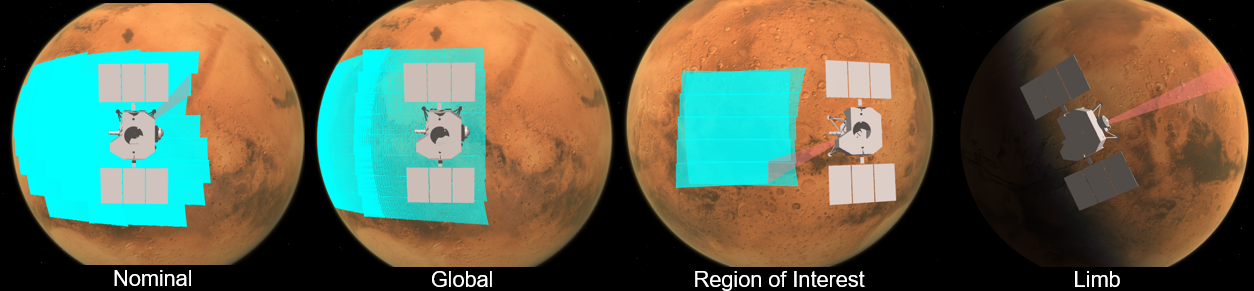
Yann Leseigneur, Gaëlle Le Bail, Thomas Gautier, Jérémie Lasue, Tanguy Bertrand, Lola Fourgeaud, Aurélien Stcherbinine, Eric Sawyer, Mélanie Jouquey, Nicolas Théret, Akira Kazama, Shohei Aoki, Alain Doressoundiram, Hiromu Nakagawa, and Antonella Barucci

            MIRS (MMX InfraRed Spectrometer) is the imaging spectrometer (0.9-3.6 µm) [1] of the JAXA MMX (Martian Moons eXploration) mission [2]. The mission will be launched in 2026 to the Martian system, with an arrival planned in 2027. The mission's main objective is to study the two Martian moons, Phobos and Deimos, to collect samples of Phobos and bring them back to Earth in 2031. Another major aim of the mission [3] and the MIRS instrument [1] is to answer key science questions regarding the transport processes of dust and water in the Martian atmosphere [3], such as: how do local and regional dust storms form, grow and evolve? What is the diurnal behaviour of water ice clouds (formation, transport, dynamics)?

            The MMX probe will be injected into a quasi-circular equatorial orbit around Mars at an altitude of about 6000 km. From this particular orbit, four different observation modes of MIRS are expected for Mars observations (see Figure 1): the so-called nominal mode that maximises the longitudinal overlap, global mapping mode that covers all the illuminated Martian disk up to medium-high latitudes (+/- 60°), region of interest mode that provides temporal resolution (down to 15 minutes) above a limited area, and the limb mode. Each mode will be useful to study the spatial and temporal variations of aerosols (atmospheric dust, water and CO2 ices), and their fine diurnal variations. Indeed, the particular orbit of MMX (the second probe after Hope to be in equatorial orbit) will get us access to observations at very different local times with high spatial resolution, which will certainly provide some answers to the question addressed above.

Figure 1: Illustration of the four observation modes of MIRS. The red swath represents the MIRS angle of view. The blue swath corresponds to the observation footprints acquired during a sequence of each observation mode, thanks to MIRS scanning capability (scanner mirror) and spacecraft maneuvers. Credits: CNES.

            To prepare for future MIRS observations, we use the DISORT (DIScrete-Ordinate-method Radiative Transfer) code [4, 5] through the pyRT_DISORT Python module [6] to simulate the expected radiance of the Martian atmosphere that MIRS will measure. The idea is to produce a look-up table (simulated spectra bank) to retrieve the aerosol properties in the flight data, which allows a faster retrieval as soon as the data are downlinked. First, we will present the parameter space exploration of the radiative transfer model done to quantify the impact of each physical parameter (e.g., observation angles, surface albedo) on the generated spectra. Then, we will discuss the look-up table parameter ranges and steps, which impact the size, as well as the computation time to create the look-up table and the time to search in it. Finally, we will show MIRS images simulated with DISORT in real conditions of the MMX probe arrival, for different atmospheric conditions (dust storms, ice clouds, clear atmosphere) and considering a simulated representative instrument transfer function [7].

Acknowledgments:
We thank the MMX JAXA teams for their efforts and CNES for the financial support and collaboration to build the MIRS instrument.

References:
[1] Barucci M. A. et al. (2021) Earth, Plan. and Space, 73, 211.
[2] Kuramoto K. et al. (2022) Earth, Plan. and Space, 74, 12.
[3] Ogohara K. et al. (2021) Earth, Plan. and Space, 74, 1.
[4] Stammes K. et al. (1988) Applied Optics, 27, 2502-2509.
[5] Stammes K. et al. (2017) Astrophys. Source Code Library, 1708.006.
[6] Connour K. & Wolff M. (2023) GitHub repository, pyRT_DISORT.
[7] Théret N. et al (2023), LPSC 2023, abstract #1142.

How to cite: Leseigneur, Y., Le Bail, G., Gautier, T., Lasue, J., Bertrand, T., Fourgeaud, L., Stcherbinine, A., Sawyer, E., Jouquey, M., Théret, N., Kazama, A., Aoki, S., Doressoundiram, A., Nakagawa, H., and Barucci, A.: MIRS/MMX: an imaging spectrometer to observe the Martian aerosols, EPSC-DPS Joint Meeting 2025, Helsinki, Finland, 7–13 Sep 2025, EPSC-DPS2025-1731, https://doi.org/10.5194/epsc-dps2025-1731, 2025.

F37
|
EPSC-DPS2025-455
|
On-site presentation
Francois Hendrick, Séverine Robert, Ian Thomas, Justin Erwin, Loïc Trompet, Shohei Aoki, Frank Daerden, Lori Neary, Yannick Willame, Arianna Piccialli, Zachary Flimon, Bojan Ristic, Manish Patel, Giancarlo Bellucci, Miguel Angel López Valverde, and Ann Carine Vandaele

Water vapor (H2O) is a highly variable minor constituent of the Martian atmosphere. Through its well characterized seasonal cycle, it controls, together with CO2 and dust cycles, the present Mars climate. In particular, H2O plays a crucial role in the cloud formation and therefore can significantly impact the Mars radiative budget. In terms of photochemistry, it also affects the oxidizing capacity of the Martian atmosphere by providing OH radicals via its photolysis.

Since the end of 1970s, H2O vertical distribution and column abundance have been observed by several space-borne infrared instruments operating either in solar occultation, limb, and/or nadir viewing modes (e.g. Viking 1-2/MAWD, Mars Global Surveyor/TES, Mars Express/PFS and SPICAM, TGO/NOMAD and ACS; see [1] and references therein). Based on these observational data sets and in combination with Global Circulation Models (GCM; see e.g. [2] and [3]), the seasonal and latitudinal variability of the water vapor abundance is now mostly understood.

Here we present a new climatology of Martian water vapor column density derived from NOMAD LNO dayside nadir observations. LNO (Limb Nadir and solar Occultation) is one of the two echelle grating infrared spectrometers installed on the NOMAD (Nadir and Occultation for MArs Discovery) instrument aboard the ESA ExoMars Trace Gas Orbiter (TGO). In these spectrometers, the echelle grating is combined with an Acousto-Optic Tunable Filter (AOTF) for the spectral window selection [4]. Since April 2018, LNO primarily measures H2O and CO in the Martian atmosphere from the nadir viewing mode. However, despite its high scientific value (more than 7 years of globally distributed observations), the LNO dataset has been largely underexploited since only the first Martian year of the mission has been analysed so far (see [5] and [6]).

The LNO nadir H2O vertical column densities over the full mission period are retrieved through an Optimal Estimation approach [7] using the ASIMUT-ALVL radiative transfer tool [8]. ASIMUT-ALVL is applied separately to LNO reflectance factor spectra from three diffraction orders around the 2.6 µm water absorption band: orders 167 (3754-3784 cm-1), 168 (3776-3806 cm-1), and 169 (3799-3829 cm-1). Altitude, pressure, temperature, H2O, CO2, aerosol dust, and water ice a priori vertical profiles are extracted at the spectra locations from the GEM-Mars GCM [3]. Emissivity spectra are taken from a home-made climatology based on [9] and [10]. Scattering by dust and water ice particles is taken into account in the forward simulations by using the LIDORT radiative transfer model [11] included in the ASIMUT-ALVL tool. A new evaluation of the LNO AOTF function and the temperature dependence of its central position has been carried out and these new calibration data are used in our H2O retrieval.

In this presentation, we will show the retrieval results over the full mission period and investigate the impact of the ASIMUT-ALVL settings on the retrieved H2O vertical column densities, the consistency between the three selected diffraction orders, and the level of agreement with other co-located observational data sets (LNO, SPICAM, and EMM-HOP/EMIRS from [5], [12], and [13],  respectively). The effect of the new calibration data on the LNO water vapor retrievals will be also discussed. In the last part of the presentation, the H2O seasonal, inter-annual, and latitudinal patterns will be assessed over the full mission period.

Acknowledgements

The NOMAD experiment is led by the Royal Belgian Institute for Space Aeronomy (IASB-BIRA) with co-PI teams from Spain (IAA-CSIC), Italy (INAF-IAPS) and the United Kingdom (Open University). This project acknowledges funding by: the Belgian Science Policy Office (BELSPO) with the financial and contractual coordination by the ESA Prodex Office (PEA 4000103401, 4000121493, 4000140753, 4000140863); by the Spanish Ministry of Science and Innovation (MCIU) and European funds (grants PGC2018-101836-B-I00 and ESP2017-87143-R; MINECO/FEDER), from the Severo Ochoa (CEX2021-001131-S) and from MCIN/AEI/10.13039/501100011033 (grants PID2022-137579NB-I00, RTI2018-100920-J-I00 and PID2022-141216NB-I00); by the UK Space Agency (grants ST/V002295/1, ST/V005332/1, ST/X006549/1, ST/Y000234/1 and ST/R003025/1); and by the Italian Space Agency (grant 2018-2-HH.0).

References

[1]Montmessin, F., et al. (2024), Mars’ Water Cycle and Escape: A View from Mars Express and Beyond. Space Science Reviews, 220 (7), pp.77. https://doi.org/10.1007/s11214-024-01099-6

[2]Lefèvre, F., et al. (2021), Relationship between the ozone and water vapor columns on Mars as observed by SPICAM and calculated by a global climate model, Journal of Geophysical Research: Planets, 126, e2021JE006838. https://doi.org/10.1029/2021JE006838

[3]Neary, L., and F. Daerden (2018), The GEM-Mars general circulation model for Mars: Description and Evaluation, Icarus, 300, 458–476, https://doi.org/10.1016/j.icarus.2017.09.028

[4]Thomas, I. R., et al. (2016), Optical and radiometric models of the NOMAD instrument part II: the infrared channels - SO and LNO, Optics Express, Vol. 24, Issue 4, 3790-3805, DOI: 10.1364/OE.24.003790

[5]Crismani, M. M. J., et al. (2021), A global and seasonal perspective of Martian water vapor from ExoMars/NOMAD, Journal of Geophysical Research: Planets, 126, e2021JE006878. https:// doi.org/10.1029/2021JE006878

[6]Smith, M. D., et al. (2021), The climatology of carbon monoxide on Mars as observed by NOMAD nadir-geometry observations, Icarus, 362, 114404, https://doi.org/10.1016/j.icarus.2021.114404

[7]Rodgers, C. D. (2000), Inverse methods for atmospheric soundings: Theory and practice, World Scientific

[8]Vandaele, A. C., M. Kruglanski, and M. De Mazière (2006), Modeling and retrieval of atmospheric spectra using ASIMUT, European Space Agency, (Special Publication) ESA SP

[9]Christensen, P. R., et al. (2001), Mars Global Surveyor Thermal Emission Spectrometer experiment: Investigation description and surface science results, J. Geophys. Res., 106(E10), 23823–23871, doi:10.1029/2000JE001370

[10]Erard, S. (2001), A Spectro-Photometric Model of Mars in the near-infrared, Geophys. Res. Lett., 28: 1291-1294. https://doi.org/10.1029/2000GL012347

[11]Spurr, R. J. D. (2006), VLIDORT, A linearized pseudo-spherical vector discrete ordinate radiative transfer code for forward model and retrieval studies in multilayer multiple scattering media, J. Quant. Spectrosc. Radiat. Transfer, 102(2), 316-342, doi:10.1016/j/jqsrt.2006.05.005

[12]Knutsen, E. W., et al. (2022), Water vapor on Mars: A refined climatology and constraints on the near-surface concentration enabled by synergistic retrievals, Journal of Geophysical Research: Planets, 127, e2022JE007252. https://doi.org/10.1029/2022JE007252

[13]Smith, M. D., et al. (2022), EMIRS observations of the aphelion-season Mars atmosphere. Geophysical Research Letters, 49, e2022GL099636. https://doi.org/10.1029/2022GL099636

How to cite: Hendrick, F., Robert, S., Thomas, I., Erwin, J., Trompet, L., Aoki, S., Daerden, F., Neary, L., Willame, Y., Piccialli, A., Flimon, Z., Ristic, B., Patel, M., Bellucci, G., López Valverde, M. A., and Vandaele, A. C.: Towards a new climatology of Martian water vapor column abundance derived from NOMAD LNO nadir full mission observations , EPSC-DPS Joint Meeting 2025, Helsinki, Finland, 7–13 Sep 2025, EPSC-DPS2025-455, https://doi.org/10.5194/epsc-dps2025-455, 2025.

F38
|
EPSC-DPS2025-1423
|
On-site presentation
Lori Neary, Loïc Trompet, Frank Daerden, Ian Thomas, Bojan Ristic, and Ann Carine Vandaele

On Mars, gravity-wave induced density and temperature fluctuations have been observed by orbiting platforms (e.g. [1-5]), during aerobraking [6-7] and from the surface [8]. Their effects are also seen in airglow imagery [9].

We present a climatology of gravity wave activity as seen by the ExoMars Trace Gas Orbiter (TGO) Nadir Occultation for MArs Discovery (NOMAD) instrument [10] and explore the seasonality and latitudinal variability of perturbations seen in the upper atmosphere. Using the Solar Occultation (SO) observation mode of NOMAD, we can also examine the differences in activity at sunrise and sunset.  Two different infrared wavelength regions are used to retrieve CO2 densities in the troposphere (below 50 km) and in the mesosphere (50-100km). From these densities, we can infer temperatures [11, 12], and investigate the perturbations seen in the vertical profiles.

The GEM-Mars Global Circulation Model (GCM) [13, 14] uses two parameterisations for the impacts of orographic [15] and non-orographic gravity waves [16-18], originating from the terrestrial version of the model [19-21]. By comparing temperatures, mapping the perturbations and analysing the derived potential energy and gravity wave drag from the observations, we can then adjust the schemes’ tuning parameters to better match the NOMAD temperatures. For example, in the non-orographic scheme, the lower bound vertical wavenumber, which limits the maximum vertical wavelength of the spectrum allowed, can be adjusted. Various sensitivity studies will be shown.

Acknowledgements

This project acknowledges funding from the Belgian Science Policy Office (BELSPO) (grant B2/223/P1/MOMENTUM). The NOMAD experiment is led by the Royal Belgian Institute for Space Aeronomy (IASB-BIRA) with co-PI teams from Spain (IAA-CSIC), Italy (INAF-IAPS) and the United Kingdom (Open University). This project acknowledges funding by: BELSPO with the financial and contractual coordination by the ESA Prodex Office (PEA 4000103401, 4000121493, 4000140753, 4000140863); by the Spanish Ministry of Science and Innovation (MCIU) and European funds (grants PGC2018-101836-B-I00 and ESP2017-87143-R; MINECO/FEDER), from the Severo Ochoa (CEX2021-001131-S) and from MCIN/AEI/10.13039/501100011033 (grants PID2022-137579NB-I00, RTI2018-100920-J-I00 and PID2022-141216NB-I00); by the UK Space Agency (grants ST/V002295/1, ST/V005332/1, ST/X006549/1, ST/Y000234/1 and ST/R003025/1); and by the Italian Space Agency (grant 2018-2-HH.0).

References :

1 England, S. L. et al. Journal of Geophysical Research: Space Physics (2017)

2 Vals, M. et al. Planetary and Space Science 104708 (2019)

3 Heavens, N. G. et al. Icarus 341, 113630 (2020)

4 Starichenko, E. D. et al. J Geophys Res Planets 126, (2021)

5 Starichenko, E. D. et al. A&A 683, A206. (2024)

6 Creasey, J. E. et al. Geophys. Res. Lett. 33, L22814 (2006)

7 Fritts, D. C. et al. Journal of Geophysical Research 111, (2006)

8 Guzewich, S. D. et al. Journal of Geophysical Research: Planets 126, e2021JE006907 (2021)

9 Altieri, F. et al. Journal of Geophysical Research: Planets 117, n/a-n/a (2012)

10 Vandaele A. C. et al. Space Science Reviews 214, (2018)

11 Trompet L. et al. Journal of Geophysical Research: Planets 128, e2022JE007277 (2023)

12 Trompet, L. et al. Journal of Geophysical Research: Planets 128, e2022JE007279 (2023)

13 Neary, L. and Daerden, F.  Icarus 300, 458–476 (2018)

14 Daerden, F. et al. Icarus 326, 197–224 (2019)

15 McFarlane, N. A. Journal of the Atmospheric Sciences 44, 1775–1800 (1987)

16 Hines, C. O. Journal of Atmospheric and Solar-Terrestrial Physics 59, 371–386 (1997)

17 Hines, C. O. Journal of Atmospheric and Solar-Terrestrial Physics 59, 387–400 (1997)

18 Charron, M. et al., J. Met. Soc. of Japan, Vol. 80, No. 3, pp. 335–345 (2002)

19 Côté, J. et al. Monthly Weather Review 126, 1373–1395 (1998)

20 Côté, J. et al. Monthly Weather Review 126, 1397–1418 (1998)

21 Yeh, K.-S. et al. Monthly Weather Review 130, (2002)

How to cite: Neary, L., Trompet, L., Daerden, F., Thomas, I., Ristic, B., and Vandaele, A. C.: Exploring gravity wave activity in the Martian atmosphere using ExoMars TGO/NOMAD observations and modelling, EPSC-DPS Joint Meeting 2025, Helsinki, Finland, 7–13 Sep 2025, EPSC-DPS2025-1423, https://doi.org/10.5194/epsc-dps2025-1423, 2025.