
 ,,,
,,,- Laboratoire de Meteorologie Dynamique, CNRS, Sorbonne Université, PARIS, France (forget@lmd.ipsl.fr)
Protected by centimeters of dry sediments, a planetary-scale mantle of relatively pure water ice covers the entire mid and high latitudes of Mars. Its presence down has been shown by numerous lines of evidence including geomorphology [e.g. 1], neutron spectroscopy [2], in-situ observations [3], and the observations of exposed ice in fresh craters and local outcrops [4,5]
Given the purity of the ice, it is most likely that this ice has been accumulated as snow from the atmosphere when the climate was different (today perrenial water ice is not stable at the surface outside the polar regions). This ice would have later sublimed and buried itself below a protective sublimation lag. Using Global climate Models, the origin of ice ages has been discussed for more than twenty years, first with the scenario that when the obliquity of Mars reached more than 40° (and not less), as occurred on Mars more than 5 million years ago, the Northern polar layered deposits became unstable and formed glaciers in the tropics and at mid-latitudes. When the obliquity decreased back toward the present-day value (below 30°), the glaciers became unstable and tended to cover the mid and high latitudes with the now-observed mantle of ice.
But there was a problem.
At least the upper part of the “latitude dependent ice mantle” is estimated to be geologically very young, most likely less than one million years [1]. This young age has been enigmatic because the tropical and mid-latitude remnants of glaciers supposed to have been the source of the ice mantle are estimated to be much older, tens of millions of years. Moreover, the obliquity has been below 35° for at least 5 million years [10]. How could the very recent latitude mantle have formed ?
In the past years, we have significantly upgraded the Planetary Climate Model in order to adapt it to the modelling of the very humid martian climates predicted at high obliquity [11]. In particular we have improved the calculation of the impact of latent heat when surface ice sublimes (negligible on Mars today), the albedo of the fresh snow (always thin today), the cloud microphysics and, above all, the radiative effect of water ice clouds (which play a secondary role on present-day Mars). With such a model, we have discovered that PCM simulations performed assuming the same climate system as today, but with obliquities of as low as 35° or even 30°, predict a fascinating climate completely different than today and unlike the one modeled by the previous version of the PCM. The key driver are the water ice clouds, which induces a significant ~20 K greenhouse effect and a very humid and cloudy climate [11, 12]. Depending on the orbital configuration, the seasonal CO2 ice cap can disappear! In such conditions, with the improved ice albedo and latent heat effects, the PCM predict the accumulation of a mantle of ice in the mid-latitude for obliquity above 30°, thus as recently as 380,000 years ago. The time of the last ice age on Mars ?
Following this finding, using multiple simulations of the PCM combined with 1D modelling studies of the sublimation and self-burying of the ice, we have simulated the evolution of the mid-latitude ice deposits to find that the mid-latitude buried ice layer could be the remnant of a surface ice layer deposited on the surface when the obliquity was beyond 35° [13]. We calculate that a 630 kyr-old surface ice at latitudes 40-55 would now be at depths of 25 to 165 centimeters depending on the wind velocity, albedo, thermal inertia, and the ice dust content. Such modeled depths are consistent with the observations, thus explaining why out-of-equilibrium ice can still be found in these locations. Moreover, the modeled variability explains the observed longitudinal variations.
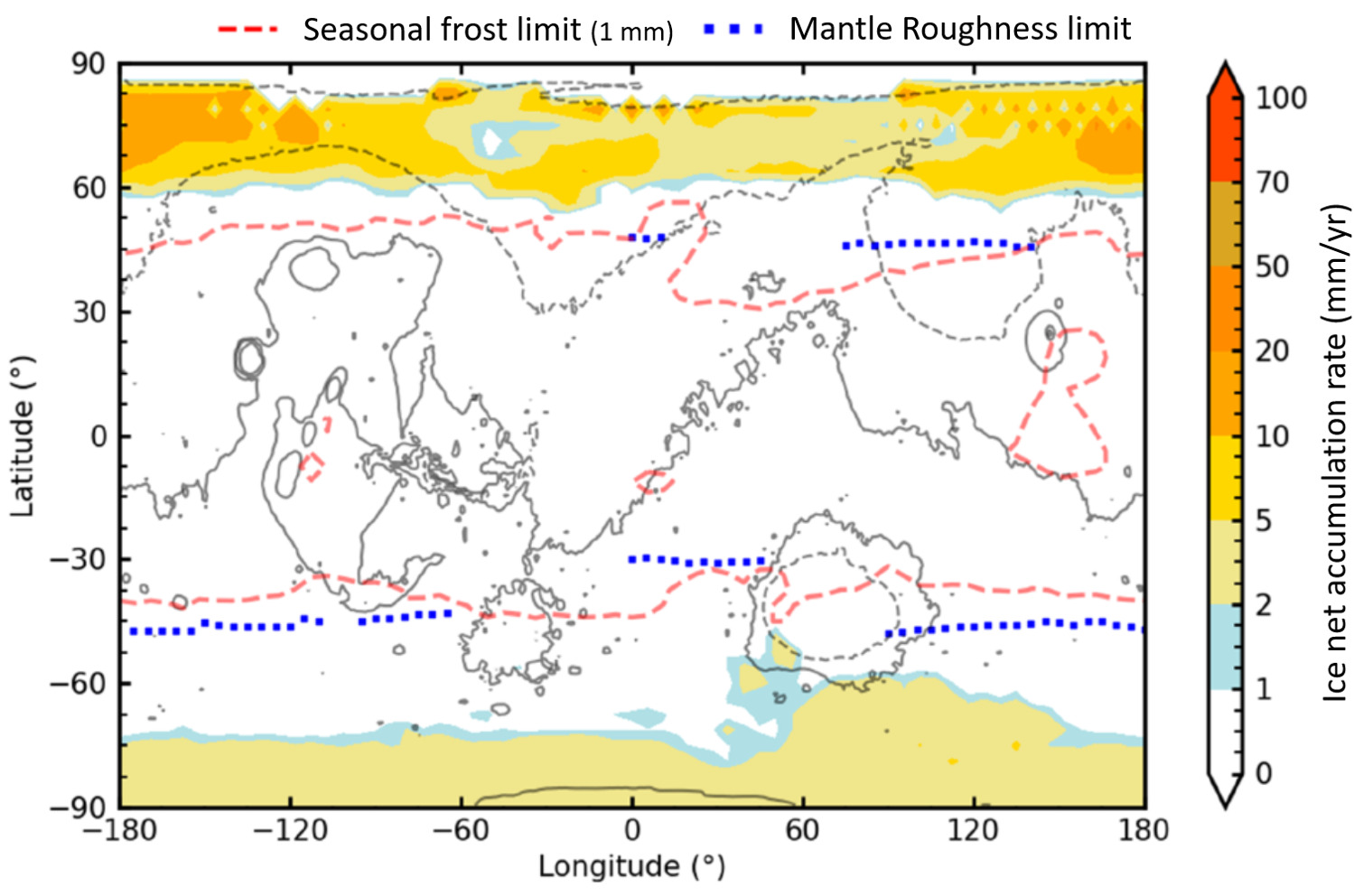
Fig. 1. Net ice accumulation predicted by the Mars Planetary Climate Model assuming an obliquity of 30°, perihelion at northern summer solstice, a snow albedo of 0.7, and a perennial source of water at the north pole like today. Adapted from [11]
References: [1] Head et al. (2003) Recent ice ages on Mars, Nature, 426. [2] Boynton, W. V., Feldman, W. C., Squyres, et al. (2002) Distribution of Hydrogen in the Near Surface of Mars: Evidence for Subsurface Ice Deposits, Science, 297. [3] Mellon, M. T., Arvidson, R. E., Sizemore, H. G., et al. (2009) Ground ice at the Phoenix landing site: Stability state and origin, JGR-Planets 114. [4] Byrne, S. et al. Distribution of mid-latitude ground ice on Mars from new impact craters. Science 325 (2009). [5] Dundas, C. M. et al. Widespread exposures of extensive clean shallow ice in the midlatitudes of Mars. JGR-Planets 126 (2021). [6] Mischna, M. A., Richardson, M. I., Wilson, R. J., and McCleese, D. J. (2003) On the orbital forcing of Martian water and CO2 cycles: A general circulation model study with simplified volatile schemes, JGR-Planets, 108 [7] Levrard, B., F. Forget, F. Montmessin, and J. Laskar (2004), Recent ice-rich deposits formed at high latitudes on Mars by sublimation of unstable equatorial ice during low obliquity, Nature, 431. [8] Forget et al. (2006) Formation of Glaciers on Mars by Atmospheric Precipitation at High Obliquity, Science, 311. [9] Madeleine, J.-B., F. Forget, et al. (2009), Amazonian northern mid-latitude glaciation on Mars: A proposed climate scenario, Icarus, 203, 390–405. [10] Laskar et al. (2004), Long term evolution and chaotic diffusion of the insolation quantities of Mars, Icarus, 170. [11] Naar, Joseph, PhD thesis, Sorbonne Université (2023). [12] Madeleine, J.-B., J. W. Head, F. Forget, et al. (2014) Recent ice ages on Mars: The role of radiatively active clouds and cloud microphysics, GRL., 41, 4873. [13] Vos, E.V., Forget, F.F., Lange, L.L., Naar, J.N., Clement, J.B.C. and Millour, E.M. (2024). Martian Subsurface Mid-Latitude Glaciers Stability and Flux from GCM Simulations. LPI Contributions, 3040, p.1228.
Acknowledgements. This project has received funding from the European Research Council (ERC) under the European Union’s Horizon 2020 research programme (grant agreement No 835275)
How to cite: Forget, F., Joseph, N., Eran, V., Lucas, L., Jean-Baptiste, C., and Ehouarn, M.: Modelling very recent ice ages on Mars with the Planetary Climate Model, EPSC-DPS Joint Meeting 2025, Helsinki, Finland, 7–12 Sep 2025, EPSC-DPS2025-1185, https://doi.org/10.5194/epsc-dps2025-1185, 2025.


