
 4,
4,- 1Faculty of Engineering and Applied Science, Memorial University of Newfoundland, St. John’s, NL A1C 5S7 Canada
- 2Columbia Astrophysics Laboratory, Columbia University, New York, NY 10027
- 3Max Planck Institute for Plasma Physics, Wendelsteinstraße 1, 17491 Greifswald, Germany
- 4LATMOS/CNRS, Université Versailles Saint Quentin, Guyancourt, France.
Introduction
Sputtering in planetary science occurs as the solar-wind (SW)—a stream of energetic ions emitted from the Sun—impacts an airless body, ejecting atoms from its surface [1,2]. This process alongside micrometeorite impacts, photo-stimulated desorption, and thermal desorption contribute to the formation of planets’ exospheres [3–5]. While various spacecraft can detect exospheric species such as MESSENGER, BepiColombo, LADEE, and CHACE-2, they cannot discern the respective contributions of the mentioned processes and thus a strong theoretical understanding of sputtering is needed to quantify its influence on the exosphere [6–9].
The sputtering yield is well-studied. In contrast, the angular distribution of ejecta has been given significantly less attention, its treatment being particularly sparse in cases relevant to planetary science. As such, sputtering models that consider the angular distribution of ejecta often assume isotropy. Here, we present a theoretical study quantifying anisotropy in the angular distribution of ejecta for SW-induced sputtering cases, helping advance the understanding of sputtering’s contribution to exosphere formation. Further, we compare the results to a common experimental case since experiments often employ heavier, higher energy ions to leverage the enhanced mass detection consequent of a greater sputter yield. These experimental results must then be scaled to inform SW-induced sputtering and, as such, unique behaviors occurring for lower mass impactor cases may be overlooked. Finally, following quantification, we consider the relative contributions from four ejecta-types demonstrated in Fig. 1, an approach enabling us to understand the underlying behavior leading to anisotropy differences between the different cases considered.
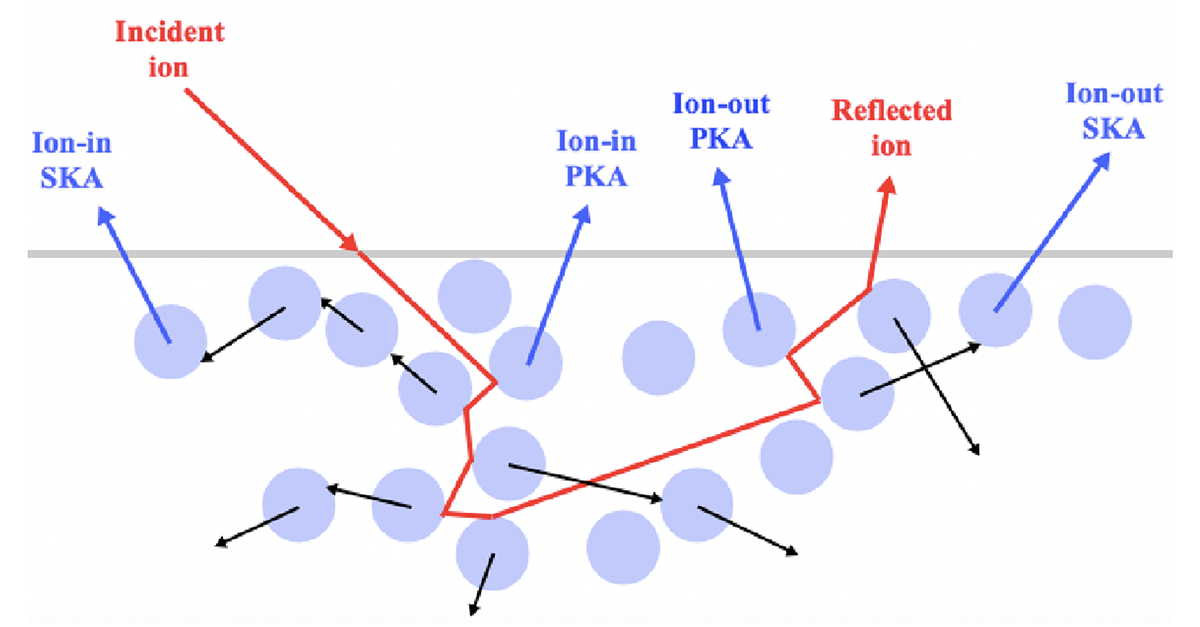
Fig. 1: An incident ion (red) impacts a target, collides with atoms within, and exits as a reflected ion, triggering four ejecta-types in the process (blue), from left to right: ion-in SKAs, ion-in PKAs, ion-out PKAs, and ion-out SKAs.
Methodology
To simulate sputtering, we utilized the software SDTrimSP which follows the binary collision approximation (BCA) model where sputtering occurs through a sequence of independent collisions within a material prior to the ejection of an atom [1,2]. While both electronic and collisional effects occur in the sputtering process, the latter dominate at energies below 100keV amu-1 and thus we consider collisional sputtering exclusively [2].
We selected 1 keV ionized Hydrogen (H+) and 4 keV ionized Helium (He++) to emulate the SW, while 20 keV ionized Krypton (Kr+) was employed given its prevalence in experimental studies. For the target surface, silica (SiO2) was selected given its prominence in both the lunar and Mercurian surfaces and recurrent usage in experiments [10–12]. We simulated ion incidence angles between 0° and 85° (measured from the surface normal) while ejecta were interpreted as a function of polar and azimuthal angles, ranging from 0° to 90° and 0° to 180°, respectively. The scenario is illustrated in Fig. 2.
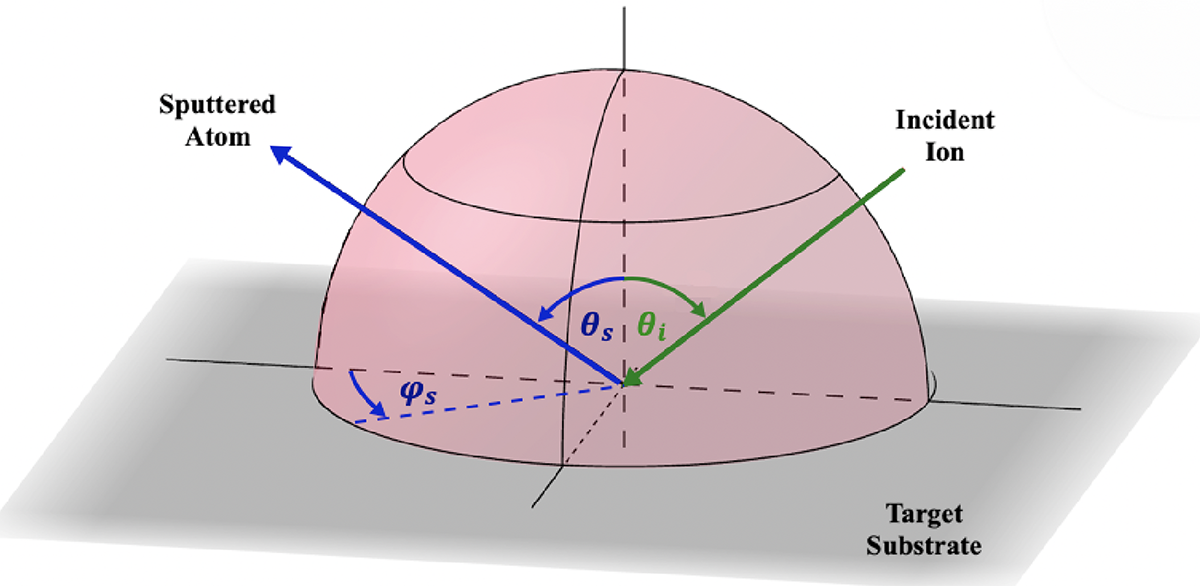
Fig. 2: An incident ion impacts a target substrate at an incidence angle, θi, sputtering an atom as a function of polar (θs) and azimuthal (φs) angles within the depicted quarter-sphere.
Results
Forward-backward anisotropy exists when a greater percentage of atoms are sputtered at azimuthal angles between 0° and 90° than 90° and 180°. While the azimuthal distribution of ejecta is isotropic at normal incidence, anisotropy emerges as the ion incidence angle is varied. Noticeable differences in anisotropies between ion cases arise as the ion’s incidence angle is made increasingly oblique, forward-backward anisotropy becoming most pronounced in the H+ case while developing more modestly in the He++ and Kr+ cases. Alternatively, to assess anisotropy in the polar distribution of ejecta we consider anisotropy occurring as a greater percentage of atoms are sputtered between 0° and 45° (“low” angles) than 45° and 90° (“high” angles). At normal incidence, low-angle anisotropy is prominent in all cases. With increasing incidence angle, the polar distribution of ejecta becomes more isotropic in the H+ case, slightly more anisotropic in the He++ case, while remaining relatively steady in the Kr+ case.
The divergence in the anisotropies witnessed in the H+ case from those occurring in the other two impactor cases considered can be explained by an interplay between the percentage contribution of specific ejecta-types and the extent to which they are forward and low-angle pronounced. On the one hand, the ejecta-types most readily sputtered forward and at high-angles are generally most prominent in the H+ case and on the other, individual ejecta-types in the H+ case typically have higher forward and lower low-angle sputtering percentages than those in the He++ and Kr+ cases.
Concluding Statement
The findings demonstrate that sputtering anisotropy varies significantly depending on the ion-target case considered. While anisotropies in the He++ and Kr+ cases are similar, there are clear differences in the case of H+ bombarding SiO2. Experimental cases using increased energies and masses are, therefore, likely underestimating the degree to which forward-backward anisotropy is present in SW-induced sputtering cases, while overestimating the extent of anisotropy in the polar distribution of ejecta. Accounting for these effects is essential when scaling experimental results to inform planetary sputtering.
How to cite: Clouter-Gergen, B., Morrissey, L., Bu, C., Mutzke, A., Verkercke, S., and Savin, D.: Solar Wind-Induced Sputtering: Investigating Anisotropy in the Angular Distribution of Ejecta using SDTrimSP, EPSC-DPS Joint Meeting 2025, Helsinki, Finland, 7–12 Sep 2025, EPSC-DPS2025-1193, https://doi.org/10.5194/epsc-dps2025-1193, 2025.


