TP8 | The Multi-Scale Physics of Surface-Bounded Exosphere and Surface Interactions

TP8

The Multi-Scale Physics of Surface-Bounded Exosphere and Surface Interactions
Conveners: Alexander Peschel, Sébastien Verkercke, Rozenn Robidel, Liam Morrissey, Menelaos Sarantos
Orals TUE-OB3
| Tue, 09 Sep, 11:00–12:30 (EEST)
 
Room Neptune (rooms 22+23)
Posters MON-POS
| Attendance Mon, 08 Sep, 18:00–19:30 (EEST) | Display Mon, 08 Sep, 08:30–19:30
 
Finlandia Hall foyer, F71–75
Tue, 11:00
Mon, 18:00
Understanding surface-exosphere coupling has direct implications for past and current planetary data sets, as well as planning and interpreting future exploration missions. This session explores the physics governing the interactions between surface-bounded exospheres and their planetary surfaces, spanning scales from atomistic processes to global dynamics. We welcome contributions from data analyses, laboratory experiments, and simulations aimed at enhancing or integrating our understanding of these interactions. Topics of interest include the physical chemistry of surface–volatile exchange and key drivers such as the plasma environment, micrometeoroid bombardment, and related processes—including space weathering, irradiation, and volatile implantation. We encourage studies that bridge multiple processes or dimensional scales, with a particular emphasis on the bidirectional coupling between surfaces and exospheres, where surface properties influence exospheric behaviour and exospheric processes, in turn, affect surface evolution. We also invite comparative investigations across different planetary bodies (including the Moon, Mercury, and icy moons) to refine the physical description of exosphere–surface interactions. Ultimately, we aim to foster a comprehensive, multi-scale understanding of the physics shaping these environments. The insights gained from this session could have significant implications for planetary science and exploration.

Key Themes:
• Atomistic Modeling: Utilizing atomistic approaches to provide insights and possible validations for larger-scale processes.
• Parameter Identification: Determining key parameters for surface-bounded exospheres and surface interactions at varying scales will inform further atomistic research and guide observational and laboratory experiments.
• Surface–Exosphere Linkages: Explaining the connections between surface-bounded exospheres and their respective surfaces, including compositional and topographic effects.
• Comparative Investigations: Encouraging comparative studies across different planetary bodies (including icy moons) to enhance our knowledge of underlying processes.

By addressing these key themes, the session explicitly links micro-scale processes to macro-scale dynamics, thereby bridging scales and enriching our integrated understanding of exosphere–surface interactions. We particularly encourage early career scientists to submit an abstract for an oral presentation.

Session assets

Orals: Tue, 9 Sep, 11:00–12:30 | Room Neptune (rooms 22+23)

Chairpersons: Rozenn Robidel, Liam Morrissey
11:00–11:03
11:03–11:15
|
EPSC-DPS2025-614
|
ECP
|
On-site presentation
Nicol Latsia, Georgios Tsirvoulis, Erika Kaufmann, David Haack, Mikael Granvik, and Axel Hagermann

Introduction

Mercury’s surface undergoes extreme diurnal and annual temperature variations driven by high-intensity insolation,  radiative loss due to its lack of atmosphere, its spin-orbit resonance, and eccentric orbit. These thermal variations have proven important for the regolith production [1], caused by thermal cracking on atmosphereless planetary bodies. In this study, we aim to examine the solar radiation effects on Mercury’s surface regolith.


Measurements

We simulate the power density of the solar radiation impinging on a planetary surface at Mercury’s perihelion distance of 0.31 au using the Space and High-Irradiance Near-Sun Simulator (SHINeS) [2] at Luleå University of Technology to study the spectral response of terrestrial analogue materials. The analogues used include basalt, gabbro, andesite, anorthosite, diorite, and boninite, and they were selected for their close geochemical properties to Mercury’s surface. Notably, boninite is currently considered one of the closest terrestrial hermean analogues. The samples were ground and sieved to <75 μm to simulate the fine-grain regolith of Mercury [3]. The reflectance spectra in the visible to near-infrared (VIS/NIR) range (0.44 - 2.5 μm) were acquired pre- and post-irradiation to evaluate spectral changes.


Results

The experimental results (Figure 1) show a decrease in reflectance in all samples across the VIS and NIR spectra, except gabbro, which increases brightness in the NIR above 1470 nm. Darkening and reddening were more pronounced in samples with higher Fe content, such as boninite and basalt, while gabbro, despite its moderate Fe content, remained spectrally stable. We attribute this discrepancy to the dependence of solar radiation absorption on the samples’ albedo. The less reflective samples absorb more energy.

Figure 1: The reflectance spectra in the visible and near-infrared regions for the six samples  - basalt (BAS), andesite (AND), anorthosite (ANO), boninite (BON), diorite (DIO), and gabbro (GAB) – before (blue line) and after (red line) irradiation at 1.40 W/cm2. Most samples exhibit a reduction in brightness in the VIS and NIR  spectra. Gabbro presents an increase of brightness in the NIR above 1470 nm. In the NIR, boninite shows a significant drop in brightness along with changes in its absorption band depths [Latsia et al. 2025, in review].

References

[1] Molaro J. and Byrne, S. 2012. Rates of temperature change of airless landscapes and implications for thermal stress weathering. Journal of Geophysical Research: Planets, 117(E10).

[2] Tsirvoulis, G., Granvik, M. and Toliou, A., 2022. SHINeS: Space and High-Irradiance Near-Sun Simulator. Planetary and Space Science, 217, p.105490.

[3] Domingue, D.L., Chapman, C.R., Killen, R.M., Zurbuchen, T.H., Gilbert, J.A., Sarantos, M., Benna, M., Slavin, J.A., Schriver, D., Trávníček, P.M. and Orlando, T.M., 2014. Mercury’s weather-beaten surface: Understanding Mercury in the context of lunar and asteroidal space weathering studies. Space Science Reviews, 181, pp.121-214.

[4] Hunt, G.R. and Ashley, R.P., 1979. Spectra of altered rocks in the visible and near infrared. Economic Geology, 74(7), pp.1613-1629.

[5] Maturilli, A., Helbert, J., John, J.M.S., Head III, J.W., Vaughan, W.M., D'Amore, M., Gottschalk, M. and Ferrari, S., 2014. Komatiites as Mercury surface analogues: Spectral measurements at PEL. Earth and Planetary Science Letters, 398, pp.58-65


How to cite: Latsia, N., Tsirvoulis, G., Kaufmann, E., Haack, D., Granvik, M., and Hagermann, A.: Experimental investigation of solar radiation effects on Mercury’s surface regolith, EPSC-DPS Joint Meeting 2025, Helsinki, Finland, 7–13 Sep 2025, EPSC-DPS2025-614, https://doi.org/10.5194/epsc-dps2025-614, 2025.

11:15–11:27
|
EPSC-DPS2025-102
|
ECP
|
On-site presentation
Sebastien Verkercke, François Leblanc, Jean-Yves Chaufray, Michael S. Phillips, Giovanni Munaretto, Emma Caminiti, and Liam Morrissey

Mercury’s surface that interacts directly with solar particles and micro-meteoroids, resulting in a surface-bound exosphere composed of planetary atoms (Leblanc & Johnson 2003, Berezhnoy & Klumov 2008). Various elements, such as Na, K, Ca, and Mg, have been detected on Mercury's surface and in its exosphere (McClintock et al. 2018). However, while sulfur has been identified on Mercury's surface (Nittler et al. 2020), it has not been observed in the exosphere (Leblanc et al. 2023). Despite this, numerous studies predict that sulfur, like other volatiles, should be released through micro-meteoroid impact vaporization and photon-stimulated desorption (Sprague et al. 1995, Berezhnoy & Klumov 2008, Schaible et al. 2020). Mercury's surface can reach temperatures up to ~700 K on the dayside, allowing atoms to thermally desorb from the surface. The temperature gradient in Mercury's porous regolith should promote Knudsen diffusion in the subsurface. Repeated adsorption and desorption could lead to the migration of volatiles within the regolith, creating a long-term reservoir (Verkercke et al. 2024).

Recent research suggests that geological formations known as hollows, primarily observed in craters, might be formed by the local accumulation of subsurface sulfur (Phillips et al. 2021, Barraud et al. 2023). These features could be maintained by the migration of atomic sulfur in the exosphere and/or diffusion processes in the subsurface. In fact, subsurface volatile reservoirs have been proposed to explain the origin of certain geological features. Calcium sulfide has been suggested as a candidate to account for the presence of low-reflectance material, including hollows (Barraud et al. 2023). The correlation of these features with impact craters indicates that the volatiles forming these structures are buried and require impacts to be exposed (Thomas et al. 2014, Blewett et al. 2016, Phillips et al. 2021).

The variability of sulfur in Mercury's exosphere and subsurface was recently examined using an exospheric global model (EGM) (Verkercke et al. 2025). This model uses a Monte-Carlo approach to predict the ejection of surface atoms (Leblanc & Johnson 2010) through four processes: photon-stimulated desorption (PSD), solar wind sputtering (SWS), micro-meteoroid impact vaporization (MMIV), and thermal-stimulated desorption (TSD). Verkercke et al. (2025) predicted that sulfur primarily accumulates at the cold poles, which are a result of Mercury's 3:2 spin-orbit rotation, particularly in areas with high calcium surface abundance. However, this study did not correlate the total sulfur quantity in Mercury's regolith with hollows. Since the material forming hollows is believed to be buried in the subsurface, this study focuses on the volatiles accumulated in the regolith and shielded from ejection processes. Using a 3-D EGM with the same assumptions as Verkercke et al. (2025), this work aims to analyze the amount of sulfur as a function of depth in the regolith and compare the spatial distribution of the sulfur reservoir with the hollows' spatial distribution reported by Thomas et al. (2014) and Blewett et al. (2016). Additionally, a similar analysis is conducted for sodium on Mercury to compare the reservoir formation processes between the two volatile species. Our results indicate a similar spatial distribution of the sulfur reservoir and hollows, with no such correlation found for sodium, emphasizing the role of hot and cold longitudes in the formation of these reservoirs.

References


Barraud, O., Besse, S., & Doressoundiram, A. (2023). Low sulfide concentration in Mercury’s smooth plains inhibits hollows. Science Advances, 9(12), eadd6452.

Berezhnoy, A. A., & Klumov, B. A. (2008). Impacts as sources of the exosphere on Mercury. Icarus, 195(2), 511-522.

Blewett, D. T., Stadermann, A. C., Susorney, H. C., Ernst, C. M., Xiao, Z., Chabot, N. L., ... & Solomon, S. C. (2016). Analysis of MESSENGER high‐resolution images of Mercury's hollows and implications for hollow formation. Journal of Geophysical Research: Planets, 121(9), 1798-1813.

Leblanc F., Johnson R.E., (2010), Mercury exosphere I. Global circulation model of its sodium component, Icarus, Volume 209, Issue 2, Pages 280-300, ISSN 0019-1035, https://doi.org/10.1016/j.icarus.2010.04.020.

Leblanc, F., Sarantos, M., Domingue, D., Milillo, A., Savin, D. W., Prem, P., ... & Raines, J. (2023). How Does the Thermal Environment Affect the Exosphere/Surface Interface at Mercury?. The Planetary Science Journal, 4(12), 227.

McClintock, W. E., Cassidy, T. A., Merkel, A. W., Killen, R. M., Burger, M. H., & Vervack Jr, R. J. (2018). Observations of Mercury's Exosphere: Composition and Structure: Chapter-14 (No. GSFC-E-DAA-TN66712). Cambridge University Press.

Nittler, L. R., Frank, E. A., Weider, S. Z., Crapster-Pregont, E., Vorburger, A., Starr, R. D., & Solomon, S. C. (2020). Global major-element maps of Mercury from four years of MESSENGER X-Ray Spectrometer observations. Icarus, 345, 113716.

Phillips, M. S., Moersch, J. E., Viviano, C. E., & Emery, J. P. (2021). The lifecycle of hollows on Mercury: An evaluation of candidate volatile phases and a novel model of formation. Icarus, 359, 114306. https://doi.org/10.1016/j.icarus.2021.114306

Schaible, Micah J., et al. "Photon‐stimulated desorption of MgS as a potential source of sulfur in Mercury's exosphere." Journal of Geophysical Research: Planets 125.8 (2020): e2020JE006479.

Sprague, Ann L., Donald M. Hunten, and Katharina Lodders. "Sulfur at Mercury, elemental at the poles and sulfides in the regolith." Icarus 118.1 (1995): 211-215.

Thomas, R. J., Rothery, D. A., Conway, S. J., & Anand, M. (2014). Hollows on Mercury: Materials and mechanisms involved in their formation. Icarus, 229, 221-235.

Verkercke, S., Leblanc, F., Chaufray, J. Y., Morrissey, L., Sarantos, M., & Prem, P. (2024). Sodium enrichment of Mercury's subsurface through diffusion. Geophysical Research Letters, 51(21), e2024GL109393.

Verkercke, S., Chaufray, J-Y., Leblanc, F., Georgiou, A. P., Phillips, M. S., Munaretto, G.,Lewis , J., Ricketts, A., and Morrissey, L. (2025) A Novel Theoretical Approach to Predict the Inter-Annual Variability of Sulfur in Mercury's Exosphere and Subsurface. Frontiers in Astronomy and Space Sciences

How to cite: Verkercke, S., Leblanc, F., Chaufray, J.-Y., Phillips, M. S., Munaretto, G., Caminiti, E., and Morrissey, L.: Mercury’s Hollows : A Potential Signature of the Sulfur Exosphere-Subsurface Transport, EPSC-DPS Joint Meeting 2025, Helsinki, Finland, 7–13 Sep 2025, EPSC-DPS2025-102, https://doi.org/10.5194/epsc-dps2025-102, 2025.

11:27–11:39
|
EPSC-DPS2025-1213
|
ECP
|
On-site presentation
Anastasis Georgiou, Benjamin Alan Clouter-Gergen, Kai Nordlund, Flyura Djurabekova, Eduardo M. Bringa, and Liam S. Morrissey

Introduction

Sputtering of surfaces by ion irradiation is an important process in planetary science, influencing the exospheric composition and surface evolution of airless bodies such as the Moon, Mercury, icy bodies, and asteroids. Such bodies without a significant atmosphere or intrinsic magnetic field are directly impacted by solar wind (SW) ions originating from the Sun’s corona and consisting of approximately 95% protons (H+), 4% alpha particles (He++) and 1% minor ions. These impacts can cause atoms from the surface of the airless body to be ejected into its exosphere, influencing its formation and composition. For example, sodium (Na) abundance in Mercury’s exosphere has been correlated to SW activity and magnetic field dynamics [1].

Binary collision approximation (BCA) models have been used to model sputtering of regolith grains like those found on the surface of the Moon and Mercury [2–4]. While BCA models can be used to understand the implantation and ejecta characteristics, they require key user-specified inputs such as surface binding energy (SBE) which can be derived through molecular dynamics (MD) simulations [5]. In addition, BCA models can only simulate single atom ejections without taking into account molecules that can be ejected while also being unable to simulate the complex bond breakage and formation occurring during energetic impacts.

Despite being more computationally expensive, MD simulations can provide an alternative method of simulating the entire sputtering process of surfaces by SW ions. While MD sputtering simulations of planetary surface silicates are not well studied, previous research has used MD to study the ejection of atoms and molecules from icy surfaces [6] by energetic ion impacts. In addition, Huang et al. used MD simulations with a reactive force field (ReaxFF), which allows for bond breakage and formation, to study the implantation of SW hydrogen on the Moon.

Methodology

In this study, we use MD with a ReaxFF potential to simulate the sputtering process of energetic SW ions impacting an amorphous albite substrate. We impact the albite surface with 1 keV hydrogen and 4 keV helium (similar to SW conditions) at an angle normal to the substrate surface. The simulation includes both cumulative and non-cumulative bombardment. During cumulative impacts, the surface is continuously bombarded by ions over time, whereas in non-cumulative impacts, the surface resets to its initial state before being bombarded again with a hydrogen ion. After each impact for both cases, we sample the system for any ejected atoms or molecules and record their energy, velocity and ejection angle. We then compare our MD simulations to similar BCA models and available experimental data.

Results

Initial results show the ability of MD simulations to better understand SW sputtering on mineral substrates, potentially removing the need for complex calculations of SBEs and the errors introduced by BCA modelling. These preliminary results show a complex distribution of the sputtering yield, dominated by O atoms. From these initial 50 H and He impacts, no molecules were ejected from the substrate. In addition, we observe an initial sputtering yield of 0.14 for H ions and 0.32 for He ions, a behaviour that is expected due to the higher energy of the He ions. In both incident ion cases, more than 50% of the sputtering yield is O atoms. This agrees well with MD simulations of O SBEs that suggest that O can be weakly bound to the surface. Building on these results, we will use cluster computing resources to significantly increase statistics by simulating thousands of impacts (both static and dynamic) and better capture the sputtering yield, sputter energy, angle and ion backscatter. This will allow us to evaluate preferential sputtering and how the energy distribution (and thus the SBE) can potentially vary as weathering via SW progresses. We will then compare these findings to predictions from BCA modelling, highlighting the significance of molecular interactions and surface change in the sputtering process. Furthermore, we anticipate that the data will reveal insights into the role of surface roughness and defect structures on the ejection dynamics of atoms from the amorphous albite surface. In addition, unlike BCA models MD can identify any molecules that may sputter from the silicate surface. Finally, further simulations will aim to study the sputtering process of adsorbed sodium on amorphous albite as BCA models can only model adsorbed species as changes in the concentration and not as chemically adsorbed species.

References

[1]      R.M. Killen, M. Sarantos, A.E. Potter, P. Reiff, Icarus 171 (2004) 1–19.

[2]      N. Jäggi, A. Mutzke, H. Biber, J. Brötzner, P.S. Szabo, F. Aumayr, P. Wurz, A. Galli, Planet Sci J 4 (2023) 86.

[3]      P.S. Szabo, R. Chiba, H. Biber, R. Stadlmayr, B.M. Berger, D. Mayer, A. Mutzke, M. Doppler, M. Sauer, J. Appenroth, J. Fleig, A. Foelske-Schmitz, H. Hutter, K. Mezger, H. Lammer, A. Galli, P. Wurz, F. Aumayr, Icarus 314 (2018) 98–105.

[4]      L.S. Morrissey, M.J. Schaible, O.J. Tucker, P.S. Szabo, G. Bacon, R.M. Killen, D.W. Savin, Planet Sci J 4 (2023) 67.

[5]      L.S. Morrissey, O.J. Tucker, R.M. Killen, S. Nakhla, D.W. Savin, Astrophys J Lett 925 (2022) L6.

[6]      C. Anders, H.M. Urbassek, 482 (2019) 2374–2388.


How to cite: Georgiou, A., Clouter-Gergen, B. A., Nordlund, K., Djurabekova, F., Bringa, E. M., and Morrissey, L. S.: Atomic-scale simulations of solar wind sputtering of airless bodies by solar wind ions, EPSC-DPS Joint Meeting 2025, Helsinki, Finland, 7–13 Sep 2025, EPSC-DPS2025-1213, https://doi.org/10.5194/epsc-dps2025-1213, 2025.

11:39–11:51
|
EPSC-DPS2025-118
|
ECP
|
On-site presentation
Amanda Ricketts, Anastasis Georgiou, Deborah Berhanu, Denton Ebel, Francois Leblanc, Menelaos Sarantos, Sebastien Verkercke, and Liam Morrissey

Introduction: The surfaces of airless, planetary bodies like the Moon and Mercury are constantly exposed to several processes that eject atoms into the exosphere1,2. While the composition and densities of these exospheres are known based on observational data from exploratory missions3, the source of each component is not well understood. This uncertainty necessitates better constraints for accurately interpreting the observed exospheric data. While complex laboratory studies drive reliance on theoretical models to study these exosphere-surface interactions.

Molecular dynamics (MD) simulations rely on interatomic potentials to model interactions at the atomic level without requiring user-provided inputs. However, their high computational load restricts the size and timescale of simulations. As an alternative, MD can be employed to determine critical mineral-specific parameters, such as the surface binding energy (SBE), that can then serve as inputs for large-scale ejection models.

This methodology has been used to study mineral-specific SBEs of both crystalline and amorphous surfaces4,5. More recently, we also considered the effect of adsorbates (i.e., atoms that eject below the escape energy and return to the surface) on SBE and subsequent emission processes for crystalline and amorphous surfaces6. However, the surfaces of these planetary bodies are much more complex than has been considered in these studies. For example, space weathering causes transient or localized hydroxylation of surface minerals via solar wind proton interactions7, as well as dynamic oxygen depletion due to preferential sputtering8. No study has considered how these different structures will affect the SBE and subsequent predicted exospheres. Without considering these complexities the MD derived SBEs are limited in their application to exosphere modelers.

Methodology: This study evaluates the adsorption of Na onto hydroxylated and oxygen depleted SiO2, albite, and anorthite, determining SBE distributions using MD simulations.

Results:  Figure 1 displays the SBE distributions of adsorbed Na on 100% hydroxylated and clean (i.e., non-hydroxylated) SiO2, albite, and anorthite surfaces.

Figure 1. SBE distributions of adsorbed Na on the hydroxylated surfaces of SiO2, albite, and anorthite. The whole lines represent the hydroxylated SBE distributions of each surface, and the dashed lines represent the clean surface (i.e.,  non-hydroxylated) SBE distributions.

First, it is evident that the hydroxylation of SiO2, albite, and anorthite surfaces results in a distinct shift of SBE distributions and significantly reduces the average SBEs of adsorbed Na. The average SBE of Na adsorbed onto a clean SiO2 surface is 5.7 eV, while the average SBE of Na adsorbed onto a hydroxylated SiO2 surface is 2.8 eV. We attribute these findings to the unique bond types and interactions formed in each case.

In the clean surface models, it is expected that adsorbed Na atoms form ionic bonds with the surface oxygen atoms which have a high bond strength. In the hydroxylated surface models, the surface oxygen atoms are already bonded to hydrogen, reducing its availability for interactions with the adsorbed Na. Instead, Na may be interacting via hydrogen bonding or weak van der Waals interactions with -OH groups, resulting in lower SBEs. These findings align with previous relevant literature9,10, however future experimental work is required for validation.

In summary, the localized hydroxylation of surface minerals on the Moon and Mercury suggests that lower energy sites are available for adsorbates, making ejection processes of these atoms significantly more efficient.  It is therefore paramount to understand the extent of localized hydroxylation on the surface of airless bodies in order to then quantify the contributions of different sources into the exosphere. Next, surface oxygen depletion of these surfaces will be investigated. The development of a database of SBEs that capture the complexities of surfaces on airless planetary bodies is crucial for connecting source processes to atomic species and achieving a complete understanding of the surface-exosphere connection.

References:

1. Killen, R.M., et al. (1999)

2. Wurz, P., et al. (2022)

3. McClintock, et al. (2018)

4. Morrissey, L., et al. (2022)

5. Morrissey, L., et al. (2024a)

6. Morrissey, L., et al. (2024b)

7. Yeo, L.H., et al. (2024)

8. Killen, R.M., et al. (2007)

9. Wang, X. (2023)

10. Wang, G., et al. (2020)

How to cite: Ricketts, A., Georgiou, A., Berhanu, D., Ebel, D., Leblanc, F., Sarantos, M., Verkercke, S., and Morrissey, L.: Uncovering the Role of Hydroxylation and Oxygen Depletion on the Surface Binding Energy of Adsorbates: A Molecular Dynamics Study, EPSC-DPS Joint Meeting 2025, Helsinki, Finland, 7–13 Sep 2025, EPSC-DPS2025-118, https://doi.org/10.5194/epsc-dps2025-118, 2025.

11:51–12:06
|
EPSC-DPS2025-1133
|
ECP
|
On-site presentation
Kris Laferriere and Ali Bramson

The presence of OH/H2O on the lunar surface has been known since 2009 through observations of the 3-micrometer absorption feature diagnostic of OH and/or H2O [1, 2, 3].  This hydration signature has been observed to vary across a lunar day, with similar signatures in the morning and evening, and the lowest abundance observed at local noon [4, 5]. Evidence for diurnal variability suggests that a component of the hydration strength is mobile, migrating in response to temperature variations of the surface. It has been proposed that localized, temporary shadows can provide refuge for these adsorbed particles into the daytime, due to surface roughness and topography [6]. The dependence of variability in band strength on illumination has been poorly explored. 

Previous modeling work [7] predict a much higher H2O abundance (3 ×10⁵ molecules/cm3) than the ~0.6 molecules/cm3 measured by the neutral mass spectrometer (NMS) aboard the Lunar Atmosphere and Dust Environment Explorer (LADEE) as presented in [8]. However, Laferriere et al. (2025) [9] found that in accounting for the desorption from a rough surface, the fraction of the 3 μm absorption that is variable on diurnal timescale, the number of particles observable (reaching >20 km over the equatorial region on the dayside), and the fraction of molecules that are H2O separate from OH, modeled exospheric abundances consistent with surface hydration are within an order of magnitude of the LADEE exospheric observations. However, consistent with that found previously with other similar models [10], [9] were not able to replicate the observed symmetry in diurnal variability. This is expected, as these modeling approaches do not account for an ongoing source mechanism at the lunar surface due to the solar wind. Combining our results of loss rates with the solar wind proton flux [11] and the predicted H ion to OH conversion rate [12] yields an OH production rate of 28–93 molecules/cm2/s that would be needed to reach equilibrium.

Thus, it is necessary to better constrain sourcing mechanism(s) to understand the diurnal behavior of hydration on the lunar surface. Previous observations of the 3 µm hydration feature are complicated by the lack of successful instrumentation designed specifically to study this feature. While the Moon Mineralogy Mapper (M3) aboard Chandrayaan-1 provides high spatial resolution, the spectrometer’s range ends at 3 µm which limits analysis of the OH/H2O feature in detail and also makes thermal emission removal difficult. This has led to disagreements over interpretations of 3 μm band strength, ranging from no variability [13] to variability with temperature, latitude, and time of day [14, 15, 16]. The spectrometers used in [2, 3, 5] were limited in spatial scale (>30 km/pixel) when they observed during lunar flybys.

Chandrayaan-2’s Imaging Infrared Spectrometer (IIRS) observations present a new opportunity to study the variability of lunar hydration due to its spectral range from 0.9–5.3 μm and a spatial resolution ~80 m. Here, we explore the IIRS data to constrain the diurnal variability of hydration. As the level-1 (calibrated) data provided by ISRO has a correction applied which minimizes the 3 µm hydration feature we do not use this dataset for our analysis (Figure 1). This instrument is still relatively new, and does not have extensive calibration pipelines published compared to those produced for M3 [17], so we first produced our own calibration of the level-0 data (raw minus dark data).

We first apply a linearization (provided by ISRO) to account for the non-uniformity of the detector. Then, we convert the data from digital number to radiance. We exclude any pixels within our bad pixel map, which was determined by searching through the spectra by hand and includes the regions of the order sorting filters (Figure 2). We do not attempt to apply a radiance adjustment for the OSF regions or the edges of the spectrometer and instead choose to exclude these regions from our analysis. We use a resistant mean to smooth the spectral data. We apply a modified version of the methodology from [5] to remove thermal emission beyond ~3 µm, allowing us to determine the temperature per pixel. The two observations that we focus on here are of the same surface of the Moon at two local times of day (morning and evening, Figure 3), taken ~1.5 months (~1.5 lunar days) apart.

We also measured the 2 µm pyroxene absorption band to ensure that the abundance does not appear to evolve between the two observations. This would suggest that the optical geometry strongly affects the observations and thus the 3 µm variability would not be trustworthy. We find that the 3 µm feature is ubiquitous, with lower abundances in the morning (~2 hours after the morning terminator) than the evening (1 hour prior to evening terminator), as found previously.


References

[1] Clark (2009), Science, 326, 5952. [2] Pieters et al., (2009), Science, 326, 5952. [3] Sunshine et al., (2009), Science, 326, 5952.[4] Hendrix et al., (2019), GRL, 46, 5. [5] Laferriere et al., (2022), JGR: Planets, 127, 8. [6] Davidsson & Hosseini, (2021), MNRAS, 506, 3. [7] Smolka et al., (2023), Icarus, 397. [8] Benna et al., (2019), Nature Geoscience, 12, 5. [9] Laferriere et al., (2025), JGR: Planets, 130, 4. [10] Schorghofer (2014), GRL, 41, 14. [11] Zeller & Ronco., (1967), Icarus, 7, 1-3. [12] McLain et al., (2021), JGR: Planets, 126, 5. [13] Bandfield et al., (2018), Nature Geoscience, 11, 3. [14] Li & Milliken, (2017), Science Advances, 3, 9. [15] Grumpe et al., (2019), Icarus, 321. [16] Wohler et al., (2017), Science Advances, 3, 9. [17] Green et al. (2011), JGR: Planets, 116, E10.


This work is funded by a NASA LDAP under grant number 80NSSC23K1336. We acknowledge the use of data from the Chandrayaan-II, second lunar mission of the Indian Space Research Organization (ISRO), archived at the Indian Space Science Data Centre (ISSDC).

Figure 1: Radiance for Level-1 and our recalibrated data revealing difference around 3 µm feature.

Figure 2: Bad pixel map for the spectrometer.


Figure 3: Two observations covering the same surface, observed under different lighting conditions.


How to cite: Laferriere, K. and Bramson, A.: Ballistic transport and solar wind hydroxylation as the mechanisms for diurnal variability of hydration signatures on the Moon, EPSC-DPS Joint Meeting 2025, Helsinki, Finland, 7–13 Sep 2025, EPSC-DPS2025-1133, https://doi.org/10.5194/epsc-dps2025-1133, 2025.

12:06–12:18
|
EPSC-DPS2025-83
|
ECP
|
On-site presentation
Conor Hayes and John Moores

Introduction

It is now generally accepted that water and other volatiles exist on the Moon [1, 2], though their distribution and abundance are still poorly-constrained. Much work has been put into understanding how lunar volatiles are transported from their delivery sites to the polar cold traps where they have been detected. These models can generally be divided into two regimes: collisional transport through a transient post-impact atmosphere [3] and ballistic transport through a non-collisional surface-bounded exosphere [e.g. 4, 5, 6]. Transient atmospheres allow for rapid but episodic delivery of volatiles to cold traps, while ballistic transport permits a much slower but potentially continuous delivery.

Given the exponential dependence of the residence time on temperature, there has been significant focus on characterizing the Moon’s thermal environment, particularly at scales below the resolution of existing orbital datasets [e.g. 3, 7]. However, comparatively little attention has been dedicated to another key parameter: the desorption activation energy. The activation energy (Ea) is as significant to a molecule’s time adsorbed to the surface as the temperature is, with larger values leading to longer residence times:

Most ballistic transport models use a single value for the activation energy. This is a problematic assumption for several reasons. Temperature-programmed desorption (TPD) measurements of water desorption from Apollo samples have indicated that a single surface can have a broad range of activation energies [8, 9]. Additionally, the lunar surface does not have a uniform composition, with the most significant compositional dichotomy occurring between the maria and the highlands [10]. There is no reason to assume that these different surfaces would have the same (or even similar) activation energies. This allows for the potential of a positional dependence on the ability of water and other species to desorb from the surface, which may challenge the idea that ballistic transport results in a more-or-less uniform delivery to all cold traps.

Furthermore, the specific value (or range of values) of the activation energy is not well-understood, particularly for non-water volatiles. The applicability of a frequently-cited value of 0.415 eV for water is questionable, as this value was derived for water molecules sublimating from a water-ice substrate [11]. Except for limited areas within the polar cold traps, this is unlikely to be representative of real-world conditions. Even a small (~10%) increase in the activation energy has the potential to measurably affect transport behaviour, particularly when small-scale surface roughness is considered due to the greater dependence of residence time on temperature for larger activation energies [3].

Our goal is to highlight the importance of developing a more comprehensive understanding of activation energies for lunar volatiles, whether through experimental work (e.g. TPD) or models (e.g. molecular dynamics).

Methods

We use a standard ballistic transport model adapted from the one presented in Kloos et al. [6]. Molecules desorb from the surface in a random direction with a speed chosen from the Maxwell-Boltzmann distribution for the residence site’s surface temperature. For simplicity, we do not include the effects of small-scale roughness. Molecules hop across the surface until they land in a cold trap or are photolyzed. The activation energy is modeled both as a single value and as a distribution of values, following the form laid out by Schöghofer [12].

Results

An overview of the relationship between surface temperature, desorption activation energy, and surface residence time is presented in Figure 1. As the activation energy increases, so does the temperature at which the residence time is a significant fraction of a lunar day. This effect is more pronounced at lower temperatures, suggesting that transport near the lunar poles may be particularly affected by the choice of activation energy, particularly given the seasonally-shadowed regions that create complex and time-variable areas of sustained low temperatures [6].

We plan to present results examining a wide range of parameter space, including uniform and non-uniform surface compositions and the relative importance of single-value activation energies versus a broad distribution of energies.

Figure 1. The interrelated effects of desorption activation energy and surface temperature on the surface residence time for water molecules. The horizontal dotted line in each panel represents a residence time of half a lunar day. The vertical dotted line in the left panel indicates the typical maximum temperature of the Moon’s permanently-shadowed regions.

References

[1] Colaprete, A., et al. (2010). Detection of water in the LCROSS impact plume. Science, 330(6003):463–468.

[2] Li, S., et al. (2018). Direct evidence of surface exposed water ice in the lunar polar regions. Proceedings of the National Academy of Science, 115(36): 8907–8912.

[3] Prem, P., et al. (2018). The influence of surface roughness on volatile transport on the Moon. Icarus, 299:31–45.

[4] Schörghofer, N. (2014). Migration calculations for water in the exosphere of the Moon: Dusk-dawn asymmetry, heterogeneous trapping, and D/H fractionation. Geophysical Research Letters, 41(14):4888–4893.

[5] Moores, J. E. (2016). Lunar water migration in the interval between large impacts: Heterogeneous delivery to Permanently Shadowed Regions, fractionation, and diffusive barriers. Journal of Geophysical Research: Planets, 121(1):46–60.

[6] Kloos, J. L., et al. (2021). Illumination conditions within permanently shadowed regions at the lunar poles: Implications for in-situ passive remote sensing. Acta Astronautica, 178:432–451.

[7] Hayes, C. W., et al. (2024). Topography-enhanced ultra-cold trapping at the LCROSS impact site. Journal of Geophysical Research: Planets, 129(7):e2023JE007925.

[8] Poston, M. J., et al. (2015). Temperature programmed desorption studies of water interactions with Apollo lunar samples 12001 and 72501. Icarus, 255:24–29.

[9] Jones, B. M., et al. (2020). Investigation of water interactions with Apollo lunar regolith grains. Journal of Geophysical Research: Planets, 125(6):e06147.

[10] Yang, C., et al. (2023). Comprehensive mapping of lunar surface chemistry by adding Chang'e-5 samples with deep learning. Nature Communications, 14:7554.

[11] Sandford, S. A. & Allamandola, L. J. (1988). The condensation and vaporization behavior of H2O: CO ices and implications for interstellar grains and cometary activity. Icarus, 76(2):201–224.

[12] Schörghofer, N. (2023). Adsorption kinetics of water and argon on lunar grains. The Planetary Science Journal, 4(9):164.

How to cite: Hayes, C. and Moores, J.: Characterizing the Importance of Desorption Activation Energies on Delivery Rates of Volatiles to the Lunar Cold Traps, EPSC-DPS Joint Meeting 2025, Helsinki, Finland, 7–13 Sep 2025, EPSC-DPS2025-83, https://doi.org/10.5194/epsc-dps2025-83, 2025.

12:18–12:30
|
EPSC-DPS2025-451
|
ECP
|
On-site presentation
Alexander Peschel, Cesare Grava, Jakob Breternitz, and Philipp Reiss

Introduction.

Traditionally, models of surface-bounded exospheres assumed a perfectly spherical planetary surface. Neglecting the surface roughness and topography simplifies the surface-exosphere interaction and reduces the computational complexity and effort. One of the consequences of this simplification can be seen in the surface temperatures, which are often included as a simple analytical formula based solely on the subsolar location, or as a look-up function based on remote sensing data (e.g., Butler, 1997; Crider an Vondrak, 2002; Killen et al., 2019). These approaches do not account for the surface variability and local shadowing, which causes colder surfaces and hotter slopes tilted towards the Sun.

Recent studies have begun to address surface roughness in exosphere modelling: Prem et al. (2018) introduced small‐scale shadows through Gaussian roughness in water‐exosphere simulations, finding enhanced water retention; Grava (2023) used altitudes from LOLA and temperature snapshots from Diviner to find that topography and its resulting change in surface temperatures plays an important role for the exosphere; Laferriere et al. (2025) investigated sloped temperature distributions for OH/H₂O, reporting locally colder surfaces and higher adsorbed concentrations. Though, their low particle counts highlighted a need for more numerically efficient approaches. In this work, we present a new and efficient approach to including relevant surface slopes in a lunar exosphere Monte Carlo simulation to model noble-gas particle density distributions and investigate the effects of slopes. This study aims to quantify how realistic slope distributions based on the LOLA dataset influence noble gas distributions in the lunar exosphere.


Methods.

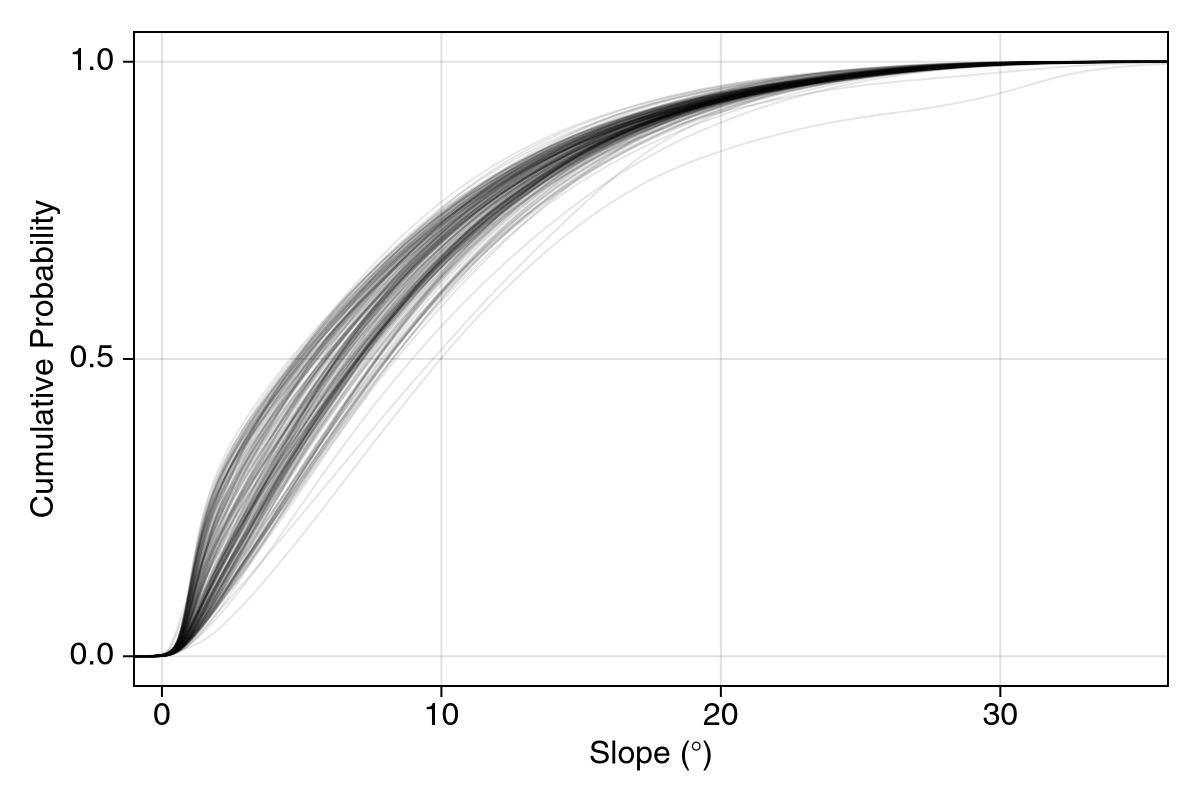
High‐resolution LOLA topography (512 px/°) was processed into cumulative density functions (CDFs) of slopes for 1°x360° latitude strips, depicted in Figure 1. Each line in this plot represents the CDF of a single strip, showing that topographic slope distributions on meter scales across the entire Moon’s surface are relatively similar, with only some exceptions close to the poles. In our model, a new slope is drawn from the CDF at the corresponding latitudinal position at every surface interaction, including topography purely probabilistically and, thus, more efficiently.

Figure 1. Cumulative distribution functions of surface slopes from 1°x360° latitude strips on the Moon, based on the LOLA dataset. Each line represents one strip, with more than 90 % of slopes falling below 20°. The maximum observed slope approaches 80°.

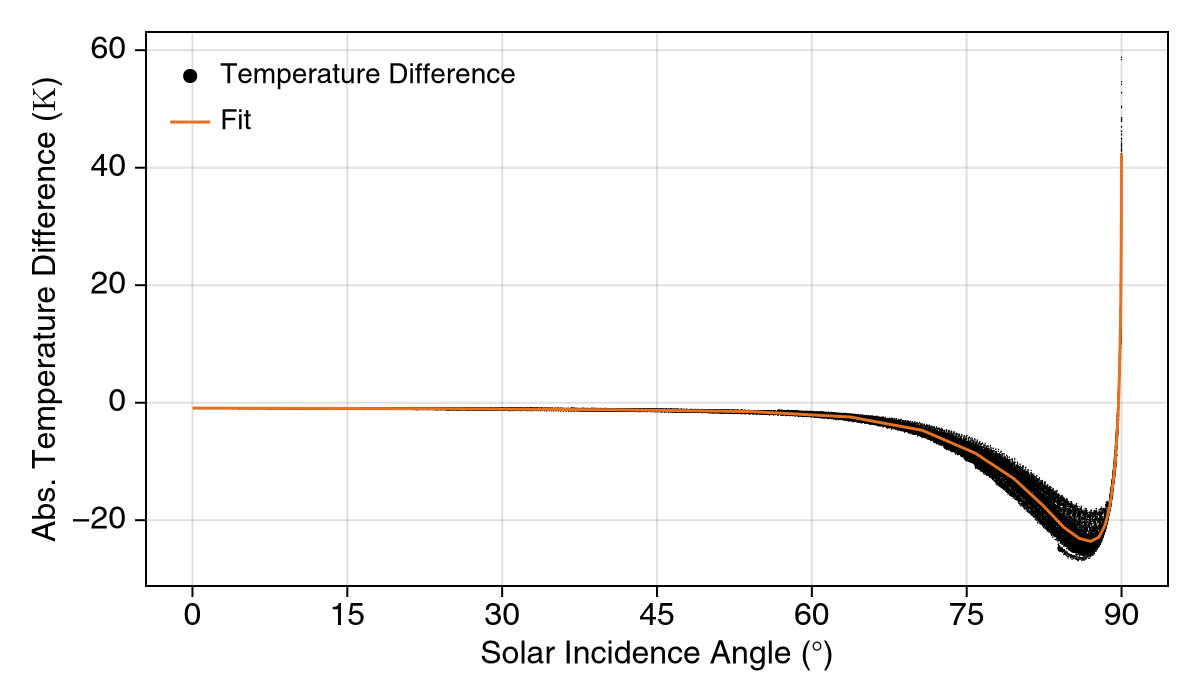
Surface temperatures were computed using the model of Butler (1997), as adapted by Crider & Vondrak (2002) and Killen et al. (2019), with the local solar incidence angle adjusted for slope magnitude and azimuth, based on Duffie and Beckman (2013). This resulted in a distribution of surface temperatures at every subsolar location linked directly to the slope distribution. Since the mean temperatures of these distributions are lower than their reference, the no-slope temperature of the analytical model at the same location, an additional temperature offset (-20K to +60K) was included in the simulation to keep the global thermal environment as similar as possible. Figure 2 shows this temperature offset at each solar incidence angle (black markers) and its fitting (orange line), done with a 20-step multilinear, exponentially spaced model.

Figure 2. Difference between sloped‐surface and flat‐surface temperatures as a function of solar incidence angle, and the 20‐step multilinear offset fit.

This topography and surface temperature model was included in our particle-tracking code, extending on previous work described by Smolka et al. (2023) for three-dimensional exospheres. Release velocities were also rotated according to the slope and its azimuth, introducing two main changes: the geometrical, and the thermal influence of slopes on exosphere densities and dynamics.

Preliminary and Expected Results.

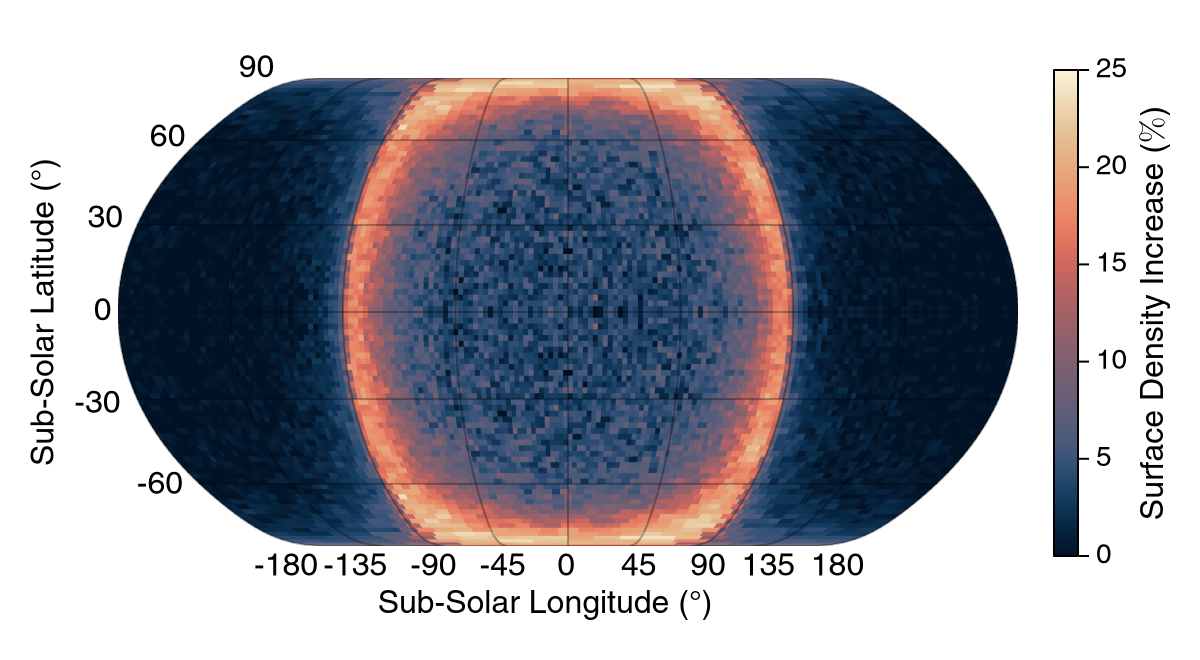
The first results show that the probabilistic approach of surface topography can be included in a Monte Carlo simulation without any major drawbacks regarding numerical efficiency. Surface number densities of Helium, see Figure 3, show increases up to ~25% along the terminator regions. This is strongly connected to the temperature model, which has the biggest spread close to solar incidence angles of 90°, see Figure 2. Preliminary studies of Neon showed similar effects, though, with lower density increases, consistent with cooler temperatures and more surface‐hugging trajectories. The effects on the Argon densities are expected to be stronger, compared to both Helium and Neon, due to adsorption on cold surfaces using the presented topography model.

Figure 3. Heatmap of the percentage increase in steady‐state Helium surface density when including slopes, relative to a flat‐surface simulation.


Conclusion and Future Work.

The planned validation against LADEE and LAMP exospheric density measurements will assess implications for satellite data interpretation. We will extend the refined temperature model to hydrogen‐based species to quantify topography effects on the lunar water cycle. In the long term, the incorporation of advanced surface temperature models (e.g., Hurley et al., 2015) and Diviner data will bridge the gap to more realistic simulations.

This research demonstrates not only that including realistic data-based topography in exosphere simulations is computationally feasible but also highlights its necessity for capturing lunar exospheric dynamics.


References.

Butler (1997). Journal of Geophysical Research, 102(E8), 19283–19291.

Crider and Vondrak (2002). Advances in Space Research, 30(8), 1869–1874.

Duffie and Beckman (2013). Solar Engineering of Thermal Processes (4th ed.). John Wiley.

Hurley et al. (2015). Icarus, 255, 159–163.

Killen et al. (2019). Icarus, 329, 246–250.

Prem et al. (2018). Icarus, 299, 31–45.

Grava (2023). Dust, Atmosphere, and Plasma Environment of the Moon and Small Bodies (DAP-2023).

Smolka et al. (2023). Icarus, 397, 115508.

Laferriere et al. (2025). Journal of Geophysical Research: Planets, 130(4).

How to cite: Peschel, A., Grava, C., Breternitz, J., and Reiss, P.: Probabilistic Modelling of Lunar Topography for Improved Exosphere Simulations, EPSC-DPS Joint Meeting 2025, Helsinki, Finland, 7–13 Sep 2025, EPSC-DPS2025-451, https://doi.org/10.5194/epsc-dps2025-451, 2025.

Posters: Mon, 8 Sep, 18:00–19:30 | Finlandia Hall foyer

Display time: Mon, 8 Sep, 08:30–19:30
Chairpersons: Sébastien Verkercke, Alexander Peschel
F71
|
EPSC-DPS2025-1690
|
ECP
|
On-site presentation
Johannes Brötzner, Matthias Kogler, Lukas Kalchgruber, Paul Stefan Szabo, Andreas Nenning, Andreas Mutzke, Hans Hofsäss, Markus Valtiner, and Richard Arthur Wilhelm

The solar wind, a stream of charged particles from the Sun, interacts with planetary bodies in a variety of ways. One such interaction is the reflection of solar wind ions from regolith surfaces where particles may be scattered as ions or undergo neutralisation processes, leading to the formation of energetic neutral atoms (ENAs). In either case, the scattered particles can in turn be observed by space missions providing valuable insight on the space weathering of rocky bodies and the interaction of their surfaces with the solar wind. Such information is available for, e.g., the reflection of protons at the Moon [1] or Phobos [2,3].

Similarly, the scattering of light ions off sample surfaces, referred to as low energy ion scattering (LEIS), is a commonly used ion beam analysis technique. In LEIS, the energies of ions scattered into a certain detector geometry are recorded. In these energy spectra, the positions and heights of peaks are indicative of the chemical surface composition. Consequently, LEIS is usually employed to monitor composition changes during processes like material deposition, erosion or chemical reactions [4]. Conventional LEIS setups commonly use electrostatic analysers, and thus the neutralised fraction of projectiles is not accessible. Quantifying the neutralisation probability is therefore tedious and also not available in binary collision approximation (BCA) simulations like SDTrimSP [5]. Because however the physics behind the ion scattering processes is the same as in the space environment, LEIS experiments are an ideal tool to study the reflection of solar wind ions in a simplified, controlled laboratory setting.

In this study, we present measurements using He projectiles of energies ranging between 1 keV and 5 keV on samples prepared from the pyroxenoid wollastonite (CaSiO3). The samples were prepared as flat thin films on Si substrates such that in a first step, surface roughness or regolith-like porosity would not obfuscate our understanding of the underlying physical processes. While He is significantly less abundant in the solar wind than H, it is chemically inert and thus simplifies interpretation of the results. The Ca in the sample facilitates a greater relative mass difference to the projectile and therefore a better separation from the low-energy background compared to using silicates containing lighter elements, like Na or Mg. The experiments were carried out using a commercial LEIS setup (ionTOF Qtac) with an electrostatic analyser. Additionally, we performed BCA simulations with the codes SDTrimSP and IMINTDYN [6]. Using the former, we can model the surface composition changes during sputter cleaning of the sample, while the latter is capable of calculating the resulting LEIS spectra under consideration of the actual experimental geometry, ignoring however the charge state of the scattered ions. A key feature of IMINTDYN is further that it can separate the spectra into contributions from ions that scattered once, twice or multiple times, as well as by the sample species at which the scattering event took place.

Using this combined experimental and numerical approach, we find that the multiple scattering contribution from deeper sample layers is suppressed by roughly an order of magnitude compared to single and double scattering events. Furthermore, since the simulations consider all scattered particles as neutral, while the analyzer detects only ions, comparison of the two allows for estimation of the charge fraction of scattered projectiles. This capability to assess the ion-to-neutral ratio is highly relevant for ENA studies and goes beyond what is accessible with conventional BCA simulations alone.

[1] C. Lue et al., J. Geophys. Res. Space Phys. 123 (2018) 5289–5299.
[2] Y. Futaana et al., J. Geophys. Res. Space Phys. 115 (2010), A10213.
[3] Y. Futaana et al., J. Geophys. Res. Planets 126 (2021) e2021JE006969.
[4] H.H. Brongersma et al., Surf. Sci. Rep. 62 (2007) 63–109.
[5] A. Mutzke et al., IPP Report (2019).
[6] H. Hofsäss, A. Stegmaier, Nucl. Instrum. Methods Phys. Res. B 517 (2022) 49–62.


How to cite: Brötzner, J., Kogler, M., Kalchgruber, L., Szabo, P. S., Nenning, A., Mutzke, A., Hofsäss, H., Valtiner, M., and Wilhelm, R. A.: Understanding the energy spectra of scattered solar wind ions using low energy ion scattering, EPSC-DPS Joint Meeting 2025, Helsinki, Finland, 7–13 Sep 2025, EPSC-DPS2025-1690, https://doi.org/10.5194/epsc-dps2025-1690, 2025.

F72
|
EPSC-DPS2025-1091
|
ECP
|
On-site presentation
Liam Morrissey, Ben Clouter-Gergen, Anastasis Georgiou, Jesse Lewis-Roy, Vikentiy Pashuk, and Amanda Ricketts

For nearly 40 years, planetary science studies of the exospheres of Mercury, the Moon, and other airless bodies have been hindered because of uncertainties in our understanding of the surface processes influencing exosphere formation. The surfaces of these airless bodies can be subjected to several different emission processes including solar wind induced sputtering, photon stimulated desorption, and micrometeorite impact vaporization. However, the relative contributions of these various processes to the body’s exosphere remains contested for many observed elemental species. To obtain a true understanding of the surface-exosphere connection of airless bodies we must first improve our understanding of the interplay of these different processes and how they are affected by the specific characteristics of the surface.  However, many of these key emission processes are occurring on the atomic scale, meaning global exosphere models often require atomically derived parameters as inputs. These inputs are difficult to obtain experimentally, and are therefore typically derived via fitting, often overlooking important complexities that can significantly affect predicted results. Further complicating this picture is the fact that some proportion of the ejected atoms leave the surface at energies lower than the escape energy of the body and thus return to the surface. A portion of these atoms can then be reaccommodated on the surface at an energy and composition unique from the mineral bulk.  However, current global exosphere models are unable to consider the effects of adsorbed atoms nor the contribution of emission from the newly formed adsorbed layers.

Here, we will discuss how molecular dynamics (MD) modelling on the atomic scale can be a critical tool to provide physically realizable and surface-specific input parameters for global exosphere models. We will discuss a series of our previous studies from our group based out of Memorial University that have used MD modelling to study key planetary science processes on the atomic scale. This will include MD models of sputtering, diffusion, surface adsorption, surface free energy, and micro meteorite impacts. For each study we will discuss key unknowns introducing uncertainties into global models. We will then apply atomic modelling to study these processes on the atomic scale, better understanding the underlying physics.

Finally, we will conclude with a discussion on new areas that we can apply these approaches to new research areas including icy bodies and exoplanets.

How to cite: Morrissey, L., Clouter-Gergen, B., Georgiou, A., Lewis-Roy, J., Pashuk, V., and Ricketts, A.: The At. Astra Research Group: Using Atomic Modelling to Better Explain the Surface-Exosphere Connection on Airless Bodies, EPSC-DPS Joint Meeting 2025, Helsinki, Finland, 7–13 Sep 2025, EPSC-DPS2025-1091, https://doi.org/10.5194/epsc-dps2025-1091, 2025.

F73
|
EPSC-DPS2025-18
|
On-site presentation
Rosemary Killen, Jason McLain, Orenthal Tucker, Liam Morrissey, Matthew Burger, and Ronald Vervack

We revisit the importance of Electron-Stimulated Desorption (ESD) as a source of neutral Na atoms and Na+ ions in the exospheres of Mercury and the Moon. For the first time we have calibrated the ESD yield per electron as a function of electron energy in the energy range 100 - 950 eV. This calibrated yield per electron was convolved with the electron flux as a function of energy onto Mercury's cusps to determine the average release rate of Na+ to the exosphere, using electron flux and cusp area estimates from a recent hybrid magnetosphere model (Lavorenti et al., 2023). Given that previous work showed the ESD yields of ions and neutral atoms are approximately equal, we compared the energy-weighted ESD release rate of Na+ to that derived from impact vaporization, photon-stimulated desorption, and ion-sputtering. We conclude that ESD is not a significant source of neutral Na atoms or Na+ ions to Mercury's exosphere. The electron flux and open regions are quite different at the Moon. The lunar surface is open to the solar wind since the Moon does not have a global magnetic field. The electron flux onto the Moon is taken from Artemis data.

How to cite: Killen, R., McLain, J., Tucker, O., Morrissey, L., Burger, M., and Vervack, R.: A Comparison of the Importance of Electron-Stimulated Desorption of Sodium at Mercury and the Moon, EPSC-DPS Joint Meeting 2025, Helsinki, Finland, 7–13 Sep 2025, EPSC-DPS2025-18, https://doi.org/10.5194/epsc-dps2025-18, 2025.

F74
|
EPSC-DPS2025-748
|
On-site presentation
Vikentiy Pashuk, Liam Morrissey, Ivan Saika-Voivod, and Rocky Taylor

Introduction: Several current and upcoming missions will be focusing on understanding the evolution of icy surfaces and their interaction with the exosphere. For example, Europa Clipper and JUICE aim to study the icy Moons of Jupiter [1], and ongoing work on the Moon and Mercury has identified the icy permanently shadowed regions as being of scientific and operational importance. However, while significant computational and laboratory research has been conducted on volatile interactions with silicate surfaces, there is comparatively less work on icy surfaces. Understanding the interaction of icy surfaces with the space environment on these bodies is necessary for interpreting much of the upcoming observation data. For example, binding energies and diffusion characteristics of volatiles on icy surfaces can be incorporated into exospheric models to better understand the exosphere formation. While experiments are costly and time-consuming, molecular dynamics (MD) offers a theoretical alternative by simulating the behavior of atoms in extreme environments. It has proven valuable in understanding surface diffusion and surface binding energies of key volatiles on silicate surfaces [2,3]. These approaches commonly use reactive interatomic potentials (ReaxFF) that are capable of modelling dynamic bond breaking and reformation found during chemical reactions. However, while ReaxFF potentials have been well studied and validated for silicates they remain relatively untested for the conditions and compositions relevant to icy bodies. A validation of available interatomic potentials (IPs) for ice is needed before we can apply these MD-methods to exosphere modelling.

Here, we aim to validate ReaxFF for icy surfaces by comparing the mechanical properties of ice to a standard, and well validated, water-based potential called TIP4P/Ice (that cannot model chemical reactions) and available experimental results to help build a computational and methodological framework for future surface studies. We perform MD simulations of crystalline and amorphous water-ice and focus on validating against diffusion, Youngs Modulus (EY), isothermal compressibility (kT), and density (ρ).

Methodology: We have studied crystalline and amorphous ice at 25 K, 100 K, and 264 K, the first two temperatures due to the relevance in shadowed craters on the Moon and Mercury and the latter for comparison against experiment. Crystalline proton disordered, non-polar, 1h ice was first created using GenIce. Amorphous ice was then made by melting the crystalline structure at 360 K and then equilibrating at 264 K while for lower temperatures for the amorphous ice was equilibrated at 245 K before quenching to 25 K and 100 K with rates ranging from 80 ns to 80 ps. Following the work by Baran et al. [4], we calculated the diffusion of Oxygen in amorphous ice as a function of temperature for 40 ns in a constant volume and temperature ensemble. For the EY the crystalline and amorphous substrates we produced stress-strain curves using a minimum strain rate [5]. Finally, the isothermal compressibility was computed from volume variations.

Results: First, we demonstrate a notable methodological advancement by validating the ability to convert equilibrated ice structures from TIP4P/Ice to ReaxFF formats. This allows researchers to leverage the faster TIP4P/Ice for equilibration of the surface and then switch to the more computationally intensive ReaxFF potential for the chemically reactive simulations that will be found during volatile interactions.

Due to limited experimental data, the EY of the two IPs was only compared to experimental data at 264 K [6]. For both IPs there was strong agreement when compared to experiment, a 5.2% and 5.6% difference for TIP4P/Ice and ReaxFF potentials respectively. As temperature increases from 25 K to 264 K, we found that the difference in EY between the two potentials decreased from 23% to 0.3%, suggesting that at temperatures below melting ReaxFF is well optimized. When comparing amorphous to crystalline ice, we found that the EY is lower by ~50% for ReaxFF for both 25 K and 100 K cases whereas for TIP4P/Ice the EY decreases by 28% and 42% for 25 and 100 K respectively. As expected at 264 K the sample is melted and has a Young Modulus of zero. The EY values for amorphous ice were found to increase with increasing the quenching time. The third ReaxFF potential showed similar trends but was more diffusive translating to a higher melting point and lower EY.

The calculated diffusion values for both tested IPs compared well to previous simulations that used TIP4P/Ice [4]. Isothermal compressibility for both potentials is consistent with each other but is underestimated compared to previous studies [7]. Density falls within expected ranges for both crystalline, 0.88 < ρ < 0.94, and amorphous ice, 1.05 < ρ < 1.16.

Conclusion: We tested ReaxFF potentials for key properties of icy surfaces and suggest a new validation methodological approach for future simulations. Hence, we provided a clear framework that can be reliably applied by other researchers to assess new and emerging potentials relevant to space applications. This advancement not only ensures accurate simulation of mechanical behavior of ice but also opens pathways for further exploration into icy surface chemistry. This study lays the groundwork for accelerating our understand of surface exosphere connections on icy bodies.

[1] Magnanini et al. (2024) Astronomy & Astrophysics 687 A132. [2] Morrissey, et al. (2022) Icarus, vol. 379, article no. 114979. [3] Morrissey, et al. (2022) The Astrophysical Jounral Letters 925. [4] Baran et al (2023) J. Chem. Phys. 158 (6): 064503. [5] Santos-Flórez, et al. (2018) The Journal of Chemical Physics 149.16. [6] Schulson. (1999) Jom 51 21-27. [7] Neumeier. (2018) J. Phys. Chem. 47 (3).

How to cite: Pashuk, V., Morrissey, L., Saika-Voivod, I., and Taylor, R.: Atomic Scale Modelling of Icy Surfaces: A Best Practice for Validating Interatomic Potentials and Ice Substrates in Extreme Environments, EPSC-DPS Joint Meeting 2025, Helsinki, Finland, 7–13 Sep 2025, EPSC-DPS2025-748, https://doi.org/10.5194/epsc-dps2025-748, 2025.

F75
|
EPSC-DPS2025-1193
|
ECP
|
On-site presentation
Ben Clouter-Gergen, Liam Morrissey, Caxia Bu, Andreas Mutzke, Sébastien Verkercke, and Daniel Savin

Introduction

Sputtering in planetary science occurs as the solar-wind (SW)—a stream of energetic ions emitted from the Sun—impacts an airless body, ejecting atoms from its surface [1,2]. This process alongside micrometeorite impacts, photo-stimulated desorption, and thermal desorption contribute to the formation of planets’ exospheres [3–5]. While various spacecraft can detect exospheric species such as MESSENGER, BepiColombo, LADEE, and CHACE-2, they cannot discern the respective contributions of the mentioned processes and thus a strong theoretical understanding of sputtering is needed to quantify its influence on the exosphere [6–9].

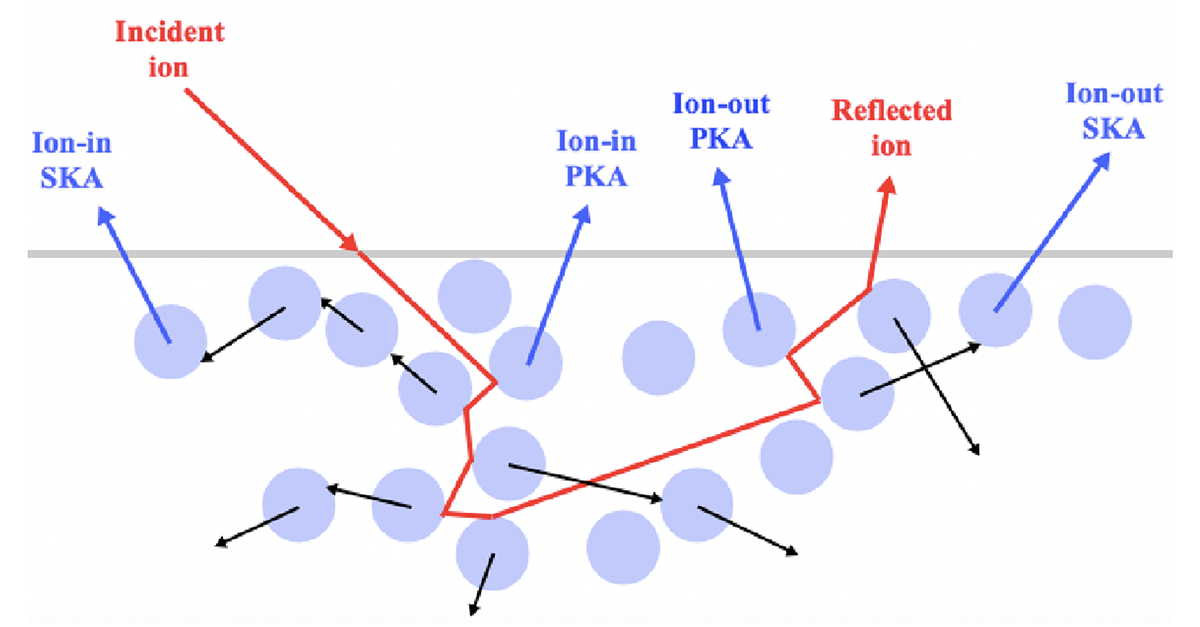
The sputtering yield is well-studied. In contrast, the angular distribution of ejecta has been given significantly less attention, its treatment being particularly sparse in cases relevant to planetary science. As such, sputtering models that consider the angular distribution of ejecta often assume isotropy. Here, we present a theoretical study quantifying anisotropy in the angular distribution of ejecta for SW-induced sputtering cases, helping advance the understanding of sputtering’s contribution to exosphere formation. Further, we compare the results to a common experimental case since experiments often employ heavier, higher energy ions to leverage the enhanced mass detection consequent of a greater sputter yield. These experimental results must then be scaled to inform SW-induced sputtering and, as such, unique behaviors occurring for lower mass impactor cases may be overlooked. Finally, following quantification, we consider the relative contributions from four ejecta-types demonstrated in Fig. 1, an approach enabling us to understand the underlying behavior leading to anisotropy differences between the different cases considered.


Fig. 1: An incident ion (red) impacts a target, collides with atoms within, and exits as a reflected ion, triggering four ejecta-types in the process (blue), from left to right: ion-in SKAs, ion-in PKAs, ion-out PKAs, and ion-out SKAs.

Methodology

To simulate sputtering, we utilized the software SDTrimSP which follows the binary collision approximation (BCA) model where sputtering occurs through a sequence of independent collisions within a material prior to the ejection of an atom [1,2]. While both electronic and collisional effects occur in the sputtering process, the latter dominate at energies below 100keV amu-1 and thus we consider collisional sputtering exclusively [2].

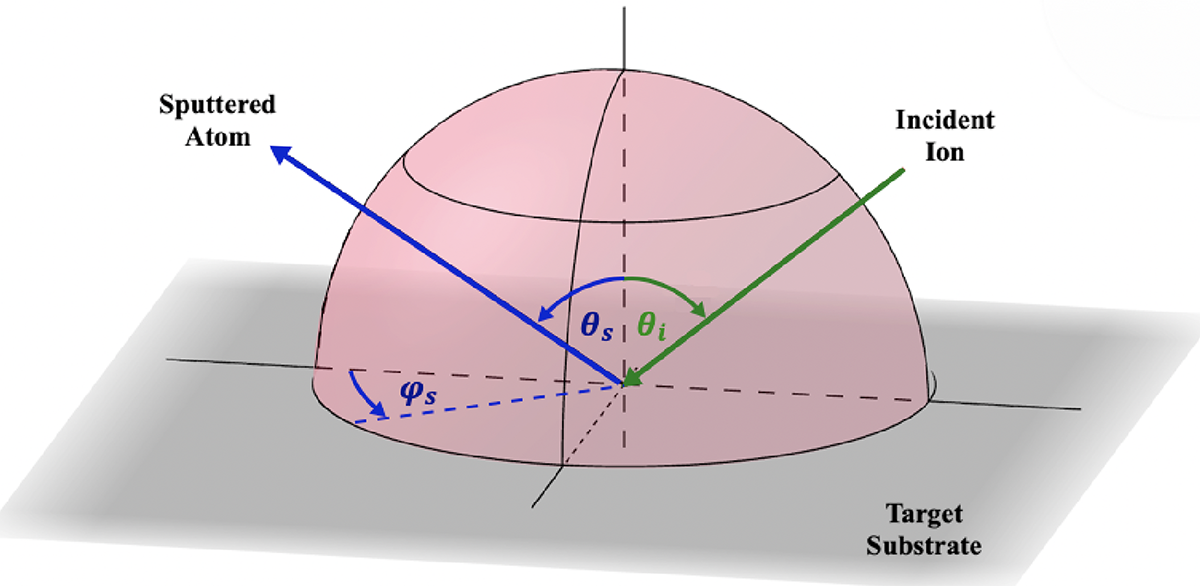
We selected 1 keV ionized Hydrogen (H+) and 4 keV ionized Helium (He++) to emulate the SW, while 20 keV ionized Krypton (Kr+) was employed given its prevalence in experimental studies. For the target surface, silica (SiO2) was selected given its prominence in both the lunar and Mercurian surfaces and recurrent usage in experiments [10–12]. We simulated ion incidence angles between 0° and 85° (measured from the surface normal) while ejecta were interpreted as a function of polar and azimuthal angles, ranging from 0° to 90° and 0° to 180°, respectively. The scenario is illustrated in Fig. 2.


Fig. 2: An incident ion impacts a target substrate at an incidence angle, θi, sputtering an atom as a function of polar (θs) and azimuthal (φs) angles within the depicted quarter-sphere.

Results

Forward-backward anisotropy exists when a greater percentage of atoms are sputtered at azimuthal angles between 0° and 90° than 90° and 180°. While the azimuthal distribution of ejecta is isotropic at normal incidence, anisotropy emerges as the ion incidence angle is varied. Noticeable differences in anisotropies between ion cases arise as the ion’s incidence angle is made increasingly oblique, forward-backward anisotropy becoming most pronounced in the H+ case while developing more modestly in the He++ and Kr+ cases. Alternatively, to assess anisotropy in the polar distribution of ejecta we consider anisotropy occurring as a greater percentage of atoms are sputtered between 0° and 45° (“low” angles) than 45° and 90° (“high” angles). At normal incidence, low-angle anisotropy is prominent in all cases. With increasing incidence angle, the polar distribution of ejecta becomes more isotropic in the H+ case, slightly more anisotropic in the He++ case, while remaining relatively steady in the Kr+ case.

The divergence in the anisotropies witnessed in the H+ case from those occurring in the other two impactor cases considered can be explained by an interplay between the percentage contribution of specific ejecta-types and the extent to which they are forward and low-angle pronounced. On the one hand, the ejecta-types most readily sputtered forward and at high-angles are generally most prominent in the H+ case and on the other, individual ejecta-types in the H+ case typically have higher forward and lower low-angle sputtering percentages than those in the He++ and Kr+ cases.

Concluding Statement

The findings demonstrate that sputtering anisotropy varies significantly depending on the ion-target case considered. While anisotropies in the He++ and Kr+ cases are similar, there are clear differences in the case of H+ bombarding SiO2. Experimental cases using increased energies and masses are, therefore, likely underestimating the degree to which forward-backward anisotropy is present in SW-induced sputtering cases, while overestimating the extent of anisotropy in the polar distribution of ejecta. Accounting for these effects is essential when scaling experimental results to inform planetary sputtering.

How to cite: Clouter-Gergen, B., Morrissey, L., Bu, C., Mutzke, A., Verkercke, S., and Savin, D.: Solar Wind-Induced Sputtering: Investigating Anisotropy in the Angular Distribution of Ejecta using SDTrimSP, EPSC-DPS Joint Meeting 2025, Helsinki, Finland, 7–13 Sep 2025, EPSC-DPS2025-1193, https://doi.org/10.5194/epsc-dps2025-1193, 2025.