
 1,3,1
1,3,1- 1Department of Physics and Astronomy, University of Texas at San Antonio, San Antonio, TX, United States of America
- 2Earth and Planets Laboratory, Carnegie Science, Washington D.C, United States of America
- 3Space Science Division, Southwest Research Institute, San Antonio, TX, United States of America
- 4Jet Propulsion Laboratory, La Cañada Flintridge, CA, United States of America
Introduction: Organic molecules are ubiquitous as primitive Solar System building blocks and are also central to astrobiology, yet their origins and evolution remain debated. These organics likely play crucial, yet poorly constrained, roles in fundamental planetary processes during the formation and evolution of planetary systems. Models of planet formation struggle to explain the rapid aggregation of dust into planetesimals, facing collisional barriers where silicate grains tend to fragment rather than stick [Birnstiel (2024)]. The presence of organic matter in chondrites and comets has fostered the hypothesis that organic matter may coat these grains, enhancing their sticking efficiency [Homma et al. (2019)]. However, current attempts to quantify this effect remain theoretical, relying on values for analogs such as terrestrial coal to represent parameters for organics present within the interstellar medium (ISM) or protosolar nebula (PSN) [Homma et al. (2019)]. Meanwhile, understanding the thermal evolution and potential habitability of icy moons and dwarf planets hinges on modeling their internal structure and heat sources, primarily tidal dissipation [Bagheri et al. (2022)]. Observations suggest that these bodies contain significant amounts of low-density refractory material, likely primitive organic matter, mixed with rock and ice [Reynard and Sotin (2023)]. The amount and the mechanical/viscoelastic properties of this organic fraction would critically influence tidal heating efficiency and internal dynamics. Accurately modeling planetesimal aggregation and icy world evolution thus requires direct measurements of the physical properties of relevant Solar System organics. Insoluble Organic Matter (IOM), the dominant organic component in chondrites, represents a key material whose origin (interstellar, nebular, parent-body) is complex [Alexander et al. (2017)]. This study utilizes nanoindentation and helium pycnometry to characterize two fundamental physical properties (Young's modulus, Y; grain density, 𝜌) of chondritic IOM (CIOM) and synthetic analogs, aiming to provide crucial data for planet formation and icy body models while simultaneously shedding new light on the complex origins and processing history of IOM.
Methods: We measured Young's modulus using dynamic nanoindentation [Oliver and Pharr (2004)] (KLA iMicro) on CIOM extracted from three carbonaceous chondrites (CCs): Murchison (CM2), Tarda (C2), and Grosvenor Mountains (GRO) 95577 (CR1) [Cody et al. (2002)]. These represent materials with varying degrees of parent body aqueous alteration. Using nanoindentation and helium pycnometry (Anton Paar Ultrapyc 3000), we also measured the Young's modulus and density of synthetic IOM (SIOM) synthesized hydrothermally via dextrose carbonization [Foustoukos et al. (2021)]. Young’s modulus measurements were compared to synthetic organic analogs representing key formation/processing pathways: (1) Ice irradiation residues [Piani et al. (2017)]; (2) Aqueous alteration organics (SIOM); and (3) Gas irradiation organics (Titan tholin analogs, [Yu et al. (2018)]). Density measurements were compared to terrestrial organic analogs typically used in planetary modelling. CIOM (and SIOM following density measurements) samples were embedded in epoxy, polished (Pace Technologies NANO-2000S), and indented under N2. Y was determined by the instrument’s software from load-displacement curves, averaging data from depths > 500 nm.
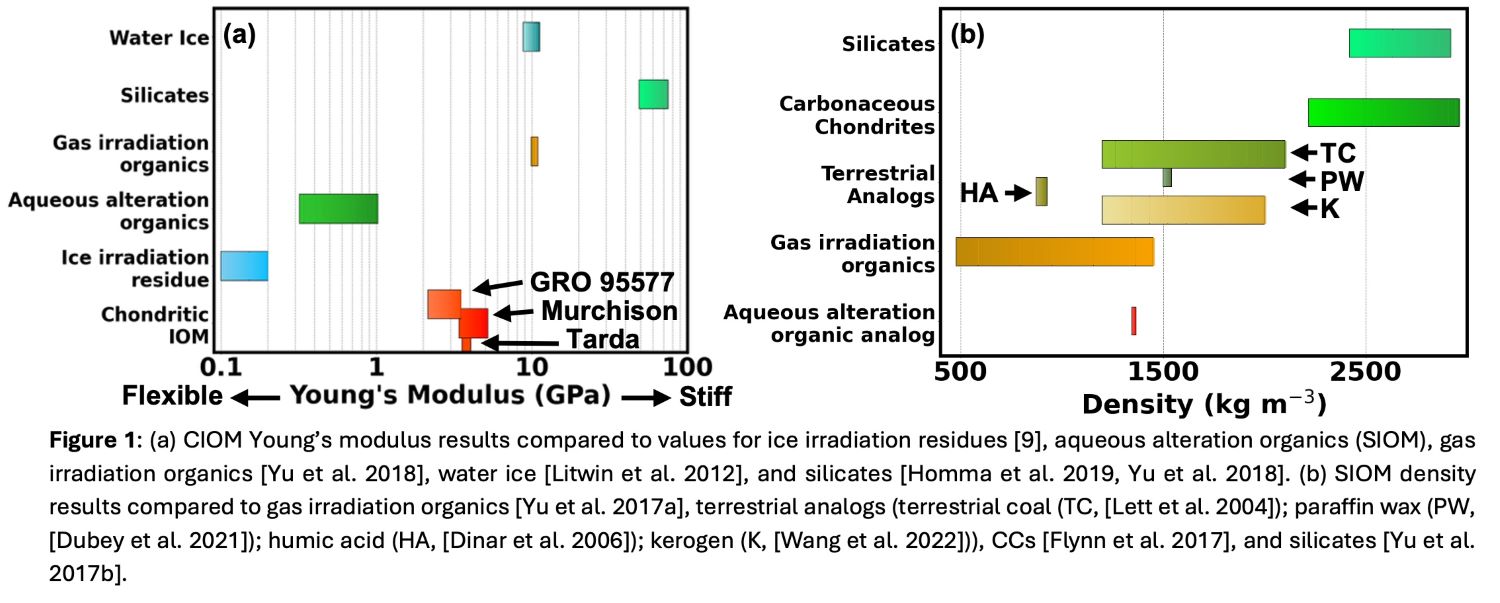
Results: Significant differences in mechanical stiffness were observed (Figure 1a). Synthetic analogs showed distinct moduli linked to formation pathways: stiffness increased in the order Ice Irradiation Residues < Aqueous Alteration Organics < Gas Irradiation Organics. CIOM from Murchison, Tarda, and GRO 95577 exhibited intermediate stiffness (Y ~ 2-6 GPa), about an order of magnitude stiffer than ice irradiation residues (Y ~ 0.1 GPa). Their moduli fell between those of aqueous alteration analogs (SIOM measured at 0.69 ± 0.4 GPa) and gas irradiation analogs (~ 10 GPa). Notably, CIOM from GRO 95577, the most primitive sample [Alexander et al. (2010)], was mechanically softer than Murchison and Tarda IOM, suggesting that the aqueous alteration of the parent body may stiffen the structure of IOM. Moreover, measurements for both CIOM and SIOM indicate the material is more flexible (lower Y) than water ice (~ 10 GPa) and silicates (> 50 GPa). Density measurements of SIOM (Figure 1b) align with values for terrestrial coal and kerogen currently used in planetary modeling.
Discussion: The intermediate stiffness of CIOM, significantly different from highly flexible ice residues but generally softer than stiff gas irradiation products, points towards a complex, multi-stage history. Based on our data, we favor a model involving the formation of precursors, likely in cold environments (consistent with isotopes), followed by subsequent processing (e.g., aqueous alteration, gas-phase reactions/irradiation), gradually creating stiffer macromolecules. Further experimentation investigating the effects of aqueously altering ice and gas irradiation organics, as well as measuring the Young’s modulus of other CC petrological types aside from those analyzed thus far (CM2, C2-ung, CR1), is necessary to confidently substantiate whether aqueous alteration affects the stiffnes of the material.
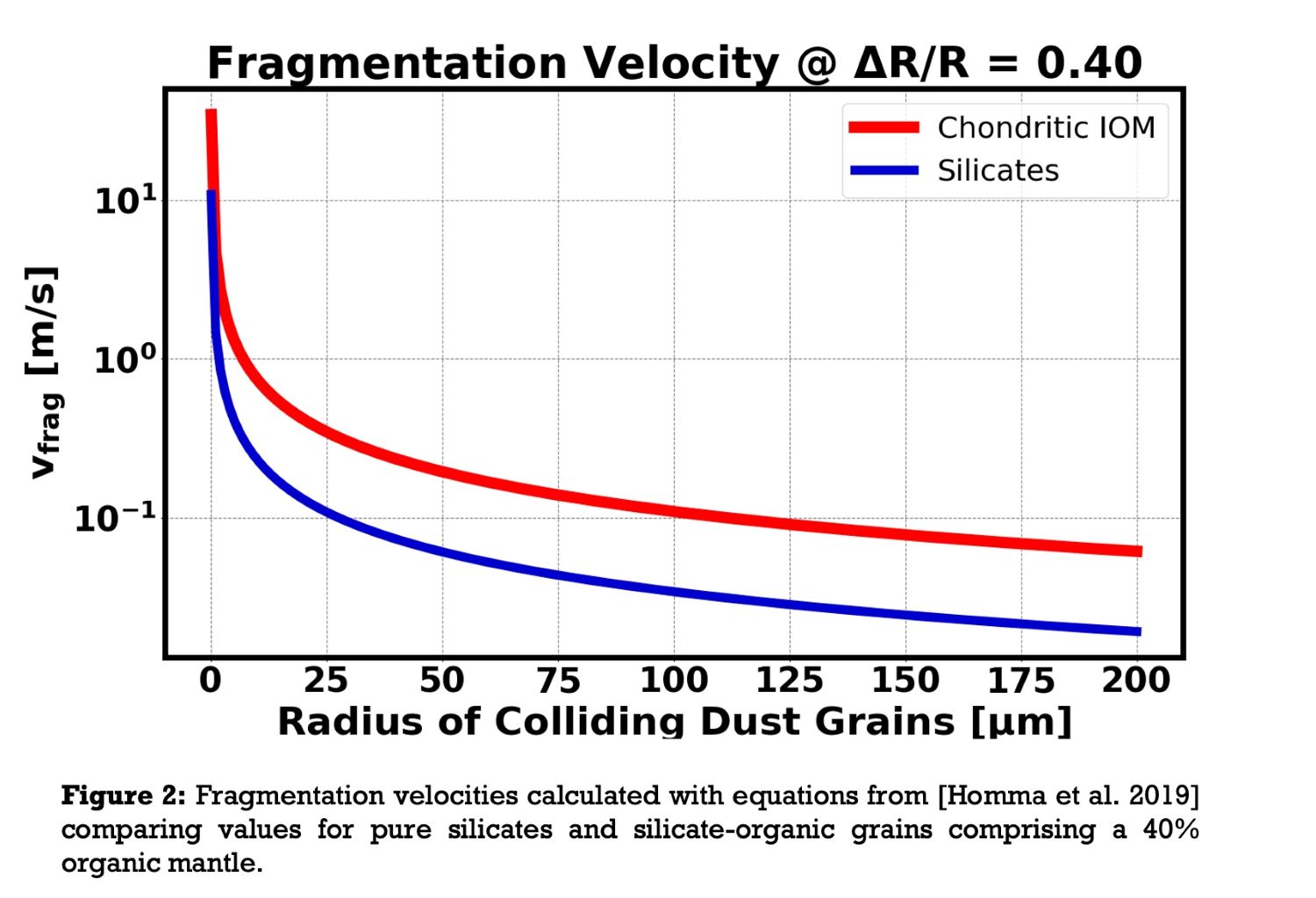
Our Young’s modulus measurements confirm that IOM is significantly more flexible than silicates. This increased elasticity, along with the density measurements, results in an enhanced sticking efficiency during dust collisions, likely promoting aggregation and assisting in overcoming fragmentation barriers, thereby potentially accelerating planetesimal growth compared to silicate-only models.
Our finding that IOM has a significantly lower Young's modulus than rock implies higher shear compliance. Therefore, an organic-rich component within an icy moon's interior (consistent with low bulk densities) would deform more readily under tidal forces, potentially leading to significantly enhanced tidal dissipation and internal heating than purely rock-ice models. This impacts internal structure, thermal history, and habitability potential of many astrobiological targets in the outer solar system.
Conclusions: Mechanical properties provide a novel diagnostic tool for deciphering IOM's complex history. Our nanoindentation results on CIOM and analogs support a multi-stage origin involving the processing of precursors in cold environments via ice irradiation, followed by gradual stiffening through processes involving aqueous alteration and/or gas irradiation. Moreover, the mechanical characteristics of SIOM and CIOM have intriguing implications, suggesting organics play key roles in facilitating planetesimal formation through enhanced aggregation and influencing the thermal evolution and habitability of icy worlds via enhanced tidal dissipation.
How to cite: Austin, E., Yu, X., Husić, A., Foustoukos, D., Miller, K., Alexander, C., Whittington, A., Castillo-Rogez, J., Vega, R., Glein, C., and Truong, N.: Mechanical Properties of Insoluble Organic Matter and Implications for Its Evolution and Influence on Planetary Processes. , EPSC-DPS Joint Meeting 2025, Helsinki, Finland, 7–12 Sep 2025, EPSC-DPS2025-1200, https://doi.org/10.5194/epsc-dps2025-1200, 2025.


