
 1,1,
1,1,- 1Arizona State University, School of Earth and Space Exploration, Tempe, AZ, United States of America (jgorourk@asu.edu)
- 2Department of Geology and Environmental Science, University of Pittsburgh, Pittsburgh, PA, USA
- 3Department of Earth and Planetary Sciences, Rutgers University, Piscataway, NJ, USA
- 4School of Earth and Atmospheric Sciences, Georgia Institute of Technology, Atlanta, GA, USA
Introduction
Venus is a volcanic wonderland—replete with lava channels at scales unseen on any other planetary body. Some lava channels on Venus resemble those seen on Mars and Earth’s Moon. For example, Venus hosts sinuous rilles with lengths of ~10–300 km and widths up to several km. However, many channels look more like the fluvial features observed on other terrestrial planets. Canali are long, narrow channels, over ~1 km wide, ~24 m deep, and ~500 km long on average. One canale, Baltis Vallis, is ~6,800 km long, making it the longest channel found in the Solar System. The goals of our project are (1) to better understand the formation of these enigmatic features and (2) to help prioritize follow-up investigations by future missions.
Importance of Carbonatite Lavas in Outgassing Venus’s Modern-day Atmosphere
Venus diverged from Earth’s evolutionary path through the development of a CO2-dominated atmosphere, though studies dispute whether this atmosphere emerged immediately after accretion or following a protracted period of surface habitability. Observations of widespread volcanic features suggest that volcanic outgassing may have played a pivotal role in the transformation of Venus. However, basaltic lavas would only outgas a minor fraction of the CO2 in the current atmosphere from the volume of the current crust. Here we show that carbonatite lavas possess the unique properties required to (mechanically) erode the canali. Our results suggest that eruption of these carbonatites may have delivered a total mass of CO2 comparable to that of the modern atmosphere, potentially resolving one challenge to the formation of Venus’s atmosphere within the recent past.
Eruption Properties Required to Form the Venusian Sinuous Rilles
Depth profiles of lava channels reveal whether thermal or mechanical erosion is the dominant process. Canali appear to have roughly constant depths along their exceptional lengths, which is most consistent with mechanical erosion. In contrast, thermal erosion likely formed the sinuous rilles, which exhibit depths that decrease along track. For example, one previous study showed that tholeiitic basalt could form some rilles. They calculated initial lava thickness of ~2–6 m and eruption durations between several months and a few years. We use our models to test the eruption properties required to form the sinuous rilles with various types of basaltic and komatiitic lavas. Using the Markov Chain Monte Carlo method, we compute the statistical probability distributions for these properties, considering the uncertainties on several model parameters.
Implications for Venus Exploration
Upcoming missions to Venus will provide a generational leap in our understanding of lava channels. The EnVision and VERITAS orbiters will return higher-resolution images and topography of canali and rilles. Multispectral images may allow us to infer the composition of channel-forming lavas. Carbonatite on Venus may weather to form patchy coatings of anhydrite in the presence of SO2. Carbonatites and sulfates would exhibit low NIR emissivity. Laboratory studies of their emissivity under Venus’s atmospheric and temperature conditions should be performed to distinguish them from other weathering products. The subsurface radar sounder on EnVision may also elucidate the structure of lava flows in and around these channels. Ultimately, the volumes of lava that formed canali and rilles might be small relative to that of the crust. However, these channels can reveal processes that shaped the big-picture evolution of Venus over time, and in turn how Venus serves as an exemplar for the evolution of terrestrial (exo)planets.
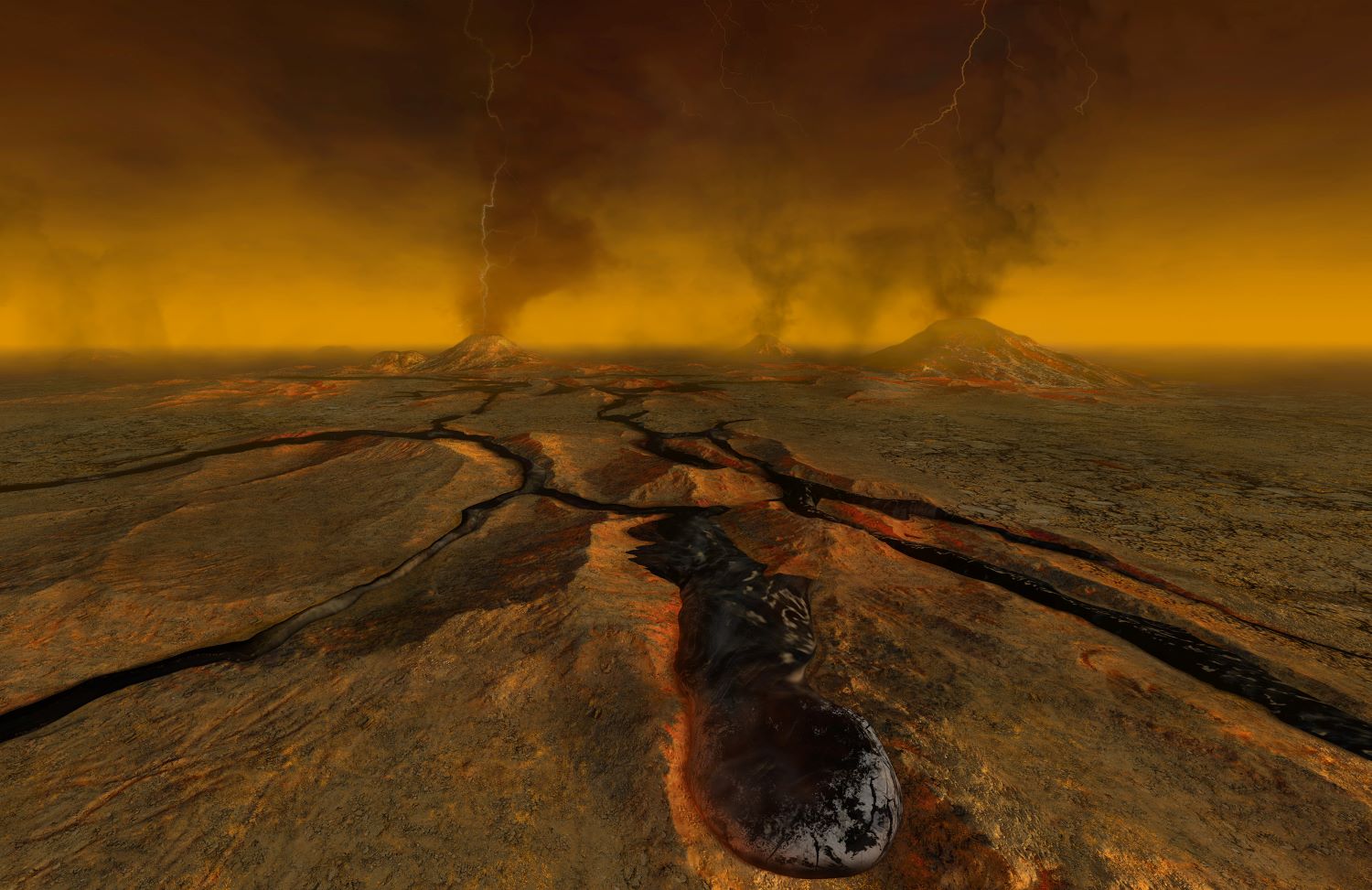
(Artist's impression of carbonatite lava forming canali on Venus, by Hernán Cañellas)
How to cite: O'Rourke, J., Trussell, A., Williams, D., Flynn, I., Black, B., and Borrelli, M.: Formation of Lava Channels on Venus: Implications for Eruption Properties and Atmospheric Outgassing, EPSC-DPS Joint Meeting 2025, Helsinki, Finland, 7–12 Sep 2025, EPSC-DPS2025-1203, https://doi.org/10.5194/epsc-dps2025-1203, 2025.


