
 ,
,- Department of Physics and Astronomy, Brigham Young University, Provo, USA (blodgett.steven.m@gmail.com)
Large-scale exoplanet discovery via transit photometry (as exemplified by the Kepler Space Telescope) has recently enabled sophisticated population-level modeling of exoplanet parameters. Perhaps the three most relevant dimensions of exoplanet parameter space are radius, period, and mass; via just these parameters, trends in exoplanet densities, interiors, compositions and habitability can be better understood. For radius and period, the full Kepler catalog (i.e., DR25 from Lissauer et al. 2024) remains the largest, most accurate, completely homogeneous exoplanet radius-period dataset. Each data point was collected in the same way and processed through a consistent pipeline. Kepler’s well-understood biases further increase its utility for studying the true radius-period distribution of close-in exoplanets.
However, the Kepler catalog lacks direct mass measurements. Most Kepler planets are out of reach of radial velocity studies, and further analysis must be performed on Kepler light curves to glean mass information for Kepler planets. Planet–planet dynamical interactions, typically detected through Transit Timing Variations (TTVs), are easiest to interpret in systems with multiple transiting planets (“multis”). Most Kepler planets show no detectable planet-planet interactions, even in multi-planet systems and even when assuming unphysically high densities. But, in systems that do have planet-planet interactions, the best mass inference is obtained when the system is modeled “photodynamically”, i.e., leveraging information from blended light curve photometry/dynamical models. Combining the best mass inferences from photodynamical modeling with the best demographic analysis from Kepler has been limited by the fact that there are no homogeneous dynamical analyses of the entire Kepler multi population.
We present the Kepler Multis Dynamical Catalog (KMDC), a recently completed (by Jones et al. in preperation) photodynamical catalog containing model-fitting posteriors for ≳90% of all Kepler multis. The KMDC supports many future analyses in exoplanetary architectures, interiors, and dynamics with important implications for the formation and evolution of planetary systems. This work focuses on using the KMDC to model the true underlying mass-radius-period distribution of exoplanets.
The KMDC enables a deeper and more accurate demographic analysis of planetary masses, radii, and densities as a function of period (and other parameters) for several reasons. First, the catalog contains mass posteriors for hundreds of previously undescribed systems. While most of the well-constrained masses are not new discoveries, previous mass measurements are a biased sample since they are often chosen by easily detectable TTVs. We remove that bias here since we modeled systems independent of mass detectability. Second, the catalog is homogenous, with data drawn only from one discovery source and run through a consistent photodynamical modeling process, reducing the biases that result from mixing heterogeneous survey, observation, and modeling methods. Finally, the catalog is nearly complete, allowing us to utilize well-understood biases of Kepler planet discovery. Even though most planets’ masses reflect our density prior (uniform from 0.01–30 g/cm3), we leverage all available Kepler data and have over 100 planets with masses measured with a precision of 25% (see Figure 1).
We demonstrate the ability of the KMDC to describe the population-level trends of exoplanet characteristics. Following Foreman-Mackey et al. 2014, we are starting with a 3-dimensional mass-radius-period non-parametric grid model of planetary occurrence rates. This is effectively extending the previously-derived radius-period occurrence rate grids of Hsu et al. 2018 into the mass dimension.
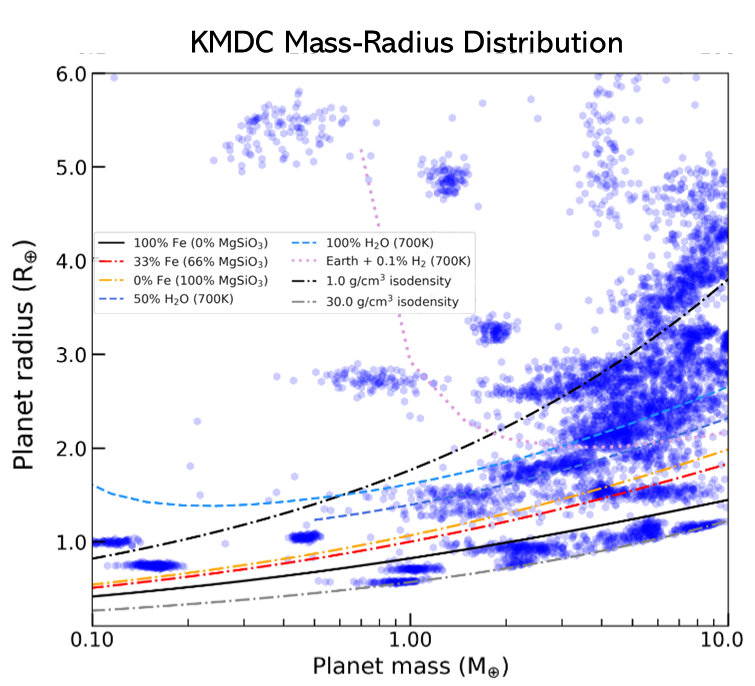
Figure 1: A subsample of the KMDC mass-radius distribution for small planets with well-measured masses. The full KMDC consists of many more measurements. Some planets have unphysical densities attributable to overfitting. Using catalog–level analyses and/or physical models can improve the prior probability distribution to minimize the effect of outliers.
We will also explore the value of parametric models, e.g., using populations of planets with different compositions, power–law occurrence rates, etc. Previous mass-radius-period parametric models have used much less data; we hope to follow these studies' work (e.g., Neil & Rogers 2020) and improve on their results with the KMDC.
How to cite: Blodgett, S., Ragozzine, D., and Jones, D.: Modeling the True Underlying Mass-Radius-Period Distribution of Exoplanets Using a Homogeneous, Kepler-Derived, Photodynamical Catalog, EPSC-DPS Joint Meeting 2025, Helsinki, Finland, 7–12 Sep 2025, EPSC-DPS2025-1206, https://doi.org/10.5194/epsc-dps2025-1206, 2025.


