
 4,1,6
4,1,6- 1Biological and Environmental Sciences, University of Stirling, Stirling, UK
- 2Scottish Universities Environmental Research Centre, University of Glasgow, Glasgow, UK
- 3School of Geographical and Earth Sciences, University of Glasgow, Glasgow, UK
- 4MVLS Shared Research Facilities, University of Glasgow, Glasgow, UK
- 5Division of Space Technology, Luleå University of Technology, Kiruna, Sweden
- 6Max Planck Institute for Solar System Research, Planetary Science, Göttingen, Germany (schroederc@mps.mpg.de)
Introduction
The search for life is a key driver of Mars exploration, yet the detection of organic compounds on Mars remains sparse. High UV and ionizing radiation levels near the surface destroy organic compounds, leading to an underground search such as that planned for the Rosalind Franklin rover’s 2 m drill. Strong oxidizing agents have been suggested to explain conflicting Viking experiments’ non-detection results, adding further stress to any organic compounds. Such agents have since been identified in the form of perchlorate [ClO4-] salts in the martian regolith (Hecht et al. 2009). Nevertheless, small amounts of organic matter have been identified at the near surface in Gale crater on Mars with the Sample Analysis at Mars (SAM) instrument package on the Curiosity rover (e.g. Freissinet et al. 2025). However, it remains unclear whether these compounds formed on Mars or whether they are remnants of meteorite input. To tighten constraints on this assessment, we need to understand how the meteorite organic inventory evolves once it is exposed to the martian environment. Here we reacted organic compounds from a carbonaceous chondrite with perchlorate salts at levels measured in the martian regolith and analyzed the organic compounds before and after reaction with a non-targeted Liquid Chromatography Mass Spectrometry (LC-MS) metabolomics approach.
Materials and Methods
Crushed samples of the carbonaceous CM2 chondrite Jbilet Winselwan (JW) were exposed to magnesium perchlorate salts. This meteorite was found in the Western Sahara in 2013 and contains ~2 wt% organics. Measured amounts of perchlorate at the Phoenix landing sites are about 20 times the estimated amount of organic matter from meteorite input. The crushed meteorite samples were exposed to 1x, 20x and 100x perchlorate anion concentration treatments, meaning that the 20x treatment reflects the concentration on Mars. All experiments were conducted under anoxic conditions. Organics were then extracted with a series of non-polar to polar solvents and analysed with Hydrophilic Interaction Liquid Chromatography (HILIC) followed by mass spectrometry using an Orbitrap mass analyzer. Data was processed using MetaboAnalyst v6.0 (Scheltema et al. 2011; Smith et al.2006; Pang et al. 2024).
Results and Discussion
A Principal Component Analysis (PCA) was conducted on the LC-MS data to evaluate the effects of progressive perchlorate treatment on the JW meteorite organic inventory. The first two principal components account for 73.9% of the variance in the dataset (PC1: 59.5%, PC2: 14.4%). The trend in PC1 (Figure 1) reflects the treatment gradient across the experiment, with a vertical trend visible from untreated to 100x perchlorate treatment. In contrast, PC2 (14.4%) does not follow a linear pattern, with the 20x perchlorate treatment exhibiting positive loadings and the 100x exhibiting negative loadings, while untreated meteorite and 1x clustered around a loading of zero. We are investigating the possible causes for the organic distribution in 20X being so distinct from the 100X along the PC2 axis - particularly since the 20X concentration matches that of Mars - and will present the results of this work at the meeting.
Additionally we created a clustered heat map of the top 75 most abundant compounds in the perchlorate treatment experiment (Figure 2). The heatmap shows compounds behave differently when the meteorite is subjected to increased perchlorate treatment. Many compounds are resistant to smaller or moderate (20x) perchlorate treatments but are destroyed with 100x treatments. However, there are many compounds which increase in concentration with increased perchlorate treatment. This could be either liberation of compounds from macromolecule material or mineral matrix, or new compounds generated by in situ reactions during the course of the experiment. This result requires further investigation.
Conclusions
Our results indicate that Mars’ organic matter input from meteorites interacts with the martian environment, changing its composition. Inspection of individual compounds putatively detected suggest that some astrobiologically relevant compounds (e.g., N bearing polar molecules) are formed when perchlorate reacts with the CM2 organics, whilst others are destroyed.
LC-MS appears to maintain the structure of organic compounds despite the presence of oxidising agents. Our results suggest this technique reduces the detection ambiguity that would otherwise be associated with perchlorate oxidation and ultimately compound destruction in GC-MS ovens. This makes it a valuable tool for future Mars sample return.
References
Hecht, M.H. et al. (2009) Detection of Perchlorate and the Soluble Chemistry of Martian Soil at the Phoenix Lander Site. Science 325, 64-67.
Freissinet, C. et al. (2025) Long-chain alkanes preserved in a Martian mudstone. PNAS 122, 13 e2420580122.
Scheltema, R. et al. (2011) PeakML/mzMatch: A file format, Java library, R library, and tool-chain for mass spectrometry data analysis. Analytical Chemistry 83, 2786-2793.
Smith, C. et al. (2006) XCMS: Processing mass spectrometry data for metabolite profiling using nonlinear peak alignment, matching, and identification. Analytical Chemistry 78, 779-787.
Pang, Z. et al. (2024) MetaboAnalyst 6.0: towards a unified platform for metabolomics data processing, analysis and interpretation. Nucleic Acids Res 52, W398-W406.

Figure 1. PCA of the meteorite treatment. PC1 (59.5%) accounts for most of the variance with a clear progression of the perchlorate treatment. PC2 (14.4%) is less clear showing high variation at the extreme ends of the treatment.
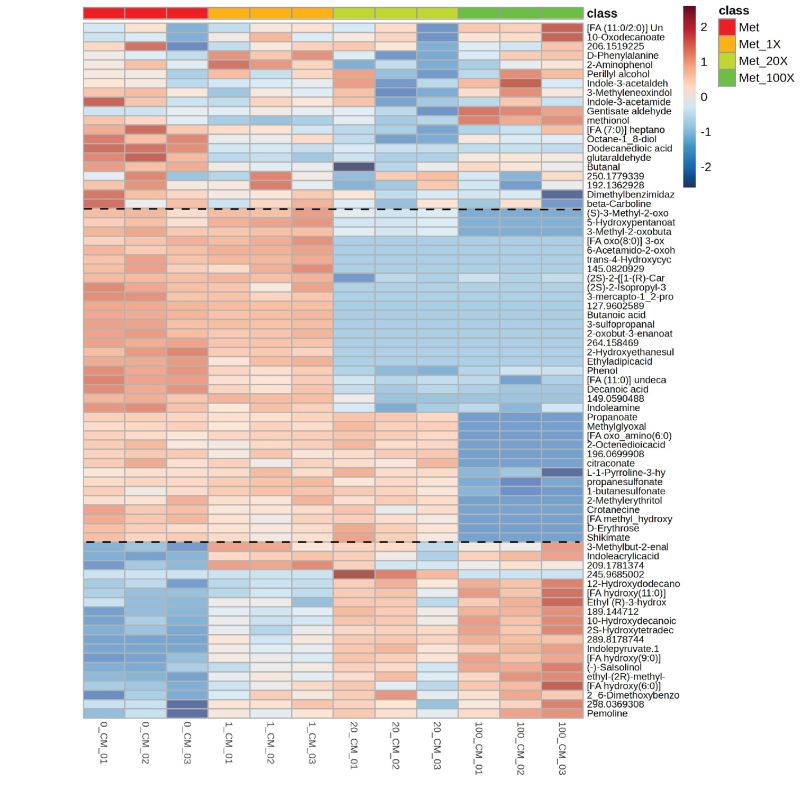
Figure 2. A clustered heatmap of the concentrations of the compounds in the meteorite perchlorate treatment. The bottom section shows compounds that have increased with the increased addition of meteorite compounds. The middle section are compounds that are semi resistant or decrease with perchlorate treatment.
How to cite: Tait, A. W., O'Brien, A. C., Hallis, L. J., Morrison, D., Regnault, C., Blackburn, G., Hagermann, A., and Schröder, C.: Reaction of perchlorate with meteorite organic compounds – implications for organic molecule characterization on Mars, EPSC-DPS Joint Meeting 2025, Helsinki, Finland, 7–12 Sep 2025, EPSC-DPS2025-1224, https://doi.org/10.5194/epsc-dps2025-1224, 2025.


