
 1,1,2,1
- 1Astronomical Observatory Institute, Faculty of Physics and Astronomy, Adam Mickiewicz University, Słoneczna 36, 60-286 Poznań, Poland.
- 2Astronomical Institute, Faculty of Mathematics and Physics, Charles University, V Holesovickach 2, 180 00 Prague 8, Czech Republic
Context
Reliable asteroid diameters underpin accurate studies on other topics like determination of the density. Traditional diameter estimates—often based on simplistic spherical models or/and on data of lower quality, can differ by tens of percent in the literature, propagating into density uncertainties exceeding 90%. On the other hand, the convex inversion thermophysical model (CITPM) (see Durech et al. 2017) is an advanced thermophysical model that simultaneously fits lightcurves and thermal-infrared data enabling precise size determination.
Aim
We aim to demonstrate that CITPM alone can yield main-belt asteroid diameters with precision comparable to multichord stellar occultations. Our goal is to determine diameters of fifteen slowly rotating, low-amplitude asteroids using CITPM, and to validate these results against occultation-based values (see our poster from Marciniak et al. for full details on occultations).
Methods
Starting from dense, multi-apparition lightcurves, we derive convex 3D shape and spin models via lightcurve inversion (see Kaasalainen, Torppa 2001, Kaasalainen et al. 2001). These models feed directly into CITPM, which optimizes shape parameters together with thermal inertia, albedo, surface roughness and diameter by fitting both visible and infrared datasets. We then compare our CITPM diameters to diameters determined by occultations (see Marciniak et al. poster) and to literature values, quantifying agreement and demonstrating CITPM standalone accuracy.
Results
For all fifteen targets, CITPM-derived diameters agree with occultation-based values to within 5%. Overall, CITPM residuals relative to occultations are smaller than those found in the literature, underscoring the advantage of simultaneous lightcurve–thermal fitting. Moreover, CITPM rely solely on photometry and thermal-IR measurements. This validates CITPM as a powerful, widely applicable tool for future large-scale asteroid size surveys. All results from this work can be found in Choukroun et al. (accepted for publication in Astronomy & Astrophysics).
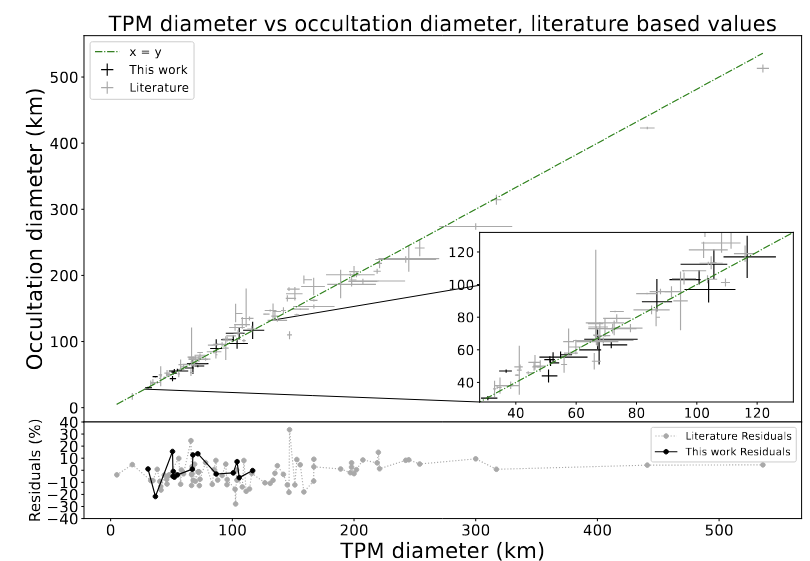
Figure 1: Representation of diameters from TPMs on the x-axis and diameters from occultations on the y-axis. Grey points correspond to values from the literature, while black points represent values from this work. The green line corresponds to y = x.
Acknowledgement
This work was supported by the grant 2020/39/O/ST9/00713 funded by National Science Centre, Poland.
References
Choukroun, A., Marciniak, A., Durech, J., et al., accepted to A&A
Durech, J., Delbo., M., Carry, B., Hanuš, J., & Alí-Lagoa, V. 2017, A&A, 604, A27
Kaasalainen, M. & Torppa, J. 2001, Icarus, 153, 24
Kaasalainen, M., Torppa, J., & Muinonen, K. 2001, Icarus, 153, 37
How to cite: Choukroun, A., Marciniak, A., Durech, J., and Perła, J.: Asteroid sizes determined with thermophysical model, EPSC-DPS Joint Meeting 2025, Helsinki, Finland, 7–12 Sep 2025, EPSC-DPS2025-123, https://doi.org/10.5194/epsc-dps2025-123, 2025.


