
 1,2,2,1,2
- 1University of Texas at San Antonio, San Antonio, TX, United States of America
- 2Southwest Research Institute, San Antonio, TX, United States of America
- 3Johns Hopkins Applied Physics Laboratory, Laurel, MD, United States of America
- 4Fibertek, Herndon, VA, United States of America
- 5The Open University, Milton Keynes, United Kingdom
Understanding processes related to volatiles and minerals on the Moon is important for constraining its surface origins and evolution. To better comprehend the history of lunar volatiles, including their delivery and transport, knowledge of regolith composition is needed. Additionally, space weathering embeds iron metal particle by-products into grain rims of the surface regolith in a ubiquitous manner. Therefore, quantifying this iron in lunar samples helps us understand space weathering effects on the Moon and across the inner Solar System (Noble et al., Icarus, 2007; Veres et al., 56th LPSC, 2025).
Raman Spectroscopy is an established technique for studying planetary samples and simulants. We present Raman spectroscopic measurements of various Apollo samples and synthetic analogs, providing further insight and confirmation into their mineralogical and volatile composition and abundance, and underscoring the effectiveness of Raman spectroscopy in advancing planetary science.
The simulants and synthetic analogs we measured include two suites of synthetic nanophase iron-infused silica gel samples from Noble et al. (2007), a synthetic mare sample analog for the Apollo 17 site, Apollo regolith samples 10084 and 15041, and the Apollo rock sample 14310.
Measurements were taken with laser excitation wavelengths of 532 nm and 785 nm, and multiple measurements were taken at different locations on certain samples. After data processing methods such as noise reduction and normalization were completed, the Raman peak shifts were identified for corresponding mineral presence and cross-compared with previous compositional studies. A selection of resulting Raman shift spectra is shown in Figure 1.
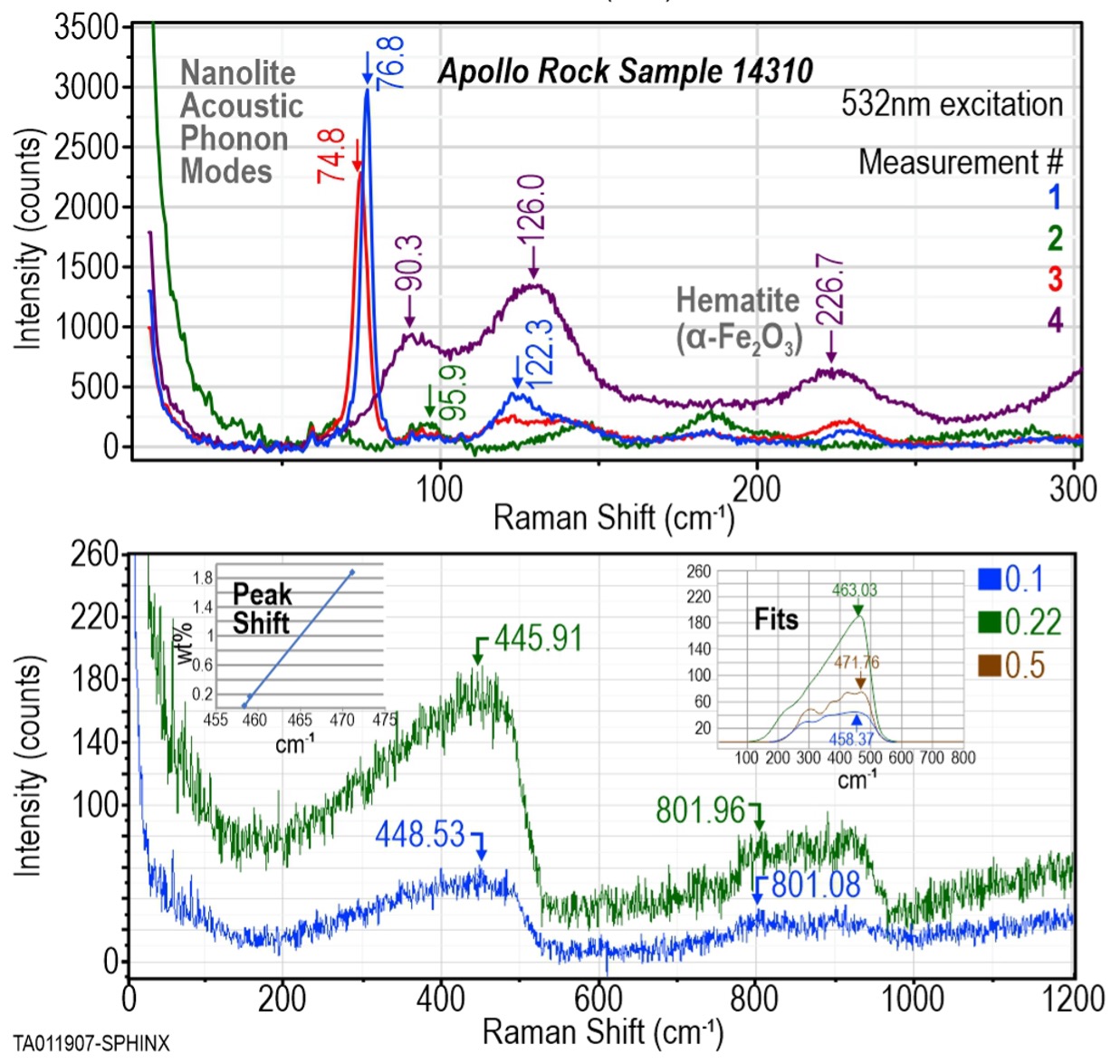
Figure 1. (top) Raman shift spectra of Apollo rock sample 14310, showing phonon mode and hematite peaks. (bottom) Raman shift spectra of silica gel samples SG50.1 and SG50.22. Insets show corresponding Gaussian-Lorentzian fits and wt%-peak shift relationship.
How to cite: Veres, B. E., Retherford, K. D., Miller, M. A., Blase, R. C., Bueno, P. C., Cahill, J. T. S., Molyneux, P. M., Moore, T. Z., Poston, M. J., Raut, U., Schwenzer, S. P., Stevanovic, A., Stockstill-Cahill, K. R., and Whizin, A. D.: Raman Spectroscopic Analysis of Lunar Samples and Synthetic Analogs, EPSC-DPS Joint Meeting 2025, Helsinki, Finland, 7–12 Sep 2025, EPSC-DPS2025-1236, https://doi.org/10.5194/epsc-dps2025-1236, 2025.


