
 1,5
1,5- 1Institute of Space Research, German Aerospace Center (DLR), Berlin, Germany (vidhya.rangarajan@dlr.de)
- 2U.S. Geological Survey, Astrogeology Science Center, Flagstaff, AZ, USA
- 3Department of Earth, Environmental and Planetary Sciences, Brown University, Providence, RI, USA
- 4Center for Space and Habitability, University of Bern, Bern, Switzerland
- 5Institute for Earth and Space Exploration/Department of Earth Sciences, University of Western Ontario, London, Canada
Introduction:
Impact craters serve as valuable natural probes for investigating the subsurface composition of Mars and other planetary bodies. Large impact events excavate material from deep within the crust, often exposing that material in central uplifts or pits, and were more prevalent during the earlier stages of Mars’ geologic evolution. In contrast, more recent impacts tend to be smaller in scale but can still expose subsurface materials from the uppermost few meters, depending on the size of the event. High-resolution visible observations of ice in the crater rims and ejecta from a subset of such impacts (e.g., Dundas et al., 2021) supported by measurements from instruments like the Mars Odyssey gamma ray/neutron spectrometer (e.g., Boynton et al., 2002; Pathare et al., 2018) and radar (e.g., Mouginot et al., 2010; Putzig et al., 2014), have provided constraints on the distribution and abundance of shallow subsurface water ice. These studies generally indicate the presence of water ice at depths of a few centimeters to meters, primarily restricted to the high- to mid-latitudes, with the most equatorward confirmed ice-bearing crater located at 35.2°N (Posiolova et al., 2022; Dundas et al., 2023), where ice was excavated from depths of ~2-8m (Dundas et al., 2023; Wojcicka et al. 2024).
The High Resolution Imaging Science Experiment (HiRISE) aboard the Mars Reconnaissance Orbiter (McEwen et al., 2007) continues to acquire high-resolution images of small, date-constrained impact craters, including those located equatorward of 35° N/S, often as a follow-up to detections by the Context Camera (CTX; Malin et al., 2007). Some of these impacts also exhibit relatively blue-toned materials within the crater walls or ejecta blankets, although most of these features have not been documented systematically. This work attempts to create a high-resolution inventory of all such equatorial impacts observed by HiRISE, with an aim to help characterize the spectral and morphological properties of the exposed bluish materials and assess their possible compositional origins.
Methods:
The procedure follows a simple manual evaluation of all HiRISE images of recent dated impact craters located between 35°N and 35°S and systematically cataloguing craters with bluish materials within the crater cavity/ejecta into a new database. This effort builds upon existing dated crater compilations, including those by Daubar et al. (2022), ice-exposing impacts documented by Dundas et al. (2021), and possibly seismic event-associated dated impact detections near InSight (Bickel et al., 2025). HiRISE-derived three-point spectra of the bluish exposures are further evaluated using the methodology described in Rangarajan et al. (2024a), which can enable the identification of coarse-grained, relatively pure water ice based on a set of diagnostic spectral parameters - specifically, the (1) BG/RED ratio, and (2) WATER-ICE parameter formulated by the ratio of the mean of the non-IR bands to the I/F in the IR band.
Results and Discussion:
So far, 30 candidate impact craters exhibiting bluish-toned materials have been identified, with this number expected to increase as analysis of the complete HiRISE dataset progresses. Figure 1 presents examples of HiRISE IRB (infrared-red-blue) composite images of such craters.
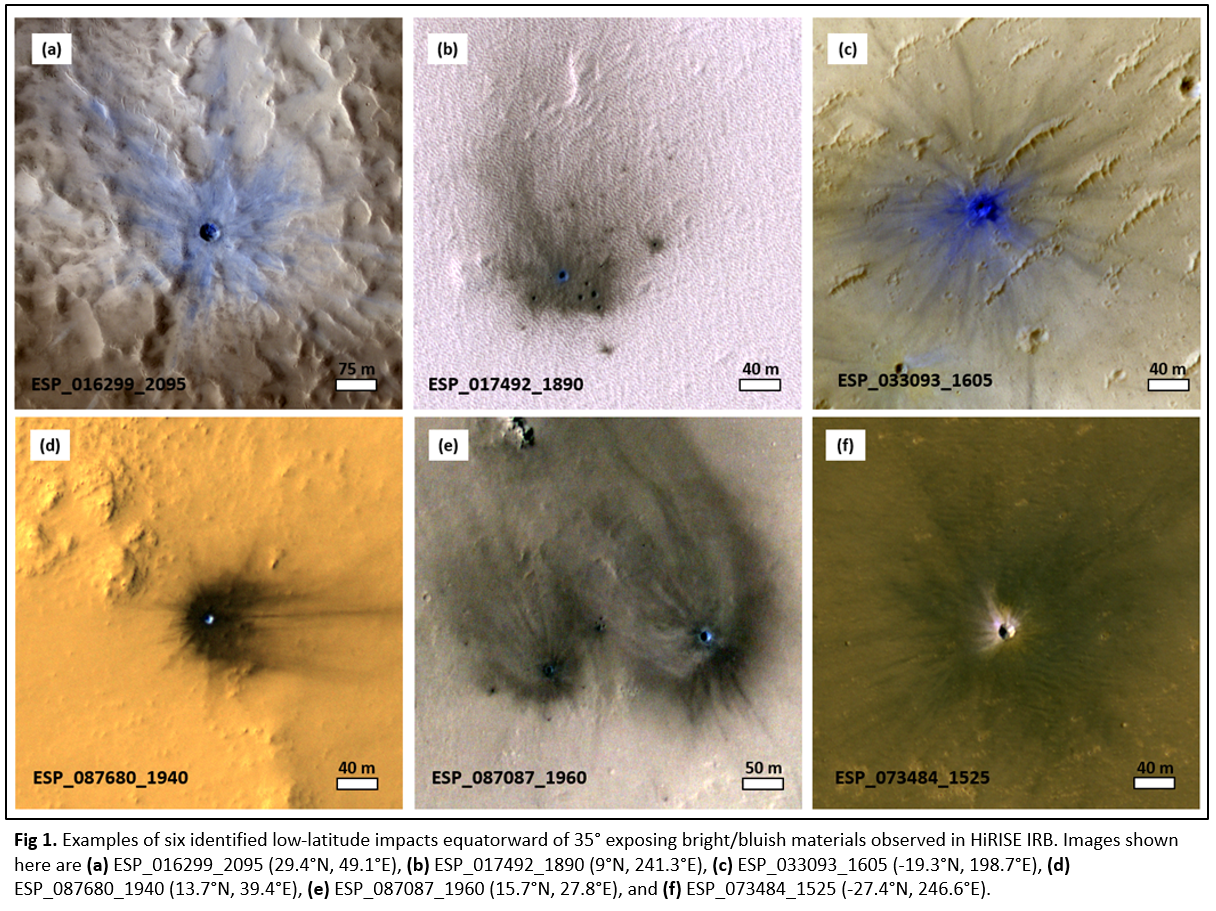
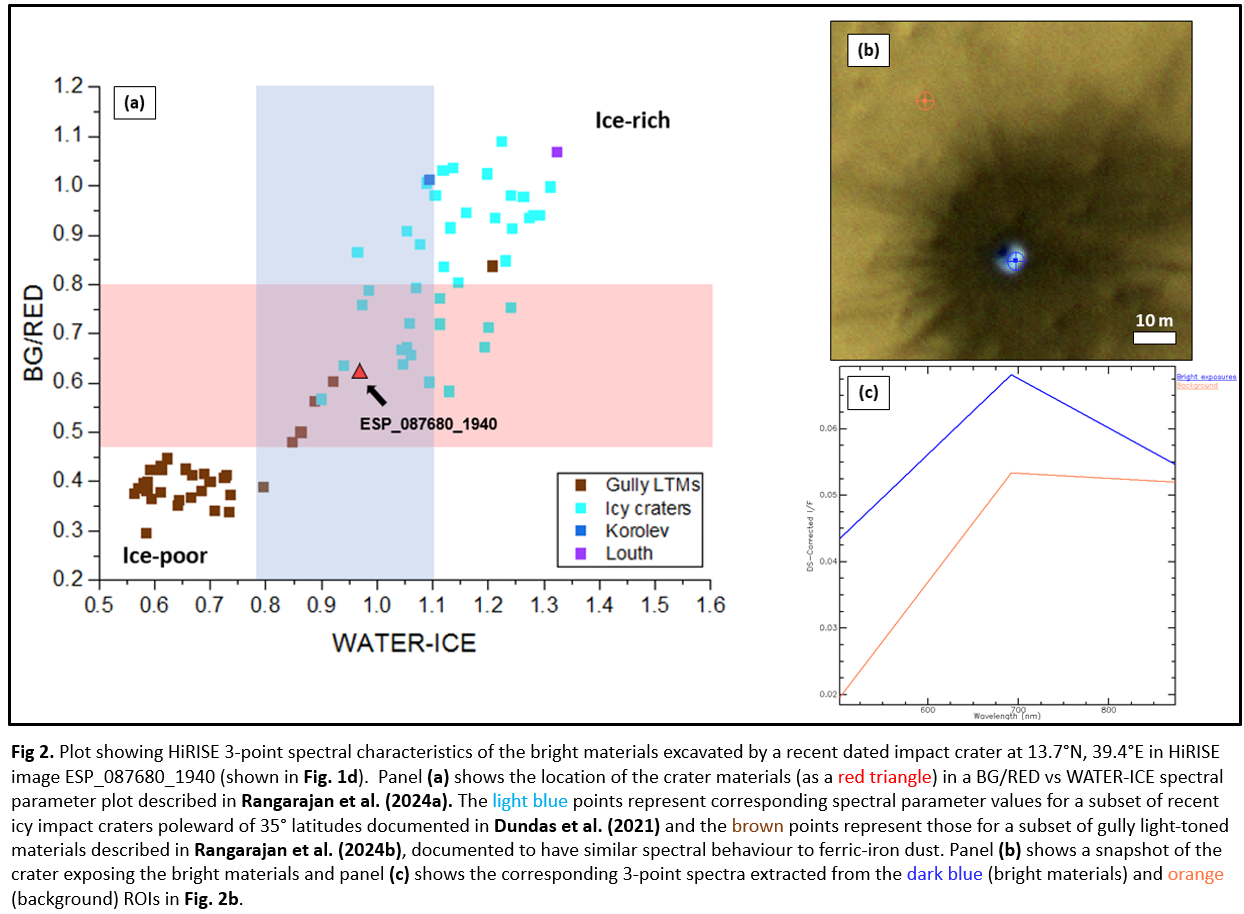
Broadly, two morphological classes are observed: (1) craters with bluish materials distributed across much of the ejecta blanket or in a continuous zone surrounding the crater rim (e.g., Fig. 1a, c) and (2) craters where bluish or bright materials are confined primarily to the interior cavity, sometimes accompanied by a thin, discontinuous halo of diffuse material not fully extending into the ejecta (e.g., Fig. 1d, f). The first category may suggest excavation of mafic-rich subsurface layers, while the second may point to the presence of localized bright ferrous-bearing materials or bright materials of other compositions exposed during impact. Alternatively, some of these materials may also represent post-impact deposition by aeolian processes, though in many cases the observed spectral characteristics, as inferred through the BG/RED and WATER-ICE spectral parameters, suggest that these are less consistent with dusty or pure mafic materials that typically lie completely in the ice-poor spectral zone (see Rangarajan et al., 2024a). One such example of a crater at 13.7°N exposing bright materials is shown in Fig. 2, whose spectral parameters, while not aligned with coarse-grained pure ice materials (i.e., ice-rich zone), are still consistent with some of the dusty ice exposed by confirmed icy impact craters (Dundas et al., 2021). However, such ice would be expected to rapidly sublimate enough to become indistinguishable from regolith (Smith et al., 2009), especially at equatorial latitudes. While similar spectral characteristics may result from other bright minerals, their specific composition still needs to be studied.
Conclusions:
The detection of some bright spots within low-latitude craters that are not fully consistent with dusty/mafic materials (as in Fig. 2) suggests that further investigation is essential to better understand the variety of minerals present at the equator. We are actively working to complete the database of these craters, and future analyses will also explore whether any spatial distribution patterns emerge among the bluish-toned impacts.
References:
Bickel et al. (2025), GRL 52, 1-10. https://doi.org/10.1029/2024GL109133
Boynton et al. (2002), Science 297, 81-85. https://doi.org/10.1126/science.1073722
Daubar et al. (2022), JGR 127, 1-21. https://doi.org/10.1029/2021JE007145
Dundas et al. (2021), JGR: Planets 126, 1-28. https://doi.org/10.1029/2020JE006617
Dundas et al. (2023), GRL 50, 1-9. https://doi.org/10.1029/2022GL100747
Malin et al. (2007), JGR 112, E05S04. https://doi.org/10.1029/2006JE002808
McEwen et al. (2007), JGR 112, E05S02. https://doi.org/10.1029/2005JE002605
Mouginot et al. (2010), Icarus 210, 612-625. https://doi.org/10.1016/j.icarus.2010.07.003
Pathare et al. (2018), Icarus 301, 97-116. https://doi.org/10.1016/j.icarus.2017.09.031
Posiolova et al. (2022), Science 378, 412-417. https://doi.org/10.1126/science.abq7704
Putzig et al. (2014), JGR 119, 1936-1949. https://doi.org/10.1002/2014JE004646
Rangarajan et al. (2024a), Icarus 419, 115849. https://doi.org/10.1016/j.icarus.2023.115849
Rangarajan et al. (2024b), 10th Intl. Conf. on Mars, Abstract #3224. https://www.hou.usra.edu/meetings/tenthmars2024/pdf/3224.pdf
Smith et al. (2009), Science 325, 58-61. https://doi.org/10.1126/science.1172339
Wojcicka et al. (2024), EPSC 2024, Abstract #771, https://doi.org/10.5194/epsc2024-771
How to cite: Rangarajan, V. G., Dundas, C. M., Daubar, I. J., Bickel, V. T., and Tornabene, L. L.: Observations and systematic documentation of relatively bright/bluish materials within the cavity and ejecta of recent low-latitude impact craters on Mars, EPSC-DPS Joint Meeting 2025, Helsinki, Finland, 7–12 Sep 2025, EPSC-DPS2025-1240, https://doi.org/10.5194/epsc-dps2025-1240, 2025.


