
 1,2,3,4,5,9,10,11,12,13,14,15,3,4,17,18
- 1University of Craoiva, Department of Physics, Craiova, Romania (popescu.marcel1983@gmail.com)
- 2Astronomical Institute of the Romanian Academy, Bucharest, Romania
- 3Instituto de Astrofísica de Canarias (IAC), Tenerife, Spain
- 4Departamento de Astrofísica, Universidad de La Laguna, Tenerife, Spain
- 5ESA, European Space Astronomy Centre (ESAC), Madrid, Spain
- 6Department of Mechatronics, Optics and Engineering Informatics, Budapest University of Technology and Economics, Budapest, Hungary
- 7Aurora Technology B. V. for ESA, ESAC, Madrid, Spain
- 8Starion Group for ESA, Madrid, Spain
- 9Department of Earth and Planetary Science, The University of Tokyo, Bunkyo, Tokyo, Japan
- 10School of Electrical Engineering, Aalto University, Finland
- 11Astronomical Institute of the Czech Academy of Sciences, Fričova 298, 25165 Ondřejov, Czech Republic
- 12Institute of Space and Astronautical Science, Japan Aerospace Exploration Agency (JAXA), Sagamihara, 252-5210 Kanagawa, Japan
- 13Department of Physics and Astronomy, Padova University, Vicolo dell'Osservatorio 3, 35121 Padova, Italy
- 14INAF-Astrophysical Observatory of Arcetri, Italy
- 15Center for Space and Habitability, University of Bern, Switzerland
- 16University of Bern, Bern, Switzerland
- 17Institute of Astrophysics and Planetary Science-INAF, Rome, Italy
- 18Université Côte d'Azur, Observatoire de la Côte d'Azur, CNRS, Lagrange Laboratory
On March 12, 2025, the ESA Hera mission performed a flyby of Mars on the way to its target, the binary asteroid system Didymos–Dimorphos. This event provided a unique opportunity to acquire spectral data (within the 0.65–0.96 micron wavelength range) and high-resolution images of the far side of the Martian moon Deimos. The observations were conducted using the HyperScout-H (HS-H) instrument, the hyperspectral imager aboard the Hera spacecraft. Simultaneously, the mission's other two instruments, the Asteroid Framing Cameras (AFC) and the Thermal Infrared Imager (TIRI), also collected data on this small, irregularly shaped natural satellite of Mars.
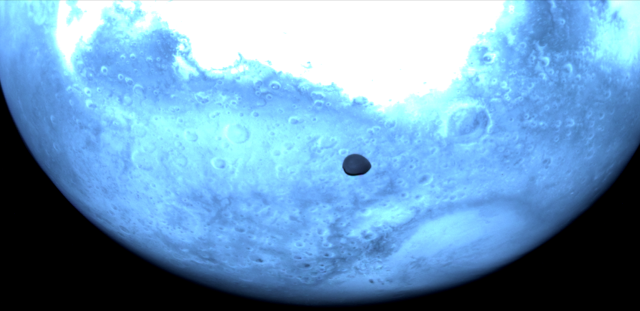
Fig.1 A false-color image of Mars and Deimos was generated for public outreach using observations acquired by the HS-H instrument. In this visualization, the color channels were shifted: blue corresponds to 0.65 µm, while red represents 0.96 µm. Deimos appears black due to albedo differences compared to Mars surface.
The composition and geomorphology of Deimos have remained unclear despite multiple observations acquired over recent decades. Images obtained by various Mars missions reveal a low-albedo object (~0.08), while spectra acquired from both Earth-based observatories and space missions resemble those of C-, X-, and D-type asteroids (e.g., Fraeman et al. 2014; Takir et al. 2021). Furthermore, Deimos is tidally locked with Mars, orbiting at 6.92 Mars radii on an almost circular orbit (eccentricity 0.00024), inclined at 1.79° (with respect to equatorial plane). These properties are the key point for understanding the origin of this natural satellite. The leading hypotheses are: (1) asteroid capture, suggested by its spectral similarity to carbonaceous asteroids; and (2) formation from a giant impact, supported by the regularity of its orbit (e.g., Kuramoto 2024 and references there in).
The HS-H instrument acquired three images of Deimos. The highest-resolution image (Fig. 1) was obtained when the spacecraft was at a distance of 1024 km from the object, at a phase angle of approximately 15°. Two additional lower-resolution images were captured before, from distances of 8800 km and 6200 km and at phase angles of 2–3°.
The HS-H instrument is based on a 5 × 5 pattern of narrowband filters (defining a macropixel) placed and repeated over the CMOS detector pixels (referred to here as subpixels). This configuration enables the instrument to sample the spectrum of each surface patch between 0.65 and 0.96 microns across 25 spectral channels. As a result, HS-H simultaneously captures both spectral and imaging data. The highest-resolution image achieved a spatial resolution of approximately 134 meters per subpixel and primarily covers the far side of Deimos, an area that had never before been imaged in these wavelengths.
The raw images were processed using the HS-H instrument pipeline. Calibrations included bias and dark current subtraction, flat-field correction, and conversion to radiance factor (RADF). The result for the high-resolution image is shown in Fig. 2. Additionally, photometric corrections were applied to account for varying illumination conditions. Spectra corresponding to each macropixel were retrieved and analyzed in relation to the geomorphological properties of the surface. The spectra were compared with those reported by other instruments for Deimos inner side, such as the Colour and Stereo Surface Imaging System (CaSSIS) aboard the ExoMars Trace Gas Orbiter mission. These results will be presented and discussed with regard to their implications for the history of Deimos.

Fig. 2 Radiance factor for each subpixel (note that subpixels correspond to different wavelength channels arranged in a 5x5 pattern).
References
1. Fraeman A. A., et al. (2014), Icarus, 229, 196–205. https://doi.org/10.1016/j.icarus.2013.11.021
2. Takir D., et al. (2022), Icarus, 371, 114691. https://doi.org/10.1016/j.icarus.2021.114691
3. Kuramoto K. (2024), Annual Review of Earth and Planetary Sciences, 52(1), 495–519. https://doi.org/10.1146/annurev-earth-040522-110615
How to cite: Popescu, M., de León, J., Prodan, G. P., Küppers, M., Kovács, G., Nagy, B. V., Grieger, B., Escalante López, A., Sugita, S., Kohout, T., Korda, D., Tatsumi, E., Lazzarin, M., Farina, A., Poggiali, G., Bickel, V. T., Raducan, S. D., Licandro, J., Palomba, E., and Michel, P.: Spectral Characterization of the Far Side of Deimos Using the HyperScout-H Instrument Aboard the ESA Hera Spacecraft, EPSC-DPS Joint Meeting 2025, Helsinki, Finland, 7–13 Sep 2025, EPSC-DPS2025-1250, https://doi.org/10.5194/epsc-dps2025-1250, 2025.


