
 2,3,
2,3,- 1Southwest Research Institute, Boulder, CO, USA (jessup@boulder.swri.edu)
- 2Institut d'Aéronomie Spatiale de Belgique, Brussels, Belgium (arnaud.mahieux@aeronomie.be)
- 3LATMOS, Guyancourt, France (emmanuel.marcq@latmos.ipsl.fr)
- 4Space Science Institute, Boulder, CO, USA (fmills@SpaceScience.org)
The composition and chemical processing occurring within the Venus atmosphere is derived by a combination of direct observation (both in-situ and remote) and chemical and climate modeling (Widemann et al. 2024, Marcq et al. 2018). Chemical modeling and atmospheric properties retrievals from observations are interdependent efforts. Venus’s bulk atmosphere is composed of CO2 (96.5%) and N2 (3.5%), while SO2 (~0.015%), Argon (0.007%) and water (0.002%) round out the top 5 gas species present in the Venus atmosphere. Observations and chemical modeling indicate that Venus's clouds also host a myriad of sulfur, oxygen, nitrogen, hydrogen, chlorine, carbon and oxygen trace gas species. While it is understood that the Venus clouds are dominantly composed of H2SO4 aerosol, and that the H2SO4 gas within the atmosphere is formed by chain reaction of SO2 photolysis leading to formation of SO3 and the interaction of SO3 with H2O—many questions remain about what controls the abundance of H2SO4, H2O and SO2 in the Venus atmosphere (Marcq et al. 2018, Bierson et al. 2020, Rimmer et al. 2021, Dai et al. 2022). Unequivocal answers to these questions are dependent on how precisely we can identify and quantify the other trace gas and aerosol forming species present in the atmosphere and their propensity to interact with Venus’s sulfur, oxygen and water budgets. (Mogul et al. 2021, Rimmer et al. 2021, Jiang et al. 2023, Jessup et al. 2020)
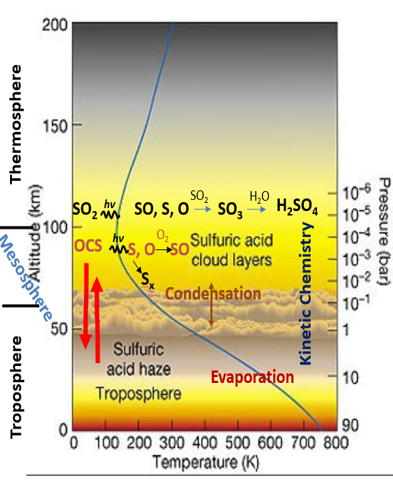
Progress in resolving these questions is being made as chemical and climate modeling become increasingly sophisticated (Stolenzbach et al. 2023, Dai et al. 2022, Dai et al. 2024). Likewise, efforts to advance and improve lab and theoretical studies of the physical properties of gases and aerosols that may be present in the Venus atmosphere are on-going (Frandsen et al. 2024, Skog et al. 2024, Jiang et al. 2023, Heays et al. 2017 Heays et al. 2023). These advances and the anticipation of several new Venus missions, motivates the review/re-analysis of several previously obtained remote/in-situ datasets (Mogul et al. 2021, Mahieux et al. 2024, Mahieux et al. 2023, Lincowski et al. 2021). As a result, several sulfur-based species previously not conclusively observed have now been definitively detected within remote sensing data (Mahieux et al. 2023), while debate rages on about species detected via in situ observation opportunities (Lincowski et al. 2021, Mogul et al. 2021).
Several gases recently positively detected by SOIR have absorption at UV wavelengths coincident with previously obtained Hubble Space Telescope spectra (Jessup et al. 2015, Jessup et al. 2020). We present a summary of the detectability of these species in the previously obtained Hubble data. We discuss what these and the recent SOIR retrievals may mean for anticipated monitoring of the Venus cloud top and middle atmosphere at UV and other wavelengths via the EnVision/VenSpec instrument (Marcq et al. 2021). We also discuss to what extent the detectability of these species at UV wavelengths impacts open controversial in-situ detections (Mogul et al. 2021); especially those that may directly impact the sulfur cycle or other cloud level atmospheric constituents (Rimmer et al. 2021).
REFERENCES:
Widemann, T., Smrekar, S.E., Garvin, J.B. et al. Venus Evolution Through Time: Key Science Questions, Selected Mission Concepts and Future Investigations. Space Sci Rev 219, 56 (2023). https://doi.org/10.1007/s11214-023-00992-w
Marcq, E., Mills, F. P., Parkinson, C., Vandaele, A.C. Composition and Chemistry of the Neutral Atmosphere of Venus space Sci Rev (2018) 214:10 DOI 10.1007/s11214-017-0438-5.
Bierson, C. J., & Zhang, X. (2020). Chemical cycling in the venusian atmosphere: A full photochemical model from the surface to 110 km. Journal of Geophysical Research: Planets, 125, e2019JE006159. https://doi.org/10.1029/2019JE006159
Rimmer, P. B. , Jordan, S., Constantinou, T., Woitke, Shorttle, O. , Hobbs, R., and Paschodimas, A., Hydroxide Salts in the Clouds of Venus: Their Effect on the Sulfur Cycle and Cloud Droplet pH. Planetary Science Journal, 2:133 (25pp), 2021 https://doi.org/10.3847/PSJ/ac0156
Dai, L., Zhang, X., Shao, W. D., Bierson, C. J., & Cui, J. (2022). A simple condensation model for the H2SO4-H2O gas-cloud system on Venus. Journal of Geophysical Research: Planets, 127, e2021JE007060. https://doi.org/10.1029/2021JE007060
Dai, L., Shao, W. , and Sheng, Z., An investigation into Venusian atmospheric chemistry based on an open-access photochemistry-transport model at 0–112 km. Astronomy &Astrophysics, 689, A55 (2024) https://doi.org/10.1051/0004-6361/202450552
Jiang, C., Rimmer, Paul B. Rimmer, et al. Iron-sulfur chemistry can explain the ultraviolet
absorber in the clouds of Venus., Sci. Adv. 10, eadg8826 (2024)
Mogul, R. Limaye S.L., Way, M. J., Cordova, J. A., (2021)Venus' Mass Spectra Show Signs of Disequilibria in the Middle Clouds Geophys. Res. Letters. 48, Issue7, 2021e2020GL091327, https://doi.org/10.1029/2020GL091327
Jessup, K.-L., Marcq, E., Bertaux, J.-L., Mills, F.~P., Limaye, S., Roman, A.2020.\On Venus' cloud top chemistry, convective activity and topography: A perspective from HST. Icarus 335. doi:10.1016/j.icarus.2019.07.006
Stolzenbach, A., Lefèvre, F., Lebonnois, S., Määttänen, A., Three-dimensional modeling of Venus photochemistry and clouds, Icarus, Volume 395, 2023,115447, https://doi.org/10.1016/j.icarus.2023.115447.
Heays, A. N., Stark, G., Lyons, J. R., de Oliveira, N., Lewis, B. R., & Gibson, S. T. (2022). https://doi.org/10.1080/00268976.2022.2153092
Heays,A., Bosman, A.D. and E.F. Dishoeck Photodissociation and photoionization of atoms and molecules of astrophysical interest, Astronomy &Astrophysics 602,A105(2017) DOI:10.1051/0004-6361/201628742
Skog, R., Frandsen, B., Kurten, T., 2024. Simulating UV-VIS Spectra for Polysulfur Species in the Venusian Atmosphere.E GU General Assembly Conference Abstracts. doi:10.5194/egusphere-egu24-8798
Frandsen, B. and Skog, R.: Breaking New Ground in Venusian Atmospheric Sulfur Chemistry, EGU General Assembly 2024, Vienna, Austria, 14–19 Apr 2024, EGU24-7533, https://doi.org/10.5194/egusphere-egu24-7533, 2024.
Emmanuel Marcq, Franck Montmessin, Jérémie Lasue, Bruno Bézard, Kandis Lea Jessup, et al. Instrumental requirements for the study of Venus' cloud top using the UV imaging spectrometer VeSUV. Advances in Space Research, 2021, 68 (1), pp.275-291. 10.1016/j.asr.2021.03.012. insu-03179739
Jessup, K. L. Emmanuel Marcq, Franklin Mills. Arnaud Mahieux, et al. Coordinated Hubble Space Telescope and Venus Express Observations of Venus’ upper cloud deck Icarus 258 (2015) 309–336 http://dx.doi.org/10.1016/j.icarus.2015.05.027
Andrew P. Lincowski, Victoria S. Meadows, David Crisp, et al., 2021 ApJL 908 L44DOI 10.3847/2041-8213/abde47
Mahieux, S. Viscardy, K.L. Jessup, F.P. Mills, et al. H2CO, O3, NH3, HCN, N2O, NO2, NO, and HO2 upper limits of detection in the Venus lower-mesosphere using SOIR on board Venus Express. https://doi.org/10.1016/j.icarus.2023.115862
How to cite: Jessup, K. L., Mahieux, A., Marcq, E., Bhushan, A., and Mills, F.: Prospective Venus Cloud trace species detectability as inferred from Hubble, EPSC-DPS Joint Meeting 2025, Helsinki, Finland, 7–12 Sep 2025, EPSC-DPS2025-1266, https://doi.org/10.5194/epsc-dps2025-1266, 2025.


