
 1,1,2,
- 1Rheinisches Institut für Umweltforschung a. d. Universität Köln, Planetenforschung, Cologne, Germany (peterk@uni-koeln.de)
- 2Swedish Institute of Space Physics, Kiruna, Sweden
- 3Universität der Bundeswehr München, Neubiberg, Germany
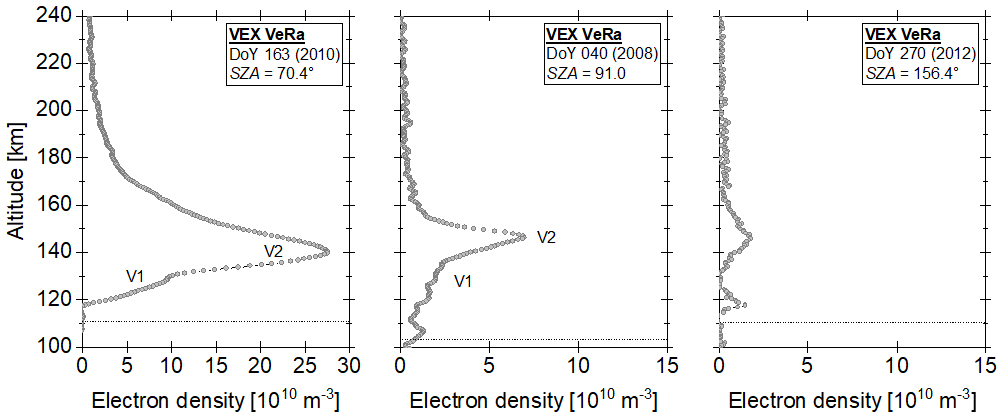
Fig. 1: Venus ionosphere observed by VEX VeRa for solar zenith angles (SZAs) on the (a) dayside, (b) terminator, and (c) nightside.The horizontal dashed line indicates the lowest valid altitude of the ionospheric observation.
The Venus Express (VEX) spacecraft orbited Venus from 2006 to 2014. The VeRa experiment [1] onboard VEX utilized radio science techniques to investigate the planet’s ionospheric electron density as well as the pressure, density and temperature of the lower neutral atmosphere.
Figure 1a presents a typical profile of the undisturbed dayside ionosphere of Venus. The lower ionosphere is dominated by photochemical processes and characterized by two major features. The ionospheric peak region (V2) mainly results from photoionization by solar EUV irradiation, while the weaker secondary V1 region originates from the primary and secondary ionization caused by solar X-rays [2]. The electron density of the lower dayside ionosphere shows a strong dependence on solar irradiation at wavelengths shorter than 95 nm [3]. Close to the planetary terminator, VeRa observes a substantial ionosphere (Fig. 1b) where the individual V2 and V1 regions can still be distinguished. On the deep nightside, VeRa observations reveal highly variable ionospheric structures when the noise level of the observations is low (Fig. 1c).
In this study, 9 years of VEX VeRa observations are used to investigate the variability of the Venus ionosphere across the dayside, terminator, and nightside regions. The derived ionospheric properties are compared with accompanying measurements of the solar wind dynamic pressure (from VEX ASPERA4 [4]), solar irradiation flux (FISM V2 model [5]), and results from a ray-tracing analysis, in order to improve our understanding of Venus’ ionospheric variability.
.
References
[1] Häusler et al. (2006) PSS 54 (13-14)
[2] Fox (2007) PSS 55 (12)
[3] Peter et al. (2014) Icarus 233
[4] Barabash et al. (2007) JGR Planets 112 (E4)
[5] Chamberlin et al. (2020) Space Weather 18 (12)
How to cite: Peter, K., Pätzold, M., Tellmann, S., Oschlisniok, J., Futaana, Y., and Häusler, B.: Exploring the variability of the Venus ionosphere with the Venus Express VeRa radio science experiment, EPSC-DPS Joint Meeting 2025, Helsinki, Finland, 7–12 Sep 2025, EPSC-DPS2025-1267, https://doi.org/10.5194/epsc-dps2025-1267, 2025.


