
 1,3,4,5,6,7
- 1UPV/EHU, Escuela Ingernieria de Bilbao, Fisica Aplicada, Bilbao, Spain (arrate.antunano@ehu.eus)
- 2Instituto de Astrofísica de Andalucía (IAA/CSIC), Granada, Spain
- 3LIRA, Observatoire de Paris, Université PSL, CNRS, Sorbonne Université, Université Paris Cité, 5 place Jules Janssen, 92195 Meudon, France
- 4Department of Astronomy, University of California, Berkeley, CA, USA
- 5Department of Earth & Planetary Science, University of California, Berkeley, CA, USA
- 6Jet Propulsion Laboratory, California Institute of Technology, CA, USA
- 7School of Physics and Astronomy, University of Leicester, UK
Elongated cloud structures in Jupiter’s polar and subpolar regions have been observed in JunoCam images [1]. These clouds present a variety of sizes and colours, and are mainly observed near the terminator, suggesting that these clouds are located at high altitudes. These elongated and elevated clouds could be divided in three main groups depending on their albedo: (i) high albedo clouds; (ii) low albedo clouds; and (iii) high albedo clouds featuring large shadows. So far, their nature remains largely unexplained. Similarly, JWST/NIRCam images of Jupiter at wavelengths between 1.65 µm and 3.60 µm captured on July 22, 2022 as part of the Early Release Science program 1373 [2], also showed dark and bright filamentary structures on Jupiter’s polar and subpolar regions. Among the diverse observed elongated structures, we focus this study on three different phenomena (all indicated in Figure 1).
The first feature is a low-albedo, elongated feature located at the sub-polar region near 50°-60° latitude south in 3.35-µm and 3.6-µm images (sensing stratospheric hazes and tropospheric clouds). This feature displays a fast meridional movement with peak velocities of 30 m/s and does not follow the usual zonal movement of Jupiter’s troposphere and stratosphere. However, the most poleward extend of this feature (near -60° latitude) follows a zonal flow. This, together with its shape, suggest that this perturbation was originated near -60° latitude and rapidly propagated equatorward. Additionally, the observed fast meridional movement hints at this feature being located at high altitudes, above the zonal flow regime. Analysis of the aurora activity and Io’s footprint compared with the polar most latitude of the dark feature and its width open the possibility that this feature might be directly related to Io’s footprint where the flux of energetic particles in Jupiter’s upper stratosphere might locally modify the chemistry of the atmosphere (see Figure 2).
The second phenomena analysed in this study are low-albedo features present at the boundary of the polar hazes in the north polar region at 1.64 µm, 2.12 µm, 3.35 µm and 3.6 µm. Unlike in the south polar region, the northern high latitudes display elongated and straight dark filaments that move with the background, creating a boundary-like structure. Similar features have previously been observed in JunoCam images at the same latitudes, appearing as slightly bright, narrow, and elongated clouds. The origin of these features, unlike the dark filament in the southern hemisphere, does not seem to be related aurora or activity from the satellite’s footprints.
The third feature is a bright arc-like structure observed in the northern polar region at latitudes higher than 70° in 3.35-µm and 3.6-µm images. Due to the lack of image pairs at 3.6 µm that could be used to track motions, we are not able to characterise its dynamics. So far, the presence of this feature remains a mystery.
In this presentation, we will share an analysis of these rare structures in Jupiter’s polar and subpolar regions, characterising their sizes, distribution and dynamics, and we will also propose different candidates that could explain the nature of these features.
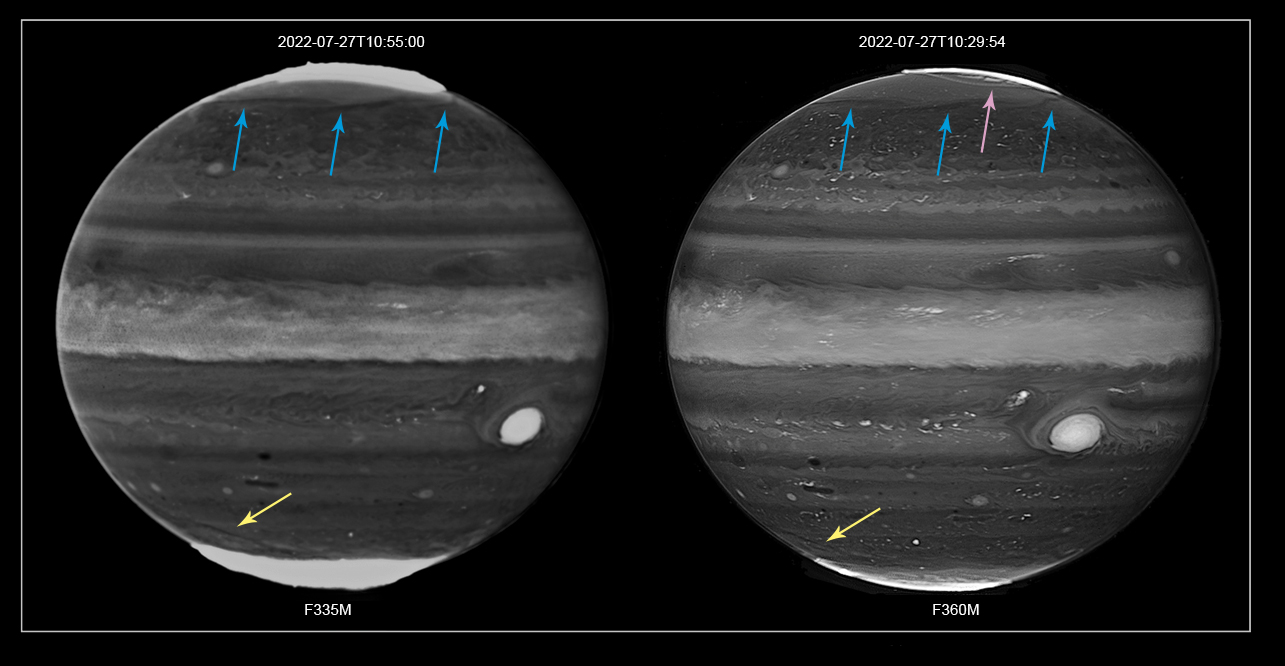
Figure 1. Images of Jupiter taken by NIRCAM onboard the JWST at 3.35 µm (left) and 3.60 µm (right), showing the diverse elongated featured analysed in this study.
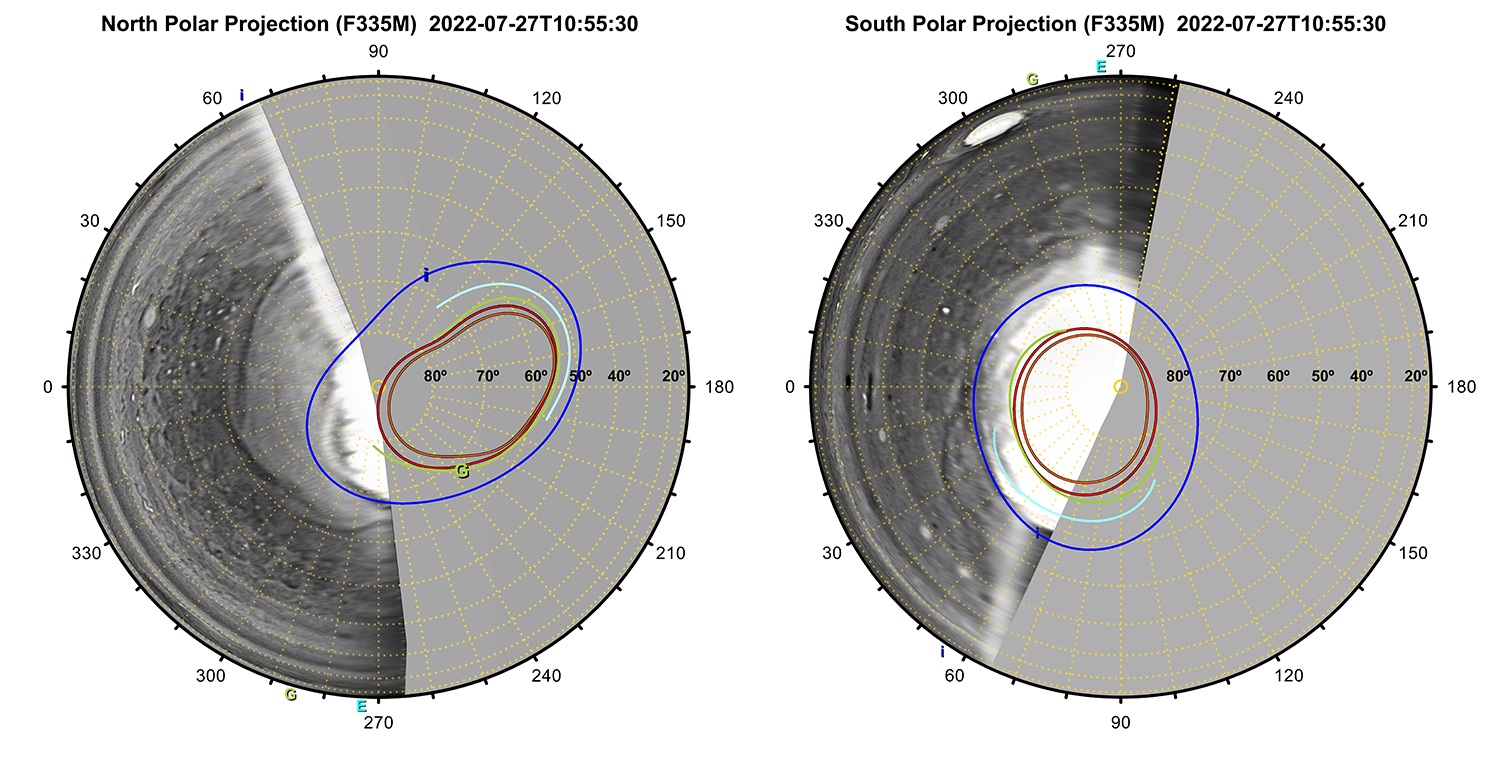
Figure 2. Polar projections at 3.35 µm showing the potential relation of the dark filament in the south polar region and the bright arc in the north polar region with Io’s footprint (indicated in dark blue). The red solid lines represent the average position of the aurora, the light blue solid line represent Europa’s footprint and the green solid line represents Ganimede’s footprint.
References: [1] Hueso, R., Sánchez-Lavega, A., Fouchet, T. et al. An intense narrow equatorial jet in Jupiter’s lower stratosphere observed by JWST. Nat Astron 7, 1454–1462 (2023). [2] Orton, G.S., Rogers, J. et al. Jupiter’s High-Altitude Hazes as Observed by JunoCam. Geophysical Research Abstracts, Vol. 21, EGU2019-3188 (2019).
How to cite: Antunano, A., Rodriguez-Ovalle, P., Hueso, R., Fouchet, T., Sánchez-Lavega, A., de Pater, I., Orton, G. S., and Fletcher, L. N.: Filamentary structures in Jupiter’s polar regions, EPSC-DPS Joint Meeting 2025, Helsinki, Finland, 7–13 Sep 2025, EPSC-DPS2025-1275, https://doi.org/10.5194/epsc-dps2025-1275, 2025.


