
 1,3,3,4
- 1Rheinishes Institut für Umweltforschung a. d. Universität Köln, Planetenforschung, Cologne, Germany (peterk@uni-koeln.de)
- 2Department of Physics and Astronomy, West Virginia University, Morgantown, WV, USA
- 3Laboratory for Atmospheric and Space Physics, University of Colorado, Boulder, USA
- 4Swedish Institute of Space Physics, Kiruna, Sweden
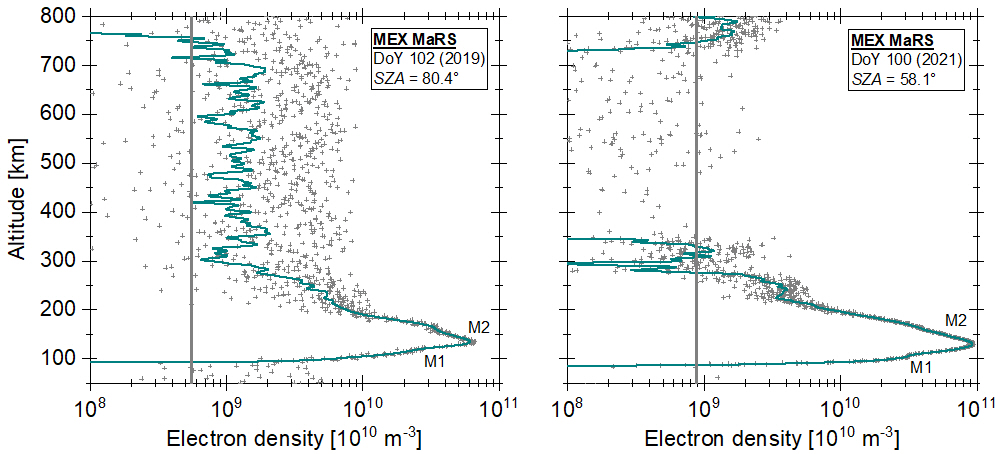
Fig. 1: MEX MaRS observation of (a) the extended Mars dayside ionosphere on Day of Year (DoY) 102 (2019) and (b) the compressed dayside ionosphere on DoY 100 (2021). Grey crosses are the original data points, while the blue line indicates the smoothed data. The vertical grey line indicates the 1ˑσ noise level of the observation.
The Mars Express (MEX) spacecraft has been orbiting Mars since December 2003. Its MaRS (Mars Radio Science) experiment uses spacecraft-Earth radio occultations to provide information about the ionospheric electron density and the pressure, density and temperature of the lower neutral atmosphere. However, due to geometrical constraints, these remote-sensing observations are never accompanied by simultaneous in-situ observations at the same position from MEX itself.
Since the arrival of the MAVEN spacecraft in 2014, new opportunities have emerged to complement MEX MaRS data with in-situ observations. This study compares the coordinates of MEX MaRS dayside ionospheric occultation events (from 2014 through the end of 2022) with MAVEN's pericenter positions to identify instances where the two datasets are spatially and temporally comparable.
The analysis shows that opportunities where MEX MaRS and MAVEN pericenter observation are comparable, are extremely rare. This work presents a detailed case study of two events where meaningful comparisons can be made under the condition that the planetary ionosphere remained sufficiently stable (Fig. 1).
Combining MEX radio science observations with MAVEN's in-situ data enables more comprehensive scientific insights into Martian ionospheric dynamics—insights that are otherwise difficult to obtain. Future and proposed multi-spacecraft missions like EscaPADE and M-MATISSE will be instrumental in expanding our understanding of planetary environments through coordinated observations.
How to cite: Peter, K., Fowler, C., Pätzold, M., Andersson, L., Ramstad, R., Tellmann, S., and Holmström, M.: Multi-spacecraft observations of the Mars dayside ionosphere: a case study with MEX and MAVEN, EPSC-DPS Joint Meeting 2025, Helsinki, Finland, 7–12 Sep 2025, EPSC-DPS2025-1289, https://doi.org/10.5194/epsc-dps2025-1289, 2025.


