
 1,2,1,1,2,
- 1University of Bern, Physics Institute, Space Research and Planetology Division, Bern, Switzerland (linus.stoeckli@unibe.ch)
- 2University of Applied Sciences and Arts Western Switzerland Valais, HES-SO Valais-Wallis, Sion, Switzerland
- 3Institute of Applied Sciences, University of Bern, Bern, Switzerland
Planetary formation theories aim to explain the evolution of planets from the proto-planetary disk. Comets are thought to be primitive remnants that never accreted into planets and now reside in the Oort cloud and Kuiper belt. Their highly elliptical orbits shield them from solar radiation for most of their lifetimes, preserving their original composition. As such, comets offer a unique window into the early Solar System. Investigating their internal structure and composition can provide critical tests for models of planetary formation.
Previous in-situ missions have employed infrared (IR) spectroscopy and ground-penetrating radar to study cometary nuclei. While radar can probe below the surface, its spatial resolution is limited by long wavelengths. Conversely, IR provides high spatial resolution but lacks subsurface penetration. Terahertz (THz) time-domain spectroscopy offers a promising middle ground, combining centimeter-scale penetration with millimeter-scale resolution. Moreover, key molecular species, such as amino acids detected on comets, exhibit distinctive absorption features in the THz range.
As part of the SUBICE project, we are investigating the suitability of THz time-domain spectroscopy for in-situ space applications. For that purpose, we built a laboratory setup called COCoNuT (Characteristic Observation of Cometary Nuclei using THz-spectroscopy) [1]. COCoNuT can simulate the conditions found on comets in a thermal vacuum chamber and houses a commercial THz time domain spectrometer. Using cometary simulants, we conduct proof-of-concept experiments to assess the viability of this technique for future space missions [2].
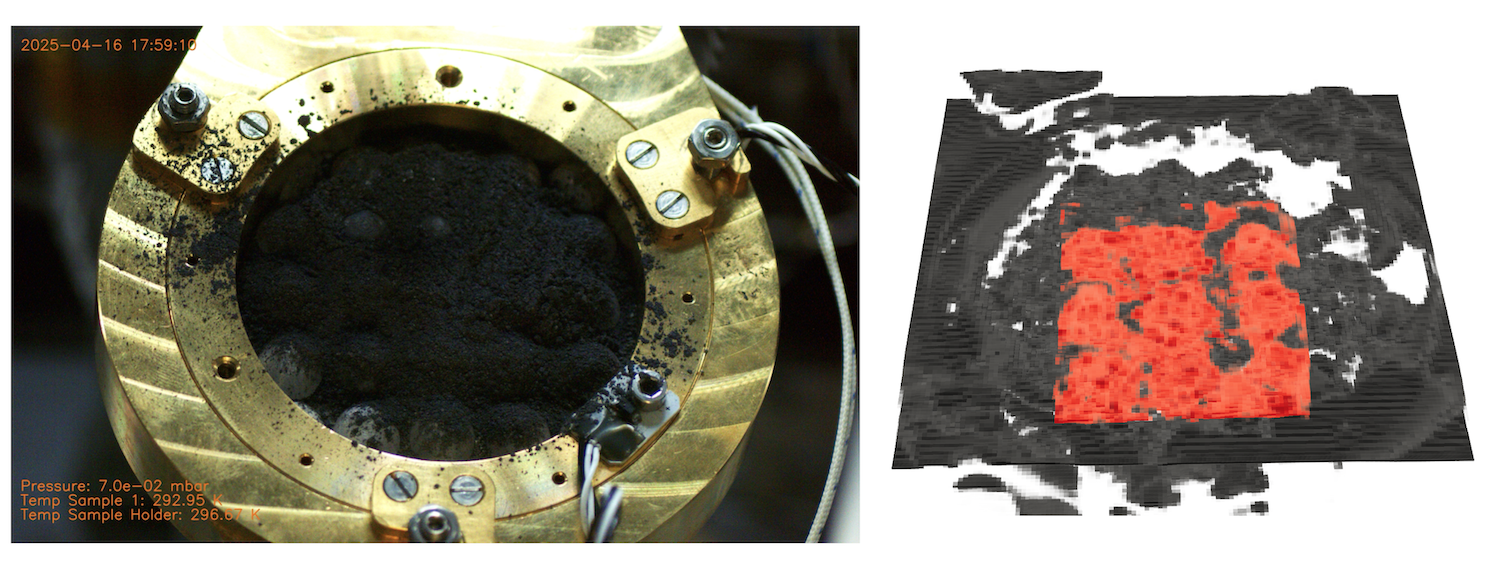
Figure 1: Pebble simulant printed out of Cyclic-Olefin-Copolymer (COC) and covered with cometary dust analogue (SiO2/charcoal, 9:1 mixture). The 3D THz scan with the reconstructed pebbles in red is shown to the right.
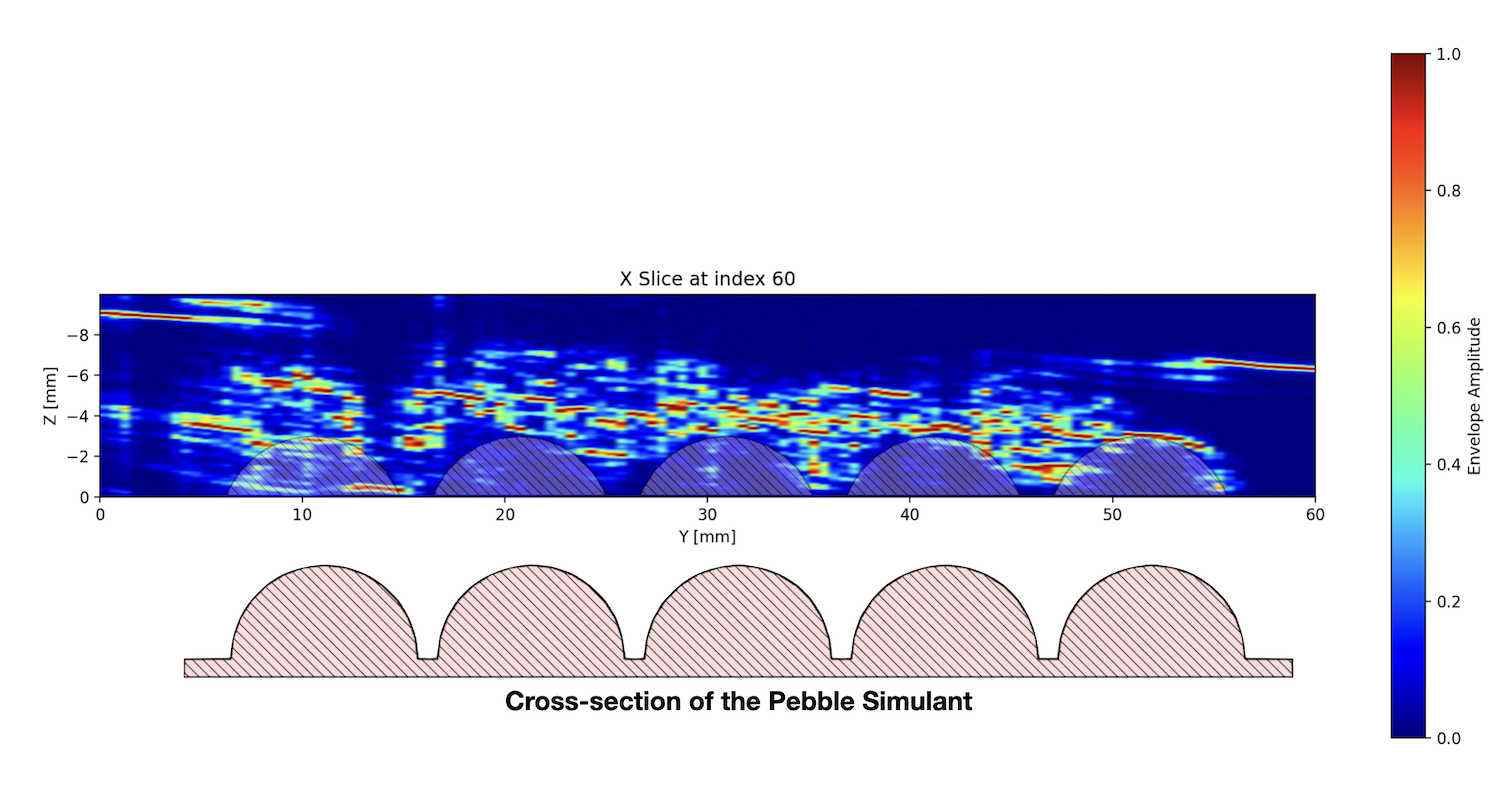
Figure 2: A slice of the cometary simulant scan. The cross section of the pebble simulant is shown below and also overlayed. The sample holder top surface is visible on the sides of the scan as a straight line. The pebbles are clearly visible as voids in the scan.
Initial measurements of ice-analogues and SiO2/charcoal dust shows that we can reconstruct pebbles located underneath the dust layer as shown in Figures 1 and 2.
We will present measurements with porous ice and ice pebbles along with olivine dust analogues.
References:
[1] Linus Leo Stöckli, Mathias Brändli, Daniele Piazza, Rafael Ottersberg, Antoine Pommerol, Axel Murk, Nicolas Thomas; Design and commissioning of a THz time-domain spectro-goniometer in a cryogenic comet simulation chamber. Rev. Sci. Instrum. 1 March 2025; 96 (3): 034502. https://doi.org/10.1063/5.0252742
[2] Pommerol, A., Jost, B., Poch, O. et al. Experimenting with Mixtures of Water Ice and Dust as Analogues for Icy Planetary Material. Space Sci Rev 215, 37 (2019). https://doi.org/10.1007/s11214-019-0603-0
How to cite: Stoeckli, L., Demion, A., Belousov, D., Meier, V., Nicollerat, M., Girard, H., Ottersberg, R., Pommerol, A., Moerschell, J., Murk, A., and Thomas, N.: The potential of in-situ THz-spectroscopy to resolve the subsurface structure of Comets, EPSC-DPS Joint Meeting 2025, Helsinki, Finland, 7–12 Sep 2025, EPSC-DPS2025-1297, https://doi.org/10.5194/epsc-dps2025-1297, 2025.


