
 1,1,1,2,4,5,6,
- 1Department of Physics, University of Helsinki, Helsinki, Finland
- 2Astronomical Observatory Institute, Adam Mickiewicz University, Poznań, Poland
- 3INAF, Osservatorio Astrofisico di Torino, Torino, Italy
- 4Observatoire de la Côte d’Azur, Nice, France
- 5Yunnan Observatories, Chinese Academy of Sciences, Kunming, People’s Republic of China
- 6University of Chinese Academy of Sciences, Beijing, People’s Republic of China
- 7Karman+, Broomfield, CO, United States
The Gaia Data Release 3 (DR3) contains high-precision sparse-in-time photometric data of more than 150 000 asteroids and low-resolution spectroscopy of more than 60 000 asteroids [1]. The wealth of asteroid data allows for the examination of asteroid classification using parameters derived from the asteroid lightcurves and their respective spectra.
MacLennan et al. [2] have derived asteroid shape and spin characteristics by modelling the Gaia DR3 photometric data with the lightcurve inversion algorithm developed by Muinonen et al. [3], starting from the genetic inversion by Cellino et al. [4]. We take the resulting linear photometric slopes and absolute magnitudes and combine them with the Gaia DR3 spectra of asteroids for which they are available. The absolute magnitudes are used together with the effective diameters reported in the Solar System Open Database Network SsODNet [5] to calculate geometric albedos, and a linear discriminant analysis (LDA) of the combined data is performed. Because we have geometric albedo information computed from the absolute magnitudes determined in the lightcurve inversion, the use of the Mahlke taxonomy [6] is best suited for the purpose of this research. Quality filtering of the photometric data and the availability of diameter information allowed the computation of geometric albedos in the Gaia G-band for 6205 asteroids [7], and the highest quality Gaia spectra for asteroids with a known Mahlke classification reduced the number of known objects down to 328. The results of the LDA can be seen in Figure 1.
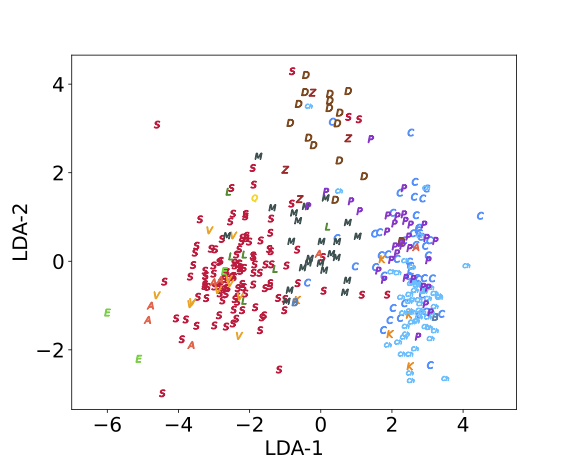
Figure 1: The combined data of linear photometric slope, geometric albedo and spectrum (from 418 nm to 770 nm) for 328 asteroids with a Mahlke classification plotted in the LDA space of the first two variables, LDA-1 and LDA-2. The letter markers represent the corresponding Mahlke class. The S-, Ch-, M-, and D-class asteroids appear to form clear groups, which is mostly demonstrated in the nearest neighbour classification results.
A nearest neighbor classifier is employed to determine how well the parameters classify asteroids in six Mahlke classes (S, Ch, C, P, M, and D). We achieve a classification accuracy of 92 % for known S-class asteroids and an accuracy of 85 % for the potentially hydrated Ch asteroids, which are of special interest to the asteroid mining industry. Given the three classification parameters, tentative class designations for 1668 previously unclassified asteroids are provided in the Mahlke taxonomy.
[1] P. Tanga et al., A&A, 674, (2023).
[2] E. MacLennan et al., in preparation.
[3] K. Muinonen et al., A&A, 642, (2020).
[4] A. Cellino et al., A&A, 687, (2024).
[5] J. Berthier et al., A&A, 671, (2023).
[6] M. Mahlke et el., A&A, 665, (2022).
[7] H. Pentikäinen et al., in preparation.
How to cite: Pentikäinen, H., MacLennan, E., Penttilä, A., Muinonen, K., Oszkiewicz, D., Cellino, A., Tanga, P., Wang, X., and Siltala, L.: Taxonomic classification of asteroids using Gaia DR3 data, EPSC-DPS Joint Meeting 2025, Helsinki, Finland, 7–12 Sep 2025, EPSC-DPS2025-1330, https://doi.org/10.5194/epsc-dps2025-1330, 2025.


