
 1,2,1,2,1,3,
- 1Belgian Institute for Space Aeronomy, Space Physics, Brussels, Belgium
- 2STAR Institute, University of Liège, Liège, Belgium
- 3Swedish Institute of Space Physics (IRF), Kiruna, Sweden
- 4Department of Physics and Astronomy, Western University, London, Ontario, Canada
- 5Institute for Earth and Space Exploration, Western University, London, Ontario, Canada
This study presents a significant advancement in reconstructing meteoroid trajectories and speeds using the Belgian RAdio Meteor Stations (BRAMS) forward scatter radio network. We introduce an improved method based on a novel extension of the pre-t0 phase technique, initially developed for backscatter radars, and adapt it for continuous wave forward scatter systems. This approach leverages phase information recorded before the meteoroid reaches the specular reflection point t0 to enhance speed estimations. Furthermore, we combine this newly determined pre-t0 speed with time of flight measurements to reduce uncertainties in the reconstructed meteoroid paths and velocities. The robustness of our method is assessed using Markov Chain Monte Carlo techniques and validated against optical observations from the CAMS-BeNeLux network.
Measurement uncertainties
A critical aspect of reliable trajectory reconstruction is the accurate characterization of measurement uncertainties, particularly for the times of flight (Δt) between receiving stations. The uncertainty σΔt is closely tied to the uncertainty in determining the specular timing t0 at each station. We developed a method to determine the uncertainty σt0 as a function of two parameters: the rise time of the meteor amplitude curve (trise) and the signal-to-noise ratio (SNR).
To derive this relationship, we performed a series of Direct Monte Carlo (DMC) simulations. For each combination of trise and SNR, ideal meteor echoes were generated using the Cornu Spiral model, including some diffusion. For each SNR value, a large number of noisy clones of the ideal echo were created by adding Gaussian noise. The t0 values were extracted from these noisy echoes using the same post-processing chain as real observations, and the statistical spread σt0 was computed.
Solver improvement
Building on the measured uncertainties, we integrate them directly into the trajectory reconstruction process by redefining the cost function used by the solver:

where w is a weight parameter balancing the influence of time of flight (Ltof) and pre-t0 speed (Lpt0) measurements:
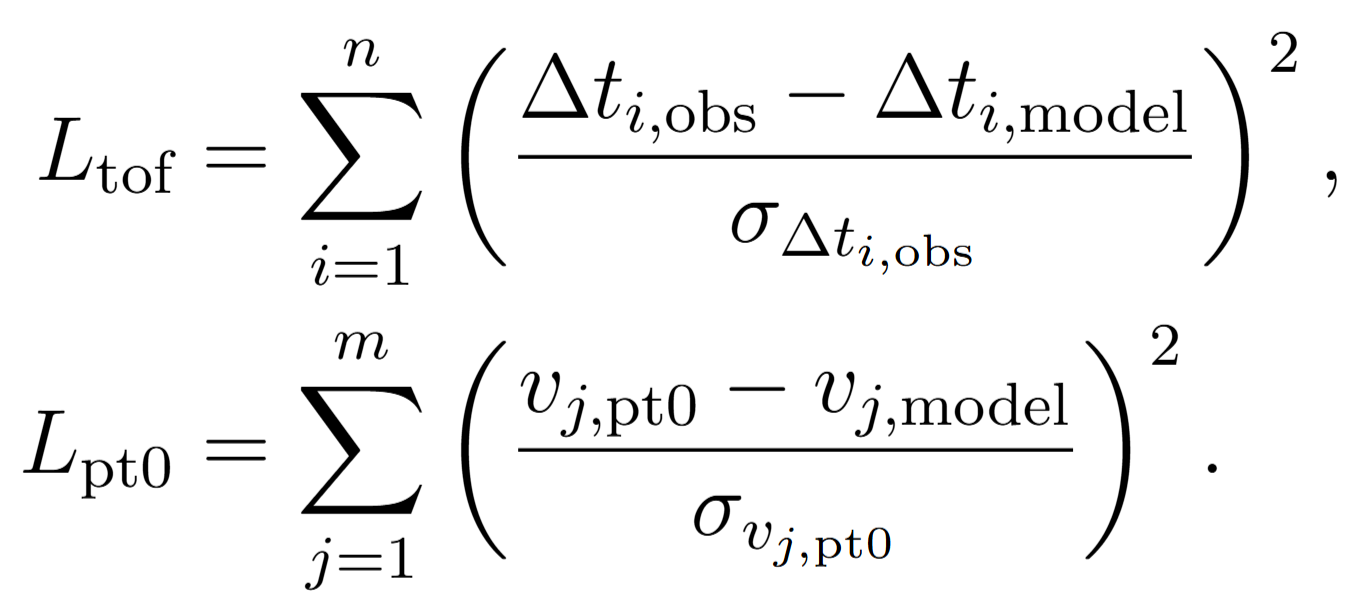
Optimizing this cost function across different values of w leads to the creation of a Pareto front representing the trade-off between minimizing the two components. The optimal solution is chosen at the "knee" of the curve, corresponding to the maximum curvature point.
Validation against optical observations
The reconstructed trajectories and speeds are compared to CAMS-BeNeLux optical data, which shows good agreement when a combination of time of flight and pre-t0 information is used. The differences are of the order of 5 % on the speed and 2-4° on the inclination.
Uncertainty propagation
To accurately quantify uncertainties on the reconstructed parameters, we employ a Markov Chain Monte Carlo approach. Assuming independent, Gaussian-distributed errors and uniform priors, the cost function L is proportional to the logarithm of the posterior probability. Thus, minimizing L is equivalent to maximizing the posterior. We use a Single Component Adaptive Metropolis-Hastings algorithm to efficiently explore the parameter space as well as to determine uncertainties and correlations.
How to cite: Balis, J., Lamy, H., Anciaux, M., Jehin, E., De Keyser, J., Kastinen, D., and Brown, P. G.: Improved meteoroid trajectory and speed reconstruction with BRAMS: pre-t0 phase technique and uncertainty quantification, EPSC-DPS Joint Meeting 2025, Helsinki, Finland, 7–12 Sep 2025, EPSC-DPS2025-1336, https://doi.org/10.5194/epsc-dps2025-1336, 2025.


