
 2,4,
2,4,- 1Asteroid Engineering Laboratory, Lulea University of Technology, Kiruna, Sweden
- 2Applied Physics Laboratory, Johns Hopkins University , Laurel, USA
- 3Korea Astronomy and Space Science Institute, Daejeon, Republic of Korea
- 4Department of Physics and Astronomy, Seoul National University, Seoul, Republic of Korea
- 5Institut UTINAM, Université Marie et Louis Pasteur/CNRS, Besançon, France
We present the ongoing effort to construct the catalog of Solar System Object (SSO) spectra obtained by the Spectro-Photometer for the History of the Universe, Epoch of Reionization, and Ices Explorer (SPHEREx). NASA's SPHEREx mission was successfully launched on March 11, 2025, and has begun conducting the first all-sky spectral survey in the 0.75–5.0 µm range, with R = 41 to 135 (see e.g., Crill, B. P., et al. 2024, arXiv:2404.11017). The mission achieves sensitivity levels comparable to WISE/NEOWISE W1–W2 and operates from space, unaffected by telluric atmospheric H₂O and CO₂ absorption, using a single, stable, well-characterized, and calibrated platform. SPHEREx is expected to deliver high-quality spectra for ~100,000 SSOs (Ivezic, Z., et al. 2022, Icarus, 371, 114696). Its spectral range is highly diagnostic for identifying surface compositions of small bodies, including hydrated minerals, water ice, and organic compounds. For example, SPHEREx will significantly expand the available data on the 2.7 µm absorption band, a feature indicative of past liquid water activity on SSOs, which cannot be observed from the ground due to atmospheric absorption (Lisse C., et al., 2024, arXiv:2402.08705)
However, additional calibration is required to obtain science-ready reflectance spectra of Small Solar System Objects. SPHEREx takes several days to obtain a full spectrum for individual targets, and during that time, the SSOs’ position and brightness change due to the changing target-spacecraft geometry and the SSO's rotation. Furthermore, the SSO's thermal emission will be imprinted on the observed spectrum. We thus need to account for multiple geometrical (spacecraft-target distance, phase curve) and physical effects (lightcurve, thermal emission) that depend on the dynamical and physical properties of a given SSO.
To address this, a collaborative SSO team has been formed to develop the calibration pipeline for SSOs and, eventually, construct a catalog of SSO spectra. The team consists of researchers from diverse institutions, including the Korea Astronomy and Space Science Institute (KASI), Johns Hopkins University Applied Physics Laboratory (APL), and Seoul National University (SNU). Ongoing work includes the collection of existing photometric data to obtain light curves for as many asteroids as possible and the preparation to operate an 11-inch telescope at Yosemite, dedicated to obtaining light curves specifically for SPHEREx calibration. In addition, efforts are underway to acquire ground-based spectra to validate SPHEREx spectral data. In this presentation, we report on the activities of the SSO collaborative team, the current status, and the future plans of the calibration pipeline and the SPHEREx asteroid spectral catalog.
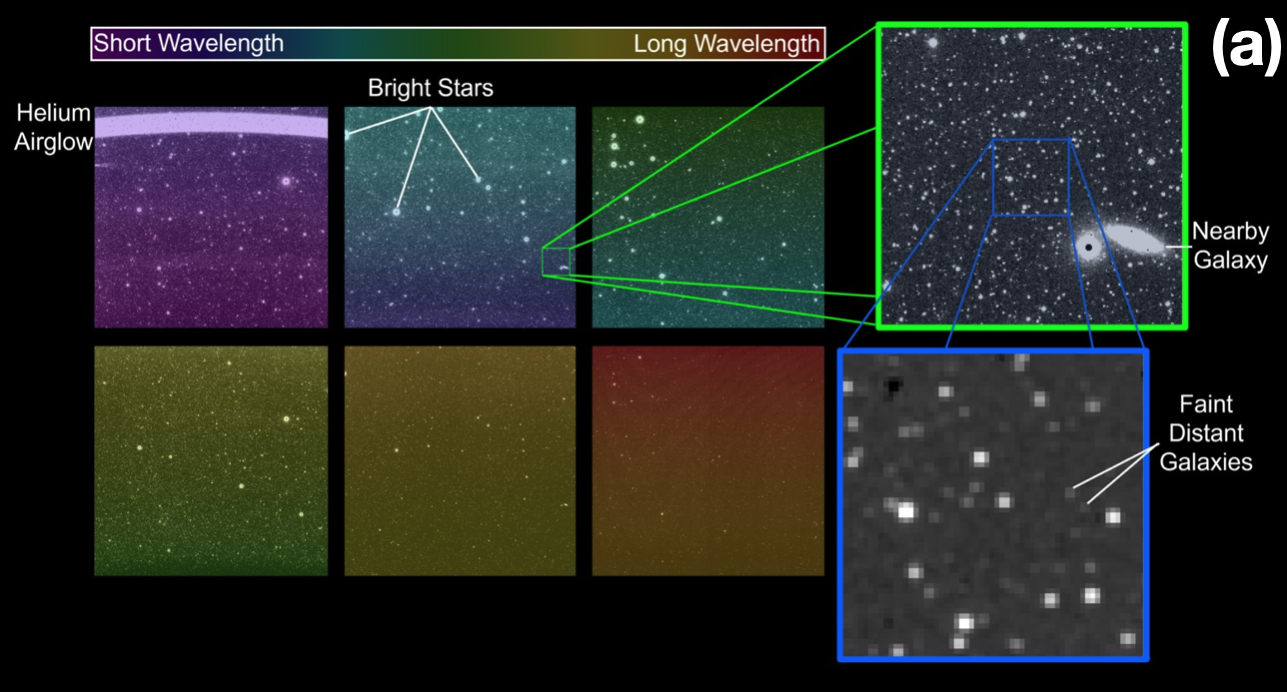
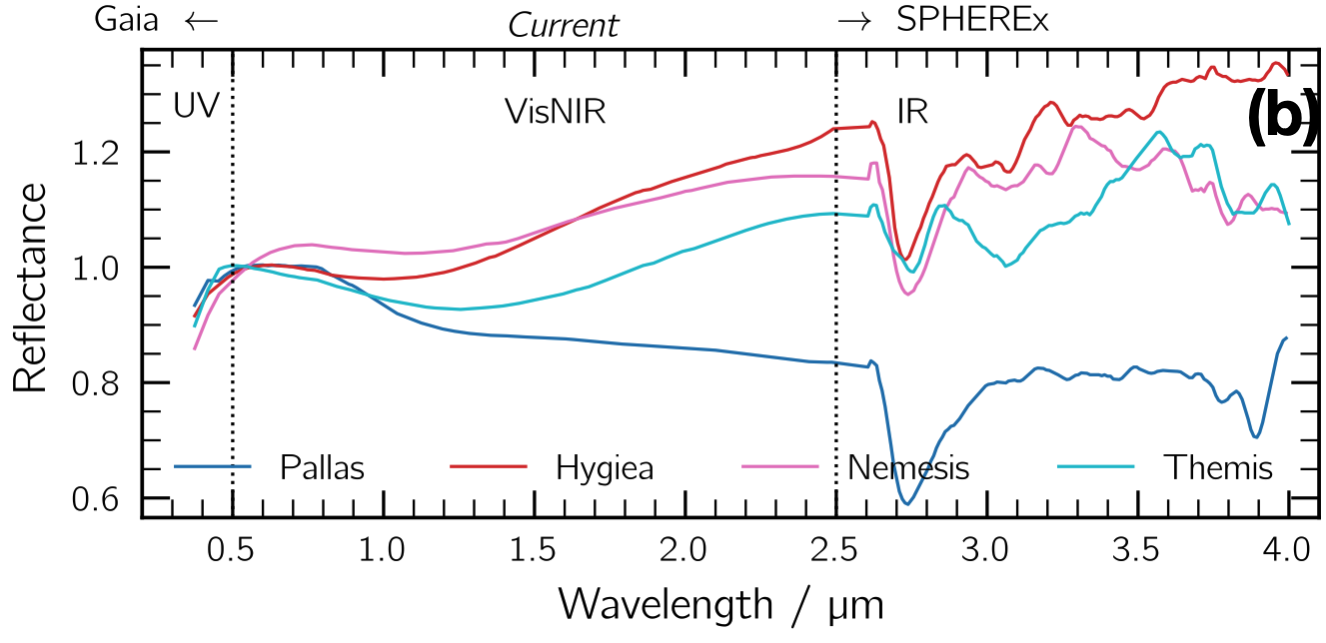
Figure (a). First light images from SPHEREx, taken on March 27, 2025, each contain over 100,000 detected sources. Every exposure includes six images — one per detector — covering a 3.5° × 11.5° field of view. The top and bottom image sets show the same sky area. When routine science begins in April, SPHEREx will take ~600 exposures daily (credit: NASA),
Figure (b). Spectra of large asteroids, produced using data from GAIA DR3, SMASS, MITHNEOS, and AKARI. SPHEREx will capture spectra in the 0.9 to 5 µm.
How to cite: Geem, J., Lisse, C. M., Bach, Y. P., Ishiguro, M., Mahlke, M., Lim, B., Jin, S., and Jo, H.: Calibration of SPHEREx Spectral Data for Small Solar System Objects, EPSC-DPS Joint Meeting 2025, Helsinki, Finland, 7–12 Sep 2025, EPSC-DPS2025-1337, https://doi.org/10.5194/epsc-dps2025-1337, 2025.


