
 1,2,3,
- 1INAF - Osservatorio Astrofisico Arcetri, Firenze, Italy (manuela.lippi@inaf.it)
- 2NASA – Goddard Space Flight Center, 8800 Greenbelt Rd, Greenbelt, MD 20771, US
- 3American University, 4400 Massachusetts Ave. NW, Washington DC 20016
Different spin configurations in multi-hydrogenated species (e.g., H2O, H2, H2CO, and NH3) are temperature dependent and once molecules are formed, forbidden rules prevent them from changing their spin state via thermal and collisional processes. For this reason, the relative ratios of species with different spin configurations (hereafter OPRs) have long been employed as cosmogonic thermometers and clocks in setting the formation conditions for species in the Interstellar medium (ISM), protoplanetary disks, and comets [1,2,3]. In particular, the comparison of these ratios from several species in different astrochemical environments may provide key clues on the physical and chemical processes that contribute to planet formation.
In recent years, the amount of observational data on nuclear spin ratios has grown rapidly, also thanks to increasing instruments sensitivity, and improved statistics and modelling. As a result, a debate about the reliability of spin temperatures as cosmogonic thermometers has started. In fact, observed discrepancy among the comet population and between comets, protoplanetary disks and and star-forming regions suggest that the nuclear-spin conversion may be possible in some cases [4,5,6,7]. This idea is indeed supported by recent laboratory experiments showing that nuclear spin conversion is possible for H2 and water ice desorption and recondensation in the ISM and protoplanetary disks [8] and during sublimation processes in the coma of active comets [5], meaning it is not possible to determine the molecular formation temperature from the spin ratios in these cases.
In this context, we will present for the first time a comprehensive statistical analysis of the spin isomeric ratios in a sample of 20+ comets, for H2O CH3OH, C2H6, CH4, and H2CO (see for example Fig. 1). These measurements were obtained in a systematic way by employing modern data reduction procedures and ad-hoc developed molecular models (e.g., [9,10]). Data were searched for possible observational biases by comparing results from different instrumental settings and observing conditions (e.g., heliocentric distance of the comet at the time of observations). In general, we find that the majority of the OPRs are consistent with thermal equilibrium independently from the analysed species (e.g., OPR ~ 3 for water and ~ 1 for methanol), even if some exceptions are present.
If we consider the OPR cosmogonic, the results are thus in favour of different formation temperatures for the different molecules, higher for water (T > 40 - 50 K) than for organic species. In alternative, nuclear spin conversion during phase transition, desorption, and/or in the coma of active comets is occurring in the majority of the cases, changing this ratio to the statistical one. Further analysis will include spatially resolved measurements along the slit when possible (as in [4]) and comparison with the most recent results related to planet- and star- forming regions.
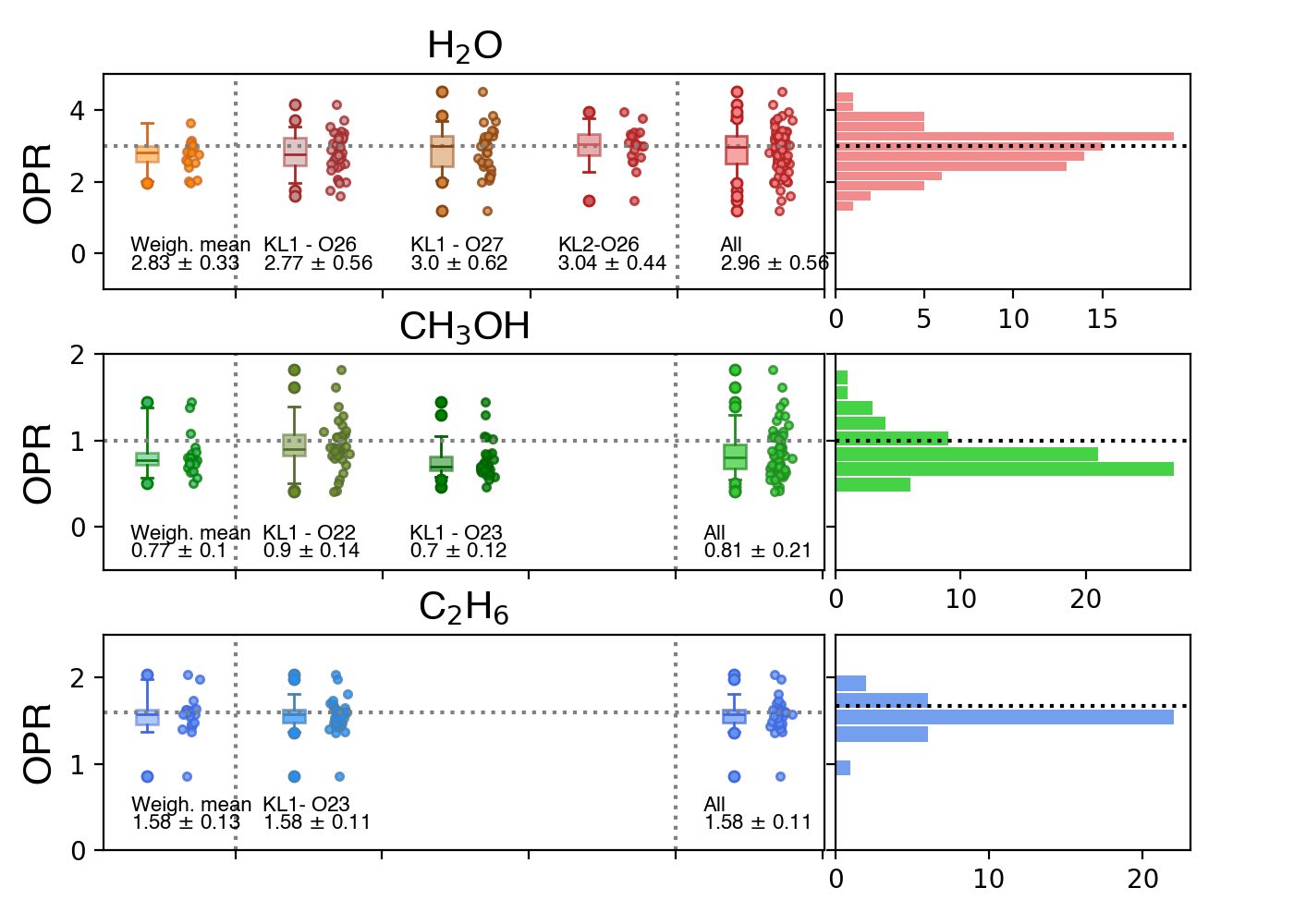
Fig 1: Example of the statistical analysis of OPRs of water, methanol and ethane that we implemented for our database of 20 comets observed in the infrared.
How to cite: Lippi, M., Faggi, S., Villanueva, G., and Bonev, B.: Do spin temperatures in water and organics in comets test the primordial conditions in our protoplanetary disk?, EPSC-DPS Joint Meeting 2025, Helsinki, Finland, 7–12 Sep 2025, EPSC-DPS2025-1342, https://doi.org/10.5194/epsc-dps2025-1342, 2025.


