
- Space Research Centre Polish Academy od Science, (lczechowski@cbk.waw.pl)
Introduction.
Currently, on Earth, we still have large areas that are uninhabited (e.g. Antarctica). The need to terraform Mars could result from various processes, e.g. eruptions of supervolcanoes, extremely strong greenhouse effects, a planetoid impacts, etc.
Atmosphere of Mars.
Atmospheric pressure on the surface of Mars ranges from 72 Pa at Olympus Mons to 1.16 kPa at the lowest lowland [1]. Water at a pressure below 6.25 kPa boils at human body temperature. This pressure determines the Armstrong limit. For p50 = 10 kPa the water boils at ~50oC - Fig. 1.
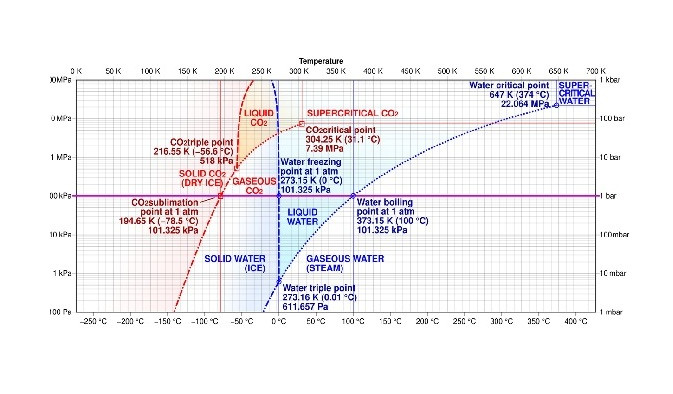
Fig. 1. Phase diagrams of H2O and CO2. This figure is licensed under the Creative Commons Attribution-Share Alike 3.0 Unsorted license.. Author. Cmglee Wikipedia.
The pressure is approximately proportional to the mass of atmosphere and the gravity. We consider a few terraforming variants v1,...v6, where descriptions are in parentheses (), and M is the required massof volatiles, h=0 corresponds to the reference level [1, 2, 3].
v1 (Armstrong limit at Hellas ), M=1.09E+17 kg.
v2 (Pressure p50 =10 kPa at Hellas), M=1.9E+17 kg
v3 (Armstrong limit at h=0 ), M= 2.31+17kg
v4 (Pressure p50 =10 kPa at h=0 ) M= 3.8E+17 kg,
v5 (Pressure 101.3 kPa at Hellas ), M= 2.1E+18 kg,
v6 (Pressure 101.3 kPa at h=0 ), M=4.12E+18 kg - the most ambitious version.
In the present work we consider only the possibility of building an atmosphere from material supplied from outside Mars. Another possibility is to use the interior of Mars.
 mainly
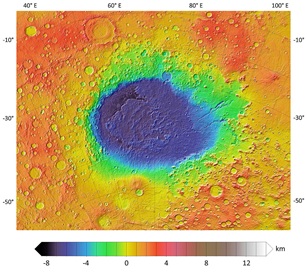
Fig. 2. Hellas Planitia, Mars' lowest lowland (~7000 m below reference level). Author: NASA / JPL-Caltech / Arizona State University - JMARS, public domain, https://commons.wikimedia.org/w/index.php?curid=29961709
The choice of bodies
Oort Cloud (OC) and Kuiper Belt (KB) are made of volatiles [2, 4]. The time of falling from KB is ~29-63 yr, and from OC is over 15,000yr [2 ] - Table 1. So, KB is better choice. .
Gravity assist and engines
Our idea is to build a thermonuclear reactor on the transported body. This reactor would use hydrogen (from water ice, which the body is made of) to produce electricity used for a ion engine. It will lead to some change of orbit that initiates gravity assist. The required energy is 1-8 times present energy produced annually on Earth. Fortunately, there are a lot of bodies of considerable size in KB and on the way to Mars, the gravitaty assist of large planets can be used.
Table 1
|
1 |
2 |
3 |
4 |
5 |
6 |
|
Kuiper B. inner |
2.90E+01 |
5.43 |
33.23 |
9.13 |
0.000554 |
|
Oort C. inner |
1.58E+04 |
0.67 |
34.10 |
10.00 |
0.000068 |
(1) Source of the matter; (2) Time of falling [yr] from (1) to Mars' orbit. (3) orbital velocity vorb [km/s]. (4) final velocity of falling vfall on Mars' orbit [km/s]. (5) v=vfall – vorbMars [km/s]. (6) mass of propellant used to reducing vorb to 0.99 vorb, for ionic FEEP.
Tidal effects and stability of bodies
To calculate effects of gravity assist we used formulas developed in [5]. They describe a minor body consisted of 2 parts m1 and m2 moving close to a large body. Motion of the part m1 of the minor body is descibed by:
m1 d/dt2 r'1 = F'1 + F'c + F'g + P' - m1 d/dt2 rs ,
where r'1=(x'1,y'1) is radius vector of the part 1 of the minor body in relation to non-inertial primed frame of reference, F'1is gravity force acting (from the large body) on part 1 of the minor body, F'c is the centrifugal forces and F'g is the gravitational attraction of part 1 by part 2. Component P'x and P'y are friction and reaction forces, respectively. The rsis the position of the center of the satellite in an inertial system. Our calculation indicates substantial problems. The effect of a gravity assist often depends on the cohasive forces of the KB bodies. Low cohesion leads to disruption. Moreover, KB bodies can be unstable close to the Sun. In such situation volatile substances escape, creating a natural rocket engine with thrust that is difficult to control. The disruption and the natural engine can lead to the body being directed in the wrong direction, e.g. towards a collision with the Earth.
Problem of impacts
The gravity assist can be used to reduce the relative velocity of impact. It is important because heating of the atmosphere will lead to the escape of gases.
Conclusions. Terraforming of Mars is possible by importing matter from other celestial bodies. The main problem is the control of the gravity assist. Note that after the construction of thermonuclear power plants and the determination of the gravity assist series, the transport process would not require additional energy. About 100 bodies with a radius of 12 km would be enough.
Acknowledgments: The research was partially performed as part of the statutory activities of CBK PAN.
References [1] Mars Fact Sheet". NASA Retrieved 2 December 2024. [2] Czechowski L. „Horizont Mars”. Conference Wroclaw, Poland, October, 24, 2024; [3] Czechowski L., LPSC2025, 1858pdf [4] Hargitai, H. and Kereszturi, A., 2015, Encyclopedia of Planetary Landforms,. ISBN 978-1-4614-3133-6. [5] Czechowski L. 1991, Earth, Moon and planets, 52, 113.
How to cite: Czechowski, L.: Terraforming of Mars and some problems of gravity assist, EPSC-DPS Joint Meeting 2025, Helsinki, Finland, 7–12 Sep 2025, EPSC-DPS2025-1345, https://doi.org/10.5194/epsc-dps2025-1345, 2025.


