
 ,,
,,- University of Valencia, Astronomical Observatory, Spain (beatriz.ramirez@ext.uv.es)
Wouldn’t it be nice to learn about geometry, proportions, statistics, the nature of light or the states of matter while touring around the galaxy in pursue of Earthlike planets? In Aula del Cel (The Sky Classroom) at the Observatori Astronòmic of the University of Valencia, we have been assisting the educational community for over twenty years with the aim of turning the Universe into our everyday classroom.
The purpose
Our primary goal is always to inspire youth through meaningful learning obtained from experience and evidence. We set the path to this sort of learning by means of our hands-on activities based on quality data backed up by scientific research.
The activity presented in this abstract is addressed to lower and upper secondary students and its specific targets are:
- To offer the students a quantitative approach to the size of our galaxy.
- To offer the students a quantitative approach to the portion of it having been scanned for exoplanet research.
- To offer the students a statistical approach to the diversity of our galaxy’s star and planet population.
- To allow students to assess the difficulties inherent in exoplanet detection by means of direct observation and the advantages of using physics and math laws to infer the presence and properties of a planet orbiting a star.
- To “rescue” the topic of extraterrestrial life from the fantasy realm and bring it to the classroom desk in the form of a list of life-supporting conditions, measurable magnitudes and detection thresholds.
- To make the students aware of the technical challenges and complexity associated with the exoplanet detection missions.
- To let the students become familiar with the nature of scientific work not limited to the scientific method and its stages but understood also as a purely cooperative task involving interpersonal skills and widespread cultural exchange.
- In the end and because of all the above, to enhance the students’ consciousness about the importance of Earth preservation and alignment with the seventeen UN Sustainable Development Goals.
The participants are invited to follow us on a tour along the Milky Way which not only should provide them with a glimpse of the abundance and variety of other solar systems but also will allow them to develop several educational key competences. We are referring to the “European Commission Key competences for lifelong learning” spanning from the more obvious mathematical, science, technology and engineering competence or digital competence until cultural awareness, multilingual or citizenship competence which are also addressed.
The tools and materials
This engaging classroom activity poses several challenges to the students, some of which we list hereafter:
- drawing a scatter diagram that shows the portion of galaxy that has been explored in the quest for exoplanets.
- determining the size of a planet by means of the analysis of a light curve and assessing the error and its sources.
- determining how frequent Earthlike planets are.
- modifying the habitability conditions of a planet by swapping its star for some other known or unknown star.
They deal with these challenges with the help of a hand-picked selection of materials and tools as diverse as the audience they are aimed at. The activity requires that the students make use of a combination of cutting-edge online tools and resources, 3D printed models, off-the-shelf software and technology and DIY setups, as well as our ever-present fundamental toolkit: rulers and crayons.
The making of
As mentioned earlier, the activity is conceived as a tour that leads the travelers to reach four successive milestones:
Milestone 1 – How many exoplanets do we know, where are they and how do they look like?
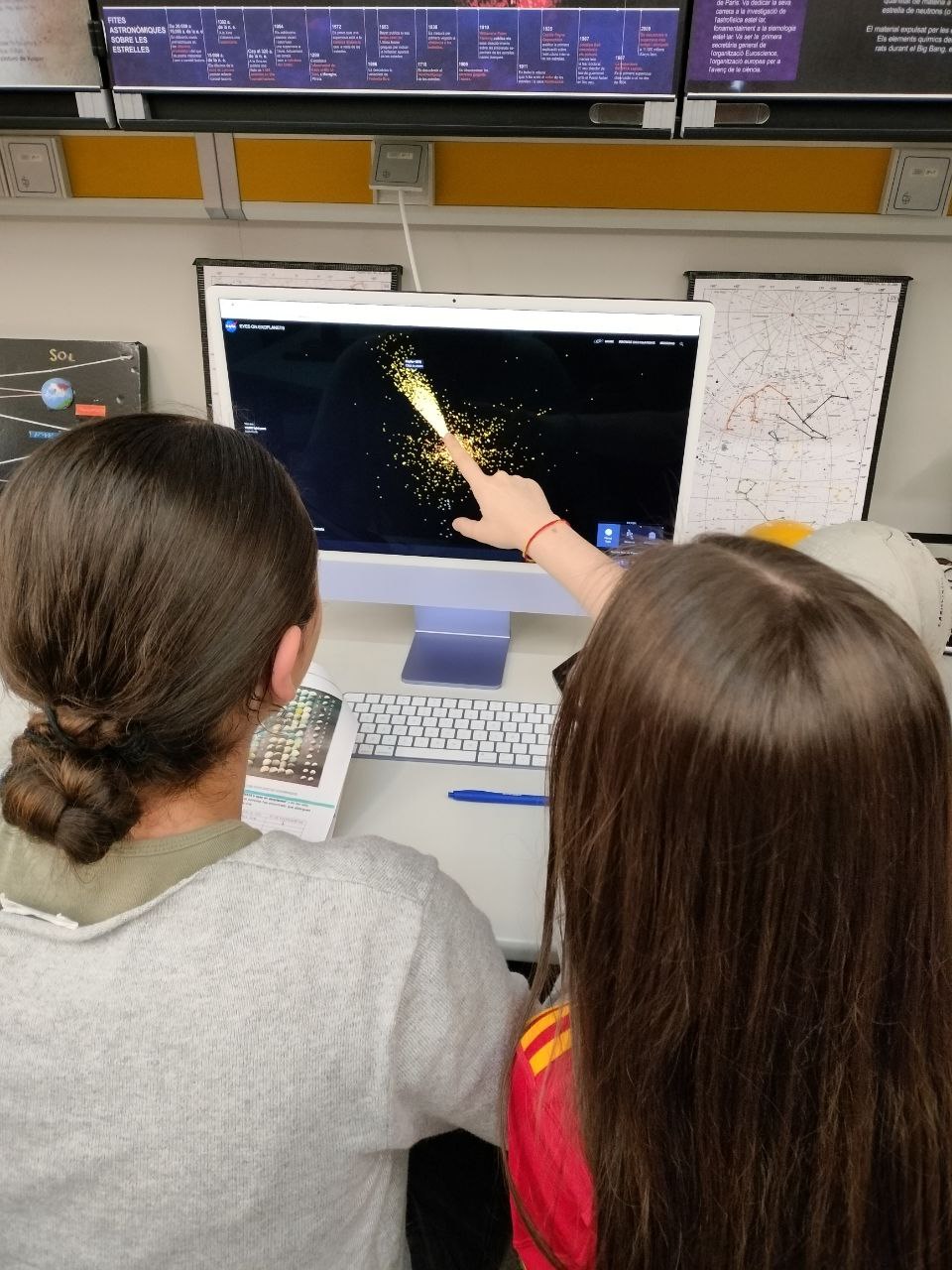
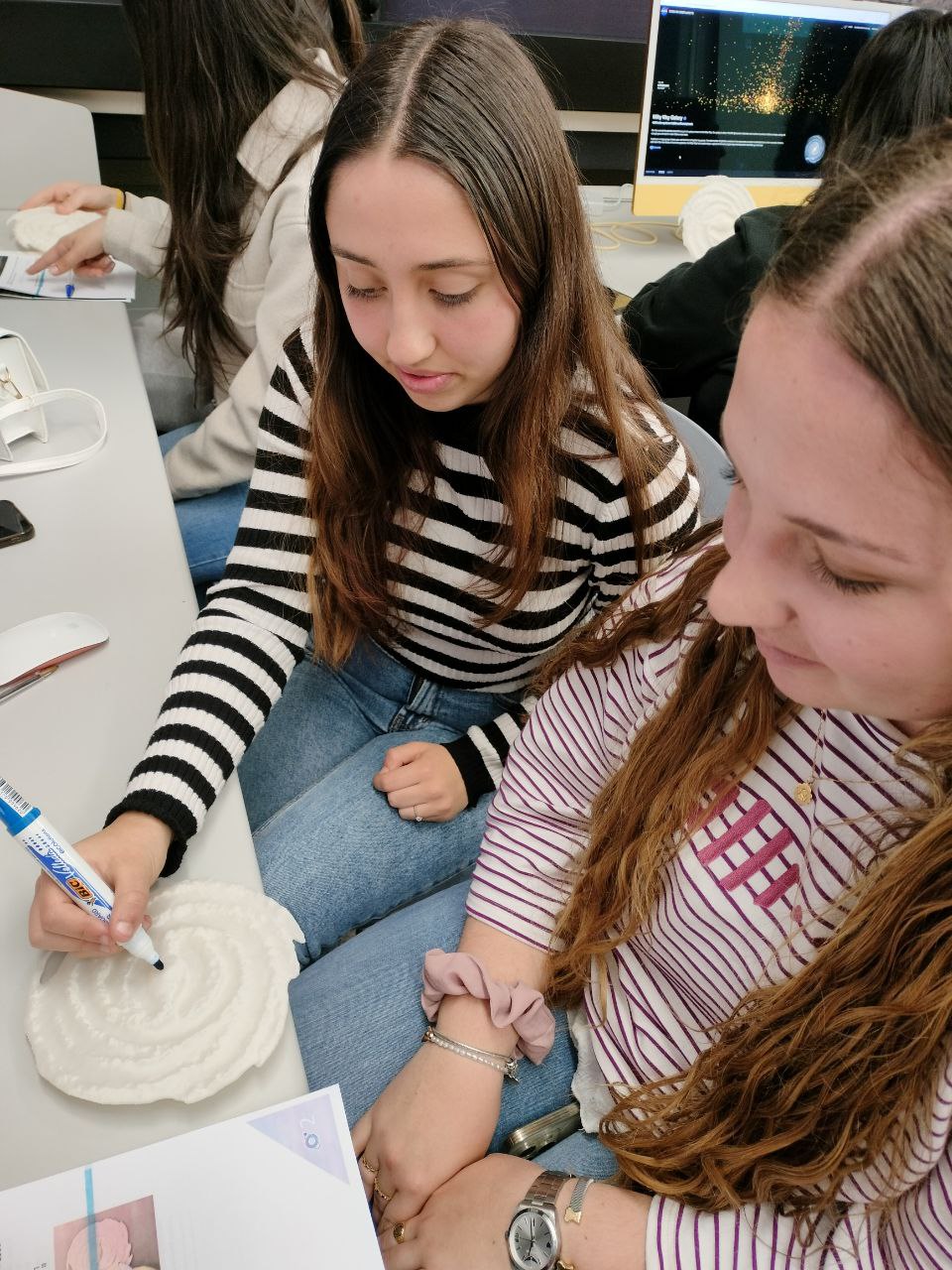
First, the students are required to dive into the scientific data published in the confirmed exoplanets database “NASA’s eyes on exoplanets”, compile the key information of randomly picked solar systems, process it applying the proper scale and transfer it to a 3D model of our galaxy.
Milestone 2 – How are exoplanets detected and how do we know about their properties? The Transit method
Second, the students assess the difficulty of perceiving a faint source of light located in the surroundings of a much brighter object such as a star. Hence, the justification for the transit detection method.
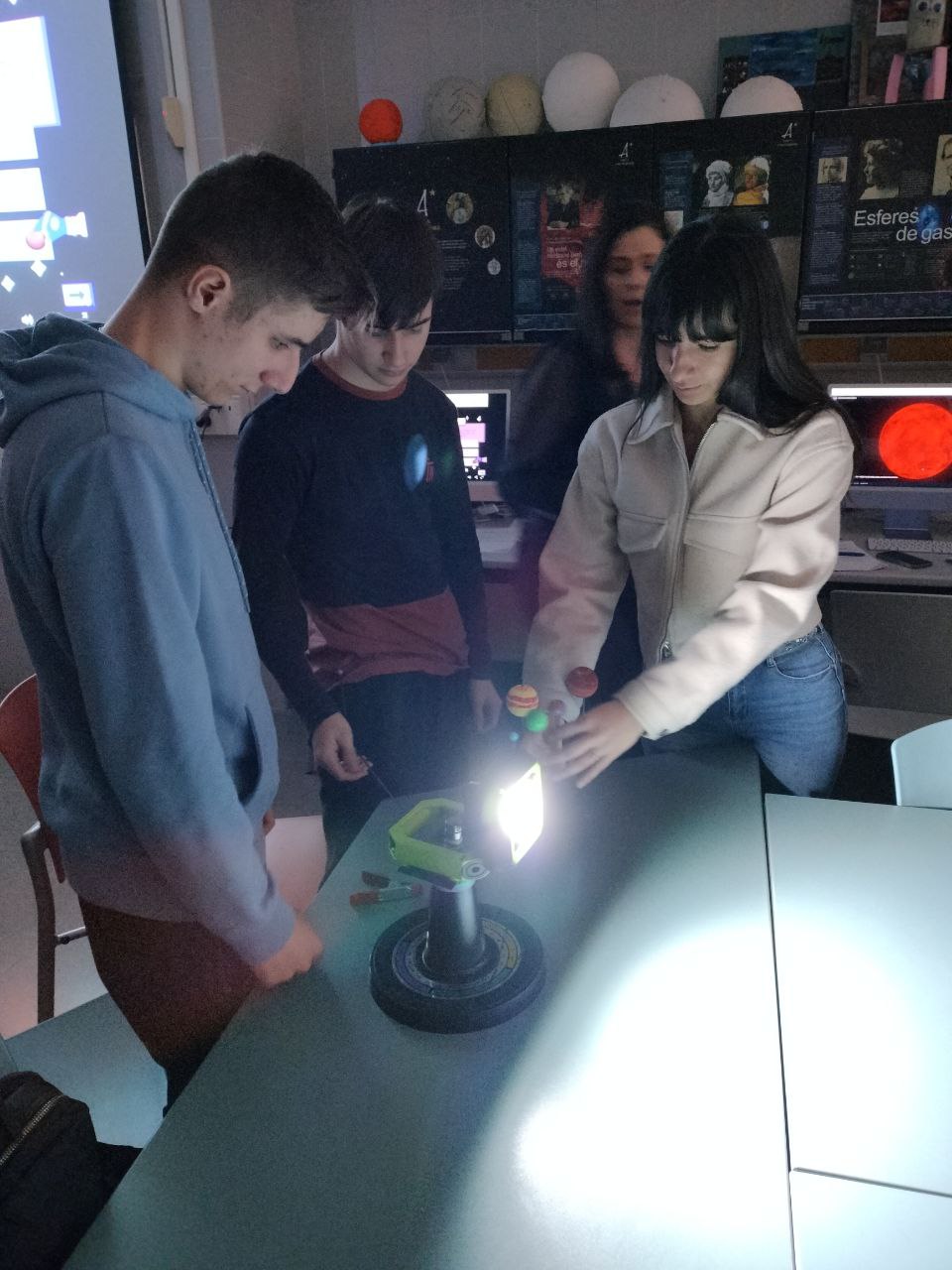
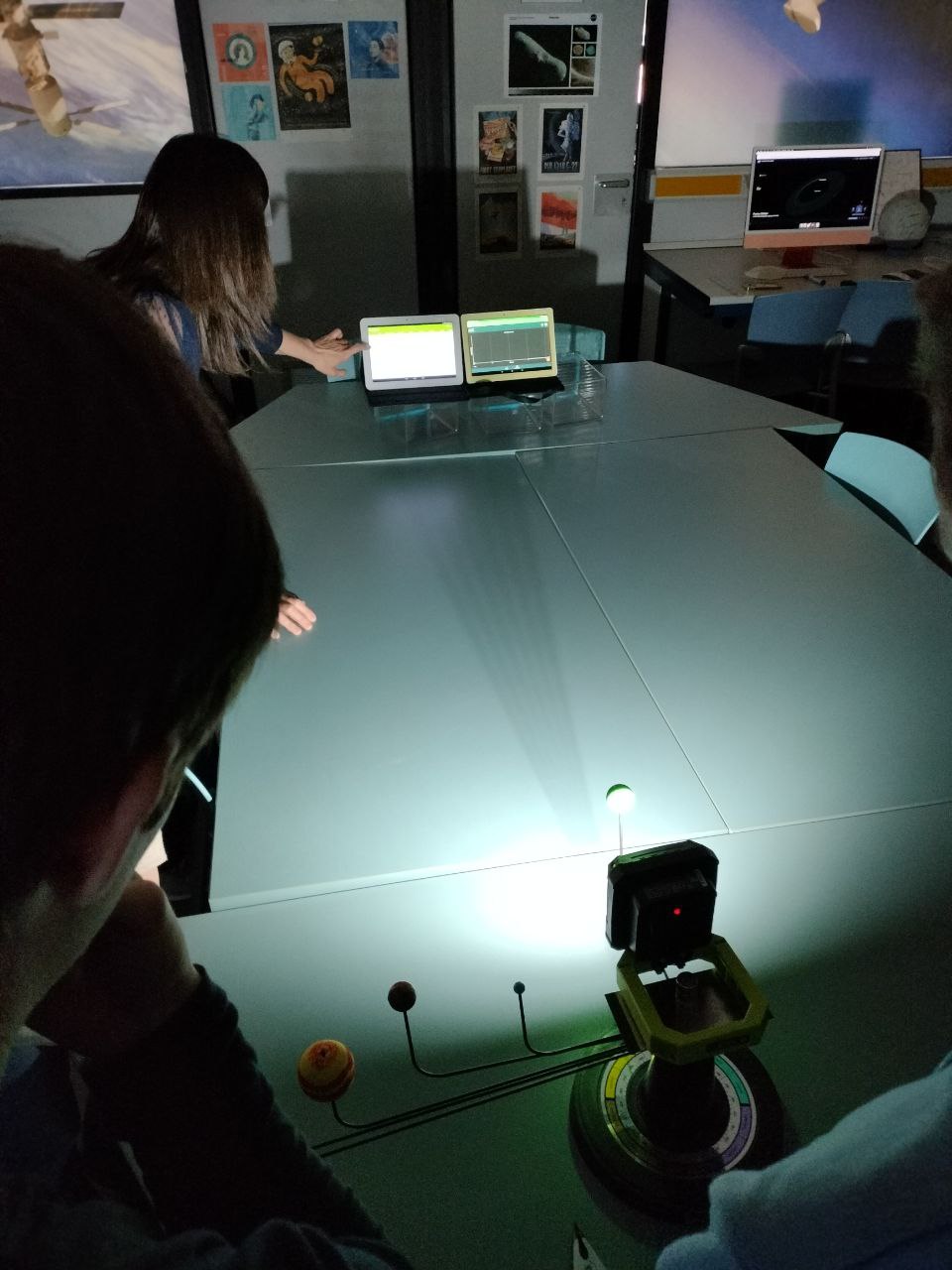
A DIY setup consisting of several balls of different sizes orbiting a led lamp is used to simulate a transit. The detector consists of the light sensor of an Android tablet together with the Playstore app “Sensors Toolbox”. The result is a light curve that reveals the existence of a planet.
All they have to do next is to apply their mathematical knowledge of proportions and geometry to extract useful information from the light measurement. They can even compare the calculated planet radius with the actual one by measuring the ball. By doing this, the students appreciate the different sources of errors.
Milestone 3 – When do we consider an exoplanet to be potentially habitable? The goldilocks zone
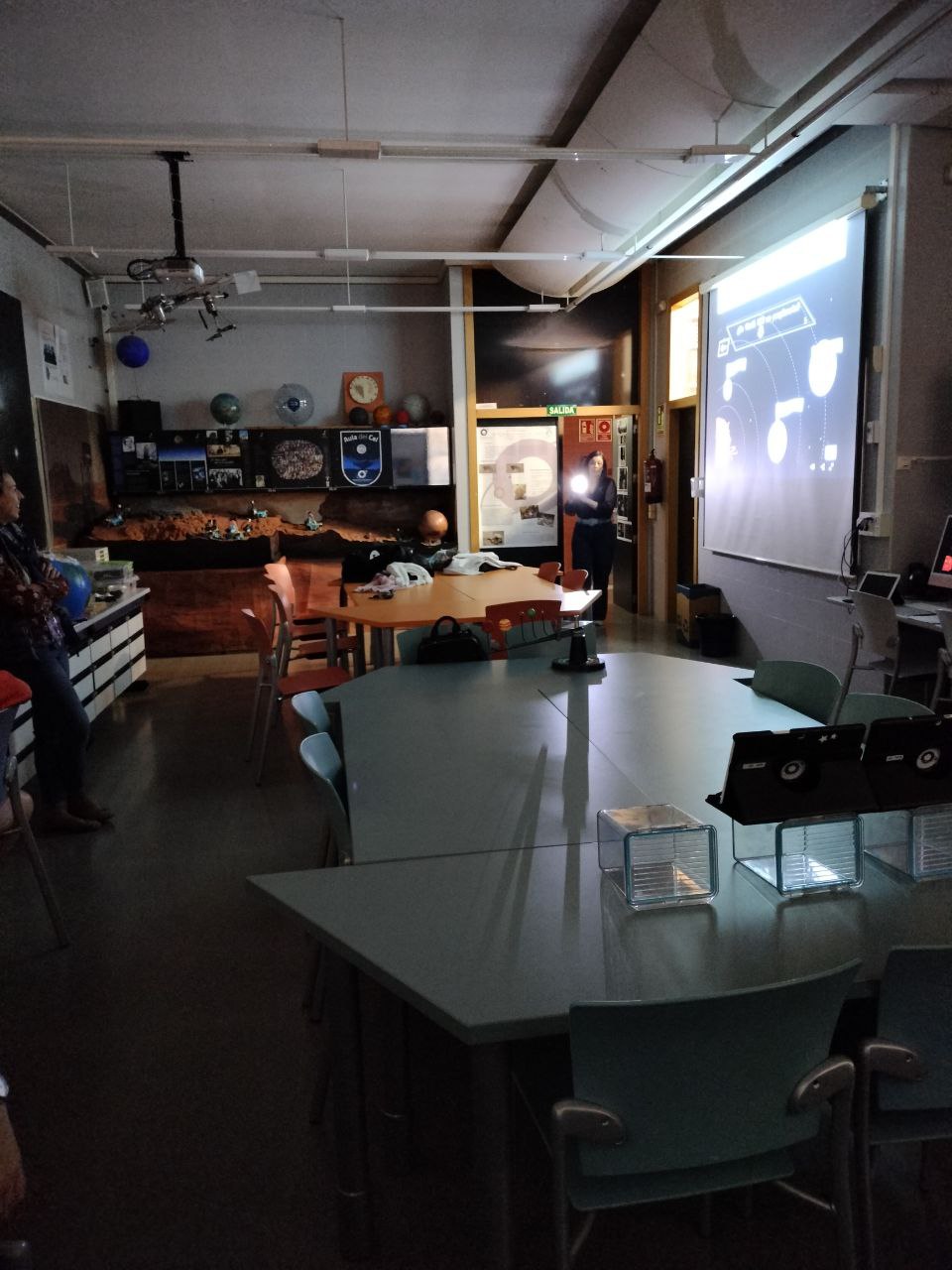
Third, the students are requested to check again the database to evaluate how many of the randomly picked solar systems in milestone 1 host potentially habitable planets. This exercise provides them with an intuitive estimate of how frequent and how distant Earthlike planets are. Concluding that to perpetuate humanity we must ensure that our planet Earth is safe and sound.
After that, making use of the commercial software Sandbox Universe, they simulate different extrasolar systems and observe how the habitability zone expands or shrinks by swapping their stars for brighter or fainter ones.
Milestone 4 – Citizen science: science relying on people
Lastly, the students are introduced to ESO-NGTS Planet Hunters citizen project in order to apply all they have learned and continue their training on a regular basis.
Conclusion
At the end of the session, the students collect a commemorative badge that credits the accomplishment of all the milestones throughout the activity. They leave the Aula del Cel (The Sky Classroom) with a smile and a much richer view of life and their home planet: a meaningful learning experience.
How to cite: Ramírez Velado, B., Oritz Gil, A., and Moya Lucas, X.: Teaching science and Earth care while exploring our galaxy, EPSC-DPS Joint Meeting 2025, Helsinki, Finland, 7–12 Sep 2025, EPSC-DPS2025-1385, https://doi.org/10.5194/epsc-dps2025-1385, 2025.


