ODAA0 | General Session of ODAA

ODAA0

General Session of ODAA
Conveners: Arianna Piccialli, Sanlyn Buxner, Nimisha Verma, Jodi Berdis
Orals THU-OB5
| Thu, 11 Sep, 15:00–16:00 (EEST)
 
Room Saturn (Hall B)
Posters THU-POS
| Attendance Thu, 11 Sep, 18:00–19:30 (EEST) | Display Thu, 11 Sep, 08:30–19:30
 
Lämpiö foyer, L55
Thu, 15:00
Thu, 18:00
The objective of the General Session is to accommodate abstracts from a program group that do not align with the themes of any existing sessions within the same program group. Please note that all submitted abstracts may be reallocated to a different session at the discretion of the respective session chairs.

Session assets

Orals: Thu, 11 Sep, 15:00–16:00 | Room Saturn (Hall B)

Chairpersons: Nimisha Verma, Jodi Berdis, Arianna Piccialli
15:00–15:12
|
EPSC-DPS2025-328
|
Virtual presentation
Elisa Maria Alessi, Elena Martellato, and Pamela Cambianica
Escape Moon
Elisa Maria Alessi1, Elena Martellato2, and Pamela Cambianica2
Elisa Maria Alessi et al. Elisa Maria Alessi1, Elena Martellato2, and Pamela Cambianica2
  • 1Consiglio Nazionale delle Ricerche, Istituto di Matematica Applicata e Tecnologie Informatiche "E. Magenes", Italy (elisamaria.alessi@cnr.it)
  • 2Istituto Nazionale di Astrofisica, Astronomical Observatory of Padova
  • 1Consiglio Nazionale delle Ricerche, Istituto di Matematica Applicata e Tecnologie Informatiche "E. Magenes", Italy (elisamaria.alessi@cnr.it)
  • 2Istituto Nazionale di Astrofisica, Astronomical Observatory of Padova

ESCAPE MOON is an educational activity conceived to explain the dynamics of meteor streams to primary school kids. The game consists of cards with questions that encourage the participants to learn about the natural bodies in the Solar System, their distances from the Sun, their motion, and in particular the Earth-Moon system. 

The activity was developed as part of the outreach efforts related to the ESA LUMIO (LUnar Meteoroid Impacts Observer) mission, a CubeSat ESA mission, led by Politecnico di Milano and supported mainly by the Italian Space Agency (ASI). LUMIO aims at characterizing meteor showers on the Moon’s farside in a range of impact kinetic energy not fully measured by previous analyses [1][2].

The main character of the game is Mazem, who lives on the Moon and receives a message warning him about a potential danger. ESCAPE MOON includes ten cards containing questions to be solved, each of them potentially triggering an interactive discussion with the kids. Examples of question are: Which natural bodies can approach the Moon? What is the main difference between a meteor shower on the Earth and one on the Moon? How does the surface of the Moon look like? What can monitor the meteor showers?. In Figures 1 to 4, some cards (in Italian) to be solved are shown.  

Figure 1. First ESCAPE MOON card. Question: Mazem lives on the Moon and sees a star and a planet, and he wonders whether there are other objects in space. Solution: By reconstructing a rhyme, the kids learn that in the Solar System there are also other planets and small bodies, like satellites, asteroids, comets, and dwarf planets.

Figure 2. Second ESCAPE MOON card. Question: Why can these objects represent a danger for Mazem? How do these objects move? Solution: the kids need to find the intruders in the picture, that are the Moon, Europe, and Enceladus, which differ from the others because they orbit around a planet instead the Sun.

Figure 3. Sixth ESCAPE MOON card. Question: Comets are dirty snowballs, loosing material, and become meteors when entering the Earth atmosphere. How is it called the most spectacular meteoritic shower? Solution: the Perseid answer is found by solving a crossword puzzle.

Figure 4. Nineth ESCAPE MOON card. Question: In the future, spacecraft will bring astronauts to the Moon. Mazem is receiving a new message, that suggests him to take shelter inside the Jules Verne crater. Kids need to find it on the lunar map. Solution: Provide the location of the crater like in battleship.

This activity was initially tested during the European Researcher’s Night (September 2024) in Milan and later presented at the French high school in Milan (lycée Stendhal). Feedback revealed that two questions turned out to be too difficult for the age targeted. The game was later adapted and simplified for a 40-hour educational project titled “Passeggiando tra i pianeti” (Walking among planets), focused on Solar System exploration. This program took place in March 2025, in a primary school in Padova (Primary School Falcone and Borsellino), under PNRR fundings. One of the most liked tasks among ~10 years old kids was to locate a crater in the lunar map (Figure 4).

The game takes about one hour and can be tailored to different age groups and interests. ESCAPE MOON is available to the entire LUMIO science team for further use and improvement.It will be part of the official CNR catalogue of activities for schools.

References

[1] Cipriano A. M., Dei Tos D. A. and Topputo F. (2018), Front. Astron. Space Sci. 5:29.

[2] Topputo F., et al. (2023), Icarus, 389, 115213.

Acknowledgements

ESCAPE MOON was funded by the Italian Space Agency through the agreement n. F43C23000340001 entitled “Supporto scientifico alla missione LUMIO”.

The shorter version of the game was prepared for a 40-hour activity funded by PNRR, in the framework of strengthening of educational offer, focusing on developeing new skills (Missione 4 – Istruzione e ricerca - Componente 1 – Potenziamento dell’offerta dei servizi di istruzione dagli asili nido alle università – Investimento 3.1 “Nuove competenze e nuovi linguaggi” del Piano nazionale di ripresa eresilienza, finanziato dall’Unione europea – Next Generation EU).

How to cite: Alessi, E. M., Martellato, E., and Cambianica, P.: Escape Moon, EPSC-DPS Joint Meeting 2025, Helsinki, Finland, 7–13 Sep 2025, EPSC-DPS2025-328, https://doi.org/10.5194/epsc-dps2025-328, 2025.

15:12–15:24
|
EPSC-DPS2025-230
|
On-site presentation
Emma Bruus, Marko Pekkola, Veikko Makela, Matias Takala, Tero Sipinen, Mikko Peussa, Markku Siljama, Eero Karvinen, Esa Palmi, and Matti Helin

Abstract

Skywarden (Taivaanvahti) observation system provides a platform for gathering information of celestial phenomena. Nearly half of the observation reports are related to objects within planetary science. These include the planets, exoplanet transits, asteroids, comets, meteor showers, fireballs and eclipses. During its 14 years of operation, Skywarden has proven to be an efficient way of communicating space-related phenomena to the public.   

1. Introduction

Citizen science has been a rising discussion topic in the scientific world during the recent decade. Many projects have already involved volunteers making observations and participating in analysis.

In Finland, the Ursa Astronomical Association has developed and maintained observation system called Skywarden (Taivaanvahti, www.taivaanvahti.fi) since 2011 [1]. The gathered dataset consists of more than 120 000 observations contributed by over 20 000 individual users.    

2. Observed phenomena

The amateur astronomical community in Finland is not only interested in astronomical phenomena but has a long history of promoting observations of atmospheric optics [1]. The reports received by Skywarden cover phenomena from the ground level (storms and atmospheric halos [5]) to distant gamma ray bursts.  45% of the gathered observation material is related to observation targets within our solar system. [Table 1]

2.1 Eclipses

Solar and lunar eclipses are often highlighted by the media and provide easy, but rare, observable events. Skywarden’s eclipse observation theme covers total, partial and annular eclipses. A negative eclipse observation indicates that the location was clouded out.

Table 1: The number of observations sent to different categories in Skywarden, 2011-2025

Category

Number of observations

Atmospheric halos

31 800

Solar system objects

21 300

Fireballs

20 400

Northern lights

15 145

Atmospheric optics, excl. halos

11 200

Deep space

 8 400

Rare clouds

 8 200

Storms

 4 300

Eclipses

 1 400


2.2 Solar system objects

Of the solar system observations, the Sun and the Moon are the most popular observation targets covering 37% of the category’s material. The observation program also covers planets, comets (14%), asteroids, meteor storms and satellites.

2.3 Fireballs

Skywarden collaborates closely with the Finnish Fireball Network in collecting fireball cases. It provides tools to gather eyewitness reports of fireballs including height, direction, angle and sound information. The approach provides a fast and easy way of mapping out where individual bolides have been observed.

3. Open data and my data

Information sent into Skywarden serves many purposes. Most important of them is the user’s need to communicate achievements, gain visibility and participate in the research. All data gathered is publicly available. Only sensitive parts like contact information remain hidden. The observers receive a modification link, which gives them full control on the sent material.  In addition to the main user interface, information is made available through open Application Programmable Interfaces (API) in several computer readable formats. [2,3]

4. Data processing and quality

Information is sent in by using web observation form dedicated to each observation topic. [Figure 1].

Figure 1: Skywarden’s solar system observation form contains fields for the observation time and -location, observer contact information, description text, images and detailed identifications.

The quality of the incoming data is pre-analyzed by using AI scoring and then checked by the moderation team. Information needed for research, like UT timestamps and coordinates, are set automatically by the system if found missing. Observations belonging to the same event are grouped together and given a shared display id.

5. Observation supporting features

Skywarden maintains an online map of available dark observation locations. Each of these sites contain a description, coordinates and an address, plus additional listed features like visibility towards different directions. This feature raises awareness of the light pollution problem and instructs city-dwellers locations of nearby observations sites without excess lighting.                                      

Skywarden’s user interface contains basic descriptions of the observed phenomena. Together with the specialists’ help, this shared information deepens the learning experience of the observer.

6. Summary and Conclusions

Skywarden provides tools for running future citizen collaboration campaigns [3,4,6]. Unlike many sky-related citizen science observation campaigns, it combines different phenomena under one single platform and publishes observation contents for open research.

During the 14 years of operation, Skywarden has established a position as a reliable source of information for news media. Suddenly occurring phenomena like fireballs or rocket launches can cause worries in citizens. By providing science-based information of the observed phenomena, we do our share in increasing trust and stability. 

Acknowledgements

The authors wish to thank Ursa Astronomical Association for funding the development and maintenance of the Skywarden observation system. We thank the members of the Finnish Fireball Network of Ursa for fruitful collaboration. Creation and presentation of this abstract has been supported by the Research Council of Finland grant 365202.

References

[1] Karttunen, H.: Ursan historia, Tähtitieteellinen yhdistys Ursa ry. 1921–2021, ISBN 978-952-5985-98-6 

[2] Bruus, E.: Skywarden’s search interface (API): https://www.taivaanvahti.fi/app/docs/interface/output_interface_en.html

[3] Grandin, M., Bruus, E., Ledvina, V. E., Partamies, N., Barthelemy, M., Martinis, C., Dayton-Oxland, R., Gallardo-Lacourt, B., Nishimura, Y., Herlingshaw, K., Thomas, N., Karvinen, E., Lach, D., Spijkers, M., and Bergstrand, C.: The Gannon Storm: citizen science observations during the geomagnetic superstorm of 10 May 2024, Geosci. Commun., 7, 297–316, https://doi.org/10.5194/gc-7-297-2024, 2024.

[4] Palmroth M., Grandin M., Helin M., Koski P., Oksanen A., Glad M. A., et al. (2020). Citizen scientists discover a new auroral form: Dunes provide insight into the upper atmosphere. AGU Advances, 1, e2019AV000133.

[5] Moilanen, J. & Gritsevich, M. (2022). Light scattering by airborne ice crystals – An inventory of atmospheric halos. Journal of Quantitative Spectroscopy and Radiative Transfer. 290. 108313. 10.1016/j.jqsrt.2022.108313.

[6] Nishimura, Y., Bruus, E., Karvinen, E., Martinis, C. R., Dyer, A., Kangas, L., et al. (2022). Interaction between proton aurora and stable auroral red arcs unveiled by citizen scientist photographs. Journal of Geophysical Research: Space Physics, 127, e2022JA030570.

How to cite: Bruus, E., Pekkola, M., Makela, V., Takala, M., Sipinen, T., Peussa, M., Siljama, M., Karvinen, E., Palmi, E., and Helin, M.: Skywarden: 14 years of citizen science, EPSC-DPS Joint Meeting 2025, Helsinki, Finland, 7–13 Sep 2025, EPSC-DPS2025-230, https://doi.org/10.5194/epsc-dps2025-230, 2025.

15:24–15:36
|
EPSC-DPS2025-1730
|
On-site presentation
Anna Losiak and the Science Center Morasko Impakt team

Morasko [1] is among only 200 places on Earth [2] which we are confident that they faced a cosmic catastrophe. About 4.5 ka ago [3], a small iron asteroid fragmented while going through the atmosphere and hit the area in central Poland. Morasko strewn field consists of a group of seven craters located in central Poland. The largest structure is 100 m in diameter. Multiple fragments of the impactor were found. The resulting impact craters form an extremely rare occurrence of an impact structure that is geomorphologically recognizable for everybody and, simultaneously, it is highly accessible as it is located within the fifth largest city in Poland: Poznan.


Figure 1. Photos of the first annual The Day of Morasko Meteorite Craters held on 5th of October 2025 in Suchy Las municipality (just next to the craters).


Unfortunately, Morasko is currently utilized for educational and tourist purposes to a very limited degree. The site is formally protected (Morasko Meteorite Nature Reserve), and there is a slightly deteriorated, but well-designed educational path. Some pieces of Morasko meteorite (along with a collection of other meteorites) are curated in the nearby Geology Museum of Adam Mickiewicz University, however, access to this display is possible only for a couple of hours a week (upon previous appointment).


Museums and/or geoparks were established near many impact sites e.g.: Chicxulub museum [4], Kaali Meteoritics and Limestone Museum [5], Meteor Crater Barringer Space Museum, Odessa Meteor Crater Museum, Ries Crater Museum Nördlingen [6], Meteorite Museum, Rochechouart [7]. Most impact sites, even if they are formally protected, are not associated with a museum.


The ultimate goal of our team (~10 years in the future) is to create an interactive museum near this unique location to allow people to explore the relationship between Space and Earth. We are a very diverse team working on different aspects of this topic, ranging from astronomy and geology, through forestry and electrical engineering up to archaeology and anthropology) representing different career stages (from early career through mid and up to emeritus), from six different academic institutions in Poland. Since the establishment of our group a year ago, we have organized a large outreach event (lectures, workshops, guided trips to the craters) visited by more than 1000 people, numerous lectures, presentations for decision-makers, and we have applied for a few grants. We welcome all the help from the European Space Science Community 😊


References: [1] Szokaluk et al. 2019. Geology of the Morasko craters, Poznań, Poland —Small impact craters inunconsolidated sediments. MAPS54:1478–1494.  [2] Osinski et al. 2022. Impact Earth: A review of the terrestrial impact record, Earth-Science Rev. 232:104–112  [3] Losiak et al. 2023. Dating Morasko Crater (Poland) — Insights into the Problem of Dating of Small Impact Craters LPSC id.1699.   [4] Losiak et al. 2016. Dating Kaali Crater (Estonia) based on Charcoal emplaced within proximal ejecta blanket. MAPS 51:681–695.  [5] Urrutia-Fucugauchi et al. 2020. Chicxulub museum, geosciences in Mexico, outreach and science communication – built from the crater up. Geosci. Commun. 4:267–280.   [6] PöSges 2005. The Ries Crater Museum in Nördlingen, Bavaria, Germany. MAPS 40:1555-1557.  [7] Lambert P. 2023 The International Congress–Festival-CIRIR 2022 (ICF-CIRIR 2022), Rochechouart, France. MAPS https://doi.org/10.1111/maps.13954


How to cite: Losiak, A. and the Science Center Morasko Impakt team: Using impact craters to teach about Space Science: the development of the interactive Science Center Morasko-Impact in Poland. , EPSC-DPS Joint Meeting 2025, Helsinki, Finland, 7–13 Sep 2025, EPSC-DPS2025-1730, https://doi.org/10.5194/epsc-dps2025-1730, 2025.

15:36–15:48
|
EPSC-DPS2025-1840
|
On-site presentation
Thibaut Roger, Guido Schwarz, and Baptiste Lavie

The NCCR PlanetS is a Swiss national collaboration of 4 higher education organisations with divisions specialised in planetary sciences (from Solar System, to exoplanets). Funded for a total of 12 years, its missions are divided being enabling planetary science, and developing structural aspects in support of the science. One of these structures has been the communication platform, which mission over the last 12 years, has been to promote the planetary science done across Switzerland, to a wide variety of target audiences: from the general public, to schools, journalists, stakeholders, politicians, and more.

I will present some of the many communication activities developed, and actions carried during those twelve years. In a few numbers, the communication of the NCCR PlanetS has been: 

  • Communication in 3 languages (English, German, French)
  • 20+ press releases per year
  • up to 150 000 visitors per year, in attended/organised general public events
  • museum exhibitions and experiments development for the public, including planetarium shows
  • a citizen science project with millions of light-curves analysed
  • special projects with Swiss iconic partners: from children’s books, to coffee cream lids and post stamps
  • tens of events with and for diplomatic partners
  • and much more...

In this oral presentation, I will also reflect on the challenges faced by the NCCR PlanetS such as the multiple national languages, but also the success and shortcomings of our evolving strategy. This gave us unique insights and lessons on what should be done from the start, or what is superfluous and doesn't lead to the most "return on investment". Finally, I will tackle our plan for the "grand finale" as our funding comes to an end in May 2026, and how we prepare the transition to the next step...

The National Centres of Competence in Research (NCCR) are a funding scheme of the Swiss National Science Foundation (SNSF). They are initially funded for 4 years, up to 12 years. The NCCR PlanetS, focused on planetary sciences, is a collaboration of the University of Bern (leading house), the University of Geneva (co-leading house), the University of Zurich (associate) and the ETH Zurich (associate). As of April 2025, the NCCR PlanetS encompasses over 200 scientists, engineers, and other support staff.

How to cite: Roger, T., Schwarz, G., and Lavie, B.: Twelve years of NCCR PlanetS communication - Promoting planetary sciences in Switzerland, EPSC-DPS Joint Meeting 2025, Helsinki, Finland, 7–13 Sep 2025, EPSC-DPS2025-1840, https://doi.org/10.5194/epsc-dps2025-1840, 2025.

15:48–16:00
|
EPSC-DPS2025-1385
|
On-site presentation
Beatriz Ramírez Velado, Amelia Oritz Gil, and Xusa Moya Lucas

Wouldn’t it be nice to learn about geometry, proportions, statistics, the nature of light or the states of matter while touring around the galaxy in pursue of Earthlike planets? In Aula del Cel (The Sky Classroom) at the Observatori Astronòmic of the University of Valencia, we have been assisting the educational community for over twenty years with the aim of turning the Universe into our everyday classroom.

The purpose

Our primary goal is always to inspire youth through meaningful learning obtained from experience and evidence. We set the path to this sort of learning by means of our hands-on activities based on quality data backed up by scientific research.

The activity presented in this abstract is addressed to lower and upper secondary students and its specific targets are:

  • To offer the students a quantitative approach to the size of our galaxy.
  • To offer the students a quantitative approach to the portion of it having been scanned for exoplanet research.
  • To offer the students a statistical approach to the diversity of our galaxy’s star and planet population.
  • To allow students to assess the difficulties inherent in exoplanet detection by means of direct observation and the advantages of using physics and math laws to infer the presence and properties of a planet orbiting a star.
  • To “rescue” the topic of extraterrestrial life from the fantasy realm and bring it to the classroom desk in the form of a list of life-supporting conditions, measurable magnitudes and detection thresholds.
  • To make the students aware of the technical challenges and complexity associated with the exoplanet detection missions.
  • To let the students become familiar with the nature of scientific work not limited to the scientific method and its stages but understood also as a purely cooperative task involving interpersonal skills and widespread cultural exchange.
  • In the end and because of all the above, to enhance the students’ consciousness about the importance of Earth preservation and alignment with the seventeen UN Sustainable Development Goals.

The participants are invited to follow us on a tour along the Milky Way which not only should provide them with a glimpse of the abundance and variety of other solar systems but also will allow them to develop several educational key competences. We are referring to the “European Commission Key competences for lifelong learning” spanning from the more obvious mathematical, science, technology and engineering competence or digital competence until cultural awareness, multilingual or citizenship competence which are also addressed.


The tools and materials

This engaging classroom activity poses several challenges to the students, some of which we list hereafter:

  • drawing a scatter diagram that shows the portion of galaxy that has been explored in the quest for exoplanets.
  • determining the size of a planet by means of the analysis of a light curve and assessing the error and its sources.
  • determining how frequent Earthlike planets are.
  • modifying the habitability conditions of a planet by swapping its star for some other known or unknown star.

They deal with these challenges with the help of a hand-picked selection of materials and tools as diverse as the audience they are aimed at. The activity requires that the students make use of a combination of cutting-edge online tools and resources, 3D printed models, off-the-shelf software and technology and DIY setups, as well as our ever-present fundamental toolkit: rulers and crayons.  

The making of

As mentioned earlier, the activity is conceived as a tour that leads the travelers to reach four successive milestones:


Milestone 1 – How many exoplanets do we know, where are they and how do they look like?

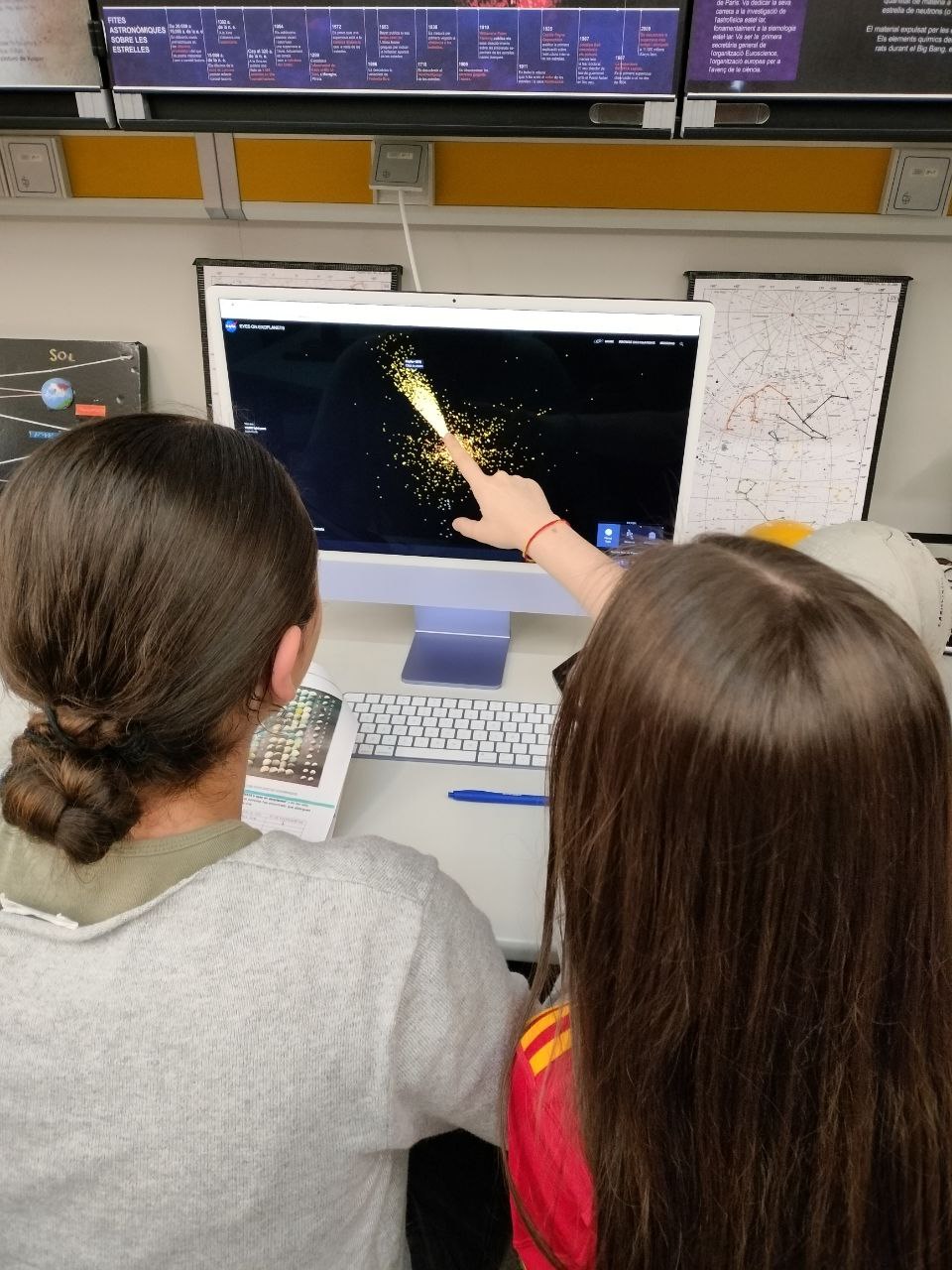
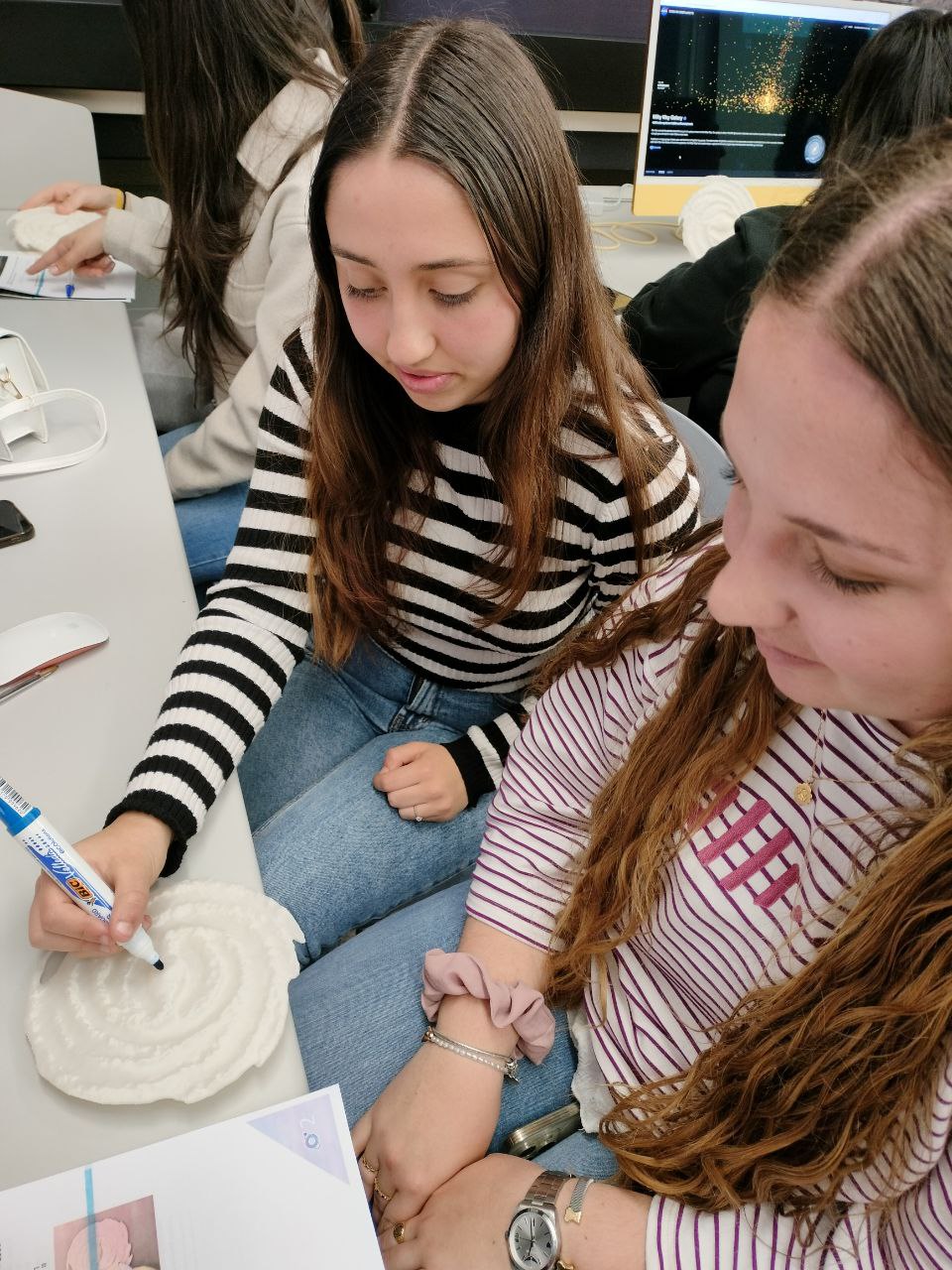
First, the students are required to dive into the scientific data published in the confirmed exoplanets database “NASA’s eyes on exoplanets”, compile the key information of randomly picked solar systems, process it applying the proper scale and transfer it to a 3D model of our galaxy. 

Milestone 2 – How are exoplanets detected and how do we know about their properties? The Transit method

Second, the students assess the difficulty of perceiving a faint source of light located in the surroundings of a much brighter object such as a star. Hence, the justification for the transit detection method.

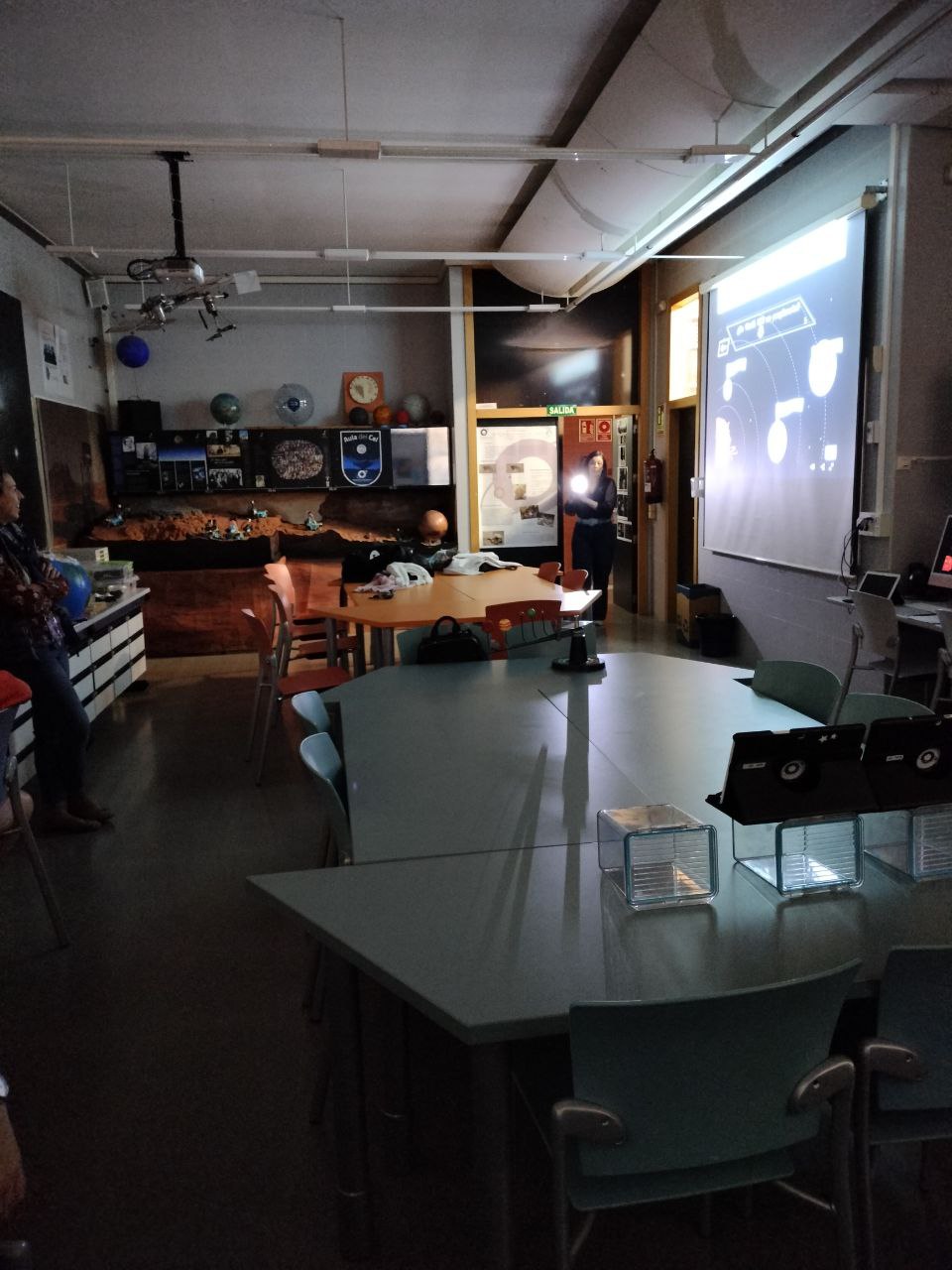
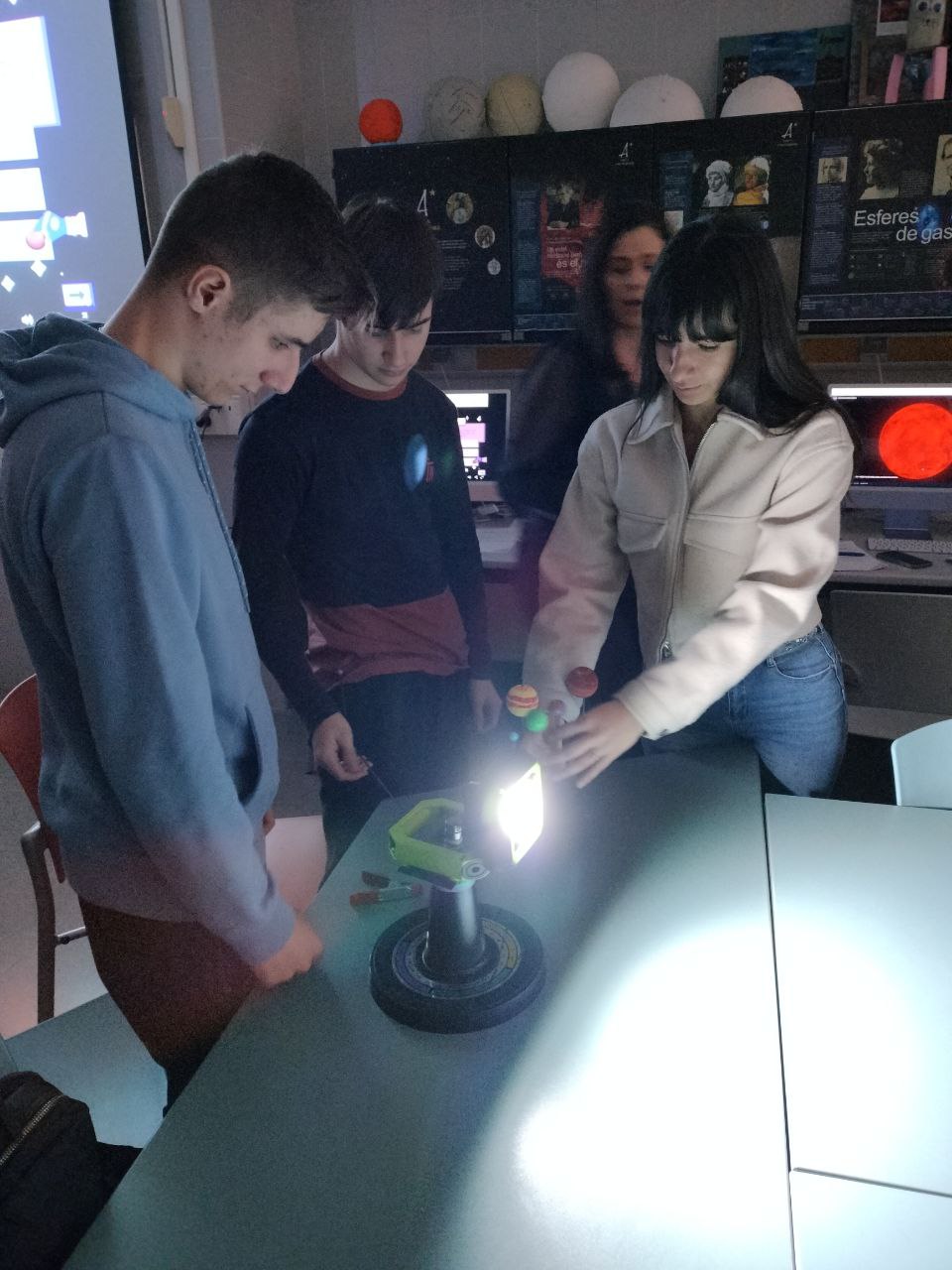
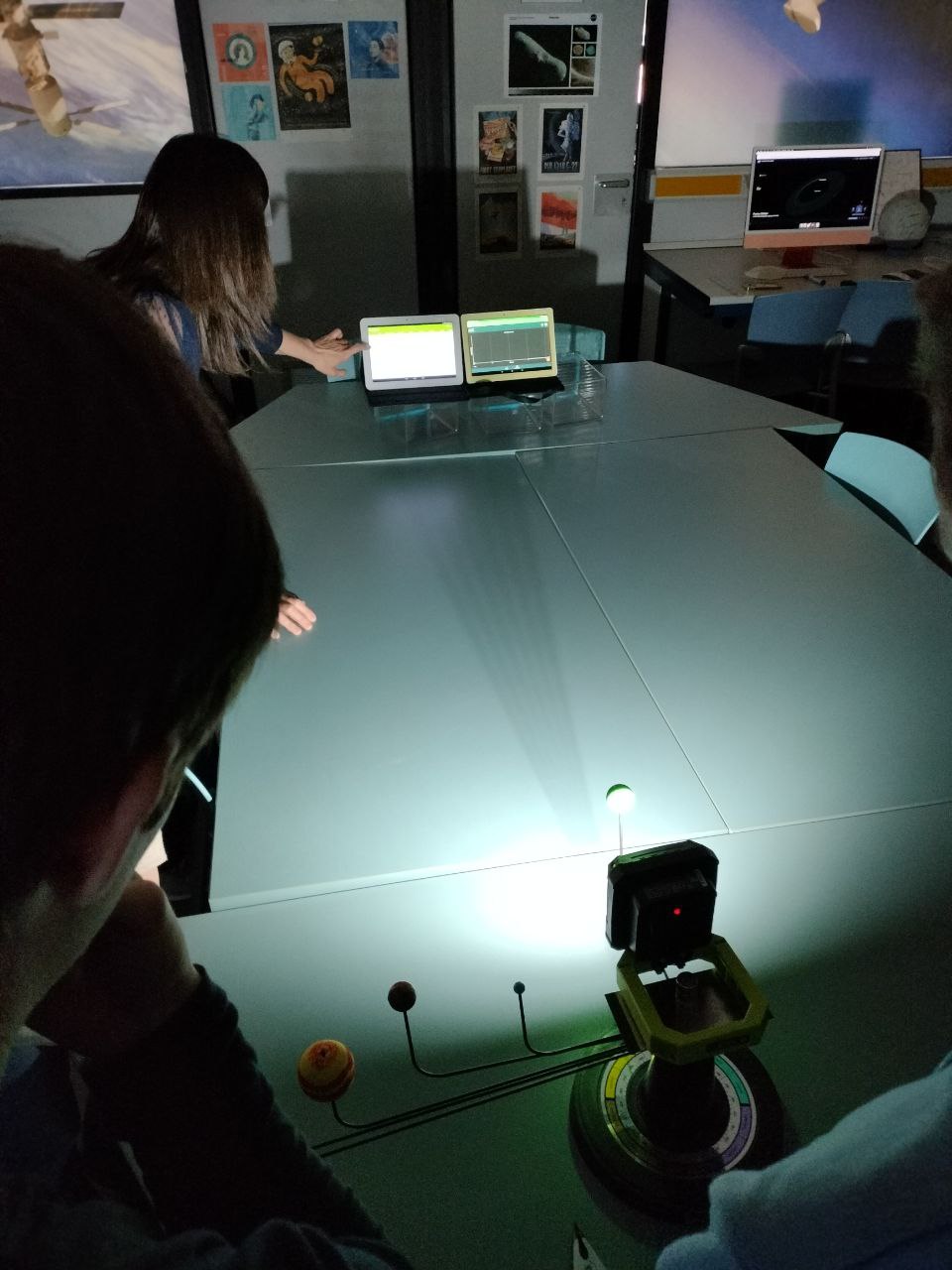
A DIY setup consisting of several balls of different sizes orbiting a led lamp is used to simulate a transit. The detector consists of the light sensor of an Android tablet together with the Playstore app “Sensors Toolbox”. The result is a light curve that reveals the existence of a planet.

All they have to do next is to apply their mathematical knowledge of proportions and geometry to extract useful information from the light measurement. They can even compare the calculated planet radius with the actual one by measuring the ball. By doing this, the students appreciate the different sources of errors. 

Milestone 3 – When do we consider an exoplanet to be potentially habitable? The goldilocks zone

Third, the students are requested to check again the database to evaluate how many of the randomly picked solar systems in milestone 1 host potentially habitable planets. This exercise provides them with an intuitive estimate of how frequent and how distant Earthlike planets are. Concluding that to perpetuate humanity we must ensure that our planet Earth is safe and sound.

After that, making use of the commercial software Sandbox Universe, they simulate different extrasolar systems and observe how the habitability zone expands or shrinks by swapping their stars for brighter or fainter ones.

Milestone 4 – Citizen science: science relying on people

Lastly, the students are introduced to ESO-NGTS Planet Hunters citizen project in order to apply all they have learned and continue their training on a regular basis.

Conclusion

At the end of the session, the students collect a commemorative badge that credits the accomplishment of all the milestones throughout the activity. They leave the Aula del Cel (The Sky Classroom) with a smile and a much richer view of life and their home planet: a meaningful learning experience.

How to cite: Ramírez Velado, B., Oritz Gil, A., and Moya Lucas, X.: Teaching science and Earth care while exploring our galaxy, EPSC-DPS Joint Meeting 2025, Helsinki, Finland, 7–13 Sep 2025, EPSC-DPS2025-1385, https://doi.org/10.5194/epsc-dps2025-1385, 2025.

Posters: Thu, 11 Sep, 18:00–19:30 | Lämpiö foyer

Display time: Thu, 11 Sep, 08:30–19:30
Chairpersons: Nimisha Verma, Jodi Berdis, Arianna Piccialli
L55
|
EPSC-DPS2025-1489
|
On-site presentation
Joseph Harrington

Universities are continually under pressure to teach more students with fewer faculty, to lower tuition, and to improve learning outcomes.  General education classes are under particular scrutiny.  As required courses, many participants are only enrolled because they need the class to graduate.  Attendance, student satisfaction, and learning outcomes are typically lower than in elective courses and even lower than in core major requirements.

Here I present my experience teaching introductory astronomy using only a video game, The University of Mars, developed by J. Charlton and collaborators at Pennsylvania State University and published by her company, TheAstroventure.com.  The cost to students at the time (Spring 2023) was $40, about 1/4 the cost of a textbook with online learning exercises.

In the game, a student's character (they can name and personalize it) travels to Mars and studies at the university there.  Some action is underground, some is on the surface, and some takes place as the characters travel around the Solar System, galaxy, and universe doing tasks and taking on challenges.  At each stage, there is both factual knowledge and intuition.  For example, time is proportional to distance traveled in each game section, starting with the solar system (yes, the students do break the speed limit).  A platform running and jumping game with adjustable planetary radius and mass demonstrates gravity; the quiz is running the platforms for time.  There is an excellent interactive 3D orrery and celestial sphere simulation that uses the different poles and orbits of Earth and Mars to drive home lessons about how planetary motions and seasons work.  Some sections include external reading on NASA and other websites.

Results were remarkable: In my initial section of 104 students, over 90% completed every assignment.  Performance on examinations typical for introductory astronomy was typical.  The final grade distribution was A:46, B:47, C:9, D:0, F:1, W:1, a DFW rate under 2%.  Subsequent, much-larger sections taught by others obtained similar results.

The self-paced nature of the game and the large test bank allowed maximal time flexibility, enabling a student hospitalized in the first week of classes, who was conscious and lucid for fewer than four weeks, to earn a B+; it was the only class he completed, and it enabled him to keep his scholarship.  Several students who were parents holding down one or more jobs stated that they likely could not have succeeded in a course with a fixed meeting time.  One student completed the entire course in a ten-day marathon just before the semester started, enabling her to take a full load of other courses; she earned a B+, taking the mid-term and final examinations when they were administered.

My effort was minimal, simply holding office hours online, keeping a steady motivational commentary going in the course's online chat to encourage students to follow the assignment schedule, and reaching out individually to students if they did not complete assignments.  In-game quiz scores and game section completion updated in near real time to the university's course management system, so the students and I could confirm their progress was recorded correctly.  I found the students to be astonishingly engaged throughout the course.

I do not suggest that all courses can be gamified, nor that this modality is ideal or even merely better for every student.  A human instructor can respond to questions in real time and can engage the students in conversations with each other that motivate learning, exploration, and retention.  Human instructors can go beyond the text if students are interested, and can answer questions about current events.  Human instructors can also modify content in response to recent requests or student performance.  Parallel sections to mine used a standard online format and an in-person delivery, so students self-selected into my section.  However, the section filled quickly and the student evaluations I received were well above the department, college, and university means in every one of nine categories (53 respondents).  In every category there were more "excellent" than "very good", more "very good" than "good", and at most two ratings of "fair" or "poor".

Given the financial constraints in higher education, students' desire for more enjoyable learning, the need for time-flexible courses, and the evident effectiveness of this approach, I find this particular course and gamified learning in general to offer an attractive alternative that bears a trial run.

I declare that I have no competing financial interests.  I am not affiliated with nor compensated by the producers of the game.

How to cite: Harrington, J.: Teaching Astronomy 101 Using Only a Video Game, No Textbook, No Lecture, EPSC-DPS Joint Meeting 2025, Helsinki, Finland, 7–13 Sep 2025, EPSC-DPS2025-1489, https://doi.org/10.5194/epsc-dps2025-1489, 2025.