
 1,1,1,1,1,1
- 1Vrije Universiteit Brussel, Archaeology, Environmental Changes, and Geo-Chemistry, Belgium (trygve.prestgard@vub.be)
- 2Vrije Universiteit Brussel, Electrochemical and Surface Engineering Research, Belgium (kitty.baert@vub.be)
Introduction
Melted micrometeorites (i.e. cosmic spherules) have not only been found to be ubiquitous across the Earth’s surface, but also throughout the geological record [1,2]. Several thousands of fossil cosmic spherules have been recovered across the Phanerozoic [3,4], and additionally several tens have been extracted from Archean sediments [5]. Although diagenesis may affect most particles, if recovered in sufficient numbers, selected specimens may display well-preserved textures and geochemical composition, which may also be applicable to their oxygen (O-)isotopic composition. This is particularly interesting as the O-isotopic composition is expected to reflect that of their parent bodies and the terrestrial atmosphere at the time of flash heating, the latter applying particularly to metal-rich (I-)type cosmic spherules [6,7]. As such, pristine fossil cosmic spherules represent windows into the history of dust-producing events in the inner Solar System and may record the oxidative capacity of Earth’s paleoatmospheres. However, a quantitative and non-destructive measure to determine the degree of terrestrial alteration applied to (fossil) micrometeorites is currently lacking. This work evaluates the potential of micro-Raman spectroscopy as an effective tool to assess terrestrial alteration in fossil cosmic spherules (particularly I-types) and the potential to uncover pristine samples without destructive analysis.
Samples and Method
Fossil cosmic spherules in this work are from the collections available at the AMGC/VUB, including samples from the Chanxhe outcrop (Belgium) of late-Devonian limestone [8]. A LabRAM HR Evolution (HORIBA Scientific) confocal spectrometer is used to obtain micro-Raman spectra (laser wavelength: λ=532 nm, spot size 1-2 µm, objective: x50LWD) of the spherule exteriors. For the purpose of bulk representativity, a minimum of twelve individual spectra have been measured for each spherule. Furthermore, to avoid the artificial production of hematite during acquisition [9], the laser was operating at 10% of its maximum intensity (meaning at 2.4 mW). Each individual spectrum is the combination of two sets of 1-minute measurements. The grading was of 600 gr/mm, implying a spectral resolution of around 2 cm-1.
First Results and Discussion
Preliminary results based on four I-type fossil cosmic spherules from the Chanxhe outcrop are presented in Fig. 1. We observe that innate iron oxide signatures (as seen in modern I-type cosmic spherules) generally coexist, or are overridden, by bands that (at least) partially resemble hematite. The presence of hematite in fossil cosmic spherules would be consistent with previous SEM studies (e.g. [10]) and is interpreted to reflect replacing primary iron oxides through weathering [11]. However, despite all four samples originating from the same outcrop, the degree of hematite(-like) replacement is highly variable. While certain samples only contain spectral signatures of hematite(-like) (i.e. #3 and #4), cosmic spherule #1 is spectrally indifferent from moderately-weathered modern Antarctic samples. These results imply that #1 may be relatively well-preserved, although additional spectra on the sectioned interior and SEM-EDS analysis are still required to confirm or infirm these interpretations. Through the analysis of these first results, it appears that the average relative intensity of the hematite(-like) (e.g. 1290-cm1-band) versus the primary iron-oxide (e.g. 660-670 cm-1) bands may be a potentially useful metric in assessing weathering in fossil (I-type) cosmic spherules. Further developments on a larger sample size will be presented during the conference.
Conclusion
In addition to being non-destructive, Raman spectroscopy provides quantitative means of evaluating terrestrial weathering in fossil cosmic spherules, including the identification of potentially pristine samples. This novel methodology may thus prove useful in tracing pristine particles that may aid in refining the dynamics of the ancient Solar System and/or Earth’s paleoclimate.
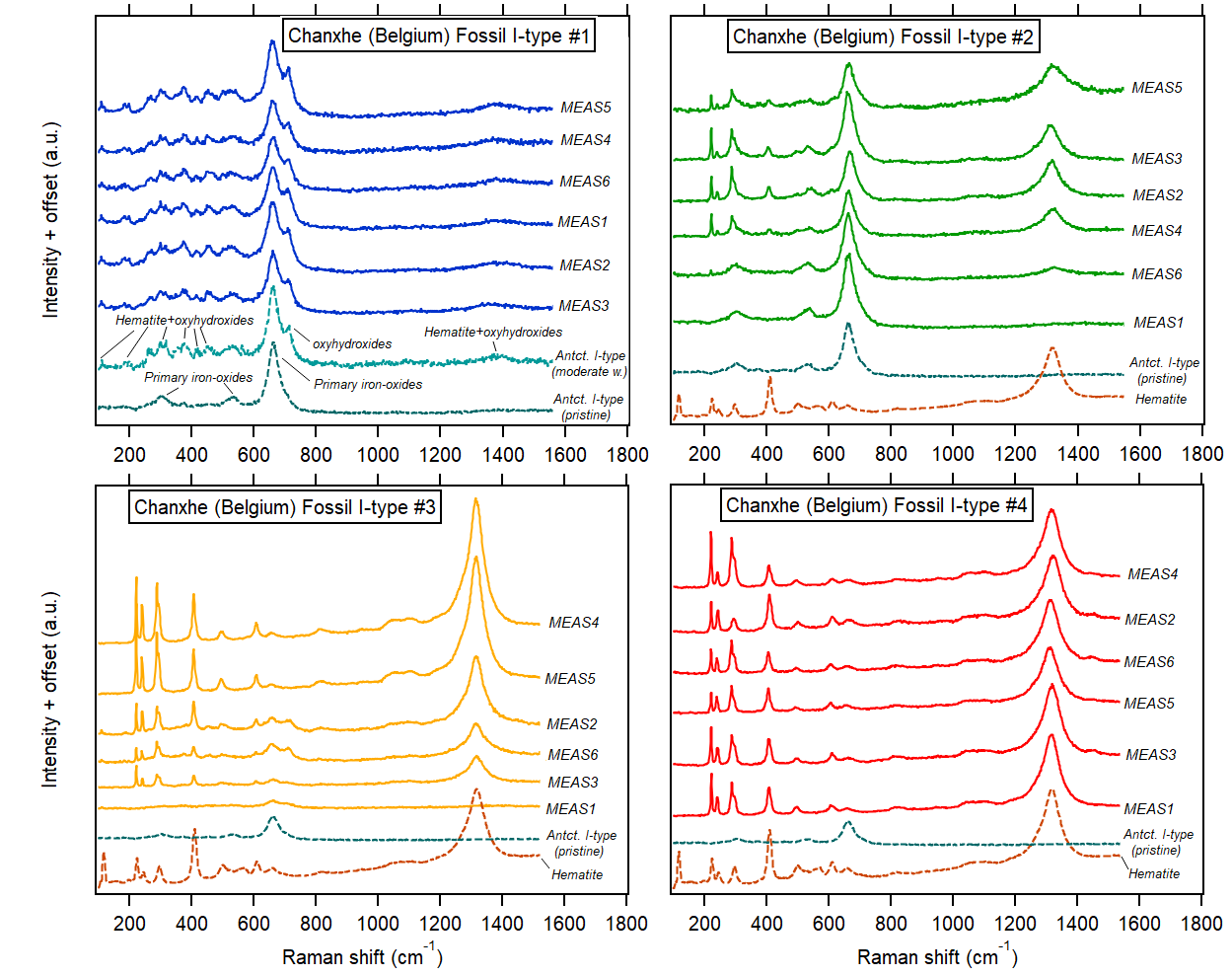
Fig. 1: Compilation of micro-Raman spectra obtained of four fossil I-type cosmic spherules from the late-Devonian Chanxhe (Belgium) collection [8] compared to two modern Antarctic I-types (one pristine and another moderately weathered), plus hematite. “Fossil I-type #1” may potentially be a relatively well-preserved sample based on its spectral similarity with modern Antarctic micrometeorites (e.g. weak hematite/oxyhydroxide-like bands). Note that although Antarctic I-types commonly display spectral evidence of weathering (hematite and/or oxyhydroxides), these bands tend to be significantly weaker than observed in our fossil samples (particularly hematite, as notably seen in Fossil I-types #3 and #4). The Antarctic spherules are from the collections available at the AMGC/VUB and were measured as part of this work. The hematite spectrum was extracted from the RRUFF database (ID: R040024.3). Offset was added for the purpose of clarity.
References
[1] Taylor, S., & Brownlee, D. E. 1991. Meteoritics 26(3):203–211.
[2] Suttle, M. D., & Genge, M. J. 2017. Earth and Planetary Science Letters 476:132–142.
[3] Mutch, T. A. 1964. Annals of the New York Academy of Sciences 119:166–185.
[4] Krämer Ruggiu, L., et al. 2022. 85th Annual Meeting of the Meteoritical Society [Abstract].
[5] Tomkins, A., et al. 2016. Nature 533:235–238.
[6] Pack, A., et al. 2017. Nature communications 8(1):15702.
[7] Fischer, M. B., et al. 2021. Paleoceanography and Paleoclimatology 36(3):e2020PA004159.
[8] Krämer Ruggiu, L., et al. 2025. (This conference).
[9] Jubb, A.M., & Allen, H.C. 2010. ACS Appl. Mater. Interfaces 2:2804–2812.
[10] Onoue, T., et al. 2011. Geology 39(6):567–570.
[11] Suttle, M. D., & Genge, M. J. 2017. 80th Annual Meeting of the Meteoritical Society [Abstract].
How to cite: Prestgard, T., Krämer Ruggiu, L., Binu Beena, D., Jonckheere, F., Pesola, J., Zelinsky, C., Boschi, S., Thiemens, M., Baert, K., and Goderis, S.: Raman Spectroscopy as a Tool to Study the Preservation of Cosmic Spherules in the Geological Record, EPSC-DPS Joint Meeting 2025, Helsinki, Finland, 7–12 Sep 2025, EPSC-DPS2025-1396, https://doi.org/10.5194/epsc-dps2025-1396, 2025.


