
 1,1,
1,1,- 1Tsinghua University, Beijing, China (wu-yx23@mails.tsinghua.edu.cn)
- 2National Astronomical Observatory of Japan, Tokyo, Japan (yhuang.astro@gmail.com)
1. Introduction
Near-Earth asteroids (NEAs) have been thought to originate from the main asteroid belt between Mars and Jupiter. However, recent research has revealed the existence of a unique family of NEA originating from lunar impact ejecta. For example, the asteroid 2016 HO3 (Jiao et al, 2024), which is the target of China's Tianwen-2 mission, and the recently discovered asteroid 2024 PT5 (Kareta et al, 2025) may belong to this category of lunar-originated asteroids. Despite these discoveries, there is still a lack of systematic understanding of the population, size distribution, and dynamical characteristics of such lunar-originated asteroids.
In this work, we combine the lunar impact history and N-body simulations incorporating the Yarkovsky effect to systematically investigate the orbital evolution of D > 5 m lunar ejecta on a timescale of ~ 100 Myr. We focus on Earth flyby events of these lunar-originated asteroids and their orbital characteristics. Considering the current observational capabilities of optical survey telescopes, we have also assessed the detectability of potential lunar-originated asteroids.
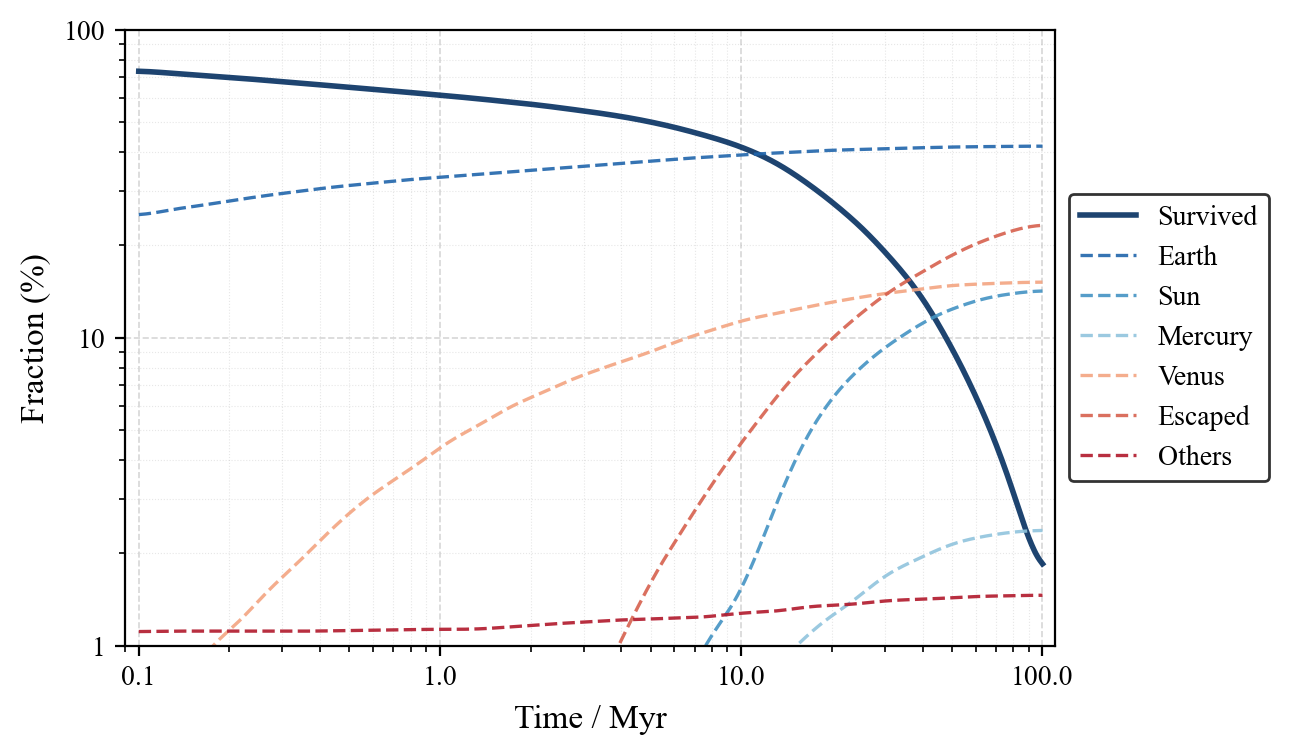
Fig. 1 Dynamical fates of all the lunar ejecta
2. Results
Through N-body simulations involving 20,000 particles ejected from the Moon for a time range of 100 Myr, we find that 41.9% of the particles eventually hit the Earth and only 1.6% can survive (Fig. 1). In particular, 24.8% of the particles hit the Earth within the first 0.1 Myr, which is consistent with the previous study (Castro-Cisneros et al, 2025). Combining the lunar impact history and cratering simulations, it is estimated that there are approximately 700,000 lunar-originated asteroids (> 5 m) still surviving, which is ≲ 1% of the NEA population. Furthermore, we find that there can be approximately 23 Earth flyby events (distance < 0.05 AU encounters) per year for such asteroids.
Among these Earth flyby events, we are most interested in those that can be detected by roving telescopes. For the "wide and shallow" survey strategy (e.g., ATLAS), by counting flybys where the asteroid's apparent V-band magnitude is < 20, we find an average of 2.3 such observing opportunities annually. These results indicate a significant potential for the discovery and subsequent verification of lunar-originated asteroids >5m in diameter.
In addition, we also find that the frequency of temporary capture events similar to that observed for 2024 PT5 is about once per century on average. This suggests that while 1 m sized asteroids may form a steady state population of Earth's minimoons (Jedicke et al, 2025), it is uncommon to find lunar-originated D > 5 m asteroids serving as minimoons.
References
Jiao, Y., Cheng, B., Huang, Y., Asphaug, E., Gladman, B., Malhotra, R., ... & Baoyin, H. (2024). Asteroid Kamo ‘oalewa’s journey from the lunar Giordano Bruno crater to Earth 1: 1 resonance. Nature Astronomy, 8(7), 819-826.
Kareta, T., Fuentes-Muñoz, O., Moskovitz, N., Farnocchia, D., & Sharkey, B. N. (2025). On the Lunar Origin of Near-Earth Asteroid 2024 PT5. The Astrophysical Journal Letters, 979(1), L8.
Castro-Cisneros, J. D., Malhotra, R., & Rosengren, A. J. (2025). Lunar impact ejecta flux on the Earth. Icarus, 116606.
Jedicke, R., Alessi, E. M., Wiedner, N., Ghosal, M., Bierhaus, E. B., & Granvik, M. (2025). The steady state population of Earth’s minimoons of lunar provenance. Icarus, 116587.
How to cite: Wu, Y., Jiao, Y., Huang, Y., Cheng, B., Dai, W.-Y., Baoyin, H., and Li, J.: Hunt for Lunar-Originated Asteroid Population from Earth Flybys, EPSC-DPS Joint Meeting 2025, Helsinki, Finland, 7–13 Sep 2025, EPSC-DPS2025-1402, https://doi.org/10.5194/epsc-dps2025-1402, 2025.


