
 1,1,
1,1,- 1Tsinghua University, Beijing, 100084, China (jiaoyf.thu@gmail.com)
- 2Lunar and Planetary Laboratory, University of Arizona, Tucson, AZ, 85721, USA
- 3Space Research and Planetary Sciences, Physics Institute, University of Bern, Bern, Switzerland
- 4IFAC-CNR, Via Madonna del Piano 10, Sesto Fiorentino FI, 50019, Italy
- 5Beihang University, Beijing, 100191, China
The dark carbonaceous asteroids, comprising over 75% of the main belt population (~50% by mass), are thought to contain the most primitive materials from the early solar system. However, the lack of direct interior measurements has greatly limited our understanding of the formation and evolution of this category. One such primitive asteroid, the 53-km Mathilde, characterized by its well-preserved giant craters, has remained a puzzle since the NEAR spacecraft's first glimpse in 1997 [1]. Recent missions to Ryugu and Bennu [2,3] have provided valuable insights into the composition and structural properties of km-size rubble piles, which are debris aggregates of primitive asteroids, offering a unique opportunity to re-examine the interior of their parent bodies--the large primitive objects like Mathilde.
Here we show that large primitive asteroids could possess a cohesive and porous interior, by reconstructing the formation of giant craters on Mathilde with hydrodynamics simulations. Our results suggest a cohesion of ~10 kPa, an internal friction coefficient of 1.0, and a crush strength of 10 to 100 MPa, in which case the giant craters on Mathilde are formed in a compaction dominated regime (Fig. 1). Most low-albedo asteroids 40–100 km diameter may possess similar interiors and similar giant craters; this will be tested by the Lucy and MBR Explorer missions. Based on these simulations, and to explain the hydration diversity and exogenic contamination observed among Ryugu and Bennu, we propose that ~85% of the small carbonaceous asteroids could have originated from the catastrophic and super-catastrophic disruptions of large primitive asteroids like Mathilde, with giant cratering events supplying the rest. Conversely, small basaltic asteroids are more likely to originate from less energetic events thus containing less exogenic.
References
[1] J. Veverka, et al., Science 278 (5346), 2109–2114 (1997).
[2] S. Watanabe, et al., Science 364 (6437), 268–272 (2019). 350.
[3] O. Barnouin, et al., Nature Geoscience 12 (4), 247–252 (2019).352.
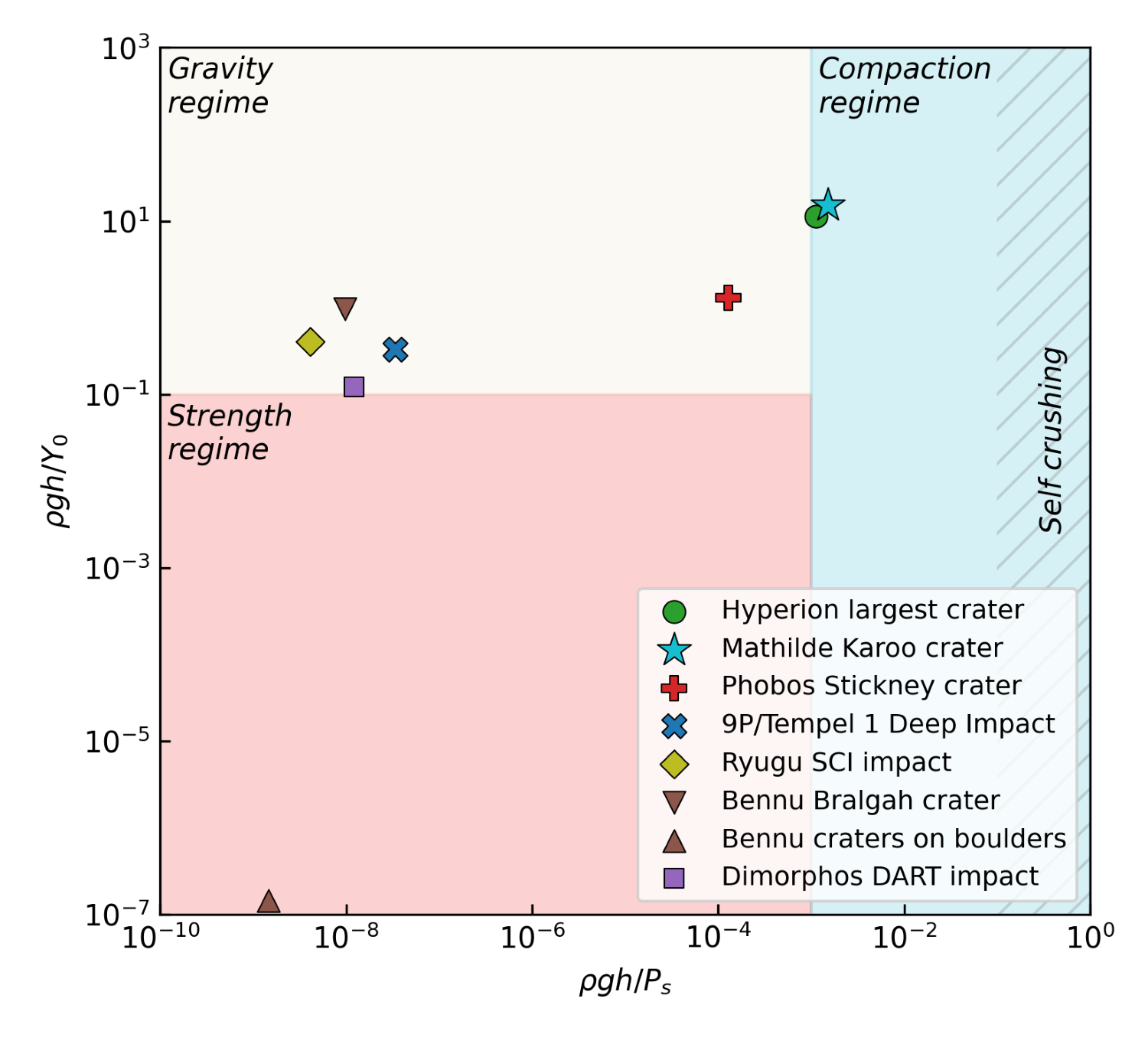
Fig.1 Giant craters on Mathilde appear to be in a transition between gravity-regime and self crushing.
How to cite: Jiao, Y., Cheng, B., Dai, W.-Y., Asphaug, E., Jutzi, M., Raducan, S., Yan, X., Yu, Y., and Baoyin, H.: Giant Craters on Asteroid Mathilde Revealing a Cohesive Porous Interior of C-type Parent Bodies, EPSC-DPS Joint Meeting 2025, Helsinki, Finland, 7–12 Sep 2025, EPSC-DPS2025-1404, https://doi.org/10.5194/epsc-dps2025-1404, 2025.


