
 1,2
1,2- 1European Space Agency, European Space Research and Technology Centre, Noordwijk, Netherlands
- 2Rheinisches Insitut für Umweltforschung, Abteilung Planetenforschung, An der Univeristät Zu Köln, Cologne, Germany
Radio occultation is a powerful remote sensing technique used to probe planetary atmospheres. By analysing the bending of a spacecraft’s radio signal as it passes through the atmosphere, this method provides detailed vertical profiles of atmospheric temperature, pressure and density [1]. This technique has been successfully applied at Mars by missions including the European Space Agency’s Mars Express (MEX) mission, which began Earth-based radio occultation measurements in 2004. These observations, conducted as part of the Mars Express Radio Science experiment (MaRS), provided valuable vertical profiles of both the neutral atmosphere and the ionosphere [1].
Another mission capable of utilising this technique is the ExoMars Trace Gas Orbiter (TGO), also led by the European Space Agency (ESA), which began its scientific operations around Mars in March 2018. While TGO has already been used to perform crosslink radio occultation measurements with Mars Express (TGO–MEX) [2] in the UHF band, it also holds a significant, yet largely unexplored, dataset obtained from radio occultations using the TGO-Earth X-band link. Once analysed, these data could significantly enhance our understanding of the Martian atmospheric structure and dynamics. In these experiments, different frequency bands are employed: the UHF band (400 MHz) for the TGO–MEX crosslink and the X-band (7.2 GHz/ 8.4 GHz) for the TGO–Earth uplink/ downlink. The UHF band is relatively more sensitive to the ionosphere [2], while the X-band link is better suited for probing the neutral atmosphere.
This study focuses on a preliminary investigation of the currently available TGO-Earth radio occultation dataset. To determine the number of possible occultation events observable from Earth, geometrical calculations are conducted using the SPICE toolkit to simulate spacecraft-Earth occultation geometries.
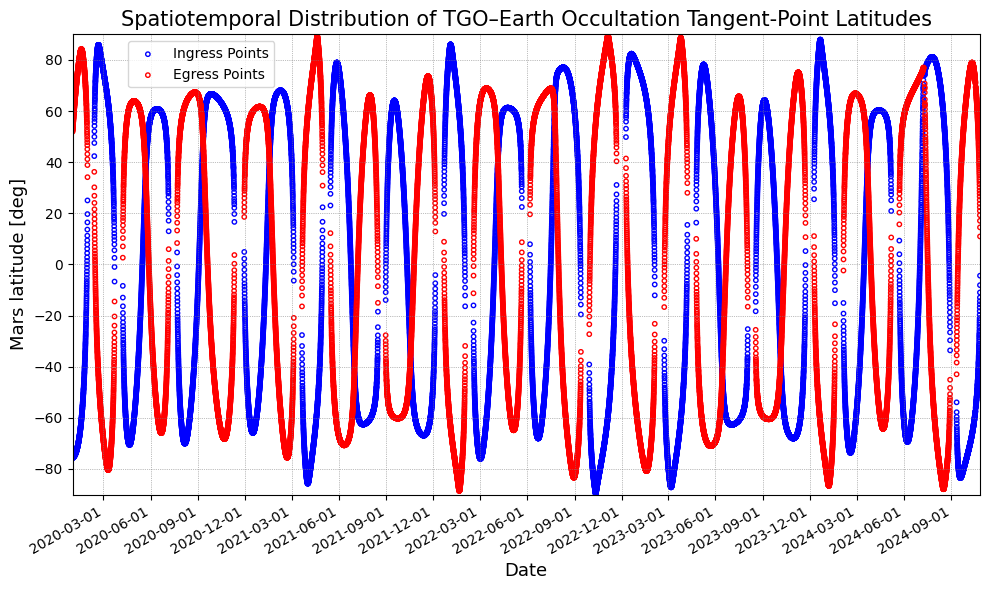
Figure 1: Latitudes of the tangent points during ingress and egress events for TGO–Earth occultations, shown over a five-year period (01/2020 –12/2024), as viewed from Earth.
Figure 1 shows the latitude of the tangent points at the times of ingress and egress during TGO–Earth occultation events on Mars, computed for the time period spanning 1/2020 to 12/2024. Although the scientific phase of the TGO mission started in 2018, archived ground station occultation data are only available from 2020 onward. Each point corresponds to the latitude of the tangent point in Mars-fixed coordinates at the time when the impact parameter crosses the planetary radius, indicating the start or end of an occultation event. During ingress, the impact parameter drops below the radius as TGO enters occultation. During egress, it rises back above it as the spacecraft leaves occultation. With an orbital period of approximately two hours, TGO completes about 12 orbits per Earth Day, providing up to 24 potential occultation opportunities daily. Due to its low-altitude, near-circular orbit, TGO provides a far greater number of occultations compared to missions in highly elliptical orbits, such as MEX, for which occultation events are less frequent. As shown in Figure 1, this results in a good opportunity to study how the latitude dependence of the neutral atmosphere varies throughout the year. Further analysis of the scientific potential of this dataset is ongoing.
References:
[1] Pätzold, M., Häusler, B., Tyler, G. L., et al. 2016, Planet. Space Sci., 127, 44, "Mars Express 10 years at Mars: Observations by the Mars Express Radio Science Experiment (MaRS)"
[2] Parrott, J., Svedhem, H., Witasse, O., et al. 2024, Radio Sci., 59, e2023RS007873, "First Results of Mars Express–ExoMars Trace Gas Orbiter Mutual Radio Occultation"
How to cite: Benthaus, M., Wilson, C., and Peter, K.: TGO-Earth radio occultation: a new data source for Mars neutral atmosphere profiling, EPSC-DPS Joint Meeting 2025, Helsinki, Finland, 7–12 Sep 2025, EPSC-DPS2025-1408, https://doi.org/10.5194/epsc-dps2025-1408, 2025.


