
 1,3,1,4,4,1
- 1Instituto de Astrofísica de Andalucía (IAA-CSIC), Granada, Spain (antoine@iaa.csic.es)
- 2Space Science Institute, Boulder, Colorado
- 3Laboratoire de Météorologie Dynamique (LMD/IPSL), CNRS, Paris, France
- 4LATMOS, CNRS, Sorbonne Université, Université Versailles St Quentin, Paris, France
Introduction
In this study which is a follow-up of [1], we use the most recent version of the ground-to-thermosphere VPCM [2] that includes an ionosphere model, ambipolar diffusion and nitrogen chemistry [3]. This tool allows us to investigate and identify in 3D potential mechanisms responsible for the observed variability in Venus’s atmosphere, in the region between 80 km and 130 km altitude. NO and O2(Δg) airglows, are commonly used to shed light on the global dynamics and circulation patterns above 90 km. Their characteristics are a combination of horizontal, vertical transport and chemical net reactions [1,4].
We performed sensitivity tests of unconstrained parameters (e.g. gravity waves drag and eddy diffusion vertical profile) to evaluate the impact on the dynamical structures, O number density, temperature and O2(Δg) nightglow characteristics. These results depict possible scenarios useful to interpret future EnVision observations of trace compounds in those mesosphere layers currently poorly constrained, and not fully explained by current 3D models.
Motivation of this study
Modeling the region between 80 and 130 km, that marks the transition between superrotation regime in the deep atmosphere and the day-to-night circulation in the thermosphere, is a key step towards understanding the processes governing Venusian dynamics. Recent V-PCM improvements presented in [2] and [3] focused on Venus’s atmosphere above 130 km, and performed a comprehensive validation of model results with PVO, Magellan and VEX observations in the thermosphere and ionosphere. However, those model developments, together with ad-hoc tuning of parameters (see [2] for details) to fit observational data, changed dramatically the global circulation in the transition region in comparison to [1], as illustrated in Fig. 1. It was therefore necessary to carry out a follow-up to the study by [1].
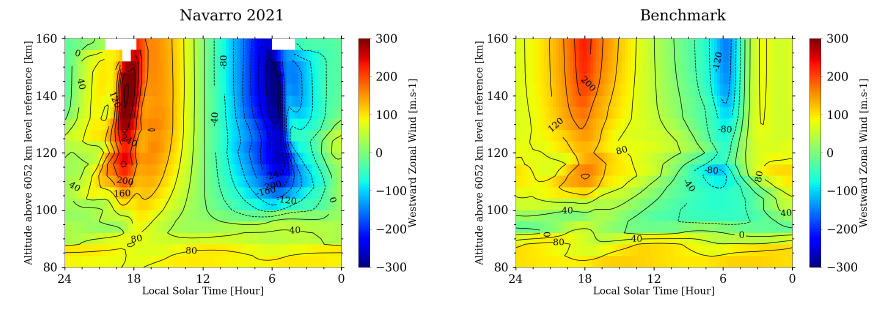
Figure 1: Zonal wind around the equator (latitude 20ºS-20ºN) in local time and altitude predicted by the V-PCM in [1] (leftside) and [2,3] (rightside).
Sensitivity tests of unconstrained parameters of gravity waves
Among the processes studied here, gravity waves are an important source of variability, but they remain extremely poorly constrained by observations. Non-orographic gravity waves are generated in the convective layer of clouds. They will propagate upwards where they will eventually break above 90 km, injecting their momentum into the mesosphere/thermosphere, which will affect wind circulation. In this abstract, we present the cases of two key parameters: the initial amplitude of the GW and the dissipation parameter. In our scheme, the dissipation parameter ensures that the waves are dissipated before reaching the top of the model, and is intended to mimic the dissipation of GW at high altitude.
We found that this region (80-130 km) is very sensitive to the unconstrained parameters used in the non-orographic gravity wave parameterization implemented in the V-PCM [2,4]. For instance, the remnant superrotation (~100 m/s) simulated by the V-PCM peaks between 100 and 125 km, depending on the amplitude of non-orographic GW (see Figure 2). Decreasing the initial GW amplitude seems to reduce the retrograde supperrotative component between 90 and 110 km altitude.
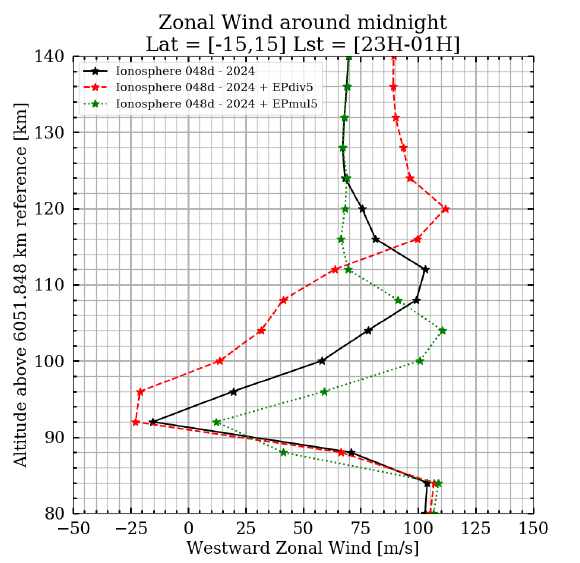
Figure 2: Zonal wind profiles around the anti-solar point simulated with the reference V-PCM [2,3] (in black) and varying the maximum EP-flux amplitude in the GW parameterization by a factor x5 (EPmul5) and /5 (EPdiv5).
Figure 3 shows simulated zonal wind between 80 and 160 km in the equatorial region as function of local time for several GW configurations. By varying this diffusion parameter by a factor of 0.1 to 100 around our reference value, we see that the larger this parameter, the lower the altitude at which gravity waves begin to dissipate, as expected. However, this explored range of Rdiss values had no effect on the horizontal and vertical positioning of the O2(Δg) emission peak around 100 km. We found, however, a reduction in RSZ remanent around 110 km and larger zonal winds at the terminators with increasing Rdiss (see Fig. 3). This is also associated with an increase in temperature around the antisolar area, linked to an increase in adiabatic heating caused by a stronger downward vertical wind.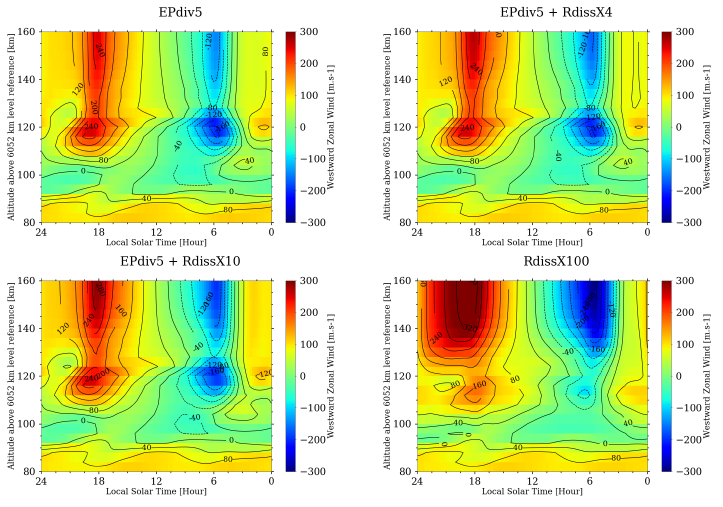
Figure 3: Zonal wind in local time and altitude predicted by VPCM tuning GW parameters (Rdiss is the diffusion parameter and EPflux is the amplitude of the non-orographic GW).
Acknowledgements
G.G. and A.M. acknowledge financial support from Junta de Andalucía through the program EMERGIA 2021 (EMC21 00249). AS and LML are funded by the Spanish MCIU, the AEI and EC-FEDER funds under project PID2021-126365NB-C21. IAA-team also acknowledges financial support from the Severo Ochoa grant CEX2021-001131-S funded by MCIN/AEI/ 10.13039/501100011033. This work was partly funded by project AST22_00001_23 from the European Union- NextGenerationEU, the Spanish Ministry of Science, Innovation and Universities, the Plan de Recuperación y Resiliencia, the Agencia Estatal Consejo Superior de Investigaciones Científicas and the Consejería de Universidad, Investigación e Innovación de la Junta de Andalucía.
References:
[1] Navarro et al. Icarus, 366:114400, https://doi.org/10.1016/j.icarus.2021.114400
[2] Martinez et al. 2023 Icarus, 389, 115272, https://doi.org/10.1016/j.icarus.2022.115272
[3] Martinez et al. 2024, Icarus 415, 116035, https://doi.org/doi:10.1016/j.icarus.2024.116035.
[4] Gilli et al. 2021, Icarus, 366:114432, https://doi.org/10.1016/j.icarus.2021.114432
How to cite: Martinez, A., Gilli, G., Stolzenbach, A., Navarro, T., Lebonnois, S., González-Galindo, F., Lefevre, F., Streel, N., and Lara, L. M.: Impact of unconstrained parameters on the global dynamics in the “transition region” of Venus atmosphere with the Venus PCM, EPSC-DPS Joint Meeting 2025, Helsinki, Finland, 7–12 Sep 2025, EPSC-DPS2025-1424, https://doi.org/10.5194/epsc-dps2025-1424, 2025.


