
 1,1,1,2,3,4,
- 1BIRA-IASB, Bruxelles, Belgium (justin.erwin@aeronomie.be)
- 2Université de Reims Champagne-Ardenne, CNRS, GSMA, Reims, France
- 3University of Namur, Namur, Belgium
- 4Universidad del País Vasco / Euskal Herriko Unibertsitatea (UPV/EHU), Leioa , Bizkaia , Spain
- 5ESAC, Madrid, Spain
- 6Freie Universität Berlin, Berlin, Germany
The 2030s will see the arrival of several spacecrafts, with multiple spectrometers designed to measure the atmosphere or surface using the transparency windows through the clouds on the nightside. In this work we summarize the data analysis of the VIRTIS-M dataset most relevant to the upcoming missions. We compare these results to simulations using these latest available inputs to investigate discrepancies and discuss the needs for improvements in preparation for the future missions.
The VIRTIS (Visible and Infra-Red Thermal Imaging Spectrometer) instrument was the imaging spectrometer on-board Venus Express. The mapping channel (VIRTIS-M) covering the 0.25 - 5.1µm range (Cardesín-Moinelo et al., 2020) and observed the surface and lower atmosphere on the Venus nightside. Several instruments as part of the upcoming Venus missions will study within this range. In particular, Venus Emissivity Mapper and VenSpec-M are mappers that will investigate between 0.86 and 1.18 µm (Hagelschuer et al., 2024) and VenSpec-H is a high-resolution spectrometer that will investigate between 1.1 and 2.5 µm (Robert et al., 2025). We study the expected radiance at the top of atmosphere (TOA) on nightside, since this effect the instrument performance (e.g. SNR) and geographic/measurement coverage.
Previous works have thoroughly analyzed the transparency windows (Cardesín-Moinelo et al. 2020; Mueller et al., 2020). We summarize the previous work between 1 and 2.5 µm and reanalyze in the view of upcoming missions to make consistent database for the TOA radiances.
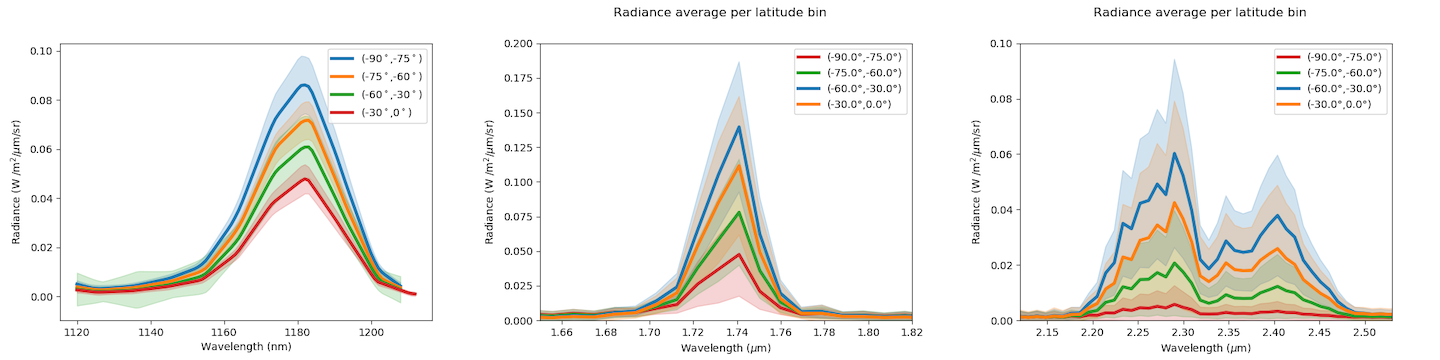
Figure 1 Average and standard deviation of Venus TOA radiance from VIRTIS-M in 3 transparency windows (left 1.18 µm, center 1.74 µm, right 2.4 µm). The averages are separated into 4 latitude bins in the southern hemisphere: 0 to -30°: low-latitude; -30° to -60°: mid-latitude; -60° to -75°: cold collar; and -75° to -90°: polar vortex. Some filtering and corrections as suggested in the literature were applied.
The nightside TOA radiances have been previously modelled and used for the retrieval of atmospheric and surface parameters. The transparency window TOA radiances are highly impacted by the aerosols scattering and CO2 absorption. Parameterizations of these effects are used in separate spectral ranges to efficiently approximate their true features. We implement these together in a radiative transfer model to present our best effort at a global model of the nightside TOA radiances expected for the future mission.
We use the ASIMUT-ALVL radiative transfer model to simulate the TOA radiances. The Venus Climate Database (Lebonnois et al., 2010) is used for atmospheric temperature, pressure, and molecular Volume Mixing Ratio (VMR). The commonly used results from Haus et al. (2016) are used for the vertical profiles of the 4 aerosols sizes. HITRAN 2020 (Gordon et al., 2022) and the Voigt line profile with CO2 pressure broadening (when available) is used for all molecules except CO2. For CO2, the sub-Lorentzian profile of Bézard et al. (2011) is used along with the continuum values from several works (Bézard et al., 2009; Bézard et al., 2011; Haus et al., 2010; Kappel et al., 2012).
The TOA radiances are presented in comparison with the data analysis from above. There are notable differences across the wavelength regions. We aim to correlate these to specific physical features to propose as useful targets for future updates.
References
Bézard, B., Tsang, C., Carlson, R., Piccioni, G., Marcq, E., and Drossart, P., “Water vapor abundance near the surface of Venus from Venus Express/VIRTIS observations,” Journal of Geophysical Research: Planets 114 (2009).
Bézard, B., Fedorova, A., Bertaux, J.-L., Rodin, A., and Korablev, O., “The 1.10- and 1.18-m nightside windows of Venus observed by SPICAV-IR aboard Venus Express,” Icarus 216 (2011).
Cardesín-Moinelo, G. Piccioni, A. Migliorini, D. Grassi, V. Cottini, D. Titov, R. Politi, F. Nuccilli, P. Drossart, “Global maps of Venus nightside mean infrared thermal emissions obtained by VIRTIS on Venus Express,” Icarus 343 (2020).
Gordon, I., Rothman, L., Hargreaves, R., Hashemi, R., Karlovets, E., Skinner, F., et al., "The HITRAN2020 molecular spectroscopic database", J. Quant. Spectrosc. Radiat. Transfer 277, (2022).
Hagelschuer, T., Pertenais, M., Walter, I., Dern, P., del Togno, S., Säuberlich, T., Pohl, A., Rosas Ortiz, Y.M., Westerdorff, K., Kopp, E., Fitzner, A., Arcos Carrasco, C., Wendler, D., Ulmer, B., Ziemke, C., Rufini Mastropasqua, S., Lötzke, H.-G., Alemanno, G., Carron, J., Réess, J.M., Vandaele, A.C., Robert, S., Marcq, E., Helbert, J., Peter, G., “The Venus Emissivity Mapper (VEM): instrument design and development for VERITAS and EnVision,” Infrared Remote Sensing and Instrumentation XXXII, Proceedings of the optical engineering + applications conference (2024).
Haus, R. and Arnold, G., “Radiative transfer in the atmosphere of Venus and applications to surface emissivity retrieval from VIRTIS/VEX measurements,” Planetary and Space Science 58 (2010).
Haus, R., Kappel, D., Tellmann, S., Arnold, G., Piccioni, G., Drossart, P., Häusler, B., “Radiative energy balance of Venus based on improved models of the middle and lower atmosphere,” Icarus 272 (2016).
Kappel, D., Arnold, G., Haus, R., Piccioni, G., and Drossart, P., “Refinements in the data analysis of VIRTIS-M-IR Venus nightside spectra,” Advances in Space Research 50 (2012).
Lebonnois, S., Hourdin, F., Eymet, V., Crespin, A., Fournier, R., Forget, F., “Superrotation of Venus' atmosphere analyzed with a full general circulation model,” Journal of Geophysical Research (Planets) 115 (2010).
Mueller, N., Smrekar, S., Tsang, C., “Multispectral surface emissivity from VIRTIS on Venus Express,” Icarus 335 (2020).
Robert, S., Erwin, J., De Cock, R., Thomas, I.R., Pereira, N., Jacobs, L., Berkenbosch, S., Bolsée, D., Vanhellemont, F., Neefs, E., Aoki, S., Bézard, B., Marcq, E., Alemanno, G., Helbert, J., Vandaele, A.C., “Scientific objectives and instrumental requirements of the infrared spectrometer VenSpec-H onboard EnVision”. Journal of Applied Remote Sensing 19.1 (2025).
How to cite: Erwin, J., Robert, S., Ducreux, E., Garate Lopez, I., Reyes Guerrero, J., Cardesin, A., and Mueller, N.: Venus nightside radiances data analysis and model comparison in view of upcoming Venus missions, EPSC-DPS Joint Meeting 2025, Helsinki, Finland, 7–12 Sep 2025, EPSC-DPS2025-1428, https://doi.org/10.5194/epsc-dps2025-1428, 2025.


