
 1,1,1,1,3,1,5,1,1,1,
- 1INAF-Osservatorio Astronomico di Padova, Padova, Italy (giovanni.munaretto@inaf.it)
- 2University of Arizona, Tucson, USA
- 3School of Geography and Planning, University of Sheffield, Winter Street, Sheffield S10 2TN, UK
- 4Laboratoire de Planétologie et Géosciences, Nantes Université, Univ. Angers, Le Mans Université, CNRS UMR 6112, 44300, Nantes, France
- 5Department of Geosciences, University of Padova, IT
- 6Physikalisches Institut, University of Bern, CH
Introduction: Eskers are elongated sinuous ridges formed by sediment deposition within subglacial channels, created by meltwater draining beneath or within glaciers. On Earth, they are critical for reconstructing past glacial processes, including ice-sheet dynamics, meltwater drainage patterns, and former ice extent and flow direction [1,2]. On Mars, the identification of eskers provides a unique opportunity to investigate the planet’s glacial history and past water availability [3]. Their presence on Mars is particularly intriguing because indicates that specific thermal or climatic events enabling the production of meltwater occurred in its recent (< 1 Gyr ago) past [3,4,5,6]. Martian eskers have been predominantly identified in the planet’s mid-latitudes, often associated with viscous flow features (VFFs), which are interpreted as debris-covered glaciers [6], and at the margins of the South Polar Cap [7]. Key regions include Phlegra Montes [3], Tempe Terra [e.g., 4,5,8] and NE Hellas [9]. These studies suggest that even during the predominantly cold and arid Amazonian epoch, locally elevated geothermal fluxes, suggested by the presence of tectonic and/or impact structures enabled subglacial melting. We identified three new candidate eskers associated with VFFs in the Deuteronilus Mensae – Imsenius Lacus region of Mars. By analzying their morphology, morphometry, topography, geologic context and cratering record, we aim to test whether they are indeed eskers and discuss their possible formation scenarios. However, the lack of association with clear tectonic and/or impact structures providing significant geothermal heat could indicate a potential for a climatic driver for the meltwater source.
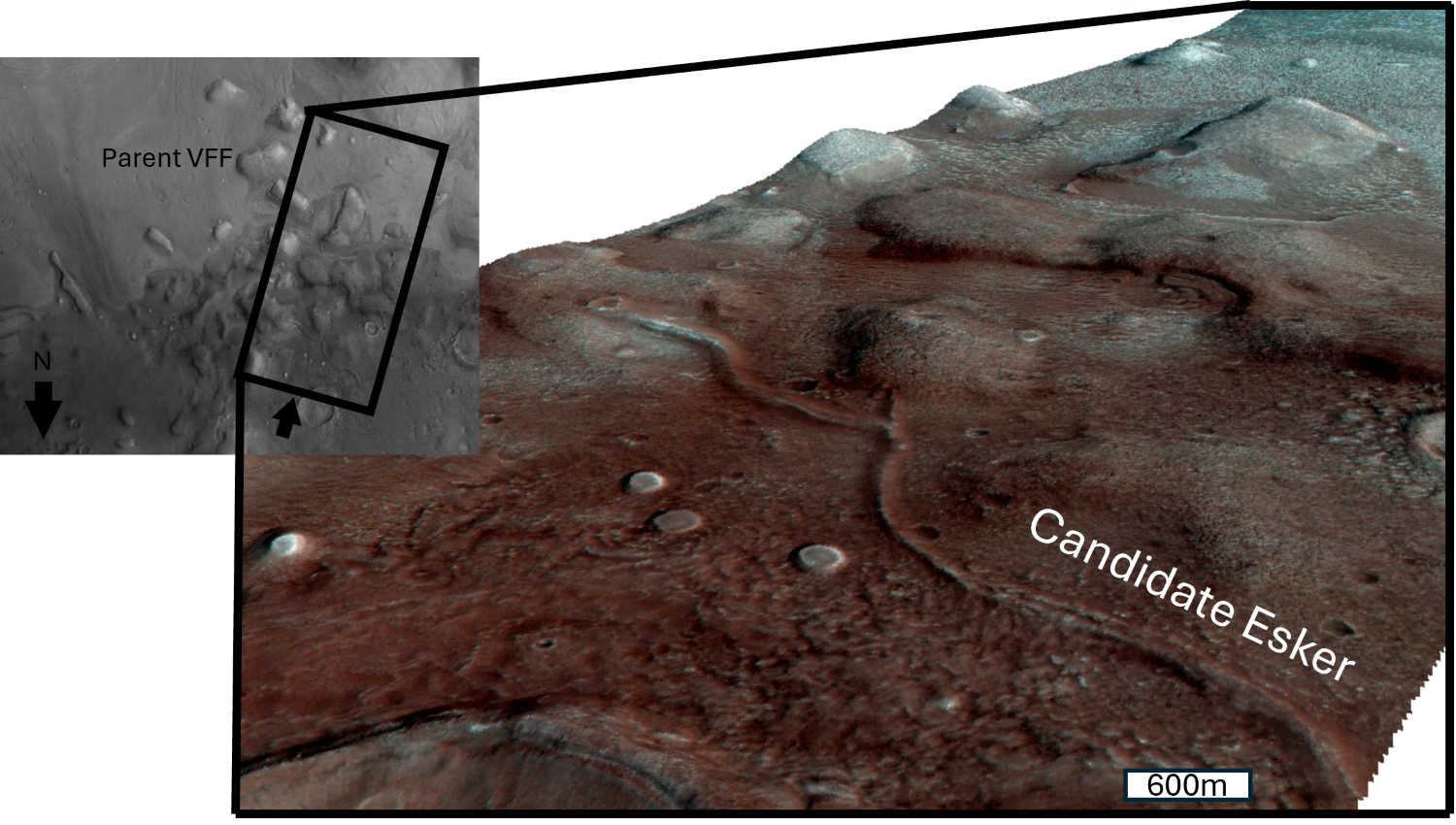
Fig. 1. Top left panel: CTX mosaic of the “D1” candidate esker in our study. Main Panel : CaSSIS colour composite draped over CaSSIS DTM showing a 3D representation of the scene.
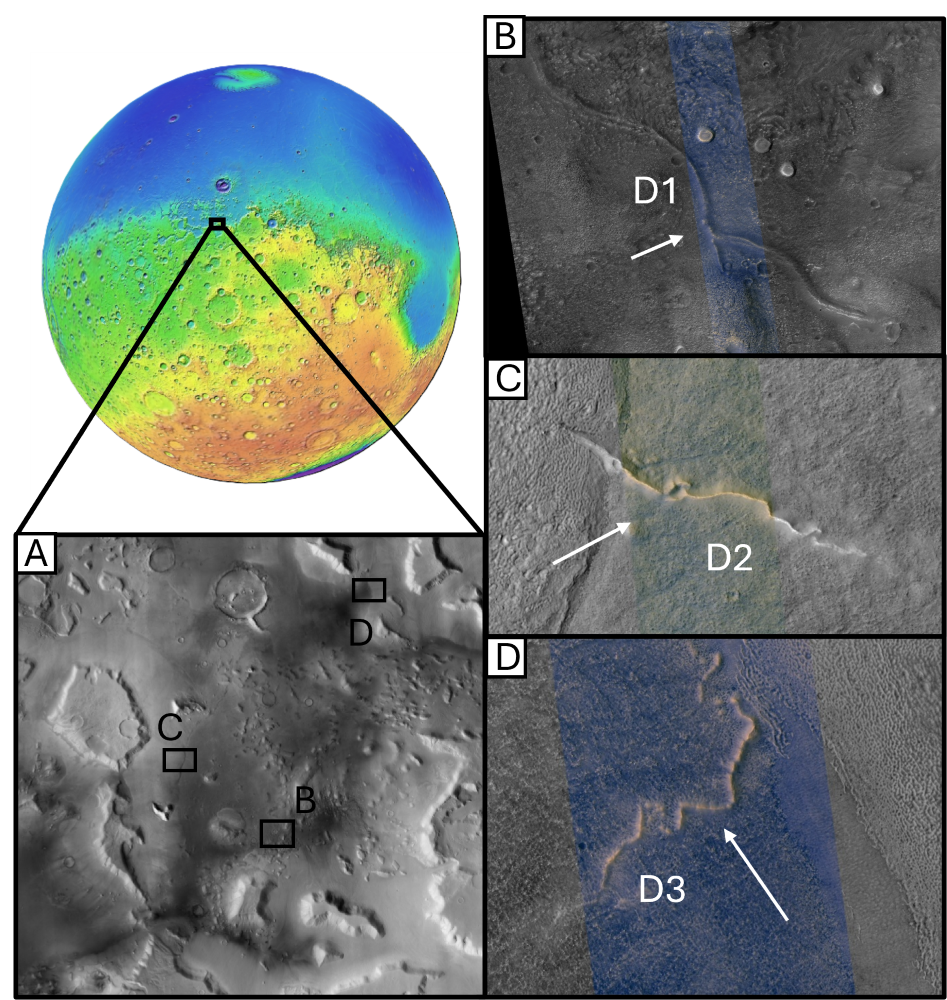
Fig. 2. A). Mars elevation map in orthographic projection indicating the location of Deuteronilus Mensae. CTX mosaic of the location with the three identified eskers, labeled as D1, D3 and D3 and depicted in panesl B, C and D, respectively
Data & Methods: We assess the morphology of the three identified eskers (named D1, D3 and D3 Fig. 2) by analyzing CaSSIS [10] and HiRISE [11] monochrome and colour composite images at 4.65 m/px and 0.3 m/px, respectively. In particular, HiRISE DEMs and orthophotos at 1.0 m/px are used to digitize the esker crests in QGIS. From these, we calculate their length and sinuosity according to the approach of [2]. Following [5,8], we digitize transects perpendicular to the esker crestline (Fig. 3A), sample the elevation profile along each of them and measure its base width and height (Fig. 3B).

Fig. 3. A) Example of transects digitized along the crestline of the D1 candidate esker. B) Example of elevation profile and width and height measurements. C) Comparison of the D1 and D2 candidate eskers base height and width with data from West Tempe Terra [6] and North-West Tempe Terra [9]
Results & Future Developments: We compared width vs height for the D1 and D2 candidate eskers (D3 is work in progress) with the measurements of other martian eskers in North-West Tempe Terra (NWTT in Fig. 3C) and in West Tempe Terra (WTT in Fig. 3C) from [6] and [9]. We find that D2 has similar 3D morphometries to those portions of the WTT and NWTT eskers with similar crest morphologies, while the D1 also has wider and higher portions. The similarity between the 3D morphometries (height vs width) of D1, D2 and those of well established Martian eskers [6,9], confirms our initial esker hypothesis. This provides novel insights on the geologic history of Deuteronilus Mensae, suggesting that episodes of localized meltwater production occurred during the Amazonian. A preliminary interpretation of the possible drainage and deglaciation of the study area as suggested by the analysis of the eskers, complemented by the assessment of their geologic context and modelled ages obtained by impact crater counting, will be presented at the conference.
Acknowledgments. The authors wish to thank the spacecraft and instrument engineering teams for the successful completion of the instrument. CaSSIS is a project of the University of Bern and funded through the Swiss Space Office via ESA’s PRODEX programme. The instrument hardware development was also supported by the Italian Space Agency (ASI) (ASI-INAF agreement no.I/018/12/0), INAF/Astronomical Observatory of Padova, and the Space Research Center (CBK) in Warsaw. Support from SGF (Budapest), the University of Arizona (Lunar and Planetary Lab.) and NASA are also gratefully acknowledged. Operations support from the UK Space Agency under grant ST/R003025/1 is also acknowledged. This work has been developed under the ASI-INAF agreement n. 2024-40-HH.0. FB acknowledges a Leverhulme Trust Early Career Fellowship
References:
[1] Shreve, R. L. (1985). Geological Society of America Bulletin, 96(5), 639–646. [2] Storrar,et al., (2014). Quaternary Science Reviews, 105, 1–25. [3]Butcher FEG, Arnold NS, Balme MR, et al. Eskers associated with buried glaciers in Mars’ mid latitudes: recent advances and future directions. Annals of Glaciology.2022;63(87-89):33-38. [4] Gallagher, C., & Balme, M. R. (2015). Earth and Planetary Science Letters, 431, 96–109. [5] Butcher, F. E. G. et al., (2017). Journal of Geophysical Research: Planets, 122(12), 2445–2468. [6] Woodley, S. Z., et al., (2022). Icarus, 386, 115147. [7] Butcher, FEG, Conway, SJ and Arnold, NS (2016) Are the Dorsa Argentea on Mars eskers? Icarus 275, 65–84. doi: 10.1016/j.icarus.2016.03.028 [8] Butcher, F. E. et al., (2020). Earth and Planetary Science Letters, 542, 116325. [9] Grau Galofre et al., 2024 Icarus, 420, p.116211 [10] Thomas, N., Cremonese, G., Ziethe, R., et al. (2017) Space Sci. Rev., 212, 1897–1944.[11] McEwen, A. S. et al., (2007) J. Geophys. Res. Planets, 112, E5.
How to cite: Munaretto, G., Bertoli, S., Tusberti, F., Tullo, A., Byrne, S., Butcher, F. E. G., Grau Galofre, A., Cremonese, G., Re, C., Massironi, M., Pajola, M., Lucchetti, A., Rossi, C., and Thomas, N.: Identification of three candidate martian Eskers in Deuteronilus Mensae, Mars: Implications for possible local wet-based glaciation, EPSC-DPS Joint Meeting 2025, Helsinki, Finland, 7–12 Sep 2025, EPSC-DPS2025-1431, https://doi.org/10.5194/epsc-dps2025-1431, 2025.


