
 1,4,5,6,7
- 1IRAP, CNES, Université Toulouse III Paul Sabatier, CNRS, Toulouse, France (aurelien.stcherbinine@irap.omp.eu)
- 2IAS, Université Paris-Saclay, CNRS, Orsay, France
- 3LAM, Université Aix-Marseille, CNRS, CNES, Marseille, France
- 4LATMOS/IPSL, UVSQ Université Paris-Saclay, CNRS, Sorbonne Université, Guyancourt, France
- 5German Aerospace Center (DLR), Institute of Planetary Research, Berlin, Germany
- 6Université Paris-Saclay, CNRS, GEOPS, Orsay, France
- 7Institut Universitaire de France, IUF, Paris, France
Introduction
OMEGA-Py [1,2] is a Python 3 module dedicated to the scientific use of data provided by the Observatoire pour la Minéralogie, l’Eau, les Glaces et l’Activité (OMEGA) instrument onboard the ESA Mars Express (MEx) orbiter [3]. It has been developed as an alternative to the IDL routines of the OMEGA legacy software provided by the instrument team for the past 20 years [4] and its validation by comparison with the results of the IDL routines has been endorsed by the OMEGA PI. The module notably includes a Python reimplementation of the most recent release of the IDL OMEGA software (v10, SOFT10) [4], which performs the reading, calibration, and reduction of the level 1B data publicly available on the ESA PSA to produce level 2A data (calibrated reflectances cubes) that can be used for the scientific analysis. In addition, the module also includes built-in functions to perform the atmospheric and thermal corrections of the data (using previously published methods) and graphic tools dedicated to the OMEGA hyperspectral data including interactive visualization of the cubes or generation of composite OMEGA maps. Also, since the release of its version 3.0 in October 2023 (currently in version 3.2, released on January 2025), OMEGA-Py is now distributed as part of the official OMEGA software ecosystem (https://www.ias.u-psud.fr/omega/software.html).
Why this module?
The accessibility of data returned by space missions is a crucial point to ensure the development of open science, and unfortunately the OMEGA dataset has acquired over the past years a reputation in the community for being challenging and requiring a significant amount of investment to use. With OMEGA-Py we aim to tackle this reputation by providing a free all-in-one toolbox to load, correct, analyze, and visualize the OMEGA data, along with a full online documentation with examples.
Data handling
OMEGA-Py includes a reimplementation of the readomega.pro routine of the IDL software, which reads and processes the L1B data that can be downloaded from the PSA to generate the L2A. A sensible improvement with OMEGA-Py is its implementation in Object Oriented Programming, which makes the simultaneous handling of several OMEGA observations easier. When loading an OMEGA observation, all the extracted data are stored within an OMEGAdata object. In addition, the wavelengths are also automatically reordered in ascending order and the spectra are ”cleaned” to remove the overlaps between the three channels (V, C, L) as well as the identified corrupted pixels. This allows the user to have direct access to reflectance spectra that can be used for scientific analysis purposes.
Data correction
Using orbital remote sensing observations like OMEGA data for scientific analysis and research may require to apply some corrections to remove the atmospheric and/or thermal contributions that affect the spectra, as shown on Figure 1. Methods to correct the OMEGA observations have been described in several publications and extensively used over the past 20 years [e.g., 5, 6], but they have never been part of the distributed IDL software.
Here OMEGA-Py provides to the users built-in functions to easily correct the data from the atmosphere using the typical volcano-scan technique [5], and from the thermal emission of the planet [6,7]. Plus, as the thermal correction of an OMEGA data cube is time-consuming, parallel processing using the multiprocessing module has been implemented to fasten the process.

Figure 1 – Correction steps of an OMEGA spectrum with OMEGA-Py (reproduced from [8]).
Visualization
OMEGA-Py also comes with a set of visualization functions specifically developed for the OMEGA data, including:
- Projection of the data maps on a longitude/latitude equatorial or polar grid, according to the geometry of the observation.
- Generation of composite maps from a series of OMEGA observations, either for the reflectance or a previously computed spectral criteria (see Figure 2).
- Interactive display of an OMEGA observation that allows the user to display the spectra by clicking with their mouse on the pixels of the map (see Figure 3).
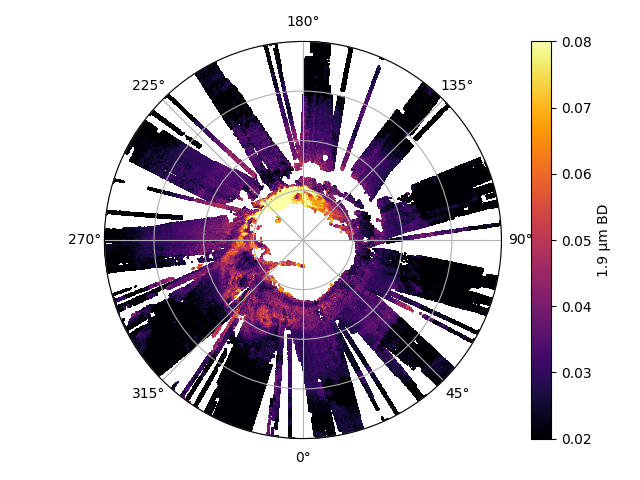
Figure 2 – 1.9 µm band depth map in the North polar regions from OMEGA observations, excluding areas covered by water ice, made with OMEGA-Py [8].
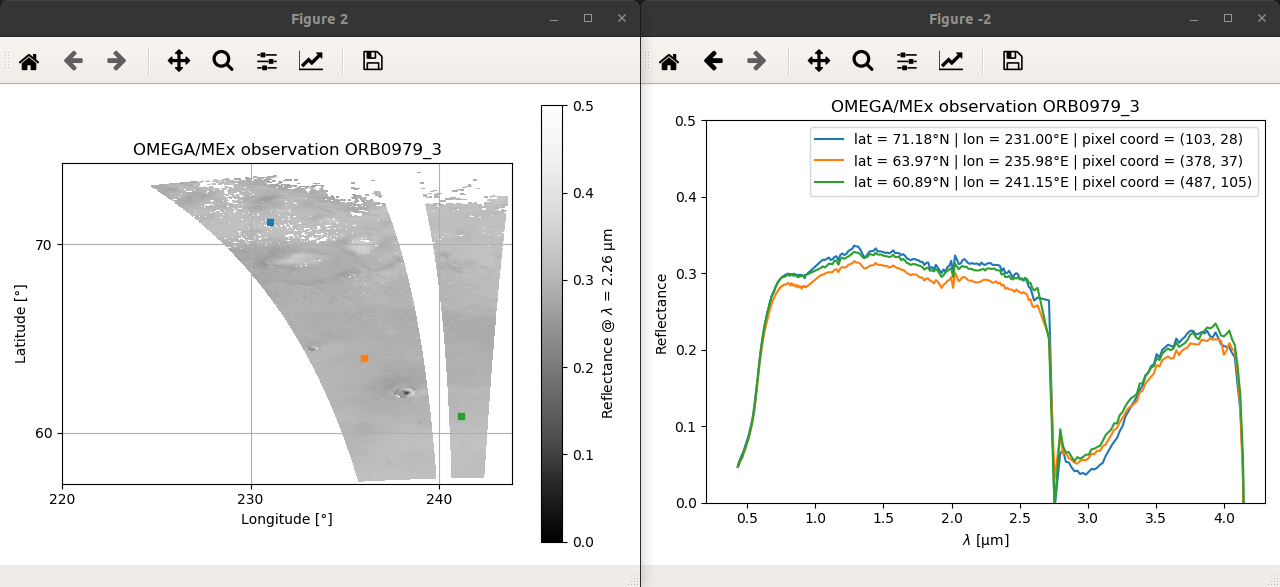
Figure 3 – Interactive visualization of an OMEGA observation with OMEGA-Py.
Conclusion & Perspectives
With OMEGA-Py we provide a new and complete solution to use and analyze the data that are returned since 2004 by the OMEGA instrument. The Python implementation and the presence of built-in correction and visualization functions will help in making the huge and very complete OMEGA dataset more accessible, especially for the younger generation of scientists and students, or for people who want to have a quick and easy access to some OMEGA data for comparison with other instruments, models or lab work. Plus, its very easy way to load OMEGA data and the functionalities to improve the processing time make the module perfectly suitable for batch processing or data mining. The official validation of the module by the instrument team in 2023, as an alternative solution to the legacy IDL software, has been an important step for the project. Since its first release in 2020, OMEGA-Py has been used in several published studies and ongoing projects [e.g., 8–11].
Acknowledgments
The full documentation of the OMEGA-Py Python module is available at https://astcherbinine.github.io/omegapy.
References
[1] Stcherbinine A. et al. (2024) JOSS, 9(99), 6566. [2] Stcherbinine A. et al. (2025) OMEGA-Py:Python tools for OMEGA data, (v3.2), Zenodo. [3] Bibring J.-P. et al. (2004) ESA Publication Division, 1240:37–49. [4] OMEGA Team , SOFT 10 IDL routines (2004). [5] Langevin Y. et al. (2005) Science, 307(5715):1584–1586. [6] Jouglet D. et al. (2007) JGR: Planets, 112(E8). [7] Audouard J., Ph.D. thesis Université Paris-Sud XI (2014). [8] Stcherbinine A. et al. (2021) Icarus, 369:114627. [9] Leseigneur Y. and Vincendon M. (2023) Icarus, 392:115366. [10] Barraud O. et al. (2024) EPSC2024-921. [11] Brasil F. et al. (2025) JGR: Planets, 130, e2024JE008726
How to cite: Stcherbinine, A., Langevin, Y., Carter, J., Vincendon, M., Leseigneur, Y., Barraud, O., and Schmidt, F.: The OMEGA-Py Python module: a complete and easy way to work with OMEGA/MEX observations, EPSC-DPS Joint Meeting 2025, Helsinki, Finland, 7–12 Sep 2025, EPSC-DPS2025-1434, https://doi.org/10.5194/epsc-dps2025-1434, 2025.


