
 1,1,2,2,
- 1HES-SO Valais-Wallis, HEI, Système Industriels, Switzerland (valentin.meier@hes-so.ch)
- 2University of Bern, Physics Institute, Space Research & Planetary Science Division
- 3University of Bern, Institute of Applied Sciences
Abstract
Comets are believed to be relics of the early Solar System, preserving pristine material that has undergone minimal thermal processing since planetary formation. Understanding their composition and internal structure—particularly the relationship between ices and refractory materials—is essential for testing current models of planet formation, such as pebble accretion [1]. While ground-penetrating radar (GPR) allows for 3D mapping of subsurface structures, and Raman spectroscopy offers detailed chemical analysis of surface materials, neither is ideally suited for non-contact, high-resolution analysis at centimeter-scale depths in opaque granular media. Terahertz time-domain spectroscopy (THz-TDS), with its capacity to penetrate non-metallic media, offers a promising alternative by enabling both structural and spectroscopic characterization in a single pulse.
As part of the SUBICE project, this work explores the miniaturization of THz-TDS systems for borehole applications on comets, focusing on simulated designs that could be integrated into future lander missions or robotic probes. The goal is to maintain high energy efficiency and spectral fidelity while minimizing optical complexity to reduce internal reflections (echoes), pulse distortion and energy loss, as well as preserving a large bandwidth.
Three conceptual designs were considered:
-
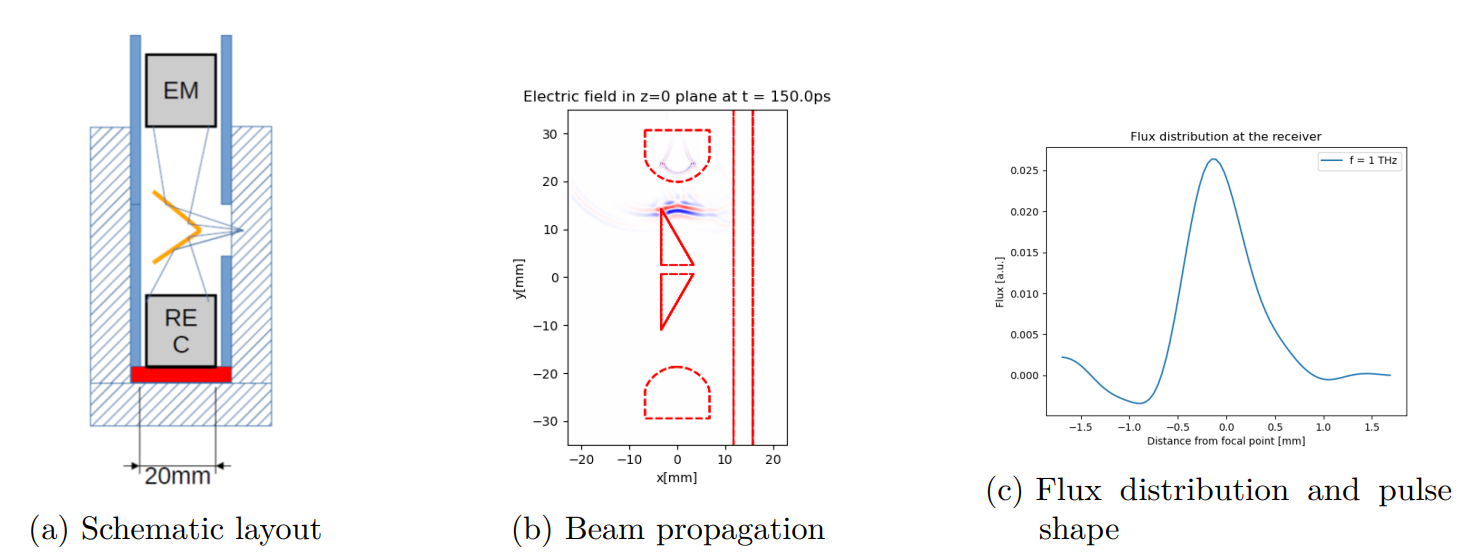
Off-axis reflection compact system: (Figure 1) A pair of conventional THz emitter and receiver modules are placed face to face, aligned such that a focusing THz beam is formed using aspherical silicon lenses. Two flat mirrors are used to deflect the beam sideways, enabling analysis of the borehole wall and underlying structures, and redirect it toward the receiver.
-
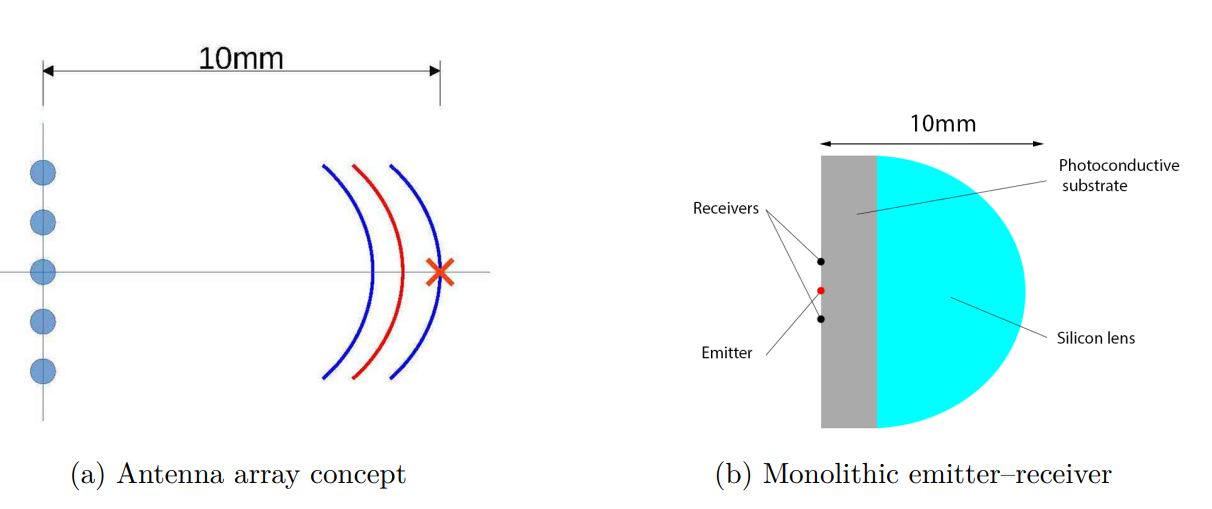
Antenna array with programmable emission delays: (Figure 2a) A lensless solution is explored where an array of THz emitters (blue dots on the figure) is driven with variable time delays to create constructive interference at a desired focal point. This electronically controlled beam-steering approach enables 2D scanning across the borehole wall without moving parts. In THz-TDS, each emitter requires optical excitation by a femtosecond laser pulse between two electrodes. This requirement can be met by integrating a microlens array to distribute the excitation beam to the emitter array — a technique demonstrated in prior literature [2].
-
Monolithic emitter–receiver design with shared lens: (Figure 2b) The third approach aims to reduce both volume and alignment complexity by combining emitter and receiver into a single optical block. An aspherical lens focuses the beam from the emitter toward the target. After perpendicular reflection (e.g. on a borehole wall and one underlying materials), the returning pulse is captured by receiver antennas placed adjacent to the emitter. These antennas are positioned to intercept the returning beam, which remains within a ~1 mm diameter spot. Since THz antennas have typical dimensions on the order of hundreds of microns, this design is geometrically feasible. A combination of variant 2. and 3. is also examined, without additional THz lens.
The simulations were performed using MEEP (MIT Electromagnetic Equation Propagation) with a spatial grid optimized for subwavelength resolution and absorbing boundary conditions to limit artifacts. In addition to flux maps, we evaluate pulse integrity by inspecting time-domain waveforms at the receiver. Maintaining pulse shape is essential to preserve spectroscopic resolution.
As a representative example, a snapshot of the pulse propagation and the flux distribution at the focus point of the off-axis reflection compact system configuration are illustrated (Figure 1b and 1c).
In this scenario, the emitter is characterized by a broadband Gaussian dipole pulse centered at 1 THz with a bandwidth of 4 THz. The pulse propagates through a silicon lens (refractive index 3.41) and is deflected toward the borehole wall using two flat mirrors. The focal spot at 1 THz reaches a FWHM of approximately 1 mm, consistent with efficient focusing. The flux distribution confirms that the energy remains concentrated along the intended path with limited dispersion. It should be noted that, due to normalization at the source, the y-axis values do not reflect absolute energy efficiency, however results are comparable to those of conventional THz setups employing spherical lenses and off-axis parabolic mirrors, which were also simulated.
These simulations assess not only the energy transfer efficiency but also the preservation of the pulse shape, which is critical for accurate spectroscopic analysis. Pulse integrity affects the clarity of spectral features, making beam shape and minimal distortion essential.
These concepts aim to guide the future integration of THz-TDS in borehole probes for cometary exploration. Unlike GPR, THz-TDS can resolve fine-scale structures and provide spectral fingerprints of volatiles and organics. Its depth range (cm-scale) and non-destructive nature make it a compelling complement to existing tools, especially for layered or porous cometary soils.
References
[1] Lambrechts, M., & Johansen, A. (2012). Rapid growth of gas-giant cores by pebble accretion. Astronomy & Astrophysics, 544, A32. https://doi.org/10.1051/0004-6361/201219127
[2] Ata Akatay, Caglar Ataman, and Hakan Urey, High-resolution beam steering using microlens arrays. Optics Letters, 31(19), 2861–2863 (2006). https://doi.org/10.1364/OL.31.002861
How to cite: Meier, V., Demion, A., Nicollerat, M., Moerschell, J., Stöckli, L., Murk, A., Girard, H., Belousov, D., and Thomas, N.: Simulation of compact THz-TDS systems for borehole applications in cometary soil analysis, EPSC-DPS Joint Meeting 2025, Helsinki, Finland, 7–12 Sep 2025, EPSC-DPS2025-1440, https://doi.org/10.5194/epsc-dps2025-1440, 2025.


