
 1,1,3,1
- 1LATMOS, UVSQ, Guyancourt, France
- 2ISAE Supaero, Toulouse, France
- 3IAP, Paris, France
- 4SCIENTEAMA, Hérouville-Saint-Clair, France
Over the last 15 years, Ground Penetrating Radars have been successfully used to locally characterize the subsurface of the Moon and Mars, on board rovers. Most of these GPR operate in a single polarization but future ones, and in particular WISDOM/ExoMars, will have full polarimetric capacities. Measuring depolarization could bring key insights into buried structures in the subsurface. In particular, studies using observations from Synthetic Aperture Radars (SAR) orbiting the Moon have identified the Circular Polarization Ratio as a parameter that could provide information on the scattering processes occurring in the subsurface. More specifically, CPR unusually high values on Permanently Shadowed Regions (PSRs) of the Moon have been interpretated as the signature of water ice. In this work, we investigate, through numerical simulations, how the CPR as measured by polarimetric GPR operating from the surface, is related to the subsurface scatterer distribution and composition, and how it could be used as a tool to potentially estimate the quantity of buried ice.
WISDOM and LGPR: two polarimetric GPRs
Among the future GPRs to be sent to Mars is WISDOM (Water Ice and Subsurface Deposit Observation on Mars), a polarimetric step-frequency GPR, that is part of the Rosalind Franklin rover payload for the ExoMars Mission. WISDOM operates on a broad frequency bandwidth, from 500 MHz to 3 GHz, which was chosen so as to guarantee a vertical resolution of approximately 3 cm, and a penetration depth of at least 2 - 3 m. By revealing buried structures and stratigraphy, WISDOM will be key for the selection of the most promising sites for drilling operations on Mars.
WISDOM measures four polarizations: it can transmit in two linear orthogonal polarizations and receive in either co- or cross- polarization. This polarimetric feature can be used to provide quantitative information on the buried scatterers (size and density) and could play a key part in identifying buried water ice in the subsurface of Mars.
Another polarimetric GPR is currently in development for a future lunar mission: LGPR (Lunar GPR), which is inherited from WISDOM. In addition, future CNSA (Chinese National Space Agency) missions to the Moon, Chang’E7 and Chang’E8, will embark polarimetry GPR to probe terrains at the South pole. This study is therefore relevant both for future Martian or lunar missions.
The Circular Polarization Ratio
Contrary to WISDOM, most polarimetric SARs operating from orbit tend to operate in circular polarization. This led to the use of the CPR, defined as the ratio between power reflected in the same sense of circular polarization (SC) as that transmitted, and the power of the echo reflected in the opposite sense (OC).

It can also be expressed using the Stokes parameters.

Similarly, we can define the Degree of Polarization (DP) and Degree of Linear Polarization (DLP):

We established a transition formula to convert a linear polarization basis to a compact one and used it to compute Stokes vectors from WISDOM measurements, and then deduce the CPR, DP and DLP. Such method is relevant to any polarimetric linear GPR.
A history of water ice detection and CPR
The Moon stands out from other celestial bodies, with an important number of studies showing unusually high values of CPR [6], detected in the South Pole [5, 3], and partly attributed to the presence of ice clusters [2]. The high transparency of water ice would be responsible for scattering phenomena and important changes in the polarization state of the wave.
However, high values of CPR are not necessarily the footprint of the presence of water ice below the surface. Indeed, studies of different geological environments show that we can reach CPR values up to 4, without water ice [1], simply due to multiple scattering phenomena in a low loss medium [4]. It is also unclear if the high CPR measured from orbits would also be measured from the ground.
To address these questions, we performed numerical simulations of WISDOM operations over different types of subsurfaces, including different densities of buried scatterers in a water ice matrix, and evaluated the CPR for each of them.
Method
In order to simulate geological environments, and a polarimetric GPR, we use TEMSI-FD, a software developed by XLim (Limoges) and that uses the 3D Finite Difference Time Domain method to simulate radar measurements.
More specifically, we conducted a statistical study, where we generated 30 environments consisting of an icy medium, with randomly distributed spheres scatterers of a given size, with the desired filling density. The simulations are performed on a loss-less media, with a dielectric permittivity of 3, consistently with the electric properties of pure water ice.
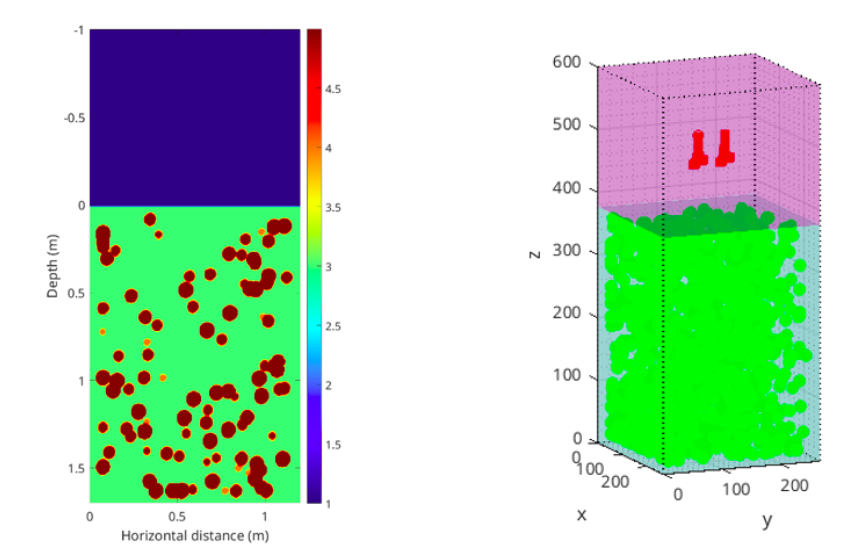
Figure 1: Example of simulated environment with spheres of 4.5cm radius, and filling density of 20%, in 2D and 3D
Preliminary results
Simulations show an increase of CPR with the density of scatterers in the subsurface, for a given radius of spheres, as expected (see Table 1).

Table 1: Simulated values of CPR, as a function of radius and filling density
However, the high CPR values reported in literature are not reached for densities smaller than 20%. Further simulations on different media, should allow us to discriminate the different values of CPR depending on the generated media, with higher filling density, more complex shapes of scatterers, and an improved processing of the synthetic data. This paper will also present the frequency-based analysis of the CPR which can bring additional information on the scattering mechanisms in place, taking advantage of the ultra-broad band of WISDOM [7].
References
[1] Campbell, 2012, J. Geophys. Res., 117(E6)
[2] Li et al., 2018, PNAS, 115, 36
[3] Spudis et al., 2013, J. Geophys. Res., 118(10), 2016-2029
[4] Fa et al., 2013, J. Geophys. Res., 118(8), 1582-1608
[5] Kumar et al., 2022, Advances in Space Research, 70(12), 4000-4029
[6] Virkki et al., 2023, Remote Sens., 15(23), 5605
[7] Brighi et al., 2024, Planetary and Space Sciences, 255:106012
How to cite: Harrar, L., Le Gall, A., Ciarletti, V., Brighi, É., Gilles, M., Hervé, Y., and Oudart, N.: Investigating the use of Circular Polarization Ratio for water ice detection by polarimetric Ground Penetrating Radars operating from the surface, EPSC-DPS Joint Meeting 2025, Helsinki, Finland, 7–13 Sep 2025, EPSC-DPS2025-1457, https://doi.org/10.5194/epsc-dps2025-1457, 2025.


