
 1
1- 1Consiglio Nazionale delle Ricerche, Istituto di Matematica Applicata e Tecnologie Informatiche "E. Magenes", Italy
- 2University of Milan, Department of Economics, Management and Quantitative Methods, Italy
The aim of this work is to present possible unsupervised machine learning methods, borrowed from the finance world, that can be applied to classify dynamical transitions appearing in the co-orbital motion.
Co-orbital dynamics appears in the three-body problem, and is widely studied to analyze asteroidal behaviors, but also to design trajectories for interplanetary missions. It can involve complex transitions that can be challenging to analyze manually due to large dataset, typically of planetary science, but also due to the role that different perturbations can play in the orbital evolution of real asteroids.
The method presented is the so-called statistical Sparse Jump Model (SJM) [1] and two novel improvements. The different formulations will be applied to medium-term time series of real asteroids and to long-term time series of simulated lunar ejecta, derived for [2]. The main orbital elements considered are the semi-major axis a, the resonant angle θ and the argument of pericenter ω. The focus will be to distinguish horseshoe (HS), quasi-satellite (QS), tadpole (TP) and compound (CP) behaviors in an automatic way and to provide meaningful metrics of the time permanence in a given regime.
The results on the behavior of lunar ejecta will be important in the context of the possible origin of important Earth's companions, like Kama'olewa or minimoons.
More details on the formulations implemented are given below.
Sparse Jump Model
The SJM takes as input a Tx P data matrix, where each row consists of given features of the system (function of a, θ and ω) at a given time t.
The model produces three main outputs:
- A sequence of latent states s = (s_1, ..., s_T), where each s_t represents a co-orbital regime (e.g., QS or HS).
- A set of centroids μ== (μ_1, ..., μ_K), with μ_k representing the most representative values for the state k.
- A feature importance vector w= (w_1, ..., w_P), where each w_p indicates the contribution of feature p to the system’s dynamics.
This is done optimizing an objective function with respect to centroids and latent states and depending on input data.
For details on model formulation and estimation, see [1,3]
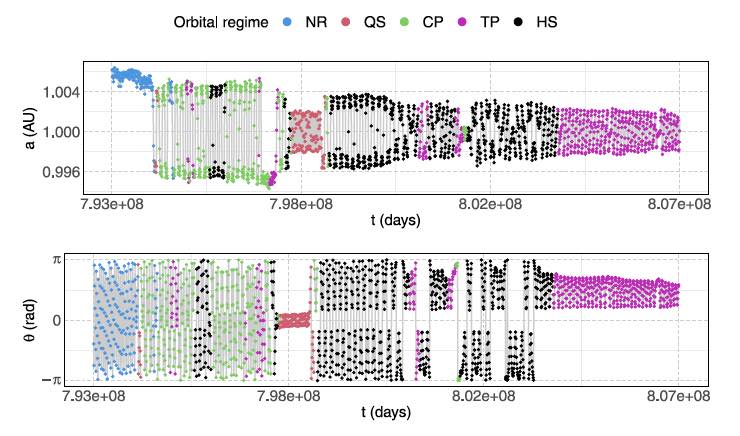
Figure 1, adapted from [4], illustrates the effectiveness of the SJM in identifying the orbital regime of a time series corresponding to lunar ejecta exhibiting a co-orbital behavior outside the Hill's sphere of the Earth [2]. As it can be seen, the case poses significant classification challenges, but the SJM delivers robust qualitative results.
Fuzzy Jump Model
A key limitation of the SJM is its reliance on hard clustering. To address this, we propose a novel extension - the Fuzzy Jump Model (fuzzy JM) - which introduces soft clustering capabilities into the SJM framework.
Our method incorporates a tunable fuzziness parameter that allows smooth transitions between hard and soft clustering. Inspired by the fuzzy c-means algorithm [5], we generalize the SJM to estimate time-varying state probabilities through numerical constrained optimization. To this end, the objective function is modified to take into account these probabilities.

Figure 2 illustrates the time-varying probabilities for the QS regime for the asteroid 164207 Cardea that transition between HS and QS phases.
During transition phases, the probability of switching from HS to QS evolves gradually, showing the ability of the model to anticipate transitions.
Robust Sparse Jump Model
A second limitation of the SJM is that feature relevance is assumed to be uniform across all states, that is, a variable selection is performed independently of the state classification.
To overcome this, we propose merging the jump model with the Clustering Objects on Subsets of Attributes (COSA) framework by [6]. In this novel framework, referred to as robust SJM, we estimate both the sequence of latent states and a state-specific feature weight matrix, where each entry quantifies the importance of a given feature within a given state.
These weights are found through a closed form formula. This formulation allows for feature selection within each state and guarantees convergence to a local optimum when the initial weights are uniform.
Acknowledgement: This work has been funded by the Italian Space Agency through the agreement n. 2024-6-HH.0, CUP n. F43C23000340001, entitled “Supporto scientifico alla missione LUMIO”.
References
[1] Nystrup, P., Lindstrom, E., Madsen, H. (2020). Expert Systems with Applications 150 , 113307
[2] Jedicke, R., et al. (2025). Icarus 438, 116587
[3] Nystrup, P., Kolm, P.N., Lindstrom, E. (2021). Expert Systems with Applications, 184 , 115558
[4] Cortese, F.P., Di Ruzza, S., Alessi, E.M. (2025). Nonlinear Dynamics, doi: 10.1007/s11071-025-11171-7
[5] Bezdek, J.C. (1981). Pattern recognition with fuzzy objective function algorithms. Springer Science & Business Media
[6] Friedman, J.H., & Meulman, J.J. (2004). Journal of the Royal Statistical Society Series B: Statistical Methodology 66 (4), 815–849
How to cite: Alessi, E. M. and Cortese, F.: A class of statistical jump models for the classification of dynamical transitions in the co-orbital regime, EPSC-DPS Joint Meeting 2025, Helsinki, Finland, 7–12 Sep 2025, EPSC-DPS2025-1465, https://doi.org/10.5194/epsc-dps2025-1465, 2025.


