
 ,,
,,- Department of Aerospace Science and Technology, Politecnico di Milano, Milan, Italy (ericscott.frizzell@polimi.it)
Introduction
Rubble-pile asteroids (those less than ∼10 km in size [1]) are loosely bound aggregates held together primarily by self-gravity between particles that compose them. Understanding their composition is an active area of research with implications for both science [2, 3] and planetary defense [4, 5]. The internal structure of a rubble-pile is an open question; models range from homogeneous distributions of particles throughout the aggregate [6] to layered structures possessing cores with distinct properties from an outer shell [7, 8]. One method of constraining the properties of a rubble-pile’s interior is to link observed surface features to seismic waves transmitted through the body. Both impacts and tidal forces generate body waves [7, 9] and are suspected to contribute to behaviors including regolith migration from micrometeoroid impact [10] or YORP spin-up [6]), body reshaping [11] and particle ejection [12].
In this work we are interested in the seismic waves generated from hypervelocity impacts and how a layered structure influences their surface expression, motivated by the HERA mission’s [13] upcoming observations of the DART impact site. We consider seismic waves generated in rubble-piles with inner cores made of larger particles than those in the outer shell. This configuration could be common if granular motion is driven by inward migration of larger particles [14]. Layering on the Moon has been suggested to enable seismically-induced surface modification over larger distances than previously known [15]. We consider how interactions between granular layers of distinct particle sizes influence the seismic disturbance of a rubble-pile’s surface, evaluating a hypothesis that larger particles in the core increases the extent of effects.
Methods
We evaluate two types of rubble-piles, comparable to Didymos (∼800 m diameter) and Dimorphos (∼150 m diameter). We build rubble-piles using GRAINS [16,17]. GRAINS simulates particle-particle contacts using the soft-body discrete element method with the ability to model non-spherical particles. Particles are randomly shaped convex hulls subject to self gravity, Hertzian contact forces and friction. While continuum-based models are often used to study impact events, they can obscure microscopic processes that may play a role in the energy transfer of wave propagation (i.e., grain scale collisions [18]). Our model is similar to [12], accounting for rough particles and layering. Our large aggregate (Fig. 1A) is made of ∼10,000 particles of ∼20 m diameter and a smaller aggregate contains meter scale boulders (∼100,000 particles, under construction).
The initial rubble-pile is aggregated from a randomly seeded cloud of particles [19]. To achieve layering, we replace the core of the homogeneous aggregate with larger particles than those in an outer shell (Fig. 1B). Layered rubble-piles undergo a settling period to ensure they are in a dynamical equilibrium state (Fig. 1C). We generate the seismic waves of an impact using the same scaling approach as [12]. A particle in the equatorial plane is selected as the synthetic impactor and given a scaled mass and velocity directed through the barycenter, equivalent to an impact’s residual seismic energy. Figure 2 shows synthetic impacts in our large rubble-pile.
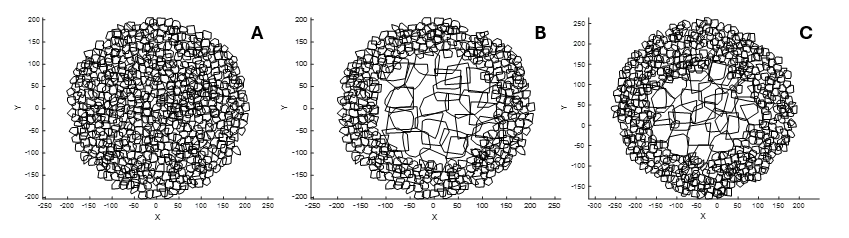
Figure 1: 2D slices of our rubble-piles∗ showing their construction. A) Initial homogeneous rubble-pile, B) Cored aggregate from A, C) Aggregate from B after settling. ∗Images are non-dimensional, Fig. 2 has physical dimensions.
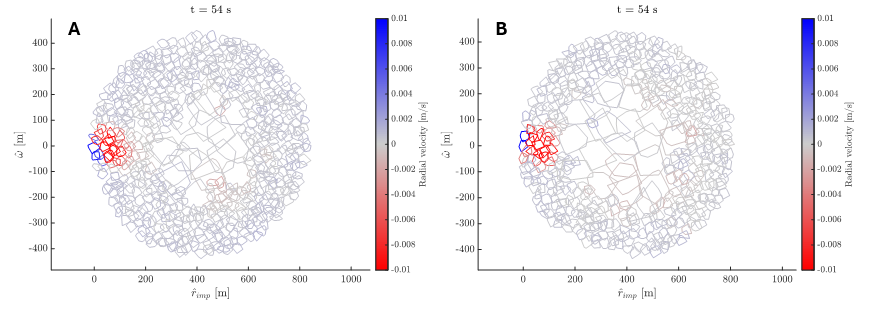
Figure 2: 2D slice in the impact plane of our large aggregate. Particles are colored by radial velocity for cores of half (A) and 3/4 (B) the size of the aggregate.
Results
We confirm our procedure for tracking the wavefront and assessing surface effects (Fig. 3). Preliminary results are inconclusive as to the effect of layering on surface modification due to the MPa elastic modulus (E) of our particles (Fig. 3A). However, we expect substantial disturbance of particles in the vicinity of the impact site as supported by other works exploring the surface effects of impact-induced waves [12]. Figure 3B and 3C show that our wave speed is lower than is typically considered for rubble-piles [10, 7, 9]. Increasing the E of our particles will yield larger body speeds since propagation speed in the Hertzian model is a function of E (this process requires further settling time - currently underway). Assessing how rough particles and layers of varied thickness influence the impact process may provide important context for connecting HERA’s upcoming observations of Dimorphos to its pre-DART impact state and provide insight into how the surface effects of impact reflect the internal structure of rubble-pile asteroids.
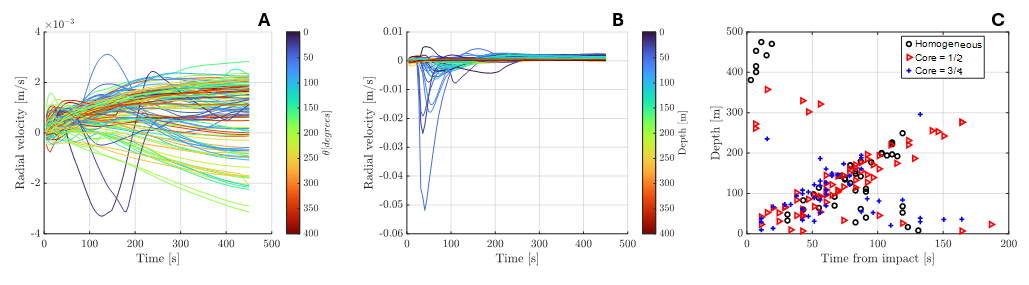
Figure 3: A and B show radial velocity vs time for particles in the outer hull (B, color corresponds to radial angle from the impact site) and interior to the rubble pile (B, color corresponds to depth). C plots the position and time of the minimums from B for impacts into different rubble-piles corresponding to a wave speed of ∼ 2 m/s.
Acknowledgments: Funded by the European Union (ERC, TRACES, 101077758). Views and opinions expressed are however those of the author(s) only and do not necessarily reflect those of the European Union or the European Research Council. Neither the European Union nor the granting authority can be held responsible for them.
References:
[1] Walsh et al. 20204, Annual Review of Astronomy and Astrophysics.
[2] Bagatin et al. 2020, Icarus.
[3] Barnouin et al. 2024 Nature Communications.
[4] Graninger et al. 2023, International Journal of Impact Engineering.
[5] Raducan et al. 2024, The Planetary Science Journal.
[6] Zhang et al. 2022, Nature Communications.
[7] Murdoch et al. 2017, Planetary and Space Science.
[8] Raducan et al. 2019, Planetary and Space Science.
[9] DellaGiustina et al. 2024, Monthly Notices of the Royal Astronomical Society.
[10] Garcia et al. 2015, Icarus.
[11] Quillen et al. 2019, Icarus.
[12] Tancredi et al. 2023, Monthly Notices of the Royal Astronomical Society.
[13] Michel et al. 2022, The Planetary Science Journal.
[14] Cheng et al. 2024, Communications Physics.
[15] Frizzell et al. 2025, Icarus.
[16] Ferrari et al. 2017, Multibody System Dynamics.
[17] Ferrari et al. 2020, Monthly Notices of the Royal Astronomical Society.
[18] Makse et al. 1999, Physical Review Letters.
[19] Ferrari et al. 2022, Icarus.
How to cite: Frizzell, E., San Sebastián, I., and Ferrari, F.: Modeling the surface effects of impact-induced seismic waves in layered rubble-pile aggregates with nonspherical particles, EPSC-DPS Joint Meeting 2025, Helsinki, Finland, 7–12 Sep 2025, EPSC-DPS2025-1470, https://doi.org/10.5194/epsc-dps2025-1470, 2025.


