SB22 | Understanding the internal structure of kilometric-size asteroids through measurements and modeling

SB22

Understanding the internal structure of kilometric-size asteroids through measurements and modeling
Conveners: Sampsa Pursiainen, Alain Herique, Christelle Eyraud, sebastien Le Maistre, Adriano Campo Bagatin, Naomi Murdoch
Orals MON-OB5
| Mon, 08 Sep, 16:30–18:00 (EEST)
 
Room Venus (Veranda 3)
Posters TUE-POS
| Attendance Tue, 09 Sep, 18:00–19:30 (EEST) | Display Tue, 09 Sep, 08:30–19:30
 
Finlandia Hall foyer, F207–211
Mon, 16:30
Tue, 18:00
Understanding the internal structure of kilometric-size asteroids from measurements and modelling

The internal structure of kilometric-size asteroids, including porosity, density variations, and mechanical properties, is critical for understanding their response to external forces such as tidal interactions, impacts, and rotational effects. These properties also have implications for planetary defense strategies, resource exploration, and our broader understanding of early Solar System processes. Several recent past and future planetary missions have or will visit kilometric-size bodies, among them the DART and HERA missions investigating the binary asteroid 65803 Didymos.

The analysis of asteroid interiors relies on radar, gravity, radio science, and seismic observations, which are standard techniques in geophysics and among the most promising ways to investigate small body structures. However, these observations necessitate highly advanced modeling due to the complexity and heterogeneity of asteroid interiors. The interpretation of these data requires sophisticated computational methods that account for the irregular shapes, variable compositions, and fragmented structures characteristic of small Solar System bodies. This session will focus on the examination of asteroid interiors through these observational techniques, complemented by laboratory experiments and computational simulations.

Session assets

Orals: Mon, 8 Sep, 16:30–18:00 | Room Venus (Veranda 3)

Chairpersons: Christelle Eyraud, Alain Herique, Naomi Murdoch
16:30–16:42
|
EPSC-DPS2025-1576
|
ECP
|
On-site presentation
Alessia Cremasco, Samuele Vaghi, Luigi Vittorio Delfanti, Iosto Fodde, Irina Luciana San Sebastian, Lucia Francesca Civati, and Fabio Ferrari

Introduction

This study presents results from a validation campaign combining microgravity experiments with numerical simulations to investigate contact dynamics in asteroid scenarios. The research is part of the ERC-funded TRACES project, which aims to characterize the behavior of granular materials in the environment of rubble-pile asteroids.

Many asteroids, ranging from a few hundred meters to several kilometers in size, are considered rubble-piles, i.e., gravitational aggregates held together by self-gravity and weak cohesion, rather than by the intrinsic strength of their bulk material [1]. Therefore, their dynamics can be effectively simulated as granular systems using N-body simulation tools. The GRAINS N-body code, used in this study, is capable of simulating gravitational interactions and contacts between large numbers of non-spherical bodies, with contact dynamics based on modules from Chrono [2]. Contact models in Chrono depend on numerous parameters, which are typically tuned to reproduce at best the macroscopic behavior of the system, rather than the local-scale properties. TRACES proposes a paradigm shift by focusing on accurate particle-scale physics, rather than relying solely on a macroscopic perspective, to enhance the realism of granular media characterization.

Experimental Campaign

The  GEMS experimental campaign, funded by ESA, included 16 tests conducted at the ZARM Drop Tower facility in Bremen. The first phase took place between October and November 2024, and the second between March and April 2025. Each phase consisted of two half-days in the GraviTower Bremen Pro, followed by six drops in the Bremen Drop Tower.

The experiments involved low-speed collisions between two 8-10 cm asteroid simulant cobbles under microgravity and vacuum conditions, replicating the asteroid environment. The simulant particles were selected to reproduce asteroid materials in terms of mechanical and surface properties. Three different sets were used: two sets were purchased from Space Resources Technologies, with chemical compositions closely matching those of carbonaceous chondrites (CM and CI), while the third set was collected from Mount Etna, with minimal atmospheric alteration. To enable the tracking, markers were placed on the simulants.

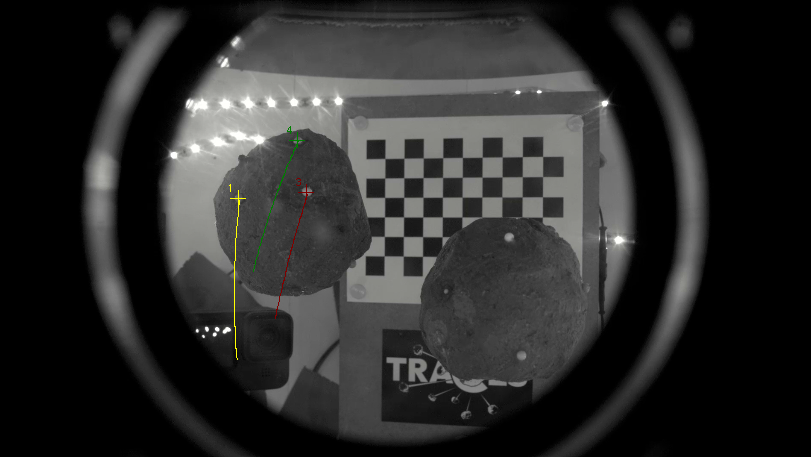
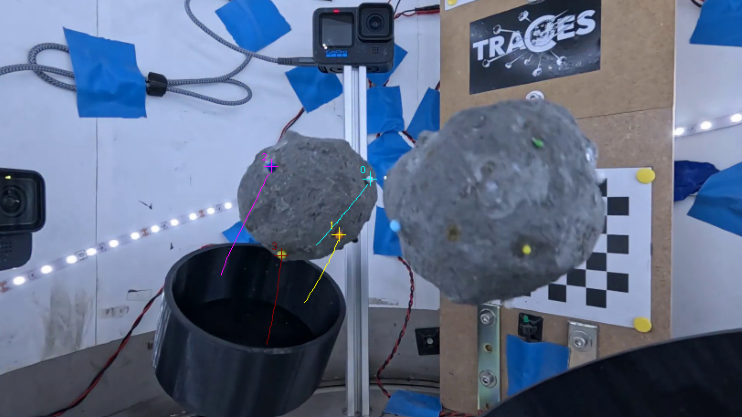
A 3D scanner was used to create a digital mesh of each cobble for the numerical replication of the experiments. In each test, the two cobbles were placed in separate bins, and the initial velocity required to obtain the collision was provided by a spring-based release mechanism. The experimental setup was mounted inside a vacuum chamber. Two high-speed cameras were placed outside the vacuum chamber, while GoPro cameras were positioned inside. Markers were tracked (Figure 1-2), and the trajectories of the cobbles before and after the contact were reconstructed.

Figure 1-2: Tracked markers from GoPro before the contact and high-speed camera after the contact.

Numerical simulations

A batch least-squares filter was implemented to estimate the initial conditions (position, velocity, attitude, and angular velocity) of the two cobbles, using the 2D pixel coordinates of the tracked markers as measurements. These pre-contact initial conditions were then used as input for the numerical simulations.

A digital twin of the experiment was developed in GRAINS to validate the contact dynamics models and tune their contact parameters. The shape of the cobbles is modeled as a mesh in Chrono, with collision detection managed through the Bullet library.

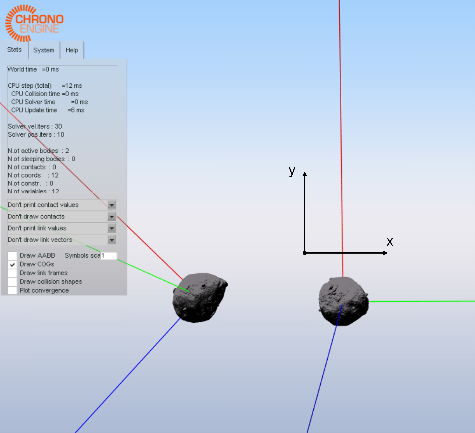
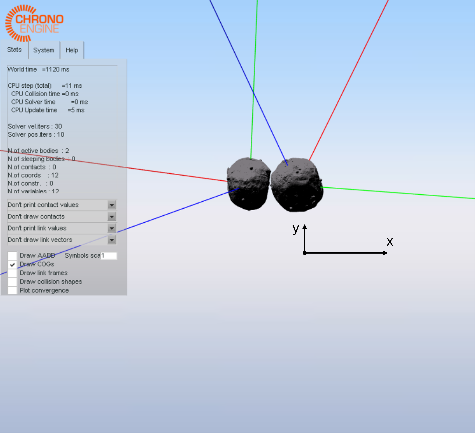
Among the contact models implemented in Chrono, namely smooth and non-smooth contacts, the non-smooth contact model with compliance [3] was selected as the most suitable for replicating the collision experiment, since this hard-body method, enhanced with damping, is expected to better reproduce the experimental results. However, all contact models are compared with experimental data to evaluate their performance. Figure 3 shows snapshots from a simulation of a Drop Tower experiment.

(a)Start: t=0s 

(b)Before contact: t=1.12s 

(c)End: t=2.219s 

Figure 3: Snapshots from a GRAINS simulation replicating an experiment conducted in the Drop Tower. The local reference frames of the cobbles are shown, with the global reference frame in black.

To accurately reproduce the post-collision trajectories observed in the experiments, the most relevant parameters to calibrate include the coefficient of friction, coefficient of restitution, compliance, and damping. A parameter estimation algorithm based on the Markov Chain Monte Carlo (MCMC) method has been developed for this purpose. The algorithm evaluates a likelihood function to assess how well the model reproduces the post-contact trajectories, based on the discrepancy between the predicted and observed 2D pixel coordinates of the markers.  The MCMC framework provides parameter distributions, giving both estimates and associated uncertainties, offering valuable insights into the sensitivity of the contact dynamics model.

Conclusions

In conclusion, useful data on contact dynamics in asteroid environments were collected during the microgravity campaign. Collisions between different pairs of cobbles were successfully observed, and the trajectories were reconstructed with satisfactory accuracy. A digital twin of the experiment and a parameter estimation algorithm were developed to validate and calibrate the contact dynamics models in GRAINS against the experimental results. The outcomes of this validation campaign will contribute to improving the realism of local-scale interaction modeling, enhancing our ability to simulate the full-scale dynamics of rubble-pile asteroids and their response to external forces.  A new experimental campaign is being designed, involving a parabolic flight with full granular media, along with a corresponding  numerical analogue scenario in GRAINS replicating the new experiments.

Acknowledgments

This work is funded by the European Union (ERC, TRACES, 101077758). Views and opinions expressed are however those of the authors only and do not necessarily reflect those of the European Union or the European Research Council. Neither the European Union nor the granting authority can be held responsible for them.

References

[1] K. J. Walsh. Rubble pile asteroids. Annual Review of Astronomy and Astrophysics, 56(1):593-624, 2018.

[2] F. Ferrari, M. Lavagna, and E. Blazquez. A parallel-GPU code for asteroid aggregation problems with angular particles. Monthly Notices of the Royal Astronomical Society, 492(1):749-761, 2020.

[3] A. Tasora, et al. A compliant visco-plastic particle contact model based on differential variational inequalities. International Journal of Non-Linear Mechanics 53, 2-12, 2013.

How to cite: Cremasco, A., Vaghi, S., Delfanti, L. V., Fodde, I., San Sebastian, I. L., Civati, L. F., and Ferrari, F.: Validating and Calibrating Contact Dynamics for Rubble-Pile Asteroids through Microgravity Experiments, EPSC-DPS Joint Meeting 2025, Helsinki, Finland, 7–13 Sep 2025, EPSC-DPS2025-1576, https://doi.org/10.5194/epsc-dps2025-1576, 2025.

16:42–16:54
|
EPSC-DPS2025-788
|
On-site presentation
Yann Berquin, Alain Hérique, Yves Rogez, Wlodek Kofman, and Sonia Zine

1 Introduction


The unique abilities of low frequency spaceborne radars to probe internal structure imaging of planetary bodies at high resolution have resulted in their use on missions dedicated to kilometric-size planetary bodies. Radar instruments on these missions include in particular the upcoming JuRa instrument onboard the HERA mission which aims at imaging the binary S-type asteroid 65803 Didymos [1]. One of the major challenge when exploiting the data to reconstruct the internal structure of kilometric-size planetary bodies lies in the relatively large size of the planetary body with regard to the radar carrier signal wavelength. Given the 60MHz radar carrier frequency, Didymos' 800m diameter and Dimorphos' 160m diameter 3D domains require too much computational resources with current available hardware to perform multiple iterations of a gradient descent algorithm on all radar orbits. This problem is common in spaceborne subsurface radar sounding where the radar signal carrier frequency, driven by geophysical and technical considerations, often results in domains too large to accurately simulate radio wave propagation [2]. In order to overcome this limitation, we propose to investigate the possibility to linearize or use approximate forward operator in gradient descent algorithms. This work aims at developing robust analysis methods to process JuRa data in order to image the interior of the Didymos binary asteroid system.


2 Radar interior imaging


Internal structure imaging from spaceborne radar consists in finding the effective permittivity contrast m={χ(x)}x ∈ ℜ3 of the asteroid from the observed scattered field at the radar antenna for multiple locations xl on the orbit and for angular frequency ω in the radar signal frequency band. It can be understood as a minimization problem of a chosen cost function S (e.g. least squares, Wasserstein distance) with regard to the effective permittivity contrast [3]. Such minimization problem is often solved using gradient algorithms

mn+1 = mn - Wn [∂f(m)/∂m]n [∂S/∂f(m)]n

where the forward operator f(m) corresponds to Maxwell's equation along with the far-field antenna gain. Wn is a positive-definite operator (e.g. Hessian of the cost function in Newton method), [∂S/∂f(m)]n  is the usual adjoint source (e.g. weighted residuals in least squares) and [∂f(m)/∂m]n is the conjugate transpose of the Frechet derivative [3]. JuRa is a monostatic radar, accordingly the kernel of the Frechet derivative can be expressed as a function of the the total electric field El,n(x,ω) associated to mn induced by the radar source. In order to perform internal structure imaging with JuRa, it is thus only necessary to compute at each step n the electric field for each position xl on the orbit and each angular frequency ω in the frequency band.

Fig.1: (a) Free space background model, (b) homogeneous asteroid background model, (c) true model.

Computing the electric field in Didymos and Dimorphos on all radar orbits for multiple steps n corresponds to the usual full waveform inversion algorithm [4]. Such a brute force approach requires considerable computational resources. One straightforward way to decrease the computational load is to linearize the forward operator around a fixed background effective permittivity contrast mb

f(m) ≈ f(mb) + [∂f(m)/∂m]b (m- mb)

For example, it is possible to use a free space background effective permittivity contrast, i.e. mb=0 (Fig. 1a), which yields the popular and low computation back-propagation and pseudo-inverse methods. However, the linearization of the forward operator is only valid as long as residuals between the true and background effective permittivity contrast remain sufficiently small. The real part of the effective permittivity of Didymos and Dimorphos is estimated to vary between εr ∈ [4 ,7] [2] and has been showed to be too large for the linearization around a free space background to perform well due to poor focusing [5].


Homogeneous asteroid model

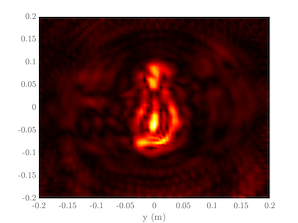
Fig. 2: Dimorphos homogeneous asteroid background model El,n(x,ω) for a given position and angular frequency along the antenna polarization component.

As an alternative, we propose to use as a background effective permittivity contrast homogeneous asteroid models with an interior effective permittivity set to an a priori estimated average value (Fig. 1b). Homogeneous asteroid models uses the shape models of Didymos and Dimorphos and strongly reduces residuals between the true and background effective permittivity contrast. Unfortunately, unlike the free space background effective permittivity contrast where El,n(x,ω) admits a closed form, computing El,n(x,ω) still requires to simulate the electric field in Didymos and Dimorphos, albeit only once. Considering Dimorphos’s largest dimension at central frequency, the domain size varies between 70 to 90 wavelengths with the expected range of εr. We investigate the possibility to use different numerical schemes to compute the electric field in the asteroid domain and their interior imaging performances including Discrete Dipole Approximation (DDA) and Physical Optics (PO). DDA is an accurate method which naturally handles scattering from far field sources and provides iterative accuracy improvement of El,n(x,ω) [6]. Our current DDA GPU implementation on an Nvidia H100 80GB requires ∼10min to accurately compute the electric field inside Dimorphos for a given position xl and a given angular frequency ω (Fig. 2) which remains prohibitive. In order to process JuRa data volume sufficiently rapidly, a compromise needs to be found between accuracy and computational load.

Fig. 3: Comparison between simulated El,n(x,ω) using PO (left) and DDA (right) inside the highlighted area in Fig. 2.

PO is a surface integral method [7] which could be used to estimate El,n(x,ω) (Fig. 3). Additional investigation venues include: (i) reducing the number of iterations in the DDA linear solver or (ii) using geometric optics to compute El,n(x,ω) and physical optics to compute f(mb).


References

[1] Michel P et al. 2022 The planetary science journal 3 160
[2] Hérique A et al. 2018 Advances in Space Research 62 2141–2162
[3] Tarantola A 2005 Inverse problem theory and methods for model parameter estimation (siam)
[4] Deng et al. (2022) IEEE Trans. Antennas & Propagation, 70(12) 11934–11945
[5] Dufaure A et al.2023 Astronomy & Astrophysics 674 A72
[6] Yurkin M A 2023 Discrete dipole approximation Light, Plasmonics and Particles (Elsevier) pp 167–198
[7] Berquin Y et al. 2015 Radio Science 50 1097–1109

How to cite: Berquin, Y., Hérique, A., Rogez, Y., Kofman, W., and Zine, S.: Internal structure imaging of Didymos with JuRa using homogeneous asteroid models, EPSC-DPS Joint Meeting 2025, Helsinki, Finland, 7–13 Sep 2025, EPSC-DPS2025-788, https://doi.org/10.5194/epsc-dps2025-788, 2025.

16:54–17:06
|
EPSC-DPS2025-1470
|
ECP
|
On-site presentation
Eric Frizzell, Irina San Sebastián, and Fabio Ferrari

Introduction

Rubble-pile asteroids (those less than ∼10 km in size [1]) are loosely bound aggregates held together primarily by self-gravity between particles that compose them. Understanding their composition is an active area of research with implications for both science [2, 3] and planetary defense [4, 5]. The internal structure of a rubble-pile is an open question; models range from homogeneous distributions of particles throughout the aggregate [6] to layered structures possessing cores with distinct properties from an outer shell [7, 8]. One method of constraining the properties of a rubble-pile’s interior is to link observed surface features to seismic waves transmitted through the body. Both impacts and tidal forces generate body waves [7, 9] and are suspected to contribute to behaviors including regolith migration from micrometeoroid impact [10] or YORP spin-up [6]), body reshaping [11] and particle ejection [12].

In this work we are interested in the seismic waves generated from hypervelocity impacts and how a layered structure influences their surface expression, motivated by the HERA mission’s [13] upcoming observations of the DART impact site. We consider seismic waves generated in rubble-piles with inner cores made of larger particles than those in the outer shell. This configuration could be common if granular motion is driven by inward migration of larger particles [14]. Layering on the Moon has been suggested to enable seismically-induced surface modification over larger distances than previously known [15]. We consider how interactions between granular layers of distinct particle sizes influence the seismic disturbance of a rubble-pile’s surface, evaluating a hypothesis that larger particles in the core increases the extent of effects.


Methods

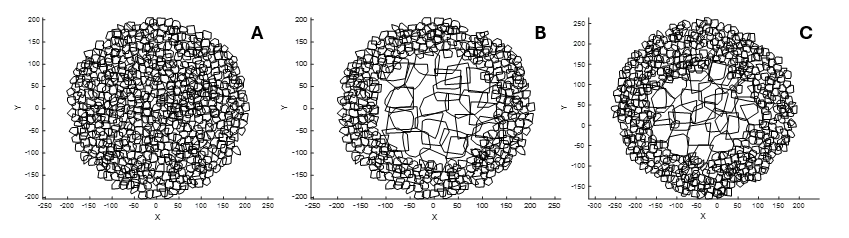
We evaluate two types of rubble-piles, comparable to Didymos (∼800 m diameter) and Dimorphos (∼150 m diameter). We build rubble-piles using GRAINS [16,17]. GRAINS simulates particle-particle contacts using the soft-body discrete element method with the ability to model non-spherical particles. Particles are randomly shaped convex hulls subject to self gravity, Hertzian contact forces and friction. While continuum-based models are often used to study impact events, they can obscure microscopic processes that may play a role in the energy transfer of wave propagation (i.e., grain scale collisions [18]). Our model is similar to [12], accounting for rough particles and layering. Our large aggregate (Fig. 1A) is made of ∼10,000 particles of ∼20 m diameter and a smaller aggregate contains meter scale boulders (∼100,000 particles, under construction).

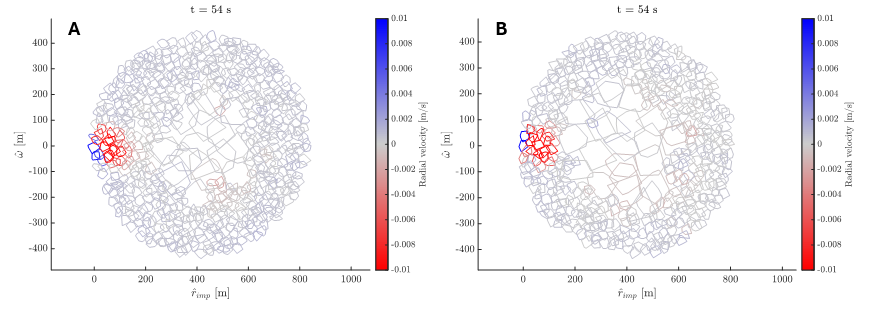
The initial rubble-pile is aggregated from a randomly seeded cloud of particles [19]. To achieve layering, we replace the core of the homogeneous aggregate with larger particles than those in an outer shell (Fig. 1B). Layered rubble-piles undergo a settling period to ensure they are in a dynamical equilibrium state (Fig. 1C). We generate the seismic waves of an impact using the same scaling approach as [12]. A particle in the equatorial plane is selected as the synthetic impactor and given a scaled mass and velocity directed through the barycenter, equivalent to an impact’s residual seismic energy. Figure 2 shows synthetic impacts in our large rubble-pile.

Figure 1: 2D slices of our rubble-piles∗ showing their construction. A) Initial homogeneous rubble-pile, B) Cored aggregate from A, C) Aggregate from B after settling. ∗Images are non-dimensional, Fig. 2 has physical dimensions.

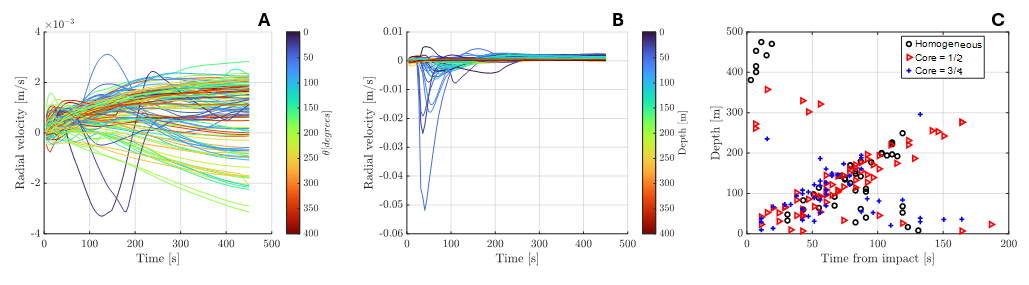
Figure 2: 2D slice in the impact plane of our large aggregate. Particles are colored by radial velocity for cores of half (A) and 3/4 (B) the size of the aggregate.


Results

We confirm our procedure for tracking the wavefront and assessing surface effects (Fig. 3). Preliminary results are inconclusive as to the effect of layering on surface modification due to the MPa elastic modulus (E) of our particles (Fig. 3A). However, we expect substantial disturbance of particles in the vicinity of the impact site as supported by other works exploring the surface effects of impact-induced waves [12]. Figure 3B and 3C show that our wave speed is lower than is typically considered for rubble-piles [10, 7, 9]. Increasing the E of our particles will yield larger body speeds since propagation speed in the Hertzian model is a function of E (this process requires further settling time - currently underway). Assessing how rough particles and layers of varied thickness influence the impact process may provide important context for connecting HERA’s upcoming observations of Dimorphos to its pre-DART impact state and provide insight into how the surface effects of impact reflect the internal structure of rubble-pile asteroids.

Figure 3: A and B show radial velocity vs time for particles in the outer hull (B, color corresponds to radial angle from the impact site) and interior to the rubble pile (B, color corresponds to depth). C plots the position and time of the minimums from B for impacts into different rubble-piles corresponding to a wave speed of ∼ 2 m/s.


Acknowledgments: Funded by the European Union (ERC, TRACES, 101077758). Views and opinions expressed are however those of the author(s) only and do not necessarily reflect those of the European Union or the European Research Council. Neither the European Union nor the granting authority can be held responsible for them.

References:

[1] Walsh et al. 20204, Annual Review of Astronomy and Astrophysics.

[2] Bagatin et al. 2020, Icarus.

[3] Barnouin et al. 2024 Nature Communications.

[4] Graninger et al. 2023, International Journal of Impact Engineering.

[5] Raducan et al. 2024, The Planetary Science Journal.

[6] Zhang et al. 2022, Nature Communications.

[7] Murdoch et al. 2017, Planetary and Space Science.

[8] Raducan et al. 2019, Planetary and Space Science.

[9] DellaGiustina et al. 2024, Monthly Notices of the Royal Astronomical Society.

[10] Garcia et al. 2015, Icarus.

[11] Quillen et al. 2019, Icarus.

[12] Tancredi et al. 2023, Monthly Notices of the Royal Astronomical Society.

[13] Michel et al. 2022, The Planetary Science Journal.

[14] Cheng et al. 2024, Communications Physics.

[15] Frizzell et al. 2025, Icarus.

[16] Ferrari et al. 2017, Multibody System Dynamics.

[17] Ferrari et al. 2020, Monthly Notices of the Royal Astronomical Society.

[18] Makse et al. 1999, Physical Review Letters.

[19] Ferrari et al. 2022, Icarus.

How to cite: Frizzell, E., San Sebastián, I., and Ferrari, F.: Modeling the surface effects of impact-induced seismic waves in layered rubble-pile aggregates with nonspherical particles, EPSC-DPS Joint Meeting 2025, Helsinki, Finland, 7–13 Sep 2025, EPSC-DPS2025-1470, https://doi.org/10.5194/epsc-dps2025-1470, 2025.

17:06–17:18
|
EPSC-DPS2025-732
|
ECP
|
On-site presentation
Topi Pajala, Christelle Eyraud, Jean-Michel Geffrin, and Sampsa Pursiainen

The European Space Agency (ESA) Hera mission is the second part of the international Asteroid Impact & Deflection Assessment (AIDA) collaboration, following NASA’s successful double asteroid redirection test (DART) impact on the binary asteroid system 65803 Didymos. Hera’s primary target is Dimorphos, the Didymos asteroid moonlet, whose structural and dynamical properties are being investigated to understand the results of kinetic impact deflection strategies. One of the mission’s core objectives is to reveal the internal composition and porosity distribution of Dimorphos through radar tomography, offering unprecedented insights into the mechanics of rubble-pile asteroids. Two CubeSats, Juventas Radar (JuRa) carrying low-frequency monostatic radar, a gravimeter and an accelometer, and Milani carrying near-infrared imager and a microthermogravimeter will be deployed near Dimorphos and send the gathered information back to Hera through Intersatellite Link (ISL) [3]. Rubble piles, which consist of loosely bound aggregates of rock held together by gravity and weak cohesive forces, pose a modeling challenge due to their granular heterogeneity and complex internal geometry. Recent works, including direct observations of the interior of the asteroid and the structure of the regolith [4], underscore the importance of validating radar-based inversion methods against known analogs. To this end, physical models with controllable structure and material properties offer a practical route for calibration and benchmarking.


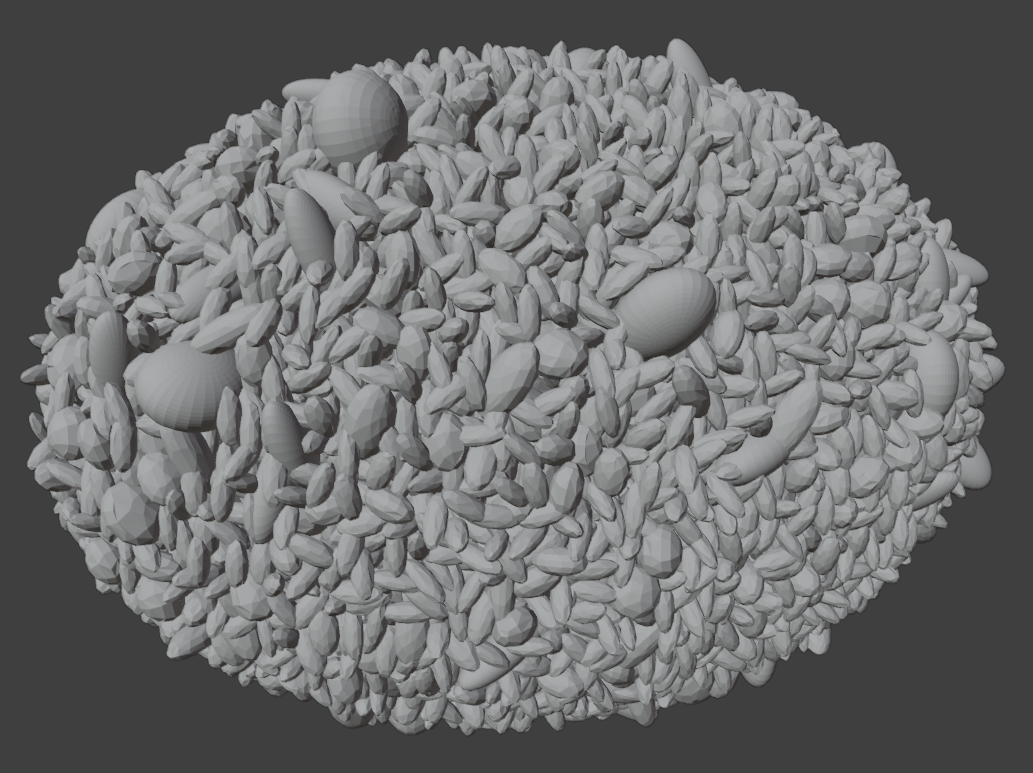
In this study, we present a complete pipeline for generating, printing, and validating analogue models of Dimorphos. Using MATLAB, a synthetic rubble-pile interior was generated procedurally on the basis of a combination of stochastic field generation, ellipsoidal particle packing (EPP), and surface conformity to topographic models derived from the optic mea surements done by Didymos Reconnaissance and Asteroid Camera for OpNav (DRACO) scientific camera involved in NASA’s DART mission. These internal geometries were exported to STL format and printed using the fused filament fabrication (FFF) method [2,5],
combined with permittivity-controlled ABS filament, ensuring mechanical robustness, accurate electrical properties and radar transparency. In this context, FFF has recently gained attention in radio frequency and microwave engineering applications, owing to advances in permittivity-controlled plastic filaments [2, 5]. This development has enabled the fabrication of complex microwave-transparent structures with tunable dielectric constants, making FFF an attractive candidate for producing radar-interrogatable analogue asteroids [2, 5]. By modulating the volume fraction between filament and air both between individual boulders and inside some of them, effective permittivity can be engineered to approximate that of asteroid minerals. This presentation describes a 18 cm diameter analogue for Dimorphos which simulates the actual rubble pile structure via EPP, taking into account the granular convection and the power-law for particle size found by examining the optical data of Dimorphos [4]. The total number of ellipsoids in this model is 18.084 with the ellipsoid diameter varying between 8-16 mm following the boulder size frequency distribution (SFD) observed in [4]. Figure 1, shows the external structure of the EPP-based analogue together with a cross-sectional slice demonstrating the actual and effective internal real relative permittivity of the body. The latter one of these corresponds to 8 GHz signal bandwidth [1] for which the average effective real relative permittivity is about 2.7 and the signal envelope wavelength inside the body about 4.6 cm (3.9 diameter-to-wavelength ratio).

References:
[1] A Dufaure et al. “Imaging of the internal structure of an asteroid analogue from quasi-monostatic microwave measurement data-I. The frequency domain approach”. In: Astronomy & Astrophysics 674 (2023), A72.
[2] A. Lingua, F. Sosa-Rey, N. Piccirelli, et al. “X-Ray Tomography-Based Characterization of the Porosity Evolution in Composites Manufactured by Fused Filament Fabrication”. In: Experimental Mechanics (2024). doi: 10.1007/s11340-024-01124-3. url: https://doi.org/10.1007/s11340-024-01124-3.
[3] P. Michel, M. K¨uppers, A. Bagatin, et al. “The ESA Hera Mission: Detailed Characterization of the DART Impact Outcome and of the Binary Asteroid (65803) Didymos”. In: The Planetary Science Journal 3 (2022), p. 160. doi: 10.3847/PSJ/ac6f52. url:https://doi.org/10.3847/PSJ/ac6f52.
[4] M. Pajola, F. Tusberti, A. Lucchetti, et al. “Evidence for multi-fragmentation and mass shedding for boulders on rubble-pile binary asteroid system (65803) Didymos”. In: Nature Communications 6205 (2024), p. 12. doi: 10.1038/s41467-024-50148-9. url: https://doi.org/10.1038/s41467-024-50148-9.
[5] Liisa-Ida Sorsa et al. “Complex-structured 3D-printed wireframes as asteroid analogues for tomographic microwave radar measurements”. In: Materials & Design 198 (2021), p. 109364.


How to cite: Pajala, T., Eyraud, C., Geffrin, J.-M., and Pursiainen, S.: Rubble pile asteroid model for Dimorphos --- 65803 Didymos I, EPSC-DPS Joint Meeting 2025, Helsinki, Finland, 7–13 Sep 2025, EPSC-DPS2025-732, https://doi.org/10.5194/epsc-dps2025-732, 2025.

17:18–17:30
|
EPSC-DPS2025-708
|
Virtual presentation
Christelle Eyraud, Astrid Dufaure, Yusuf Oluwatoki Yusuf, Liisa-Ida Sorsa, Gérard Henry, Sampsa Pursiainen, and Jean-Michel Geffrin

A lot of crucial questions about the internal structure of asteroids remain unanswered. This knowledge is fundamental, as it will provide essential data for modeling the mechanical behavior of these bodies, which is vital not only for science, but also for planetary defense [1]. Imaging the interior of these asteroids is not a trivial problem not only in terms of measurements, but also in terms of imaging algorithms. The challenges being mainly due to the very large size of these structures, and their high density and strong electromagnetic scattering. In recent years, imaging algorithms have been developed and adapted to such bodies. Some methods derive from those developed for observing the Earth and planets and adapted to imaging these bodies such as SAR tomography [2] and others methods derive from electromagnetic inverse problems as Pseudo-Inverse and Back-Propagation methods [3], [4], [5]. These imaging procedures allow structural imaging of the interior of asteroids and have two main advantages: the memory required is relatively small, so it is possible to reconstruct a large domain, which is necessary for such objects, and these procedures are generally robust to perturbations.

In this study, we focused on the algorithm developed in [3], based on Pseudo-Inverse method and combined with Principal Component Analysis (PCA). The electric scattered field on the receiver domain is obtained by the observation equation.  The induced current is estimated for each frequency using the Pseudo-Inverse method from all spatial measurement points. This takes full advantage of the spatial bandwidth of the measured field. PCA is then applied to this series of 3D images to perform a frequency-based analysis and obtain the final 3D image of the scene.

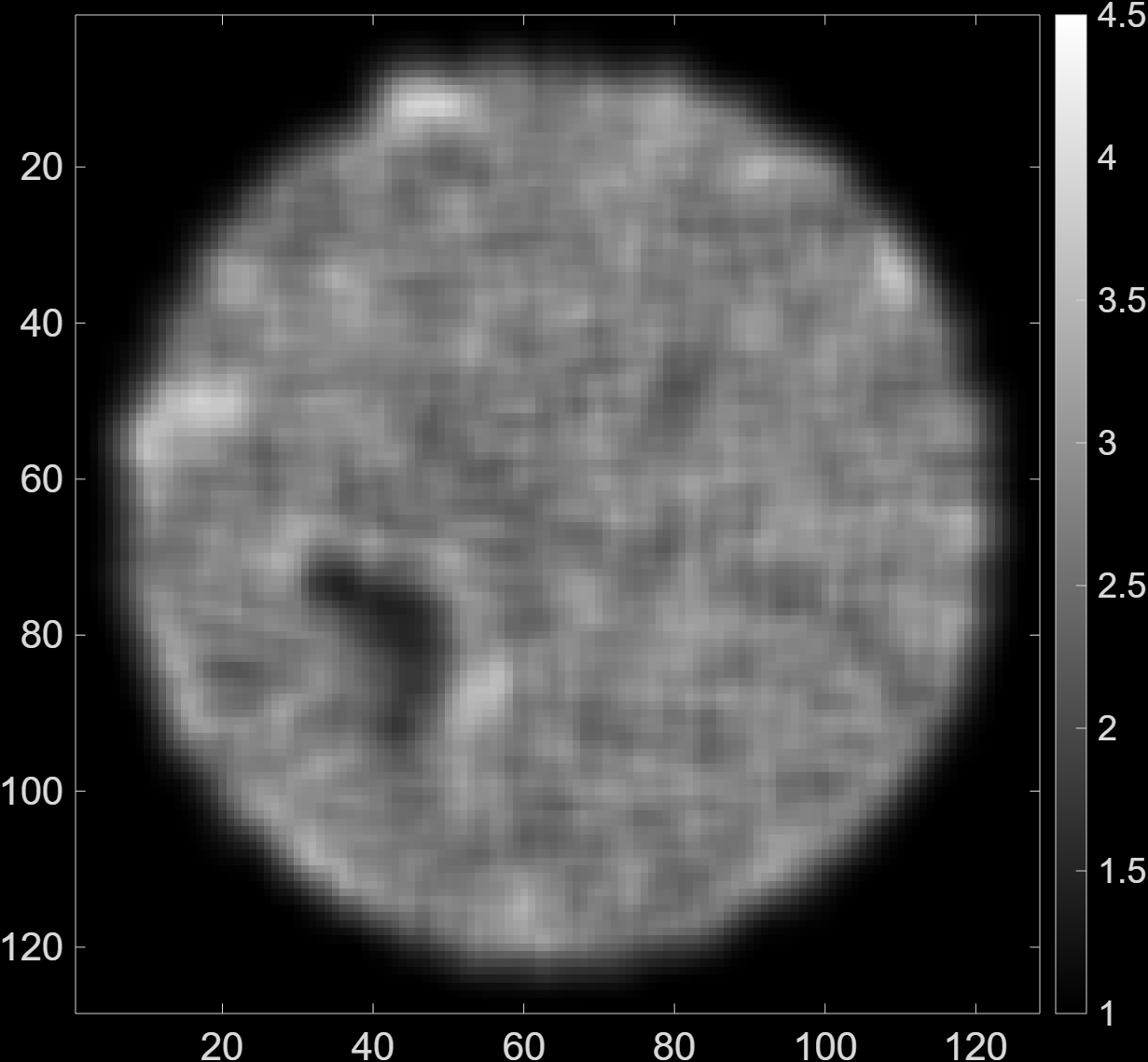
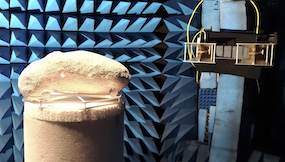
In the present study, this imaging method was applied to the scattered field of analogues measured in the laboratory, in our anechoic chamber, with the Institut Fresnel setup (Figure 1 (a)). Analogue size and wavelength are reduced by the same factor, following the microwave analogy. [6]. The configuration was chosen as quasi-monostatic to be similar to those used in space radars, such as the JuRa radar on board the Hera mission, which will probe the binairy asteroid 65803 Didymos. Figure 1 (b) shows an example of the results for the interior of the asteroid 25143 Itokawa analogue reproduced by 3D printing [7] using monostatic measurement points on a large part of a sphere around the analogue and the frequency band [3.5-10] GHz. In this slice of the 3D image, the interior void of the analogue can be seen at the correct position. The results obtained from different analogues of asteroids will be presented. An analysis of the images obtained as a function of the number of spatial measurements, the bandwidth as well as the number of frequencies will also be proposed.

Figure 1: (a) Measurement configuration in the anechoic chamber of the Institut Fresnel, Marseille 

Figure 1 (b) : Slice of the 3D reconstructed image of a analogue of the 25143 Itokawa asteroid

References

[1] A. Herique and al. Direct observations of asteroid interior and regolith structure: Science measurement requirements. Advances in Space Research, 2018.

[2] O. Gassot, A. Herique, W. Fa, J. Du, and W. Kofman. Ultra-wideband sar tomography on asteroids. Radio Science, 56(8), 2021.

[3] A. Dufaure, C. Eyraud, L.-I. Sorsa, Y. O. Yusuf, S. Pursiainen, and J.-M. Geffrin. Imaging of the internal structure of an asteroid analogue from quasi-monostatic microwave measurement data - i. the frequency domain approach. Astronomy and Astrophysics, 674(A72), 2023.

[4] L.-I. Sorsa, Y. O. Yusuf, A. Dufaure, J.-M. Geffrin, C. Eyraud, and S. Pursiainen. Imaging of the internal structure of an asteroid analogue from quasi-monostatic microwave measurement data - ii. the time domain approach. Astronomy and Astrophysics, 674(A73), 2023.

[5] M.S. Haynes, I. Fenni, and B.J.R. Davidsson. Inverse scattering under the born approximation using an object t-matrix and full bistatic spherical sampling geometry. IEEE Transactions on Antennas and Propagation, 72, 2024.

[6] R. Vaillon and J.-M. Geffrin. Recent advances in microwave analog to light scattering experiments. Quantitative Spectroscopy and Radiative Transfer, 146, 2014.

[7] Liisa-Ida Sorsa, Christelle Eyraud, Alain H´ erique, Mika Takala, Sampsa Pursiainen, and Jean-Michel Geffrin. Complex-structured 3d-printed wireframes as asteroid analogues for tomographic microwave radar measurements. Materials and Design, 198, 2021.

How to cite: Eyraud, C., Dufaure, A., Oluwatoki Yusuf, Y., Sorsa, L.-I., Henry, G., Pursiainen, S., and Geffrin, J.-M.: Imaging of the Inner Structure of an asteroid analogue from lab-Measurements with frequency analysis, EPSC-DPS Joint Meeting 2025, Helsinki, Finland, 7–13 Sep 2025, EPSC-DPS2025-708, https://doi.org/10.5194/epsc-dps2025-708, 2025.

17:30–17:42
|
EPSC-DPS2025-201
|
On-site presentation
Daniel Scheeres

Multi-component asteroid systems can be defined as collections of several distinct components, each of which may be a rubble pile body itself. There are a number of clear examples of these systems that have been observed, including binary and triple asteroids, contact binaries, asteroid pairs and clusters, and any asteroid system that has distinct components which may themselves be rubble piles. Current observations indicate that almost 50% of small, rubble pile asteroids are multi-component systems, thus these form an essential aspect of the asteroid population and their formation circumstances and evolution remain a largely open question. Of specific interest is how the different components interact with each other and form the observed asteroid population. It can be shown that for kilometric-scale and smaller bodies that such separated components can rest on each other without undergoing large-scale shape failure (Meyer & Scheeres, ApJL 963:L14, 2024), thus indicating that the components of contact binaries can themselves be rubble piles. This opens up the analysis of these bodies as few-component systems where these components can orbit each other, rest on each other, and even undergo slow collisions while still maintaining their distinct components. 

In this work we leverage these observations to analyze how the formation and evolution of such multi-component systems can be viewed in a consistent framework. To do this we leverage recent theoretical advances and analysis tools reported in (Scheeres, CMDA 135:35, 2023) and (Scheeres, Icarus  436:116563, 2025) to present a unified approach to modeling and constraining the formation and evolution of multi-component systems. These models enable us to evaluate the conditions for a system to form a contact binary or orbital binary at formation, conditions under which a system can eject a component to become an asteroid pair or cluster, pathways for a system to collapse into a contact binary, implications of exogenous forces, and the overall pathways that these systems can follow. 

These mechanical analyses are based on modeling the components as semi-rigid bodies and tracking the total angular momentum and energy of the system, both orbital and rotational, and the relative mass distributions between the components. Both analytical and numerical simulation approaches can be used. Based on fundamental celestial mechanics constraints, we can delineate the different energetically stable configurations that a multi-component system can have as a function of its total angular momentum. Thus, if a system is spun up or down due to YORP, the possible configurations of the system will change with the changing angular momentum. If a multi-component system reaches a fission spin limit, which generally occurs before surface shedding of material, its subsequent evolution will be largely dictated by the relative masses of the different components, and can lead to the creation of an asteroid pair and a slowly rotating primary, settle into a binary system, or can reconfigure its components and evolve further. The theory can provide a clear overarching approach to the analysis of outcomes, which can help inform our interpretation of the asteroidal bodies that we observe from Earth or Space-based observing platforms.  

This talk will apply this methodology to illustrate the possible evolution of several different example systems, and also address the limitations of this modeling approach.  

How to cite: Scheeres, D.: Mechanics of multi-component asteroid systems, EPSC-DPS Joint Meeting 2025, Helsinki, Finland, 7–13 Sep 2025, EPSC-DPS2025-201, https://doi.org/10.5194/epsc-dps2025-201, 2025.

17:42–17:54
|
EPSC-DPS2025-31
|
ECP
|
On-site presentation
Topi Pajala, Mikko Tuumanen, Yusuf Oluwatoki Yusuf, Alexandra Koulouri, and Sampsa Pursiainen

Several landmark space missions have focused on characterizing small bodies and advancing planetary defense, including NASA’s DART and ESA’s Rosetta and Hera missions [4]. The DART mission successfully demonstrated kinetic impact as a viable asteroid deflection technique by altering the orbital period of Dimorphos, the smaller body in the Didymos binary asteroid system [5]. The Hera mission will follow up on this event by conducting a detailed post-impact survey of the same system. HERA includes two CubeSats, Juventas and Milani. Juventas is equipped with the low-frequency monostatic radar JuRa, which will perform the first direct probing of an asteroid’s subsurface structure. JuRa transmits a binary phase-shift keyed signal with a 20 MHz bandwidth and a 60 MHz carrier frequency, powered at 5 W. The signal wavelength is approximately 5 m in vacuum and about 2.5 m within the asteroid, assuming a relative permittivity consistent with typical porous silicate materials [4].

Electromagnetic (EM) tomography [3, 2, 1] offers a non-invasive means to investigate the internal structure of asteroids, aiming to recover spatial variations in relative permittivity and density by analyzing scattered wavefields. This study focuses on simulated monostatic radar tomography, where both transmission and reception are conducted from a single satellite platform. Special attention is given to the role of wave polarization in the accuracy of structural reconstructions. Polarization, which describes the orientation of the electric field vector, is an intrinsic property of EM waves. Neglecting it can reduce computational complexity, but may affect the fidelity of the reconstructions.

The primary objective of this research is to determine how accurately a synthetic asteroid model’s internal structure can be reconstructed without modelling polarization: a strategy that can significantly reduce computational cost. To this end, the study compares simulations of EM wave propagation and tomography using single-component (scalar) and three-component (vectorial) field models. The performance of these two alternative approaches is evaluated in terms of their ability to resolve internal voids and structural boundaries.

In this study, a numerical solution for the wavefield is found via leapfrog time-stepping [6]. The Green’s function, which characterizes the impulse response of the medium, is estimated using Tikhonov-regularized deconvolution and Born approximation [7], allowing for tractable linearization of the forward problem. Several inversion strategies are explored for reconstructing the spatial distribution of relative permittivity, including tomographic back-projection and total variation (TV) regularization.

The results present the reconstructions generated from both single- and three-component models, under noiseless and noisy signal conditions. Accuracy is quantitatively assessed using overlap metrics between the reconstructed regions and ground-truth internal features, specifically focusing on voids alone and voids with surrounding structural boundaries. For noisy simulations, Gaussian noise is added to the synthetic data, and reconstruction robustness is visualized using box plots depicting overlap quantiles. Additionally, the influence of the signal envelope is investigated in a similar fashion, providing further insight into reconstruction stability and performance. The results suggest that omitting polarization does not necessarily deteriorate the quality of the structural maps, especially in the presence of uncertainty factors, such as modelling discrepancies due to signal carrier and measurement noise.

References

[1] Jian Deng et al. “EI+ FWI method for reconstructing interior structure of asteroid using lander-to-orbiter bistatic radar system”. IEEE Transactions on Geoscience and Remote Sensing, 60 (2021), pp. 1–16.
[2] A. Dufaure et al. “Imaging of the internal structure of an asteroid analogue from quasi-monostatic microwave measurement data—I. The frequency domain approach”. Astronomy & Astrophysics, 674 (2023), A72.
[3] Mark Haynes et al. “Asteroids Inside Out: Radar Tomography”. (2020).
[4] Patrick Michel et al. “The ESA Hera Mission: Detailed Characterization of the DART Impact Outcome and of the Binary Asteroid (65803) Didymos”. The Planetary Science Journal, 3.160 (2022), pp. 1–21. doi:10.3847/PSJ/ac6f52. URL.
[5] Andrew S. Rivkin et al. “The double asteroid redirection test (DART): Planetary defense investigations and requirements”. The Planetary Science Journal, 2.5 (2021), p. 173.
[6] John B. Schneider. “Understanding the finite-difference time-domain method. School of Electrical Engineering and Computer Science, Washington State University”. URL: http://www.eecs.wsu.edu/~schneidj/ufdtd/ (2010).
[7] Liisa-Ida Sorsa et al. “A time-domain multigrid solver with higher-order Born approximation for full-wave radar tomography of a complex-shaped target”. IEEE Transactions on Computational Imaging, 6 (2020), pp. 579–590.

How to cite: Pajala, T., Tuumanen, M., Yusuf, Y. O., Koulouri, A., and Pursiainen, S.: Simulation Study for Numerical Effects of Polarized vs. Non-Polarized Signal Propagation in Radar Tomography of Asteroids, EPSC-DPS Joint Meeting 2025, Helsinki, Finland, 7–13 Sep 2025, EPSC-DPS2025-31, https://doi.org/10.5194/epsc-dps2025-31, 2025.

17:54–18:00

Posters: Tue, 9 Sep, 18:00–19:30 | Finlandia Hall foyer

Display time: Tue, 9 Sep, 08:30–19:30
Chairpersons: Sampsa Pursiainen, sebastien Le Maistre
F207
|
EPSC-DPS2025-1359
|
ECP
|
Virtual presentation
Tzu-Heng Chang, Adriano Campo Bagatin, Po-Yen Liu, Manuel Pérez Molina, Stephen Schwartz, Przemyslaw Bartczak, and Paula Benavidez

The Double Asteroid Redirection Test (DART, NASA) mission and the Hera space mission (ESA) are part of the Asteroid Impact and Deflection Assessment (AIDA) international collaboration supported by NASA and ESA. The target is the near-Earth binary asteroid, (65803) Didymos, which consists of a 800-m wide S-type asteroid (Didymos) and a 160-m wide asteroid (Dimorphos).

Our group had developed two different models  — INSIDE (INternal Structure realistIc moDElling) and AROUND (AsteROid accUrate calculatioN of gravitational fielD) — to generate the possible synthetic rubble-pile structures and to calculate the gravitational field of arbitrary mass distributions. We now plan to build a suitable pipeline to suit the model of internal structure of Didymos and Dimoprhos to the Hera mission data available at different mission phases, through the INSIDE and OUTSIDE models.

The interaction between the data flow and modeling tools will be implemented and tested before Hera reaches the Didymos system in late December 2026. Starting from January 2027, Hera mission will enter Early Characterization Phase (ECF), and estimate the mass and volume of Didymos. As entering Detailed Characterisation Phase (DCP), the space measurements, GRASS and JuRa, will operate and generate a more precise asteroid model with AROUND and INSIDE. After Close Observation Phase (COP), the monostatic radar measurement of JuRa will constrain the structure of Dimorphos. At the end, in the Experimental Phase (EP), the instrumentation will orbit at low altitude and provide accurate radar and gravity measurements, and optimize the Didymos binary interior model.
In the project, we aim to design a pipeline for inspecting asteroid interiors through combining the spacecraft data to optimize modeling of gravity and internal structure from Hera mission within measurement uncertainty limits. Such internal structure modelling will be applied to later missions, such as the RAMSES mission (ESA) to asteroid Apophis in 2029.

How to cite: Chang, T.-H., Campo Bagatin, A., Liu, P.-Y., Pérez Molina, M., Schwartz, S., Bartczak, P., and Benavidez, P.: Asteroid internal structure determination from Hera mission, EPSC-DPS Joint Meeting 2025, Helsinki, Finland, 7–13 Sep 2025, EPSC-DPS2025-1359, https://doi.org/10.5194/epsc-dps2025-1359, 2025.

F208
|
EPSC-DPS2025-1706
|
ECP
|
On-site presentation
Alfonso Caldiero, Sébastien Le Maistre, Edoardo Gramigna, Riccardo Lasagni Manghi, Paolo Tortora, Marco Zannoni, Özgür Karatekin, and Alain Herique

Constraining the interior structures of asteroid Didymos and its moon, Dimorphos, is key to understanding their origin and history. In the case of Dimorphos, the current interior state could provide additional information on the effects of the impact by the NASA DART spacecraft. The ESA Hera mission will reach the Didymos binary system in 2026 and allow to characterize the gravity environment and rotational state of the two bodies. These properties are in turn sensitive to the mass distribution within the asteroids. 

We perform simulations focused on the retrieval of known mass distributions for Didymos and Dimorphos, based on the observations that are expected from the Hera mission. In our approach [1], which relies on the level-set method, we use iterative least-squares to solve the non-linear problem of estimating a set of scalar functions defined over the body. The 0-level-sets of such functions represent interfaces between areas of uniform density (density anomalies). The interior is discretized via a uniform grid, surrounded by the polyhedral mesh representing the external shape of the body. At each iteration, the solve-for parameters are the values of the level-set functions at the grid nodes, along with the density values within each anomaly. 

Our assumptions over type, resolution, and uncertainty of the geodetic observables are based on the simulations performed by the Hera radio-science team [2]. The synthetic measurements we consider include the coefficients of the spherical-harmonics expansion of the gravitational potential. Additionally, and depending on the spin state of Dimorphos at Hera’s arrival, estimates of its libration amplitude or the full tensor of inertia of both asteroids might be available. While both bodies are expected to be rubble-piles, we consider different types of interior models as ground-truth.  

The interpretation of the data in terms of interior structure is limited by the resolution and uncertainty of the gravity field, which is expected to reach degree 3 (of the spherical-harmonics expansion) for Didymos and degree 2 for Dimorphos. Therefore, the measurements would only allow to detect large-scale heterogeneities, such as those due to large boulders or voids inside the body, or produced by sizeable variations in porosity. 

More problematic is the non-uniqueness inherent to gravity inversion, which prevents unambiguous determination of the interior structure, even when gravity is complemented by the inertia tensor. Combination with other observables sensitive to the interior properties is therefore desirable. Here, we consider the impact of local-gravity information provided by the GRASS gravimeter on the surface of Dimorphos [3]. Radar-sounding information provided by the JuRa instrument [4], along with insights from surface data or laboratory studies, could additionally be introduced in the inversion as direct constraints on the level-set functions and the density values.  

By exploring the range of converged solutions in each simulation scenario, we show how the different sets of measurements and the different assumptions on their uncertainty affect the space of plausible density distributions. 


[1] Caldiero, A., & Le Maistre, S. (2024). Small bodies global gravity inversion via the level-set method. Icarus, 411, 115940. 

[2] Gramigna, E., Manghi, R. L., Zannoni, M., Tortora, P., Park, R. S., Tommei, G., ... & Kueppers, M. (2024). The hera radio science experiment at didymos. Planetary and Space Science, 246, 105906. 

[3] Ritter, B., Karatekin, Ö., Carrasco, J. A., Noeker, M., Ümit, E., Van Ransbeek, E., ... & Van Ruymbeke, M. (2021). Surface Gravimetry on Dimorphos with GRASS on Juventas. In 7th IAA Planetary Defense Conference (p. 190). 

[4] Herique, A., Plettemeier, D., & Kofman, W. (2024). Radar Tomography of Asteroid Deep Interior-JuRa/HERA to Didymos and Ra proposed to APOPHIS. In Europlanet Science Congress 2024 (pp. EPSC2024-753). 

How to cite: Caldiero, A., Le Maistre, S., Gramigna, E., Lasagni Manghi, R., Tortora, P., Zannoni, M., Karatekin, Ö., and Herique, A.: Mass distribution within the Didymos system: predicted constraints from future Hera geodetic observations, EPSC-DPS Joint Meeting 2025, Helsinki, Finland, 7–13 Sep 2025, EPSC-DPS2025-1706, https://doi.org/10.5194/epsc-dps2025-1706, 2025.

F209
|
EPSC-DPS2025-831
|
ECP
|
On-site presentation
William Hickmott, Kai Hoettges, and Stefania Soldini

Transforming dense, arbitrarily angled RF attenuation chords acquired by an in-situ swarm of surface-bound transceivers into faithful three-dimensional permittivity maps of kilometre-scale asteroids presents a critical yet inherently ill-posed inverse problem. Subsurface voids, boulders and compositional layers dictate an asteroid’s mechanical response to anchoring, sampling and deflection while preserving clues to its formation history. Radar experiments, such as the bistatic CONSERT experiment on Rosetta/Philae and the monostatic JuRa sounder aboard Hera’s Juventas CubeSat, have demonstrated subsurface sounding[1], [2], but their limited transmitter–receiver geometries sample only a small fraction of interior paths. By contrast, a distributed network of surface transceivers can acquire high-density, multi-angle chords, vastly improving volumetric coverage and reconstruction robustness.

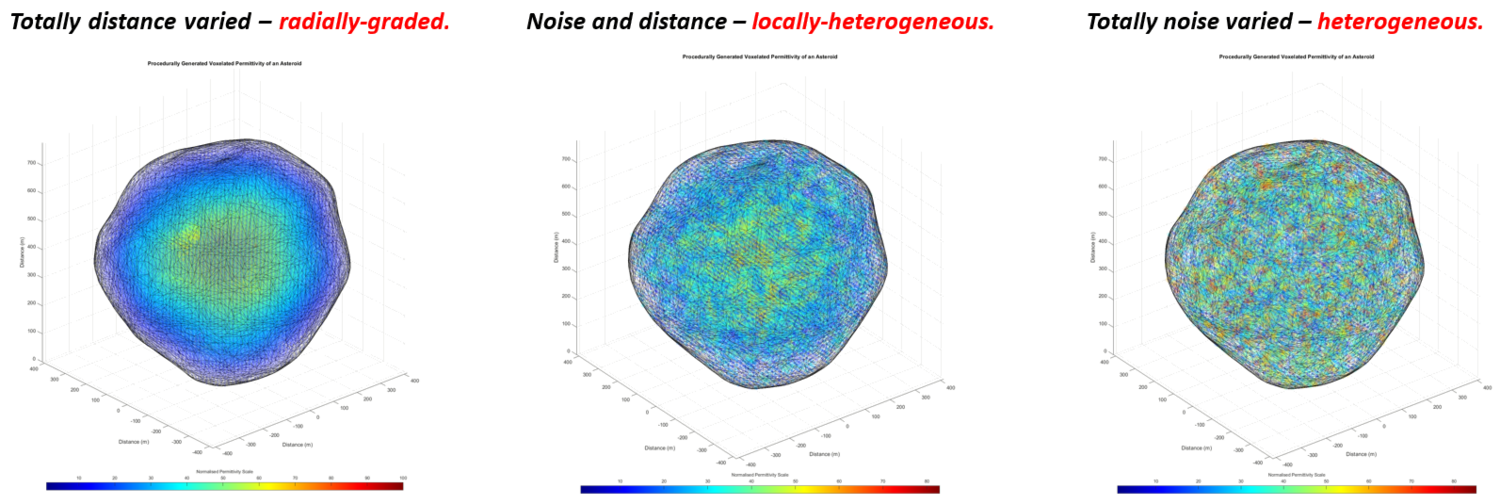
To close this gap, we developed a three-dimensional simulation framework based on high-resolution meshes from the Small Body Mapping Tool[3] and a custom generator that assigns spatially varying permittivity fields to each polyhedral model. Voids are introduced via Perlin-noise masks whose amplitude and feature-size parameters control the granularity and homogeneity of dielectric contrasts, yielding analogues from nearly uniform interiors with fine, dispersed cavities to highly heterogeneous bodies with large, sharp voids. Figure 1 shows two extreme cases and a medium range for the field noise amplitudes versus a radially defined field. Measurement acquisition is simulated by placing approximately equidistant nodes on the surface and recording attenuation along each inter-node chord, which is discretised through the volume using a three-dimensional Bresenham algorithm. By varying the number of unique signal paths, from highly underdetermined cases to richly overdetermined ones, and preserving identical datasets for machine-learning training, we enable a direct comparison of inversion methods under matched inputs.

Figure 1 Bespoke asteroid generation tool outputs, with representative extreme ends and a middle value output.

Reconstruction of the attenuation field is performed using five established paradigms under matched inputs, with the addition of early results from a ML model. Simple back-projection (SBP) smears measurement residuals directly into the volume, offering a rapid yet low-fidelity baseline. Filtered back-projection (FBP) applies a band-limited filter in the frequency domain before back-projection, attenuating low-frequency blur at the cost of ringing artefacts around sharp interfaces. Algebraic Reconstruction Technique (ART) iteratively projects individual residuals along each ray in sequence, achieving fast initial updates but leaving streak artefacts that can obscure finer structures. Simultaneous Iterative Reconstruction Technique (SIRT) aggregates corrections from all rays at each cycle, smoothing these artefacts yet demanding more iterations to converge. Bayesian Maximum A Posteriori (B-MAP) estimation enhances the forward model with discrete 7-stencil Laplacian regularisation to penalise local curvature and enforce smoothness, thereby stabilising the inversion by minimising second-order differences between neighbouring voxels, improving noise resilience while preserving broad permittivity gradients.

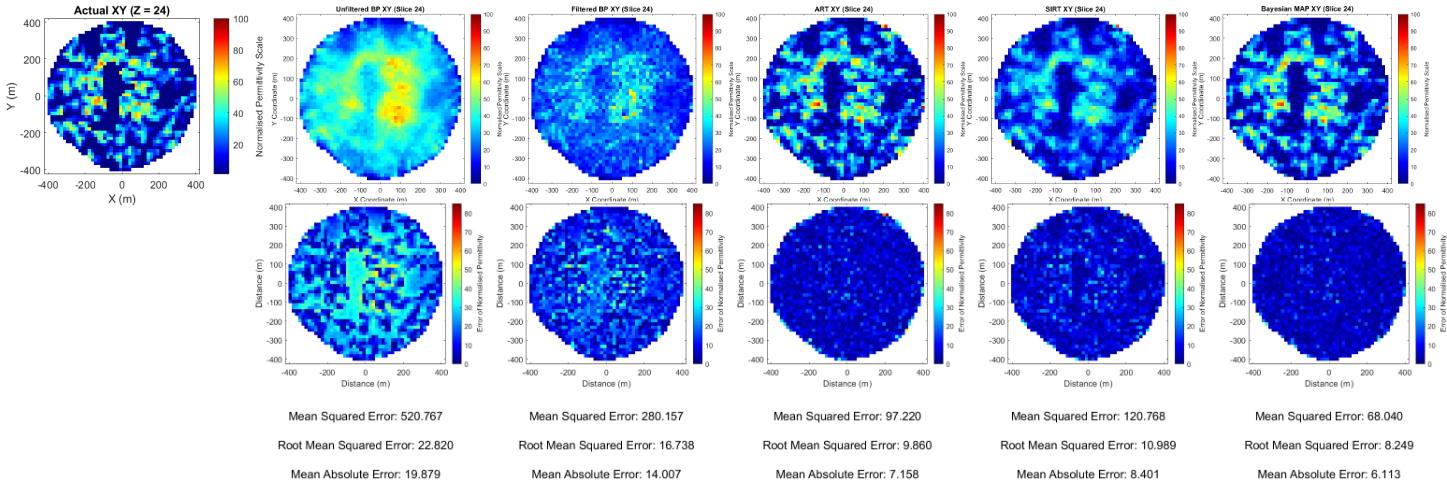
Figure 2 Top, left to right: Generated true field followed by SBP, FBP, ART, SIRT, and B-MAP reconstructions. Bottom, left to right: voxelised errors for SBP, FBP, ART, SRT, and B-MAP reconstructions.

Figure 2 juxtaposes the ground-truth permittivity distribution with reconstructions obtained by SBP, FBP, ART, SIRT and B-MAP, alongside voxel-wise error maps quantifying local deviations. Back-projection methods prove ineffective for small-body tomography: FBP’s frequency-domain filtering removes desired permittivity contrasts, while SBP suffers from 1/r blurring and over-contrasting. ART accurately captures the broad outline of void regions and consistently delivers high-quality reconstructions, with only minor streak artefacts. SIRT reduces those artefacts at the expense of blending the field, thereby diminishing accuracy. Bayesian MAP delivers the sharpest delineation of interfaces and the most uniform error distribution under noisy conditions, but only once the number of nodes approaches roughly ten times the single-dimension voxel count. For instance, a  interior achieves high-quality reconstructions from an untuned B-MAP using 500 nodes. As path density increases, all methods converge towards the true field, yet their relative performance remains unchanged: analytical approaches plateau in accuracy, algebraic solvers differ in artefact profiles, and the Bayesian method maintains superior boundary clarity and noise resilience. Early ML algorithms demonstrate promise, provided sufficiently varied training datasets.

The outcomes of this study furnish mission planners with quantitative guidance for selecting inversion methods across diverse operational scenarios. For rapid, resource-constrained surveys, ART delivers the most favourable trade-off between speed, simplicity and reconstruction quality. When measurement density is high enough (on the order of ten times the one-dimensional voxel count), Bayesian MAP becomes the method of choice, offering superior boundary delineation and robustness to noise via its 7-stencil Laplacian regularisation. SIRT, which tends to blur true permittivity variations, is not recommended for detailed small-body mapping. Early ML reconstructions show promise in underdetermined regimes, but their quantitative performance awaits completion of network training on substantially larger, more varied datasets. Identical simulation datasets have been prepared for future ML development, and detailed ML results will be reported once training converges.

By integrating high-resolution asteroid meshes, Perlin-noise heterogeneity models, variable measurement-density simulations and a suite of analytical, algebraic and statistical inversion techniques, this work establishes a comprehensive framework for evaluating radio-frequency tomographic imaging methods on kilometre-scale bodies. Mapping performance envelopes across discretisation resolutions, measurement densities and interior contrasts provides precise algorithm-selection criteria for forthcoming small-body missions. As we explore hybrid schemes that combine Laplacian regularisation with data-driven models and refine our ML architectures, this framework will underpin autonomous, high-resolution subsurface imaging capable of revealing the hidden structure of kilometre-scale asteroids.

ACKNOWLEDGEMENTS

William Hickmott is supported by the Ashworth Electrical Engineering Studentship, University of Liverpool

Stefania Soldini was supported by the Medical Research Council UKRI-FLF grant number MR/W009498/1

REFERENCES

[1]        Y. Barbin et al., ‘The CONSERT instrument for the ROSETTA mission’, Advances in Space Research, vol. 24, no. 9, pp. 1115–1126, Jan. 1999, doi: 10.1016/S0273-1177(99)80205-1.

[2]        A. Herique, D. Plettemeier, and W. Kofman, ‘Radar Tomography of Asteroid Deep Interior - JuRa / HERA to Didymos and Ra proposed to APOPHIS’. Accessed: Apr. 03, 2025. [Online]. Available: https://meetingorganizer.copernicus.org/EPSC2024/EPSC2024-753.html

[3]        JHUAPL, ‘Small Body Mapping Tool’, Small Body Mapping Tool. Accessed: May 06, 2025. [Online]. Available: https://sbmt.jhuapl.edu/


How to cite: Hickmott, W., Hoettges, K., and Soldini, S.: Comparative Evaluation of Inversion Methods for In-Situ RF Tomography of Kilometre-Scale Asteroids, EPSC-DPS Joint Meeting 2025, Helsinki, Finland, 7–13 Sep 2025, EPSC-DPS2025-831, https://doi.org/10.5194/epsc-dps2025-831, 2025.

F210
|
EPSC-DPS2025-1640
|
ECP
|
On-site presentation
Matthias Keulen, Timo Giese, Kolja Joeris, Jens Teiser, Gerhard Wurm, and Jonathan E. Kollmer

The surface of asteroids is typically covered by particles of varying size, ranging from large boulders (meters) to fine grained regolith. The mechanical properties of such surfaces, such as porosity, density, mechanical strength, or thermal conductivity are crucial for the dynamic evolution of the asteroids. The porosity of the regolith is probably the most important parameter, as the porosity of a granular bed also determines it's thermal and mechanical properties. In the low-gravity environment of an asteroid, cohesive forces between the particles are important or even dominate over the weight of the grains. To understand the physical properties of asteroid regolith, laboratory experiments with regolith simulants are a common approach. However, doing analog experiments under laboratory conditions does not necessarily lead to correct results, as the low gravity environment of asteroids must be considered.


Here, we present sedimentation experiments under reduced gravity to investigate how gravity affects the porosity of a regolith bed. On an asteroid, impacts or other disturbances will stir up regolith material, which then settles again. We simulate this process in a dedicated experiment setup at the drop tower Bremen. The whole setup is placed in a microgravity environment (residual acceleration < 10-5 m/s2). A linear stage is used to establish a controlled acceleration to the test cell, so the low gravity environment of an asteroid's surface is simulated. The level of artificial gravity ranged from 150 mm/s2 to 1000 mm/s2. As analog material two different basalt samples were used, with different grain size distributions. In addition, experiments were performed with glass spheres as sample, for a better comparison to theoretical studies.


The experiments show that the volume filling of a sedimenting regolith bed strongly depends on the local level of gravity. For fine basalt sand with particle sizes in the range of 100 µm, we see that the porosity of the resulting regolith bed increases by a factor of around 3, when the gravity level during the sedimentation is reduced from 1000 mm/s2 to 250mm/s2. This is of great importance, as the porosity of an asteroid's regolith surface strongly influences the thermal properties, such as the thermal conductivity of the surface or the thermal inertia. In addition, also the mechanical strength of a regolith scales with its porosity, which is important for future space missions.


How to cite: Keulen, M., Giese, T., Joeris, K., Teiser, J., Wurm, G., and Kollmer, J. E.: Regolith on asteroids - settling of granular and cohesive material, EPSC-DPS Joint Meeting 2025, Helsinki, Finland, 7–13 Sep 2025, EPSC-DPS2025-1640, https://doi.org/10.5194/epsc-dps2025-1640, 2025.

F211
|
EPSC-DPS2025-871
|
ECP
|
On-site presentation
Amelia Samuel, Stefania Soldini, Monica D'Onofrio, and Dario Izzo

Accurately modelling the internal density distribution of small bodies such as asteroids is essential for spacecraft navigation, scientific exploration, and planetary defence strategies. Reconstructing the density distribution from external measurements, known commonly as the “inverse gravity problem”, is a challenging problem due to its intrinsically ill-posed nature: different density distributions can yield functionally identical values for a given set of externally observable parameters, whether that is gravitational potential or Stokes coefficients from spacecraft induced accelerations, to name just a few. Furthermore, the solution is highly sensitive to the initial choice of density distribution, often causing the inversion to be dominated by biases from this starting estimate rather than tending towards the asteroid’s true internal structure.

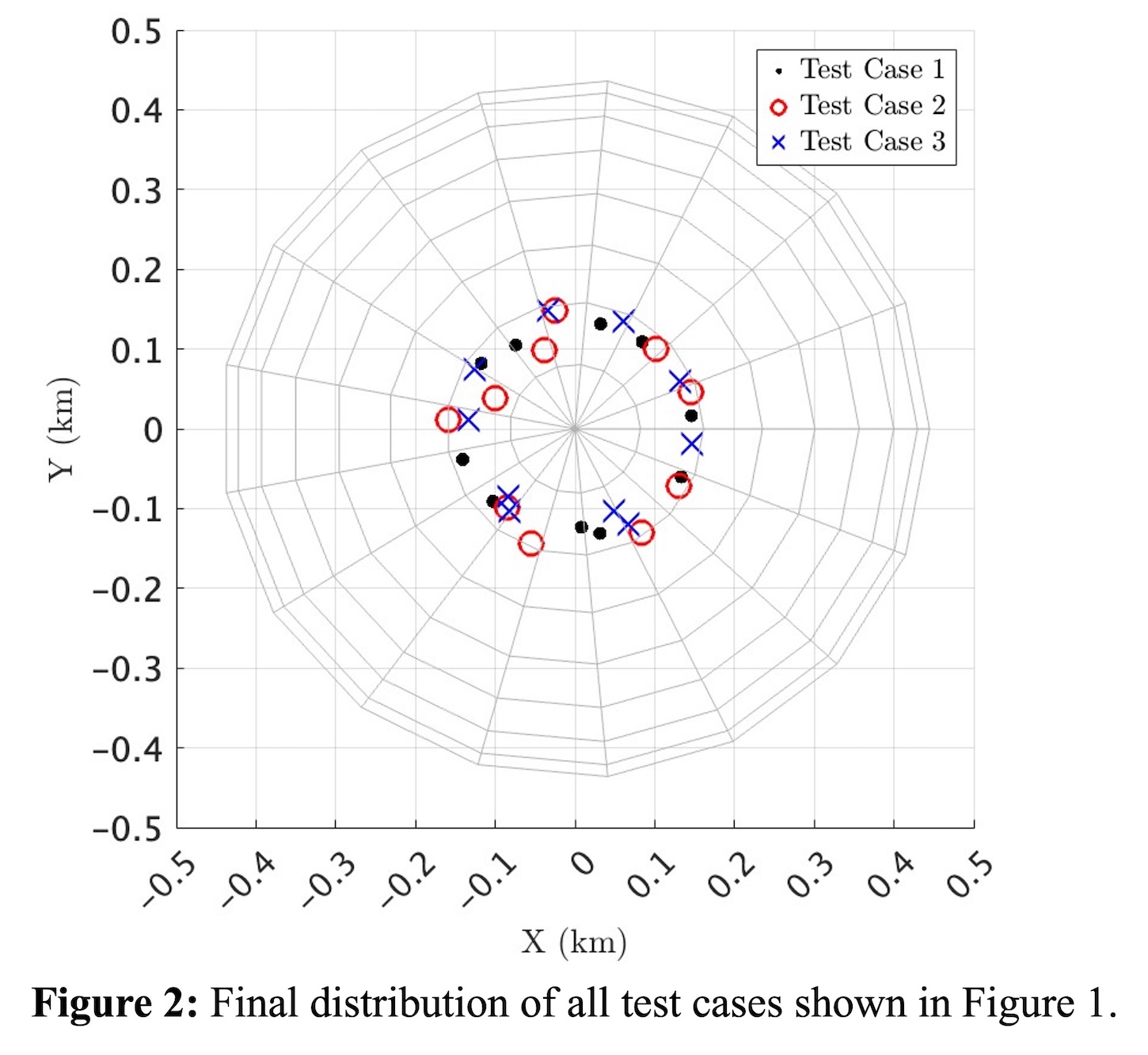
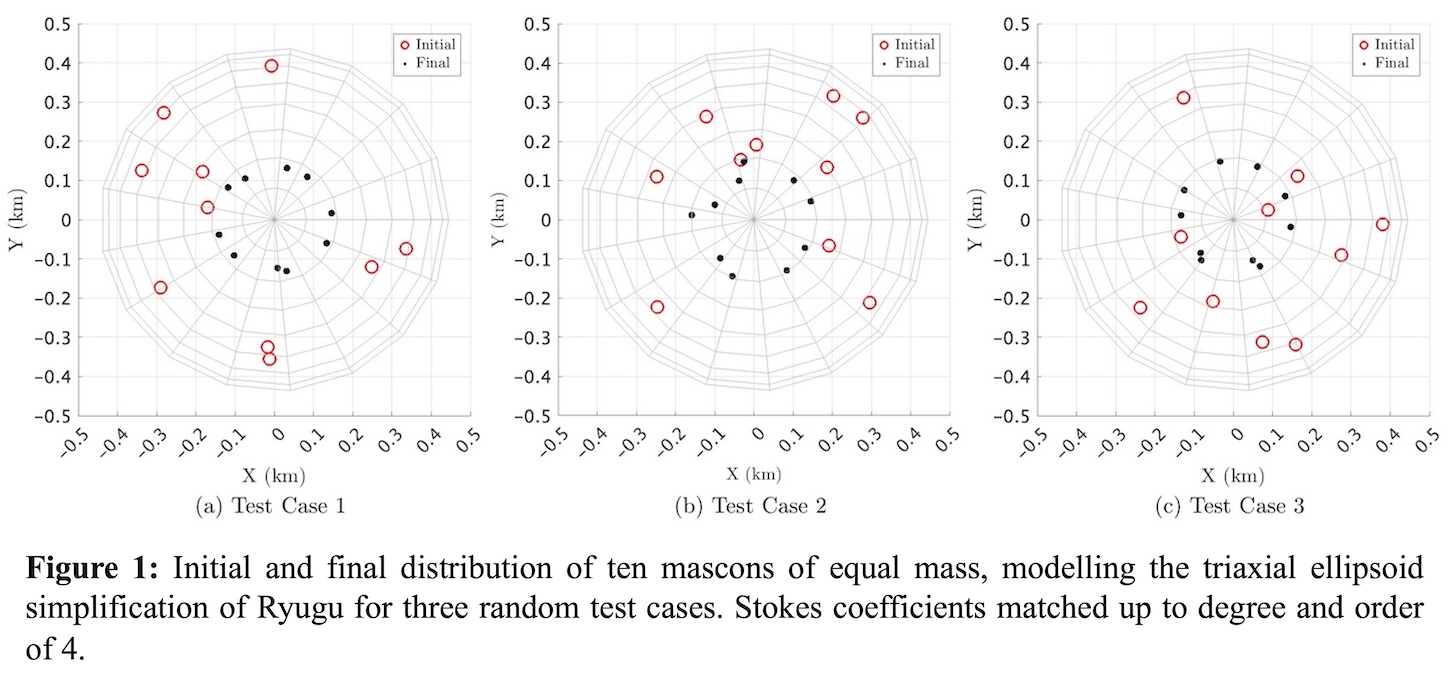
Figure 1 shows this: for three separate initial distributions, the inverse gravity problem was carried out through an iterative least squares algorithm [1], adjusting the location of the mass concentrations (mascons) to minimise the residuals between the modelled Stokes coefficients and that of the “true” model. Despite the modelled Stokes coefficients for each test being the same within immensely small tolerances, the final distribution of each case is very different, thus displaying the issue of non-uniqueness in the gravity inversion problem, albeit for a very simple case. This is shown more clearly in Figure 2, wherein all the final distributions for the same three test cases are plotted on the same set of axes.


Addressing this issue of non-uniqueness typically involves imposing additional constraints to limit the number of feasible solutions. These constraints often come from observational data; for instance, ground-based observations such as photometry and radar measurements can refine the shape model and topography [2, 3]. Beyond surface characteristics, constraints on density distribution may also be introduced through estimations of the centre of mass [4], bulk density, and porosity. Although constraints based off this information certainly narrows down physically plausible solutions, it still leaves a range of possible distributions [5], highlighting the need to explore novel approaches for imposing further constraints. Restricting the solution based off these physical parameters has been widely explored; however, the incorporation of dynamical system theory principles has not been explored as extensively. The idea of using equipotential surface to inform the density distribution has been investigated [6], but, as of yet, utilising equilibrium points remains overlooked. Equilibrium points are locations wherein the gravitational and centrifugal forces of a body balance, potentially allowing debris and small particles to linger. In future, thanks to asteroid exploration missions, such points may be observationally detected, either through tracking debris or analysing spacecraft trajectories, thereby providing direct observational data to refine density distribution models.

This study presents a preliminary investigation into whether additional dynamical information- specifically, the location of equilibrium points- can effectively constrain the gravity inversion problem. The main hypothesis is that the locations and characteristics of equilibrium points are sensitive indicators of the underlying density distributions, offering novel dynamical constraints capable of reducing the range of feasible solutions. Initially, the sensitivity of equilibrium points to small variations in asteroid internal density distributions is explored, building upon prior foundational work [7] which indicated that equilibrium point locations shift in response to density changes, highlighting their potential to differentiate between competing density models.

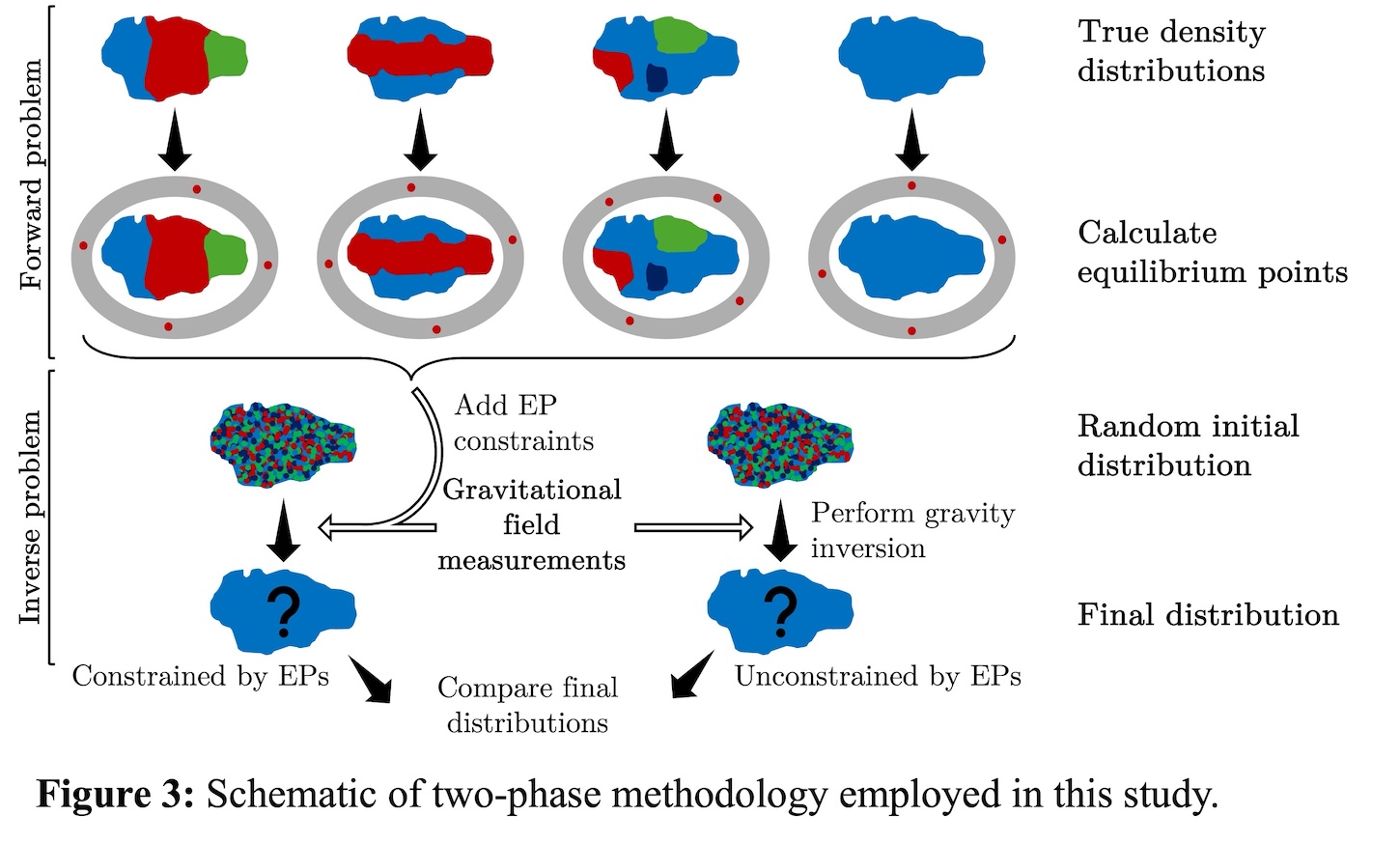
Both forward and inverse methodologies are used to explore this hypothesis in a two-stage study, outlined schematically in Figure 3. Firstly, direct gravity modelling is performed using mascons to represent the internal structure of asteroids with varying density distributions. From these models, the corresponding equilibrium points are calculated. Secondly, the inverse problem is carried out, aiming to reconstruct the original density distributions, taken to be the “true” distribution, using the location of the equilibrium points as additional observational constraints. The results obtained from the unconstrained gravity inversion and the results derived from inversions constrained explicitly by equilibrium point data for the same initial density distribution are then evaluated. This allows a comparison of final distributions assumed by each algorithm, as well as how including equilibrium points affects the sensitivity of the final density distribution is to the initial conditions.

In summary, this work presents an analysis on the feasibility of using the location of equilibrium points around a small body to restrict the inverse gravity problem. By exploring how these locations respond to different mascon configurations and incorporating equilibrium point data alongside traditional gravitational measurements, it is investigated whether solution ambiguities could be reduced by these dynamical constraints.


Acknowledgments

Amelia Samuel was supported by ESA-OSIP Grant Number 4000142822/23/NL/MGu/nh

Dr Stefania Soldini was supported by the Medical Research Council UKRI-FLF grant number MR/W009498/1

Professor Monica D’Onofrio was partly funded by the European Union’s CHIST-ERA programme under grant agreement CHIST-ERA19-XAI-009 (MUCCA)

References

[1] B. A. Jones, “Efficient models for the evaluation and estimation of the gravity field,” Ph.D. dissertation, University of Colorado at Boulder, 2010.

[2] M. Kaasalainen, T. Kwiatkowski, M. Abe, et al., “CCD photometry and model of MUSES-C target (25143) 1998 SF36,” Astronomy & Astrophysics, vol. 405, no. 3, pp. L29–L32, 2003.

[3] S. J. Ostro, L. A. Benner, M. C. Nolan, et al., “Radar observations of asteroid 25143 Itokawa (1998 SF36),” Meteoritics & Planetary Science, vol. 39, no. 3, pp. 407–424, 2004.

[4] S. Lowry, P. Weissman, S. Duddy, et al., “The internal structure of asteroid (25143) Itokawa as revealed by detection of YORPspin-up,” Astronomy & Astrophysics, vol. 562, A48, 2014.

[5] D. Scheeres, A. French, P. Tricarico, et al., “Heterogeneous mass distribution of the rubble-pile asteroid (101955) Bennu,”Science advances, vol. 6, no. 41, eabc3350, 2020.

[6] M. Kanamaru, S. Sasaki, and M. Wieczorek, “Density distribution of asteroid 25143 Itokawa based on smooth terrain shape,” Planetary and Space Science, vol. 174, pp. 32–42, 2019.

[7] S. Soldini, T. Saiki, H. Ikeda, K. Wada, M. Arakawa, and Y. Tsuda, “The effect of “MASCONS” sphere packing onto the dynamical environment around rubble-pile asteroids: Application to Ryugu,” in Europlanet Science Congress 2020 (EPSC2020), Online, 21 September–9 October 2020, Paper EPSC2020-808, 2020. doi:10.5194/epsc2020-808. [Online]. Available: https://doi.org/10.5194/epsc2020-808.

How to cite: Samuel, A., Soldini, S., D'Onofrio, M., and Izzo, D.: A Preliminary Study of a Dynamical System Approach to Asteroid Gravity Inversion for Interior Estimation, EPSC-DPS Joint Meeting 2025, Helsinki, Finland, 7–13 Sep 2025, EPSC-DPS2025-871, https://doi.org/10.5194/epsc-dps2025-871, 2025.