
 1,
1,- 1University of Helsinki, Department of Physics, Finland (eric.maclennan@helsinki.fi)
- 2Florida Space Institute, University of Central Florida, Orlando, FL, USA
The potentially hazardous asteroid 2005 NZ6 (hereafter NZ6) made an exceptionally close approach to Earth of 0.064 AU (24.9 lunar distances) in 2013 April-May. It was targeted using active radar techniques using the stations at Goldstone and Arecibo in monostatic configurations [1]. Radar images (Figure 1) suggest an elongated shape with a maximum breadth of 3 km, which is comprised of multiple lobes that is reminiscent of (4179) Toutatis [2].
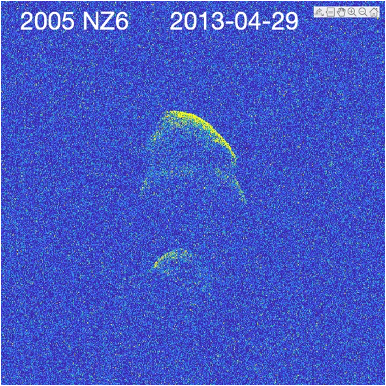
Figure 1. Arecibo radar images of 2005 NZ6 showing features that suggest a multi-lobed shape.
The eccentric and low-inclination orbit of NZ6 is oriented such that close-approaches (i.e. within 0.1 AU) to all four terrestrial planets are common. Similarly, Toutatis also makes close passes to Earth and other terrestrial planets. Unlike the extremely slow spin of Toutatis, a partial lightcurve [3] suggests a rotation period near 7 hours for NZ6. A link between the daytime April Piscid meteor shower has been suggested [4], which may be evidence of past dust ejection.
We present a preliminary shape and spin model of NZ6 from radar and lightcurve observations using SHAPE [5]. The final shape will be used as input to a thermophysical model applied to Spitzer [6] and NEOWISE [7] thermal emission observations to constrain the albedo, and thermal inertia.
References:
[1] https://echo.jpl.nasa.gov/asteroids/2005NZ6/2005NZ6_planning.html. [2] Hudson & Ostro (1995) Science270, 5233, pp. 84-86. [3] https://www.asu.cas.cz/~ppravec/newres.txt. [4] Brown et al. (2010) Icarus, 207, pp. 66-81. [5] Magri et al. (2007) Icarus 186, 1, pp. 152-177. [6] Kelley et al. (2008) Spitzer Proposal ID 50716. [7] Mainzer et al. (2014) The Astrophysical Journal 792, 1:30, 14 pp.
How to cite: MacLennan, E., Virkki, A., and Marshall, S.: Radar Shape Modeling of NEA (242643) 2005 NZ6: A Toutatis Twin?, EPSC-DPS Joint Meeting 2025, Helsinki, Finland, 7–12 Sep 2025, EPSC-DPS2025-1476, https://doi.org/10.5194/epsc-dps2025-1476, 2025.


